
7 Things Buyers Should Check Before Choosing a Cabinet Hardware Kit Manufacturer
A cabinet hardware kit looks simple until one small part is missing.
A screw is short. A bracket is packed in the wrong compartment. A hinge plate is scratched. A washer is counted incorrectly. The retail pack looks neat, but the warehouse team cannot scan it easily. None of these problems looks serious at first. Then the cabinet line slows down, the installer calls back, or the customer opens the box and finds the kit incomplete.
That is why choosing a cabinet hardware kit manufacturer should not be treated as a price-only decision.
For cabinet makers, wardrobe brands, furniture suppliers, hardware wholesalers, and cross-border e-commerce sellers, the kit is part of the product. It affects assembly speed, warehouse handling, shelf presentation, replacement service, and customer confidence.
A good kit keeps small hardware controlled.
A poor kit turns small hardware into a daily problem.
1. Check whether the supplier understands the whole kit
Many suppliers can sell screws.
Fewer suppliers understand how a complete cabinet hardware kit works.
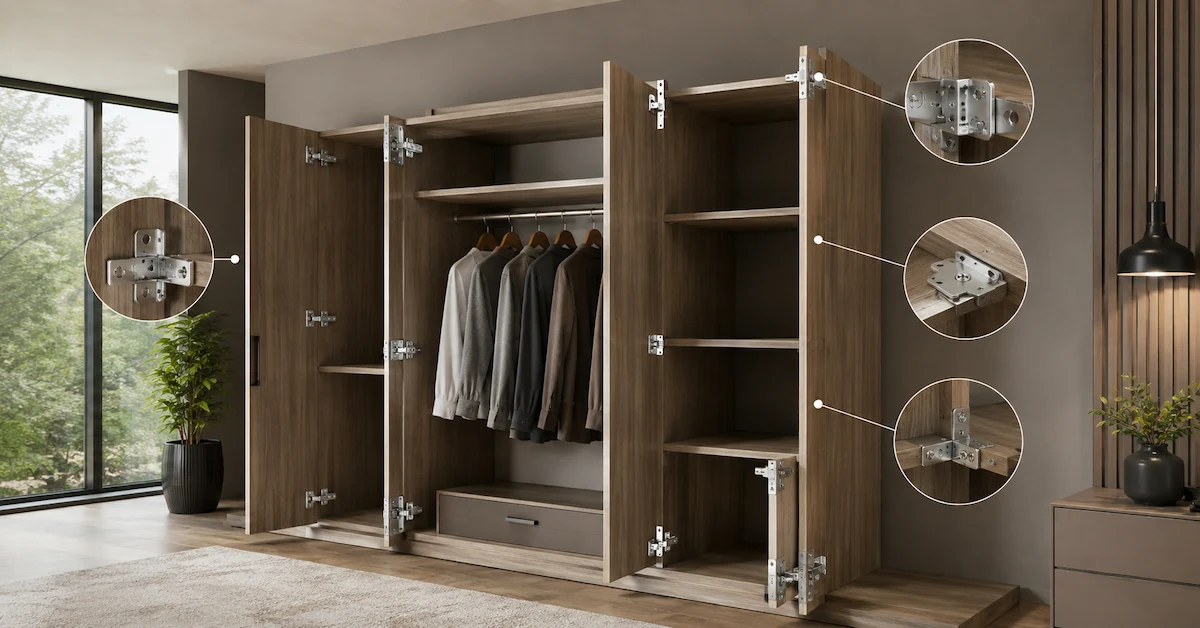
A real kit may include screws, hinges, brackets, anchors, washers, plastic caps, shelf supports, small fittings, labels, and retail packaging. The value is not only in having these parts available. The value is in putting them together correctly, in the right quantity, in a format that works for your sales or assembly channel.
For cabinet and furniture applications, the supplier should understand:
- Which parts belong together
- Which parts should be separated
- Which parts may scratch each other
- Which parts are easy to miscount
- Which parts need labels or model references
- Which parts are standard and which may need customization
If a manufacturer only talks about loose fasteners, your team may still need to handle sorting, counting, labeling, and packing later.
That may be acceptable for some simple orders. But for cabinet hardware kits, wardrobe kits, retail blister packs, or mixed furniture hardware assortments, extra handling can quickly become extra cost.
A useful supplier should think in kits, not only in parts.
2. Look at the packaging before looking at the price
Packaging is where many cabinet hardware programs succeed or fail.
A clear blister pack, clamshell pack, compartment tray, printed card, labeled bag, or bag-in-box format can all work. The right choice depends on how the kit will be used.
For retail sales, clear blister packaging is often useful because customers can see the contents. The pack can hang on a pegboard, carry a barcode, protect small parts, and make the hardware look more organized.
For warehouse picking, visibility and label clarity may matter more than appearance.
For assembly lines, fast opening and part separation may be more important than shelf display.
For e-commerce, the packaging has to survive shipping without spilling parts inside the carton.
So the question is not simply, “Does the package look good?”
The better question is, “Will this packaging still work after packing, shipping, storing, picking, and opening?”
A nice-looking retail pack that slows down loading may not be the best choice. A cheap bag that creates sorting mistakes may not be cheap in the end.
3. Confirm the fastener materials and standards
Small hardware can create large problems when specifications drift.
A cabinet hardware kit may depend on thread quality, screw length, head style, surface finish, hinge fit, bracket thickness, and washer size. If any of these details change without notice, the kit may still look similar but perform differently.
Jiangmen Jinhe Hardware Co., Ltd. focuses on machine screws, self-tapping screws, micro screws, and precision screws in materials such as stainless steel, iron, and aluminum. The company also works with GB, DIN, ANSI, BS, JIS, and ISO standards.
For buyers, this type of standards-based fastener background can be useful because cabinet kits often require repeatable parts, not one-time assortments.
Still, buyers should not rely only on broad claims.
Ask for the actual specification for your kit. Confirm the material, finish, dimensions, screw type, surface treatment, and any acceptable tolerance range. If the kit includes mixed hardware, each part family should be clear.
A cabinet hardware kit is only as reliable as the parts inside it.
4. Ask how counting and inspection are handled
A mixed hardware kit can fail even when all individual parts are well made.
Why?
Because the wrong quantity was packed.
One missing screw can stop assembly. One incorrect bracket can delay installation. One mixed washer size can create customer complaints. In retail hardware, the problem may not appear until the end user opens the package.
That is why inspection should cover the full kit, not only the fasteners.
Buyers should ask:
How are small parts counted?
Are mixed items checked manually, by weight, or by another method?
How are similar screws separated?
Is there a final kit inspection before sealing?
What documents are provided before shipment?
How are rejected or short-count kits handled?
Jiangmen Jinhe states that its products undergo strict inspection before delivery and can be supplied with necessary documentation. For buyers, that is a good starting point. The next step is to confirm how inspection works for the specific cabinet hardware kit being ordered.
A kit with ten part types needs different control from a carton of one screw size.
5. Make sure the supplier can handle related product families
Cabinet hardware rarely stays inside one category.
The same buying team may need cabinet kits this month, wardrobe hardware next month, and furniture hardware kits for a new retail program after that. If every product family needs a separate supplier, procurement becomes harder to manage.
That is why a broader furniture hardware kit manufacturer can be useful.
A supplier that can support cabinet kits, wardrobe kits, mixed fastener sets, custom assortments, and related hardware packaging may help reduce vendor handoffs. Fewer handoffs usually mean fewer opportunities for mixed specifications, inconsistent finishes, or unclear responsibility.
Jiangmen Jinhe serves customers in home appliances, electronics, furniture, building materials, medical devices, hardware wholesale, and cross-border e-commerce. That kind of customer spread may be useful for buyers who need both standard fasteners and project-based hardware assortments.
A supplier does not need to make every part in-house to be useful.
But it does need to manage the kit clearly.
6. Do not ignore warehousing and logistics
Small hardware is easy to underestimate.
It is also easy to mishandle.
Loose parts, weak cartons, unclear labels, or poorly matched packaging can create receiving problems before the kit ever reaches the customer. For retail hardware programs, damaged packaging can reduce shelf value. For assembly kits, unclear cartons can slow warehouse picking. For export orders, poor packing can create trouble during long-distance transport.
If your cabinet hardware kits are shipped frequently, split across markets, or tied to launch schedules, logistics support becomes more important.
Jiangmen Jinhe lists international freight forwarding, domestic logistics, warehousing, and supply chain services. For buyers, this can matter when hardware kits need to move through multiple channels, especially for export, e-commerce, or repeated replenishment orders.
The supplier’s responsibility should not end when the parts are counted.
The kit still has to arrive in usable condition.
7. Test communication before the order becomes urgent
Fast communication does not replace product quality.
But it often shows how a supplier will behave when something changes.
And hardware kit projects always change.
A label needs revision. A customer requests a new pack count. A screw length changes after assembly testing. A blister cavity needs adjustment. A carton mark is unclear. A shipment needs confirmation before the warehouse closes.
These are small issues, but they can delay an order if the supplier is slow to respond.
Jiangmen Jinhe says customer support responds within 30 to 60 minutes and provides solutions within 2 hours. Buyers should treat that as something to test during sampling and order preparation.
Ask questions early. Watch how clearly the supplier answers. See whether they understand the kit structure, not only the part price.
A supplier that communicates well during sampling is usually easier to work with during repeat orders.
Common mistakes buyers still make
One common mistake is choosing the cheapest fastener and forgetting the kit.
A low screw price does not help much if the packaging creates sorting work or customer complaints.
Another mistake is assuming mixed hardware is easy to pack. It is not always easy. Similar screws, washers, brackets, anchors, and small accessories can be confused quickly if the process is not controlled.
A third mistake is approving a retail pack by appearance only. A clear blister pack may look professional, but the cavity layout, sealing strength, loading speed, barcode position, and carton protection still need review.
Buyers also sometimes over-specify the part and under-specify the packaging. In real cabinet hardware programs, the label, cavity layout, carton mark, and item grouping may matter just as much as the fastener grade.
If the kit is sold through retail, used in furniture assembly, or packed with a cabinet product, packaging should be discussed early.
Not at the end.
Quick buyer checklist
Before choosing a cabinet hardware kit manufacturer, confirm the following:
- Exact parts included in the kit
- Quantity of each item
- Material and finish specifications
- Packaging format
- Part separation method
- Label and barcode requirements
- Inspection process
- Documentation provided
- Customization capability
- Logistics and warehousing support
- Repeat-order control
This checklist is not complicated, but it helps prevent expensive small errors.
Frequently Asked Questions
What makes a good cabinet hardware kit manufacturer?
A good manufacturer keeps parts consistent, packaging practical, counts accurate, and documentation clear. It should also support custom assortments when standard kits are not enough.
Why does clear blister packaging matter?
Clear blister packaging helps customers and warehouse teams see the contents quickly. It can support retail display, product visibility, barcode use, and cleaner part organization.
Can one supplier handle cabinet, wardrobe, and furniture hardware kits?
In many cases, yes. A supplier with fastener production, customization, packaging, and logistics support can often handle several related hardware kit programs.
What should buyers check first?
Start with the kit structure: parts, quantities, packaging, labels, and intended use. After that, review material, finish, inspection, and delivery support.
Is the lowest-price supplier always the best option?
Usually not. A lower price can become expensive if the kit has missing parts, weak packaging, mixed components, or poor repeat consistency.
Can cabinet hardware kits be customized?
Yes. Part mix, quantities, labels, packaging format, blister layout, carton marks, and fastener specifications can be customized when the project requires it.
A better cabinet hardware kit starts before packing
A strong cabinet hardware kit is not created at the final packing table.
It starts with a clear part list, stable fastener specifications, practical packaging, count control, inspection, and repeat supply planning.
For cabinet hardware kits, wardrobe hardware kits, furniture hardware kits, clear blister packaging, mixed fastener assortments, and custom hardware packaging, Jiangmen Jinhe Hardware Co., Ltd. can discuss standard parts, non-standard customization, inspection, packaging, logistics, warehousing, and repeat supply requirements.
For direct inquiries:
Tel/WeChat: +86 13729150102
WhatsApp: +86 13322893939
Email: sharon@hkhomeideas.com
Start with the part list, packaging channel, target quantity, label requirements, and expected order volume.
Once the kit structure is clear, choosing the right cabinet hardware kit manufacturer becomes much easier.