
Why buyers still look to Chinese screw manufacturers
When sourcing fasteners, most engineers and purchasing teams are not chasing a headline price alone. They are trying to balance consistency, specification control, and the practical reality of getting the right parts to the line on time. That is why Chinese screw manufacturers remain a serious option for so many programs. The market is broad, the product range is deep, and the better suppliers can support everything from standard machine screws to custom precision parts.
For buyers who need to buy screws wholesale China, the decision is rarely just about a catalog number. It is about whether a screws supplier China can hold dimensions across batches, document materials properly, and respond quickly when a drawing changes. In other words, the right supplier is not simply a vendor; it is part of the production system.

What a capable screw supplier should actually be able to do
Jiangmen Jinhe Hardware Co., Ltd. was founded in 2016 in Jiangmen City, Guangdong Province, and operates on a 4,000-square-meter site. According to the company information provided, its focus includes machine screws, self-tapping screws, micro screws, and precision screws made from stainless steel, iron, and aluminum. It also states compliance with GB, DIN, ANSI, BS, JIS, and ISO standards, which matters because most buyers are not looking for a generic screw; they are looking for a part that fits an existing design and inspection routine.
The company also says it serves electronics, medical devices, automation, home appliances, furniture, and building materials customers, with both domestic and international trade support. That mix is useful to note. A supplier that works across these sectors is often more familiar with the small, annoying details that drive sourcing risk: packaging integrity, lot traceability, and the difference between a screw that looks right and one that actually assembles cleanly.
What the trade-show display suggests about product breadth
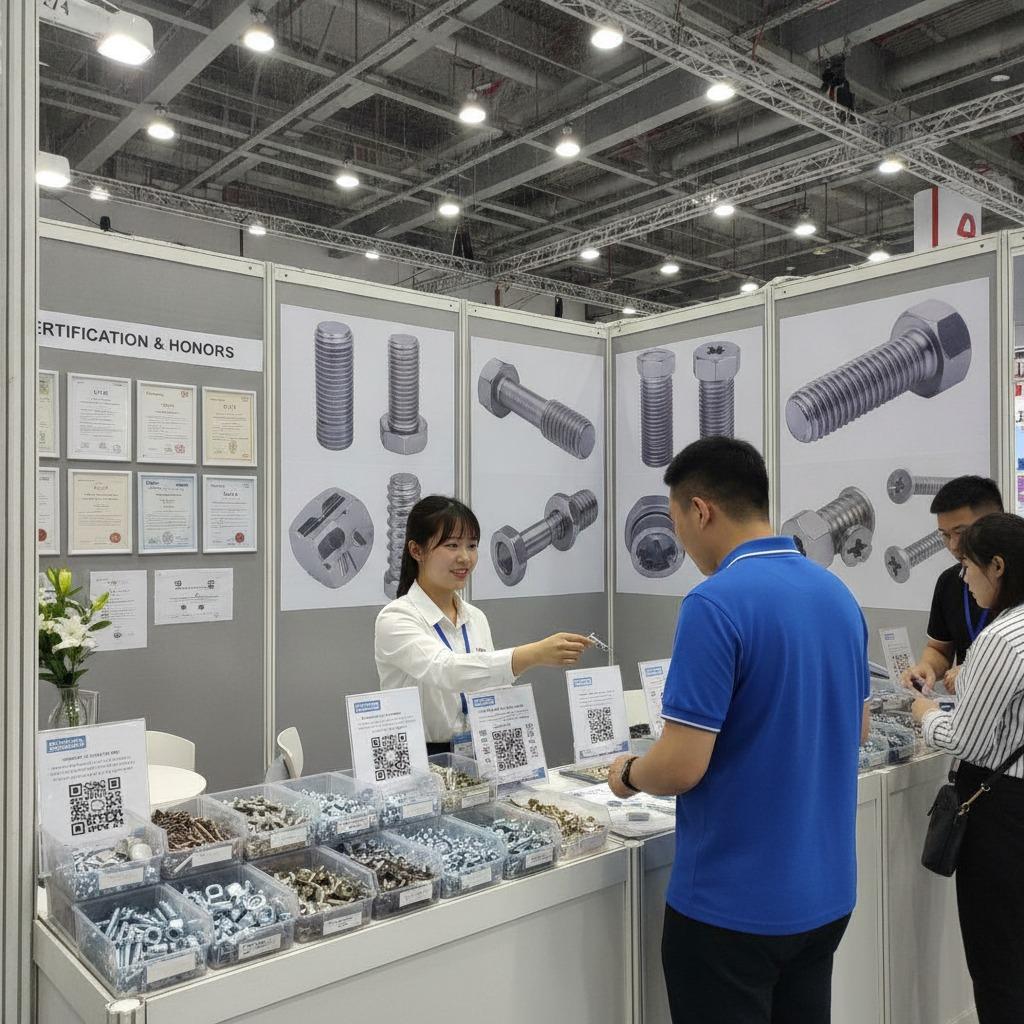
The booth image shows a wide assortment of hardware fasteners and small metal components. There are screws, bolts, nuts, washers, anchors, threaded parts, and packaged small-part sets. That breadth is a practical signal for wholesale buyers. It suggests the company is not limited to one narrow SKU family, which can help when a project needs complementary items from the same source.
Of course, a trade-show wall is not a substitute for a technical datasheet. Exact dimensions, grades, coatings, and load ratings are not visible here, and they should not be assumed. But for sourcing teams, a broad display still tells you something useful: the supplier likely understands mixed-order fulfillment, packaging for distribution, and the expectations of OEM and wholesale channels.
How to compare suppliers without getting distracted
Buyers often start with price, then discover the real cost only after the first shipment. A lower quote can disappear fast if the screws arrive with inconsistent head geometry, poor threading, or packaging that fails in transit. When evaluating Chinese screw manufacturers, it helps to compare in a more disciplined order.
1. Product range and manufacturing depth
Can the supplier handle standard parts and non-standard customization? Jiangmen Jinhe says it offers both R&D and production, which is important if you need a revision or a special head style later. A supplier with in-house manufacturing control is usually more responsive than one that only trades goods from others.
2. Materials and finishing
Stainless steel, iron, and aluminum each behave differently in production and use. Shiny plated parts may look similar on a booth panel, but the coating choice affects corrosion resistance, assembly feel, and long-term performance. Buyers should ask for material declarations and process details rather than relying on appearance.
3. Inspection and documentation
The company information states that products undergo strict inspection before delivery and are accompanied by necessary documentation. That is exactly the kind of phrase a procurement team should follow up on. Ask what is inspected, how often, and what records are kept. If a supplier cannot explain its inspection flow in plain language, that is a warning sign.
Common mistakes when sourcing screws from China
The first mistake is treating all screws as interchangeable. They are not. Head type, drive style, thread profile, and coating all influence assembly behavior.
The second mistake is assuming a display part equals a production-ready part. Trade-show samples often show capability, not final commercial specification. Request drawings, sample approval steps, and clear packaging requirements before placing a volume order.
The third mistake is overlooking logistics. Jiangmen Jinhe notes international freight forwarding, domestic logistics, warehousing, and supply chain services. That is worth paying attention to because fasteners are small, but supply-chain failures are not. A delayed carton of screws can stop a line just as effectively as a larger component shortage.
What buyers should ask before placing a wholesale order
Start with the use case. Is the screw for electronics, furniture, machinery, or general assembly? Then confirm the standard, material, finish, packaging format, and whether the order needs custom marking or special documentation.
For buyers planning to buy screws wholesale China, it also helps to ask about responsiveness. Jiangmen Jinhe states customer support responses within 30–60 minutes and solutions within 2 hours for issues. That may not be the deciding factor on its own, but in a busy sourcing environment, service speed can be as valuable as unit price.
A practical takeaway for sourcing teams
If you are comparing Chinese screw manufacturers, look beyond the initial quote and judge the supplier on production range, documentation discipline, and logistics support. The best partner is usually the one that can handle ordinary fasteners reliably and still accommodate the odd special request without turning it into a project of its own.
For teams sourcing from a China screw factory, the next step is straightforward: request product specifications, inspection terms, and packaging details, then compare those answers against your own assembly and quality requirements. That is where a promising supplier becomes a dependable one.