

Custom screw lead time is the total time from a confirmed order to parts ready for shipment, and it is built from six separate waits: drawing review, tooling, raw material, heading and threading, finishing, and inspection and packing. Quoted as one number, it hides which of those waits your order actually controls. Buyers who ask for the breakdown before they order usually discover that the date they were given starts later than they assumed.
This matters because a custom fastener is rarely the expensive part of a delay. The expensive part is an assembly line, a container booking or a retail launch waiting on a carton of screws that nobody flagged until week six. The purpose of this guide is to help a buyer test a quoted delivery date before the purchase order is released, and to put the schedule where it can be managed rather than hoped for.
What a quoted custom screw lead time actually contains
A single figure such as "25 days" is a summary of a schedule that already exists inside the factory. Ask for that schedule and the number becomes checkable. The stages below are the ones that appear in almost every custom screw order, and each has a different owner.
| Stage | What has to happen | What usually sets the duration | Who controls it |
|---|---|---|---|
| Drawing and specification review | Thread class, tolerance, material, finish and acceptance criteria confirmed against the drawing | Completeness of the drawing and the answers to technical questions | Shared — the buyer's drawing quality sets the floor |
| Tooling | Heading dies, thread rolling dies or punches designed, machined and tried | Geometry complexity and whether a similar die already exists | Supplier, sometimes a tool room partner |
| Raw material | Wire or bar in the specified grade and diameter secured | Whether the grade is a stock item or a mill order; minimum lot weight | Supplier and mill allocation |
| Heading, threading and secondary operations | Machine slot booked, dies set, trial piece checked, run completed | Machine availability and the length of the run | Supplier scheduling |
| Heat treatment and coating | Batch processed, then checked for thickness, adhesion or appearance | Queue at the finishing line and batch size | Supplier or finishing subcontractor |
| Inspection and packing | First article, sampling inspection, documents, labels and carton marks | Agreed document set and packaging complexity | Shared — the buyer defines what is required |
| Inland transport and export | Trucking, booking, customs clearance, sailing | Incoterm, port congestion and sailing frequency | Forwarder and carrier |
Two conclusions follow from this table. First, most of the calendar is not machining time; it is waiting for a slot, a batch or an approval. Second, several of those waits belong to the buyer. A supplier who quotes from the purchase order date is quietly assuming that the drawing will be approved immediately and that no question will come back.
Why two suppliers quote the same screw with different lead times
The same drawing can be produced by more than one route, and each route has a different time profile. Comparing lead times without comparing routes is like comparing prices without comparing quantities — the numbers are real but they describe different things.
| Route | What drives its lead time | Where it fits |
|---|---|---|
| Cold heading plus thread rolling | Die manufacture, machine slot and run length. Output is fast once running, but the setup is heavy and a new die has to be proven | Repeat production of a stable design at volume |
| CNC turning or milling from bar | Programming and setup, with little dedicated tooling. The first part arrives sooner, but the cost per piece is higher | Prototypes, low volume, complex features |
| Standard screw with a secondary modification | Availability of the base part plus one added setup for the modification | Length, point or drive changes on a proven part |
| Purchased part plus kitting | Supplier stock and kitting labour, not metal forming | Assortments, retail packs and hardware kits |
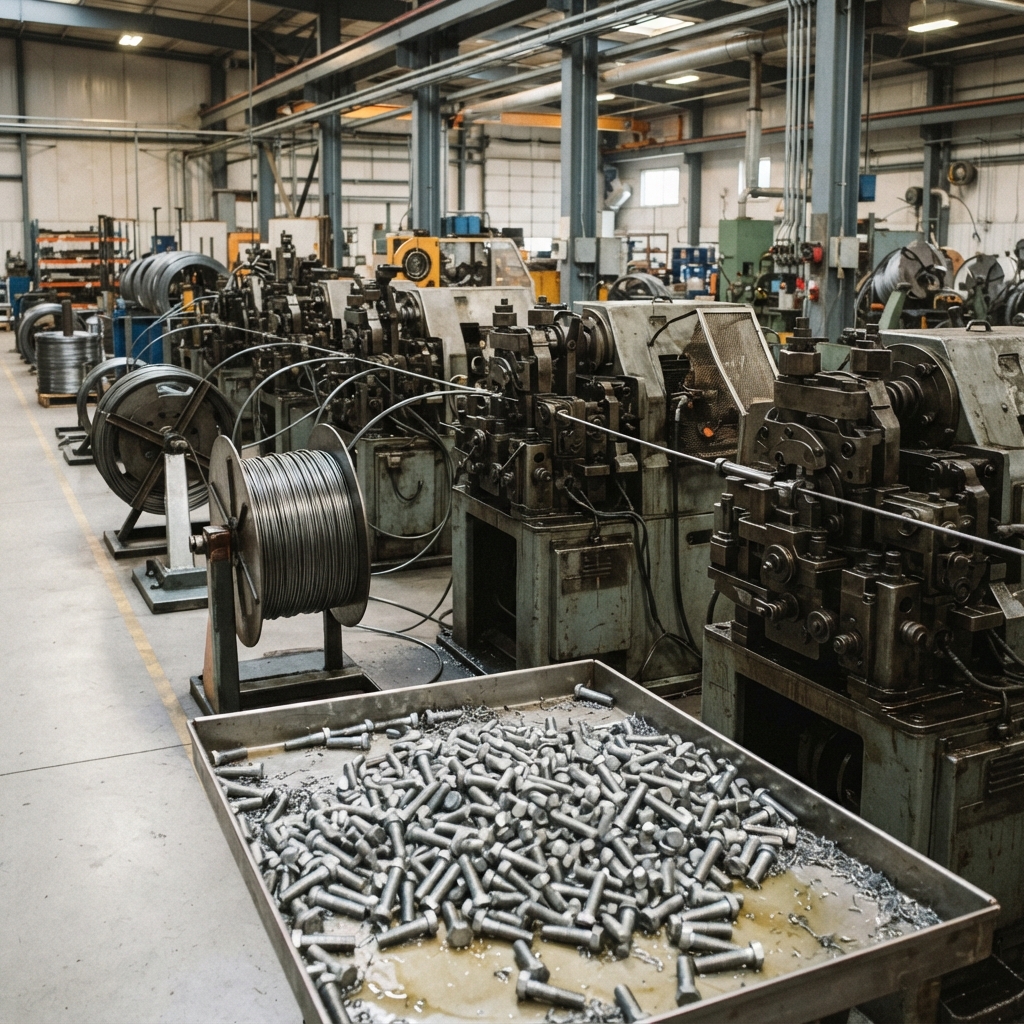
Three other variables explain most of the remaining gap between quotations. The first is vertical integration: a factory that headings, threads, punches, assembles and packs in its own workshops is not queuing for those steps elsewhere, while a trader or a lightly equipped workshop is. The second is material: a standard carbon steel grade from stock behaves very differently from a special stainless grade that has to be ordered, and the formability of the wire itself affects how easily a difficult head shape can be headed at all. The third is the delivery point: an ex-works date and a delivered date can differ by weeks on the same production schedule.
When a quotation looks unusually fast, the useful question is not "how do you do it so quickly" but "which stage have you removed, and what replaces it". Sometimes the answer is genuine — an existing die, a machine slot that is already open, a standard part that only needs one operation. Sometimes the answer is that the clock starts later than the buyer thinks.
How to verify a lead time before you place the order
A lead time can be checked in a short conversation if the questions are specific. Vague questions produce reassuring answers. These six do not.
1. Which event starts the clock?
Purchase order, deposit received, drawing approved, or golden sample approved. Each gives a different date, and the difference is often one to three weeks. Ask for the start event in writing, and ask what happens if the drawing changes after that event.
2. How much of the schedule is in your own workshops?
Heading, threading, punching, assembly, packing and inspection are the stages to name. Any stage that is outsourced adds a queue the supplier does not control, and finishing is the usual one. A supplier who can say plainly which steps are in-house and which are not is giving you a more useful answer than one who claims everything.
3. When is my machine slot booked?
Not "when the order is accepted" — when the specific machine and die set are reserved. A factory that books slots weekly can usually tell you the week your run is planned. If the answer stays at the level of "we will arrange it", the date is an intention rather than a plan.
4. What is the tooling lead time, quoted separately?
Tooling is the stage most likely to move, because it depends on a drawing that may still change. Ask for the die lead time as its own line, ask whether the die is new or adapted, and ask who approves the first article. Separate numbers are easier to hold someone to than a combined total.
5. What is the finishing turnaround, and is it a batch process?
Plating, coating and heat treatment run in batches. Your order may wait for a barrel to fill or for a scheduled line day. Ask how often the finishing partner runs your finish, and whether a Colour or appearance requirement needs an approved sample before the batch starts. This single question explains a large share of "the parts are made but not shipped" delays.
6. What were your last three ex-works dates against the dates you promised?
Not an on-time percentage, which is easy to state and hard to check, but three recent comparable orders with promised and actual dates. A supplier with nothing to show is not necessarily unreliable; a supplier who cannot describe how the comparison would be made is telling you that delivery performance is not measured.
Two supporting checks are worth adding. Ask what happens procedurally when a first article fails, because that answer reveals whether a rejection costs a day or a full re-setup. And ask for a milestone schedule with calendar dates rather than durations. Durations hide waiting; dates can be tracked.
The dates that decide whether you get the parts on time
A fastener delivery schedule usually has five dates that matter, and only one of them is the supplier's production date. Managing the schedule means knowing who owns each one.
| Date | Owner | How it slips | How to protect it |
|---|---|---|---|
| Drawing approval | Buyer | Late engineering sign-off, or a revision after tooling starts | Freeze the drawing before the PO; route changes through one named approver |
| First article approval | Shared | Sample sent without a measurement report; rejection without a written reason | Agree the inspection record and the acceptance criteria in advance |
| Production start | Supplier | Machine slot moved for a larger order | Get the planned production week in writing |
| Ex-works date | Supplier | Finishing queue, rework, packing materials | Milestone updates at die completion, run completion and finishing release |
| ETD and ETA | Forwarder | Rolled booking, port congestion, missed connection | Book early; know the next sailing; keep the option of a partial air shipment |
The practical rule is to measure performance against the ex-works date, not the arrival date. Once the goods leave the factory, the delay belongs to logistics, and logistics problems have different remedies — a split shipment, a faster sailing, or air freight for the component that stops the line. Blending factory and freight delays into one number makes both impossible to manage.
Where custom screw lead times actually slip
Across most custom fastener programmes, the same six causes recur. None of them is exotic, and each has a countermeasure that costs less than the delay.
- Buyer-side approval delay. The most common cause and the least discussed. A drawing revision after the die has been started reopens tooling and re-queues the run. Countermeasure: approve the drawing and the sample record before the PO, and treat any later change as a new schedule.
- Material grade and diameter. A special stainless grade or an unusual wire diameter may have to be drawn or ordered, and the mill's allocation decides the start date. Countermeasure: ask whether the grade is in stock, and accept a standard grade for the first lot if the application allows it.
- Finishing queue and rework. Coating and heat treatment are batch operations, and a failed adhesion or thickness check sends the batch back through the line. Countermeasure: approve the finish on a sample, specify the test, and ask which finish line is used.
- First-article rejection loops. Each loop costs a setup and a new slot, not just the inspection time. Countermeasure: send a drawing with a clear measurement datum and agree which dimensions are critical, so the first article is judged against the same criteria the buyer will use.
- The calendar. Chinese New Year, the May and October national holidays, and the shipping peak before major retail seasons all compress capacity and bookings at the same time. Countermeasure: plan orders around the holiday, not through it, and confirm the factory's actual shutdown dates rather than assuming them.
- Change orders during the run. A packaging change, an added laser mark or a quantity split can stop a line that was already set. Countermeasure: freeze packaging artwork with the drawing, and schedule changes to the next run.
One further point deserves its own line: consolidation. Less-than-container-load shipments wait for other cargo, and a booking that is "ready" can sit for a week before it moves. If the date is critical, ask for the sailing schedule at the quotation stage, not after production finishes.
Contract terms that make a delivery date enforceable
A date in an email is a hope. A date in a purchase order with a defined start event, a delivery point and a remedy is a term. Five clauses do most of the work.
- Definition of lead time. State the start event, the end event and the delivery point. "Ex-works within 30 days of drawing approval" is enforceable. "30 days" is not.
- Milestone annex. Attach the schedule with calendar dates for die completion, production start, finishing release and ex-works. This is what makes progress review possible.
- Partial shipment right. The right to ship available quantities protects the buyer's line when one component lags. Agree who pays the extra freight in each scenario.
- Delay remedy. A liquidated damages clause per week of supplier-caused delay, with a cap, is standard in industrial supply. Its purpose is to make the schedule a shared priority, not to recover money after the damage is done.
- Change control. State that any specification change after approval resets the schedule, and say by how much in principle. This prevents the argument about whose fault the delay was.
Two smaller terms are worth including because they prevent the most common disputes: who bears the cost of sorting or rework if the batch deviates from the approved sample, and which documents accompany each shipment. For the document side, an inspection plan with an agreed sampling level removes most end-of-line arguments before they start; our guide to AQL sampling for fasteners explains how to set the lot, defect classes and acceptance numbers.
How much buffer to plan, and where to hold it
Buffer is not a fixed percentage, and copying someone else's number is how buyers end up with either too much stock or too little. A defensible method uses three inputs:
- Transit variability. Ask the forwarder for the last three transit times on the lane, not the advertised one. Use the longest.
- Production variability. Ask the supplier for the last three actual ex-works dates on comparable parts. Again, use the longest.
- Your own approval time. Measure how long your team actually takes to approve a drawing or a sample, not how long it is supposed to take.
Buffer = longest observed transit − quoted transit, plus the production variance, plus your approval time. The result is usually uncomfortable, which is the point: it is the delay you have already experienced, not a theoretical risk.
Where to hold it matters as much as how much. Hold finished-goods buffer on the highest-running part or the part with the longest tooling, because restarting a cold-headed part is slow and expensive. Hold raw material buffer at the supplier only if the agreement makes that stock yours. And hold buffer in the schedule, not only in the warehouse: a production slot booked two weeks before the assembly date is a form of buffer that costs nothing but planning discipline.
What we do at JHFIX
Jiangmen Jinhe Hardware Products Co., Ltd. has manufactured fasteners since 2004 in Jiangmen, Guangdong, and exports to more than 40 countries through its authorized export partner, Jiangmen Shenxin Trading Co., Ltd. Cold heading, tapping, punching, injection molding, assembly, packing and inspection are carried out in our own workshops, which is why we can describe a schedule stage by stage rather than quoting one figure. The workshop sequence is shown on our manufacturing page.
Our range covers cam lock systems, connectors, shelf supports, wood screws, electrical screws, colour screws, custom screws, assortment kits and furniture fittings. For custom work, our engineers review the drawing, substrate and joint requirements before quoting, because the answers change both the route and the time.
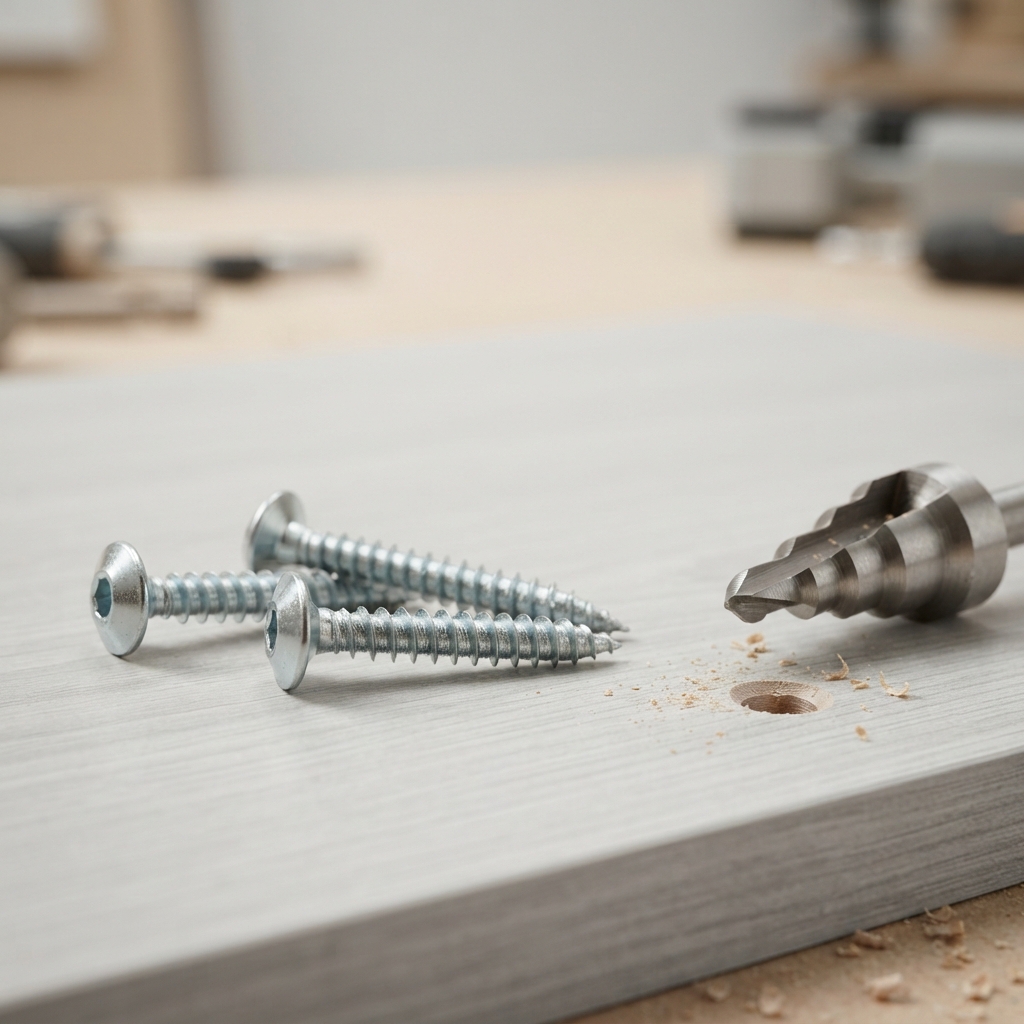
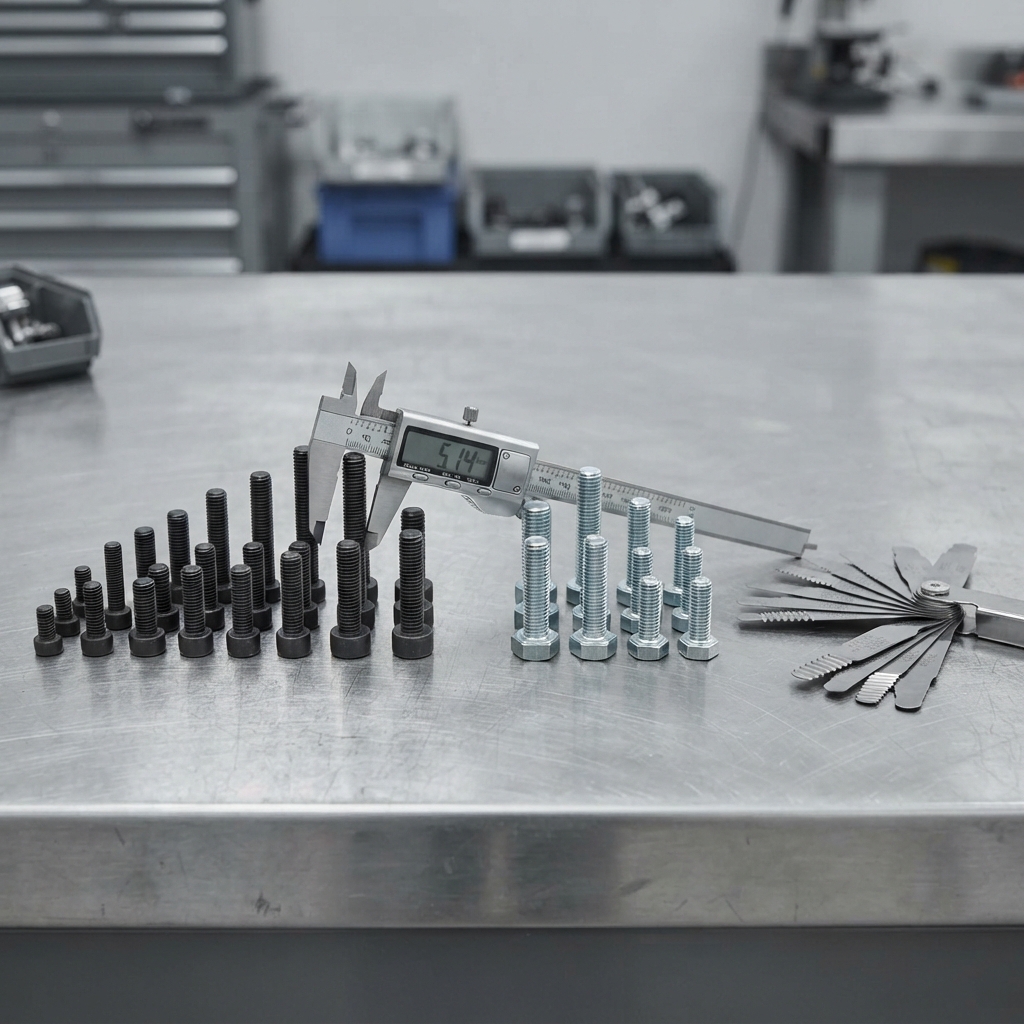
Two examples of how the route affects what a buyer should expect. The silver cross-drive countersunk self-tapping screw is a pointed screw with a countersunk head, cross recess and coarse full-length thread; the photographed configuration is 25 mm long with an M3.5 thread, while material, finish and dimensions are confirmed against the approved drawing or sample. The metric socket screw, nut and washer assortment kit combines socket screws, hex nuts, flat washers, lock washers and hex keys in a divided case, so the component list, thread sizes, quantities, compartment layout and packaging all have to be fixed before the run begins — each of those is a stage in the schedule, not a detail after it.
When you send a request for quotation, ask us for the schedule in the same breakdown used above. A supplier who can show you which waits are theirs, which are a partner's and which are yours is easier to hold to a date, and easier to work with when something moves.
FAQ
How long does a custom screw order take?
There is no universal figure, because the answer depends on the route, the tooling, the material and the finish. A standard screw with a minor modification can move quickly, while a new cold-headed design needs die manufacture, a trial and a finishing batch before it ships. Ask for the schedule broken into stages, then judge whether each stage is realistic for your part.
Does lead time start on the purchase order date?
Only if the supplier says so explicitly. Many factories start the clock at drawing approval or sample approval, because tooling cannot begin on an unapproved drawing. The difference is often one to three weeks, so the start event should be written into the order.
Can a custom screw lead time be shortened?
Sometimes, and usually by changing the work rather than by asking for speed. Options include using a standard part with a modification to avoid a new die, approving the drawing before the PO, accepting a partial shipment, or paying for air freight on the component that stops the line. Each has a cost, and the cheapest is almost always earlier approval.
Why do small custom orders sometimes take longer than large ones?
Because a small run is often scheduled around larger jobs that already hold the machine and the finishing batch. The parts themselves take less time to make; the wait for a slot can be longer. This is worth discussing before the order, since a planned delivery window can sometimes be reserved in advance.
Does plating or coating add lead time?
Usually yes, and it is a separate stage rather than part of machining. Plating and heat treatment are batch processes with their own queues, and a failed thickness or adhesion check sends the batch back through the line. Approving the finish on a sample and naming the test reduces the risk of a rework loop.
How can I check a supplier's on-time performance?
Ask for three recent comparable orders with the promised ex-works date and the actual ex-works date, plus the bill of lading date for each. Three real records tell you more than a percentage, and the way a supplier responds tells you whether delivery performance is measured at all.
What should be in a delivery schedule annex?
Calendar dates for drawing approval, die completion, first article approval, production start, finishing release, ex-works and ETD, each with the party responsible. Durations alone are not enough, because they hide the waiting between stages.
Conclusion
A custom screw lead time is a stack of short waits, and the buyer controls more of them than most quotations admit. Verify the start event, separate in-house stages from subcontracted ones, ask for dates rather than durations, and measure performance at ex-works. Do that before the order, and the delivery date becomes a plan instead of a promise.
A practical sequence for the next enquiry:
- Send one controlled drawing with material, thread class, finish, acceptance standard and packaging requirement.
- Ask for the schedule in stages, with calendar dates and the party responsible for each.
- Confirm which stages are in-house and which depend on a finishing partner.
- Agree the first article record before the die is started, and freeze the drawing at that point.
- Book the sailing before production finishes, and decide in advance how a partial shipment would be handled.
- Record the actual ex-works date, and use it to set the buffer on the next order.
If you have a drawing and a target delivery window, send both through our contact page and we will quote the production route and the schedule behind it. If you are still comparing suppliers, our screw manufacturer audit guide and custom screw sample approval checklist cover the checks that come before the first order.
Further reading: Component Solutions Group, What Actually Drives Fastener Lead Times (2026), on mill allocation, heading queues and transit; and Carpenter Technology, Heading Hints: A Guide to Cold Forming Specialty Alloys, on how wire grade and formability affect heading.