
 Why Bulk Custom Screws Are More Than a Simple Parts Purchase
Many engineers do not think too much about screws until something fails.
A thread strips during assembly.
A screw head interferes with a nearby bracket.
A coating does not match the housing finish.
A fastener runs short during a production launch.
Or the screw fits in the sample build, but behaves differently once the order moves into volume.
That is usually the point where a buyer starts searching for a custom screw manufacturer for bulk orders.
At first, it may look like a simple purchasing task. The buyer needs screws, so the buyer asks for a quote. But in real OEM and production work, custom screws are rarely just metal parts in a box. They are tied to drawings, mating components, assembly tools, torque behavior, surface finish, packaging, inspection, and shipment timing.
If the screw specification is wrong, the problem does not stay small. It spreads downstream into rework, line stoppages, quality complaints, delayed shipments, and long email chains between engineering, procurement, and suppliers.
That is why bulk screw sourcing should be treated as a controlled supply project, not a casual parts purchase.
Why custom screw sourcing becomes complicated
A standard screw works well when the application is standard.
But production environments are rarely that simple.
A screw may need to sit flush inside a plastic housing. It may need to cut cleanly into wood-based panels. It may need to hold consistently in sheet metal, appliance parts, furniture frames, electronic devices, or medical equipment assemblies. It may also need a specific finish for corrosion resistance, appearance, friction behavior, or brand consistency.
One small change can affect the whole assembly.
A different head diameter may change clearance.
A different thread length may change grip.
A different coating may change tightening feel.
A different drive recess may affect installation speed.
A small dimensional variation may become expensive when thousands or millions of parts are used.
For that reason, buyers do not only need a screw supplier. They need a supplier that understands how to turn a requirement into repeatable production.
Jiangmen Jinhe Hardware Co., Ltd., founded in 2016 in Jiangmen City, Guangdong Province, focuses on fasteners, standard parts, and non-standard customization. The company states that it produces machine screws, self-tapping screws, micro screws, and precision screws, using materials such as stainless steel, iron, and aluminum. It also works with standards including GB, DIN, ANSI, BS, JIS, and ISO.
For buyers in electronics, home appliances, furniture, building materials, medical devices, automation, and similar industries, that matters. Familiar standards and clear production language help reduce misunderstanding before the order reaches the factory floor.
What the product setup suggests
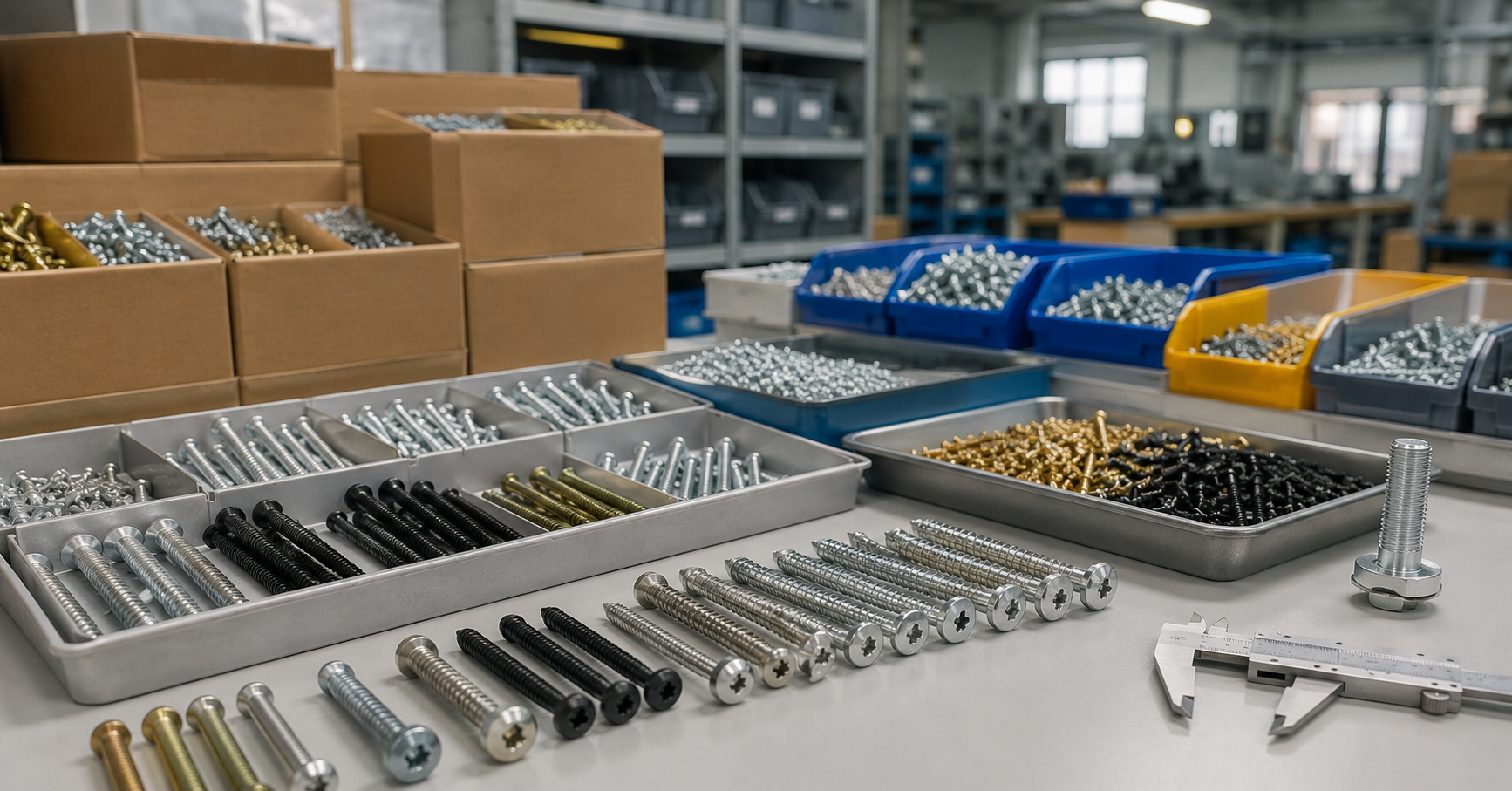
The visible product setup tells a common fastener sourcing story.
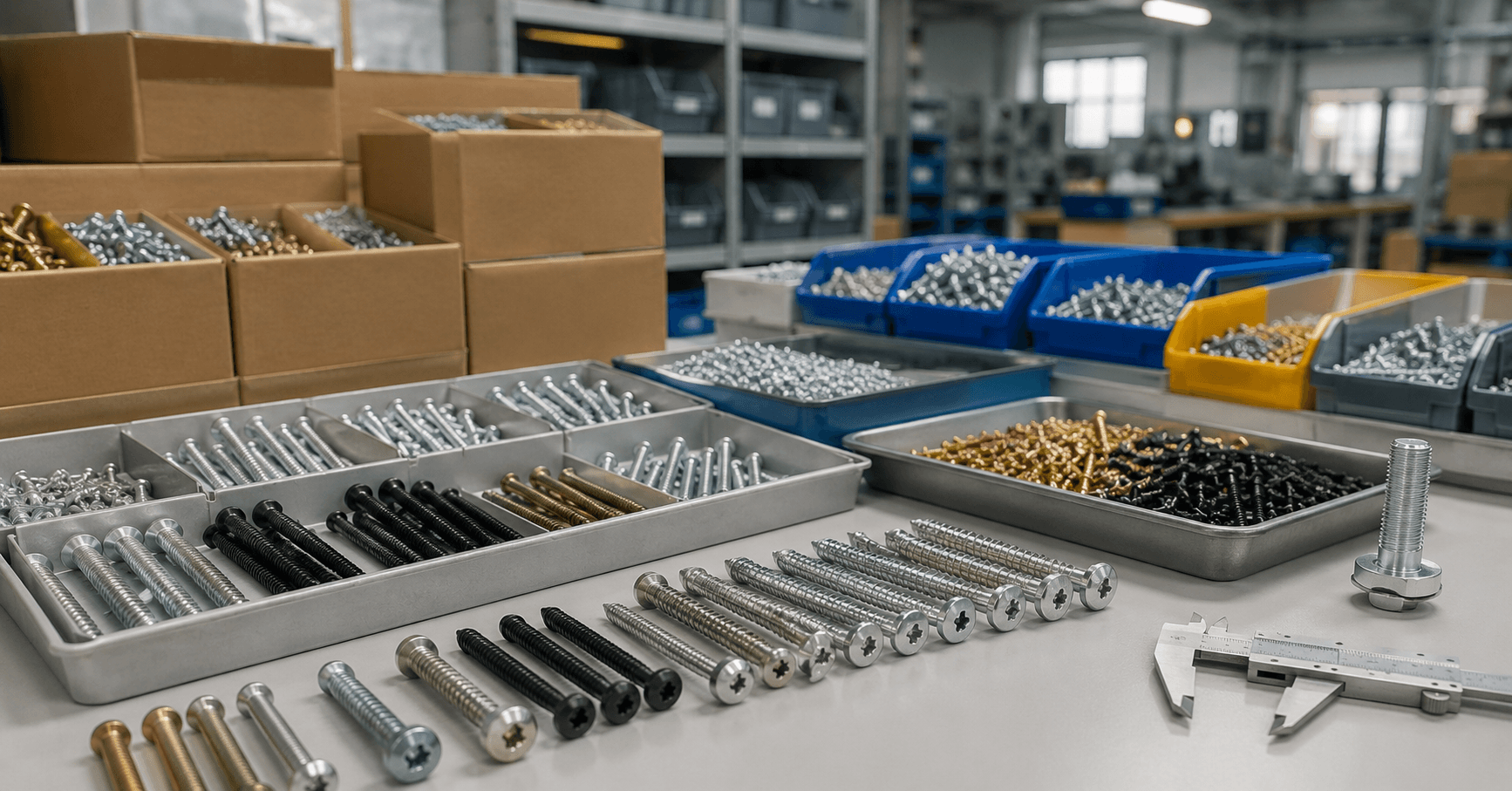
There are assorted screws in different shapes and finishes. Some are standing upright. Some are laid flat. The group includes different head styles and drive types, such as Phillips or cross recess, hex socket, and lower-profile forms. Nearby, there is a caliper and a technical drawing.
Those details are not decoration.
They point to the real work behind custom screw manufacturing: measurement, confirmation, and repeatability.
A screw may look simple, but buyers still need to confirm head diameter, head height, total length, thread coverage, shank size, drive depth, point style, finish thickness, and dimensional tolerance. In bulk production, these details decide whether the part can be assembled smoothly again and again.
The different visible surface appearances also suggest common finish variation: bright metal, black-coated, gold or yellow plated, and brass-like tones. The exact materials should not be assumed from appearance alone. A serious buyer should still request material declarations, finish descriptions, and test records when the application requires them.
Distributor or custom fastener manufacturer?
A distributor can be useful when the buyer needs standard screws quickly.
That works for ordinary stock items, emergency replacement orders, and simple applications where the screw does not need to match a special product design.
A custom fastener manufacturer is different. It becomes more useful when the screw has to fit a product, not just a catalog category.
Custom screw sourcing may involve:
| Requirement | Why It Matters |
|---|---|
| Non-standard length or diameter | Fits a specific assembly space |
| Special head style | Avoids interference or improves appearance |
| Custom drive recess | Matches tools and improves installation speed |
| Self-tapping geometry | Supports a specific substrate or panel material |
| Custom plating or coating | Meets appearance, friction, or corrosion needs |
| OEM/ODM drawing production | Controls repeatability across production runs |
| Bulk supply planning | Supports stable reorders and production schedules |
| Custom packaging | Reduces sorting, handling, and line-side mistakes |
This is where the phrase custom wholesale screws supplier becomes more meaningful. It is not only about selling a large quantity. It is about keeping the specification stable when the order becomes large.
Why the first sample is not just a sample
In bulk screw projects, the first sample should not be treated like a sales display.
It should be treated as a process check.
The buyer should test whether the screw fits the product, whether the thread behaves correctly, whether the head seats properly, whether the finish is acceptable, and whether the packaging protects the parts during handling.
Jiangmen Jinhe says it supports strict inspection before delivery and can provide necessary documentation. For OEM projects, that kind of inspection discipline matters because the sample approval stage sets the reference for future production.
A good sample review should answer several questions:
Does the screw match the drawing?
Does it fit the mating part?
Does the drive recess work with the planned tool?
Does the finish match the required appearance?
Does the thread perform correctly in the real material?
Is the packaging suitable for bulk handling or assembly use?
Can the same specification be repeated in the next order?
If the answer is unclear at sample stage, it will not magically become clearer in mass production.
How buyers should define the application first
Before asking for a quote, buyers should define where and how the screw will be used.
A screw for electronics is not evaluated the same way as a screw for furniture. A screw for home appliances may need different finish control from a screw for general industrial assembly. A micro screw for medical devices may require tighter dimensional attention than a common furniture screw.
For example, a bulk self tapping screws supplier may need to know the substrate material, pilot hole condition, installation tool, expected torque range, and whether the screw will be installed manually or automatically.
A custom metric screws manufacturer may need a drawing, standard reference, tolerance requirement, material grade, surface treatment, packaging quantity, and inspection criteria.
A clear application description saves time because it prevents the supplier from quoting the wrong thing.
Details buyers should freeze before production
Bulk screw orders often go wrong when too many details remain open for too long.
Before mass production, buyers should confirm the must-not-change items. These usually include:
- screw size
- total length
- thread length
- thread type
- head type
- head diameter
- head height
- drive recess
- point style
- material
- finish
- strength or grade requirement
- inspection standard
- packaging quantity
- carton packing method
- label or part number requirement
This may feel slow at the beginning, but it saves time later.
If these details are not frozen, the reorder may not match the original sample. That is one of the most common problems in custom screw procurement.
Where suppliers earn trust
A supplier earns trust by controlling variation.
In custom screw sourcing, buyers should ask how the factory measures parts, how it checks batches, how it handles finish consistency, and how it manages packaging before shipment.
For large orders, even a small defect percentage can become expensive. A minor issue repeated across tens of thousands of screws can become a major production problem.
That is why inspection and communication matter.
Jiangmen Jinhe states that it responds to customer issues within 30 to 60 minutes and provides solutions within 2 hours. For sourcing teams, this kind of response speed can be valuable when a shipment is waiting for release, a line is short of parts, or an overseas buyer needs fast clarification.
Of course, service claims should always be tested during real projects. But responsiveness is still a useful signal when comparing suppliers.
Common mistakes buyers still make
The first mistake is assuming that a screw is “just a screw.”
It is not. It is a controlled interface part. It connects materials, tools, torque, geometry, and final product performance.
The second mistake is specifying only the visible dimensions while ignoring finish and thread behavior. A screw can match the drawing visually and still fail during assembly if the thread form or coating is wrong for the application.
The third mistake is choosing the lowest quote without checking what is included. Does the quote include samples? Inspection? Documentation? Custom packaging? Export support? Repeat-order control? If not, the low price may hide extra cost later.
The fourth mistake is failing to confirm whether the supplier is offering a standard item, a modified standard screw, or a fully customized part. These are different sourcing paths with different cost, tooling, and lead-time implications.
The fifth mistake is not documenting the approved sample. Without a clear reference, future shipments become harder to judge.
What serious buyers should ask before placing an order
Before placing a production order with a custom screw manufacturer for bulk orders, buyers should ask direct and practical questions.
Can the supplier produce according to drawings or samples?
Can it support non-standard customization?
What materials are available?
Which standards can be followed?
How is the finish controlled?
What inspection is performed before delivery?
What documentation can be provided?
How are screws packed for bulk shipment or assembly use?
Can the supplier support repeat orders without changing the approved specification?
Can it assist with export documentation, logistics, warehousing, or freight forwarding?
Jiangmen Jinhe says it offers international freight forwarding and supply chain services. For overseas buyers, this can be useful when screw production, packaging, documentation, and shipment timing need to be coordinated together.
Bottom line for sourcing teams
If your product depends on a non-standard screw, the supplier decision should be made like a process decision.
Not a commodity purchase.
The right partner should be able to read the drawing, understand the application, confirm the material and finish, support bulk production, inspect before delivery, and keep the reorder path stable.
For OEM, ODM, and bulk fastener programs, Jiangmen Jinhe Hardware Co., Ltd. can discuss custom screws, machine screws, self-tapping screws, micro screws, precision screws, standard parts, and non-standard customization.
For custom screw and fastener inquiries, buyers can contact:
Tel / WeChat: +86 13729150102
WhatsApp: +86 13322893939
Email: sharon@hkhomeideas.com
A good custom screw supplier does more than quote quickly. It helps prevent small fasteners from becoming large production problems.