
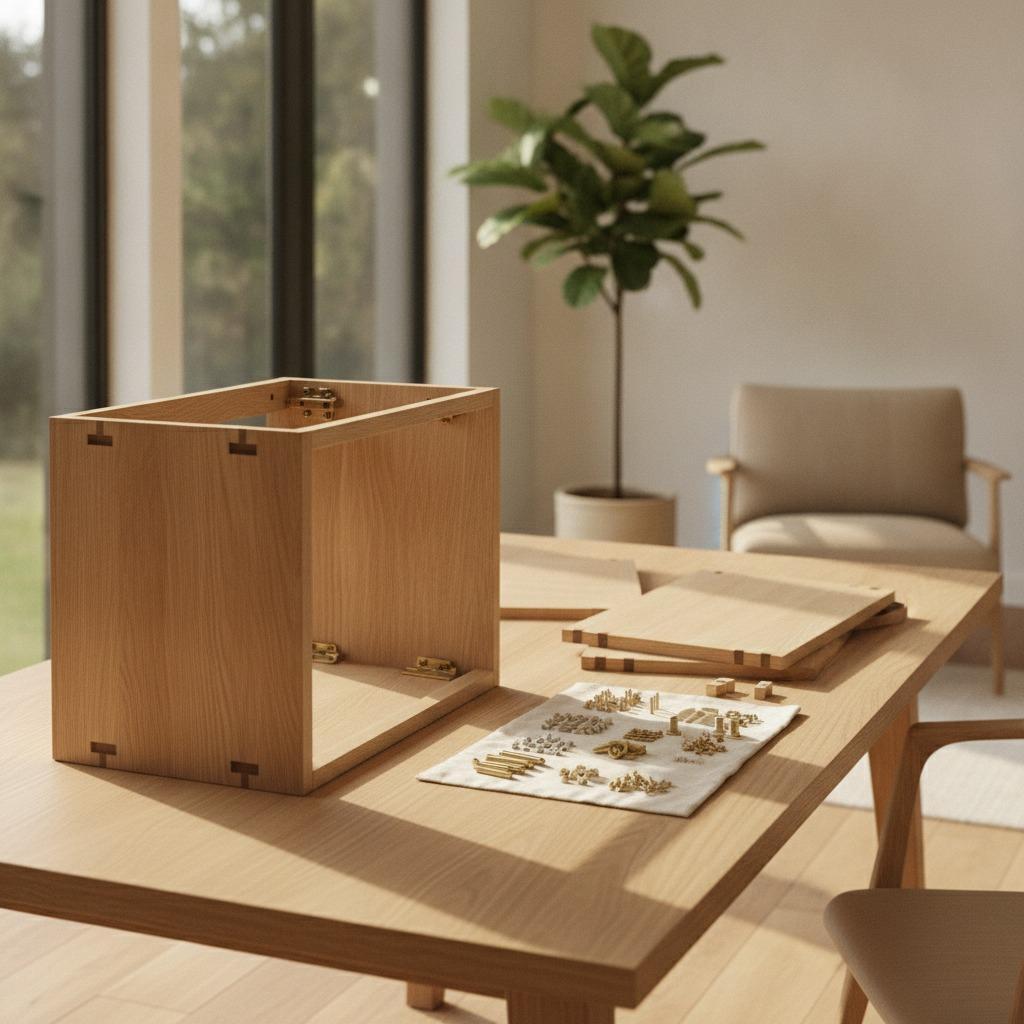
Furniture Hardware Kit Manufacturer: Why Flat-Pack Assembly Depends on More Than Small Parts
Furniture hardware sourcing looks simple from a distance.
A buyer needs screws. A few dowels. Some connectors. Maybe hinges, brackets, caps, and a hardware bag that fits inside the carton. The quote sheet looks neat, and the parts are small enough that they seem easy to manage.
Then production starts.
A connector does not match the pre-drilled hole. A screw bites too hard into the board edge. A dowel feels loose. A hinge screw is slightly wrong for the panel. The hardware bag is complete, but the parts are mixed in a way that slows assembly.
That is when teams realize a furniture hardware kit manufacturer is not only supplying small parts.
It is helping decide whether the product can be assembled smoothly, packed efficiently, and repeated across future orders without constant correction.
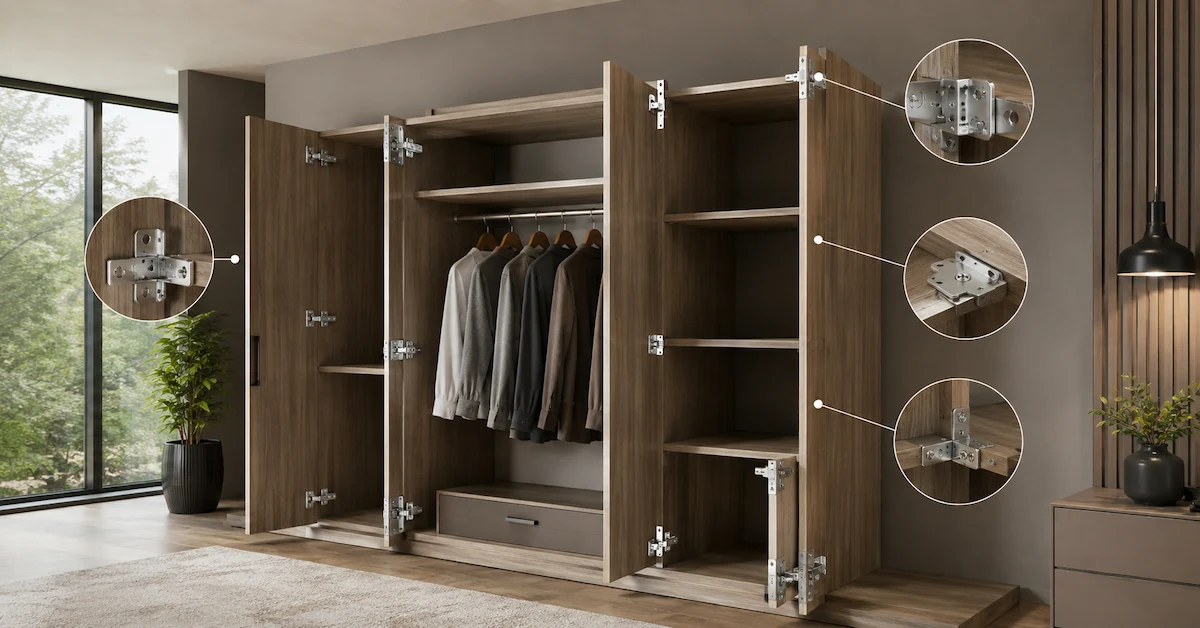
In flat-pack cabinets, wardrobes, shelving units, bookcases, desks, and modular storage furniture, the panel may get most of the attention. But the hardware decides how the panels become a finished product.
A hardware kit has to match the furniture structure
A furniture hardware kit is not just a collection of loose fasteners.
It has to match the board material, hole pattern, panel thickness, load path, and assembly sequence. If the product is designed for flat-pack delivery, the kit also has to be easy for a worker, installer, or end customer to understand.
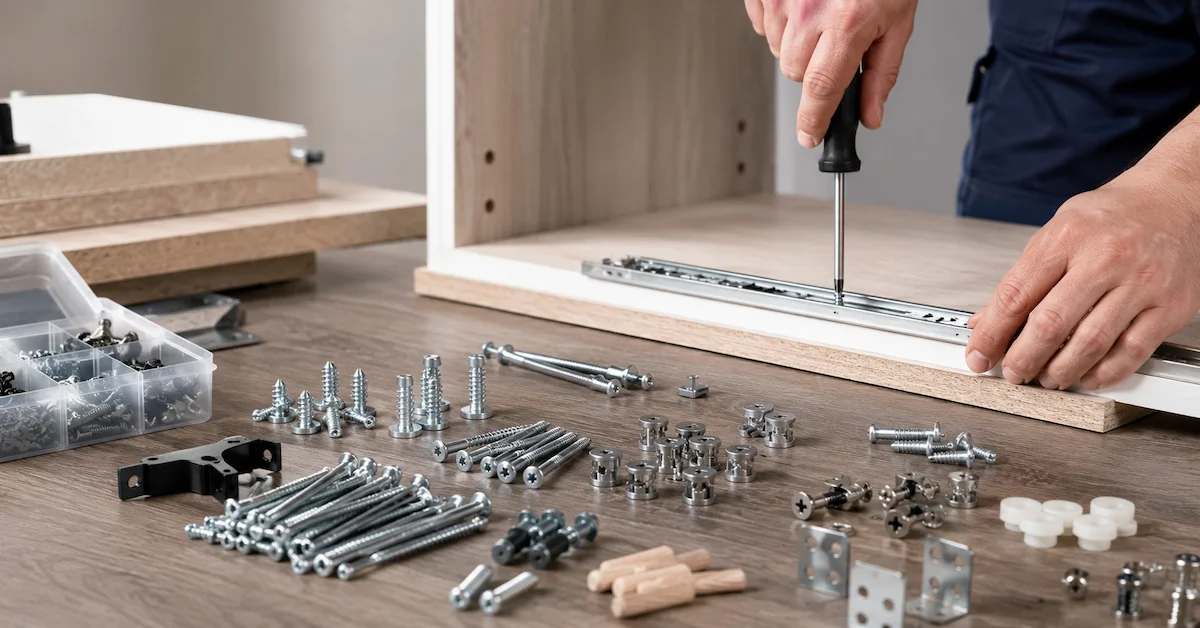
A typical flat-pack furniture kit may include:
- cam fittings
- connector bolts
- screws
- dowels
- hinge screws
- concealed hinges
- angle brackets
- shelf pins
- plastic caps
- plugs
- sleeves
- labels
- replacement parts
Some parts pull panels together. Some help locate the board before tightening. Some provide support. Some improve the finished appearance. Some only seem minor until they are missing.
That is why buyers should not approve a hardware kit by looking at parts alone.
The real question is whether the complete kit works with the furniture.
Why flat-pack furniture makes hardware more important
Flat-pack furniture depends on repeatability.
The panels are cut. The holes are drilled. The hardware is packed. The user follows the assembly sequence. Ideally, the product goes together without extra drilling, guessing, or rework.
This process works well when the hardware and board layout are designed together.
It fails quickly when they are not.
If a cam connector does not engage properly, the joint may remain loose. If the connecting bolt is too short or too long, the panels may not pull together cleanly. If the screw thread does not suit the board material, the hole may strip. If hinge screws do not match the drilling depth, the door may sit poorly.
These problems are not only technical issues.
They become customer complaints.
A buyer may call it a fastener problem. A customer usually calls it a bad cabinet.
Product example: Jinhe Φ6.2×32.8mm invisible connecting bolt
One useful example is Jinhe’s Φ6.2×32.8mm invisible connecting bolt, a furniture connector designed for hardware connection applications.
According to the product information, this connecting bolt is under the Jinhe brand and has the following specifications:
| Item | Specification |
|---|---|
| Product Name | Connecting Bolts |
| Brand Name | Jinhe |
| Size | Φ6.2×32.8mm |
| Length | 32.8mm |
| Diameter of Thread | Φ6.2 |
| Material | Carbon Steel |
| Finish | Zinc / Nickel, customizable |
| Function | Furniture Hardware Connection Accessories |
| Customized Service | Support OEM and ODM |
This type of connector is relevant for flat-pack furniture because many cabinet and storage products need hidden or semi-hidden fastening systems. The connector should help join panels without leaving bulky hardware on the outer surface.
For buyers, the important point is not only the size.
It is how the connector works with the board.
A Φ6.2×32.8mm connecting bolt may be suitable for a specific pre-drilled pattern, but the final fit still depends on panel thickness, hole depth, matching connector parts, tightening method, and the furniture structure.
That is why sample testing matters before bulk orders.
Invisible connecting bolts should be tested with real panels
Invisible connecting bolts are often chosen because buyers want clean furniture surfaces.
That makes sense.
A visible screw head or bulky bracket may not suit a modern bedroom cabinet, home office unit, wardrobe, or modular storage product. Hidden connectors can make the finished furniture look cleaner and more refined.
But hidden hardware can also be less forgiving.
If the drilling depth is wrong, the bolt may not seat correctly. If the matching connector does not engage well, the joint may not pull tight. If the board material is too soft, the connection may feel weak after repeated assembly.
Before approving an invisible connecting bolt, buyers should test:
- actual board material
- board thickness
- hole diameter
- hole depth
- edge distance
- matching connector parts
- tightening tool
- assembly sequence
- final joint stability
- packaging method
A part that looks correct on a table may behave differently inside MDF, particleboard, plywood, laminated board, or veneered panels.
The bench test is where the truth usually appears.
Compatibility with board material comes first
Different furniture panels respond differently to fasteners.
Particleboard can be cost-effective and widely used, but it may need careful screw and connector matching near the edge. MDF machines cleanly, though repeated tightening may create problems if the hardware is not selected well. Plywood often holds better, but its layered structure still affects drilling and tightening feel.
A furniture hardware kit supplier should understand these differences.
For a connecting bolt, the buyer should confirm whether the thread diameter, length, finish, and matching hardware suit the intended board. A carbon steel connector with zinc or nickel finish may work well in many indoor furniture applications, but the final specification should still match the product environment.
A dry bedroom cabinet and a humid utility storage unit do not always need the same finish expectations.
The supplier should not guess.
The buyer should not assume.
A good kit makes assembly easier, not just stronger
Furniture hardware is not only about strength.
It is also about assembly behavior.
A strong connector that is hard to identify, difficult to tighten, or awkward to install may still cause trouble. For flat-pack furniture, this matters even more because the person assembling the product may not be a trained worker.
The hardware kit should answer simple questions before the user asks them:
Which part goes first?
Which screw belongs to this connector?
Which holes are used for the invisible bolt?
Are the parts separated clearly?
Is the hardware bag matched to the instruction sheet?
Are spare or replacement parts easy to identify?
If the kit creates confusion, the product feels poorly designed even when the hardware quality is acceptable.
Good hardware should make the assembly feel obvious.
Packaging is part of the product
Many sourcing teams focus on part price and forget packaging until late in the project.
That is risky.
A flat-pack hardware kit may contain many small parts that look similar. Two screw lengths may differ by only a few millimeters. A small connector sleeve may hide under larger metal parts. A dowel may be mistaken for another insert. If parts are mixed poorly, assembly slows down.
For OEM furniture hardware kits, packaging should support the assembly process.
Useful options may include:
- separated bags by assembly step
- printed labels
- model references
- barcode labels
- compartment trays
- clear blister packaging
- spare-part packs
- inner carton protection
- replacement kit coding
A furniture hardware kit manufacturer should be able to discuss how the kit will be packed, counted, labeled, and repeated.
The packaging does not need to look expensive.
It needs to prevent mistakes.
Standard parts and OEM customization both have a place
Standard parts are useful when they fit the furniture design.
They are easier to reorder, easier to replace, and usually easier to manage across different product lines. A standard connecting bolt or screw may be the right choice when the board thickness, hole pattern, and load requirement are already common.
Customization becomes useful when the design needs something more specific.
For example, buyers may need:
- a different bolt length
- a different thread diameter
- a customized zinc or nickel finish
- special packaging
- private-label hardware kits
- modified connector combinations
- different counts for different furniture models
- OEM or ODM support
Jinhe’s product information notes OEM and ODM support for the Φ6.2×32.8mm connecting bolt, which is important for furniture buyers who need project-specific hardware rather than a one-size-fits-all kit.
Still, customization should solve a real problem.
It should not create extra complexity without improving assembly, packaging, appearance, or repeat supply.
What Jiangmen Jinhe Hardware brings to furniture kit sourcing
Jiangmen Jinhe Hardware Co., Ltd. works with machine screws, self-tapping screws, micro screws, precision screws, standard parts, and non-standard customization. Its material range includes stainless steel, iron, aluminum, and carbon steel products for different hardware applications.
For furniture buyers, that fastener background is relevant because a complete hardware kit often needs several part families at once. A project may involve invisible connecting bolts, screws, dowels, hinge hardware, brackets, caps, labels, and packaging requirements.
The company’s product page also lists carbon steel as the material for the Φ6.2×32.8mm connecting bolt, with zinc or nickel finish options that can be customized. This makes the product suitable for buyers who need a defined furniture connector specification and want to discuss OEM or ODM requirements.
In real sourcing, the value is not only in one connector.
It is in whether the supplier can help keep the complete kit consistent.
Common sourcing mistakes buyers should avoid
One common mistake is treating the hardware kit as a commodity.
A low-cost kit can become expensive if it causes rework, missing-part claims, damaged panels, slow assembly, or customer complaints.
Another mistake is assuming one generic kit can fit every cabinet design. It usually cannot. Board thickness, hole pattern, connector style, hinge position, and assembly method all affect the final result.
A third mistake is approving loose samples without testing the complete furniture assembly. Loose parts show appearance and size. They do not show whether the full kit works with the board.
Buyers also sometimes ignore packaging. In flat-pack furniture, packaging is part of the product experience. If the hardware kit cannot be counted quickly and matched to the instruction sheet, the furniture becomes harder to assemble.
The final mistake is not planning for repeat orders. A sample kit may be perfect. The real test is whether the next shipment matches it.
Practical questions buyers should ask
Before choosing a furniture hardware kit manufacturer, buyers should ask:
What parts are included in the complete kit?
Which parts are standard, and which are customized?
Does the connector match the board thickness?
What hole diameter and depth are required?
Can the invisible connecting bolt be tested in real panels?
What material and finish options are available?
Can zinc or nickel finish be customized?
Does the supplier support OEM or ODM service?
How are small parts separated in packaging?
How is kit completeness checked before shipment?
What inspection documents are available?
Can replacement packs be supplied later?
Can the same specification be repeated in future orders?
Can logistics, warehousing, or export support be included?
These questions help buyers move away from simple price comparison and toward real assembly performance.
 Frequently Asked Questions
What does a furniture hardware kit manufacturer provide?
A furniture hardware kit manufacturer may provide screws, connecting bolts, cam fittings, dowels, hinges, brackets, caps, sleeves, labels, and customized packaging for furniture assembly.
What is an invisible connecting bolt used for?
An invisible connecting bolt is used to join furniture panels while reducing visible hardware on the exterior surface. It is common in cabinets, wardrobes, shelving, and flat-pack furniture.
Why does board material matter?
Board material affects how screws, bolts, inserts, and connectors hold inside the panel. MDF, particleboard, plywood, laminated panels, and veneered boards may require different hardware choices.
Can the Φ6.2×32.8mm connecting bolt be customized?
According to the product information, the Jinhe connecting bolt supports OEM and ODM service, and its zinc or nickel finish can be customized.
Should buyers test hardware before bulk orders?
Yes. Buyers should test the hardware with actual panels, drilled holes, assembly tools, packaging format, and the complete assembly sequence before mass production.
Why is packaging important for furniture hardware kits?
Packaging helps prevent missing parts, mixed fasteners, unclear assembly steps, and customer complaints. For flat-pack furniture, the hardware kit is part of the user experience.
Good hardware keeps furniture production calmer
A good furniture hardware kit does not need to look complicated.
It needs to work.
The connector fits. The bolt tightens. The screw holds. The hinge lines up. The parts are complete. The packaging is clear. The next order matches the approved sample.
That is what buyers should expect from a reliable furniture hardware kit manufacturer.
For furniture hardware kits, invisible connecting bolts, zinc plated furniture connectors, flat pack cabinet hardware, furniture connector kits, OEM furniture hardware, and custom furniture fasteners, Jiangmen Jinhe Hardware Co., Ltd. can discuss material options, standard parts, non-standard customization, OEM/ODM service, inspection, packaging, warehousing, logistics, and repeat supply requirements.
For direct inquiries:
Tel/WeChat: +86 13729150102
WhatsApp: +86 13322893939
Email: sharon@hkhomeideas.com
Start with the panel material, board thickness, hole pattern, connector style, hardware list, packaging method, and expected order quantity.
Once those details are clear, the right furniture hardware kit becomes much easier to source, assemble, and repeat.