
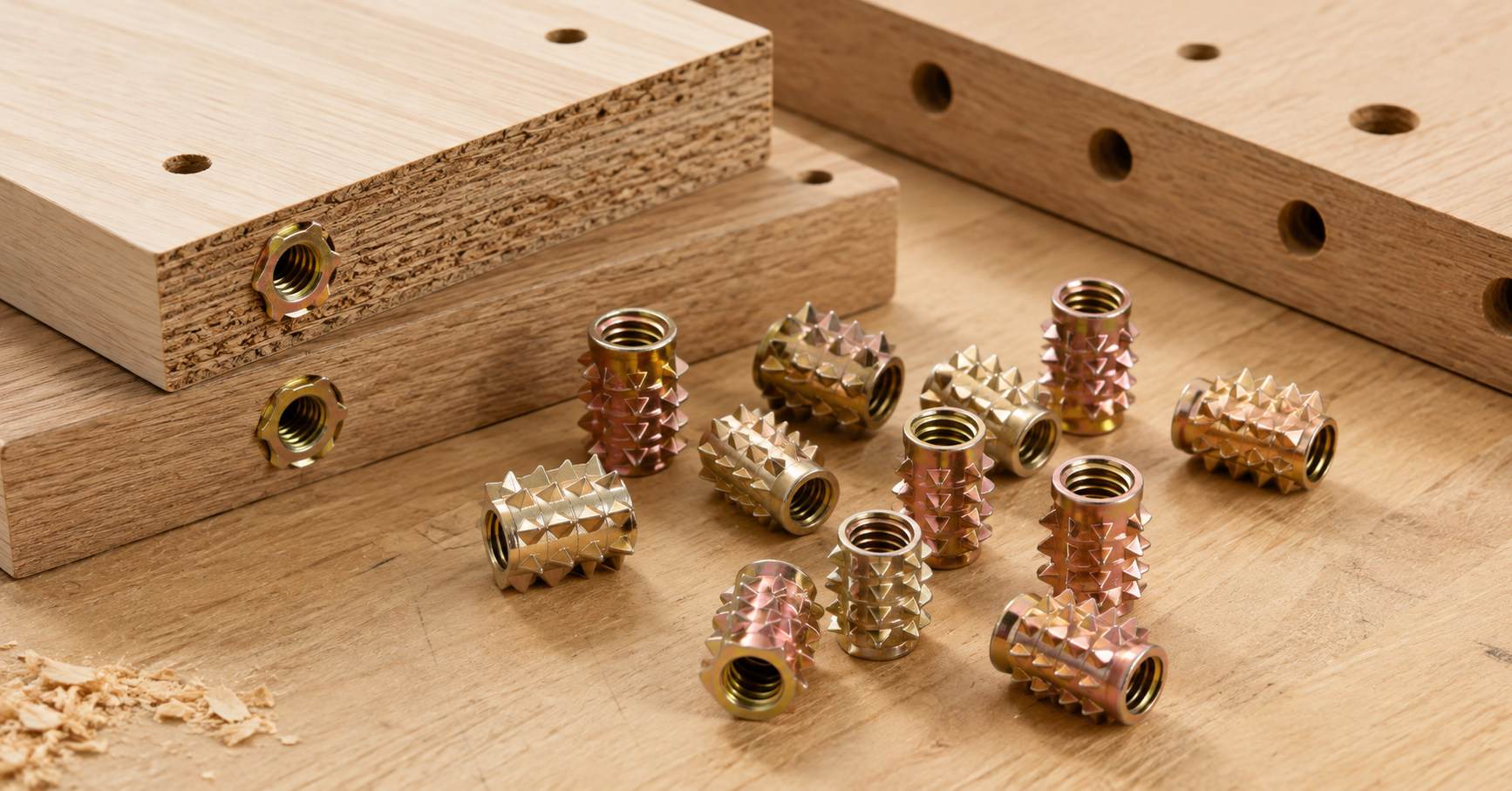

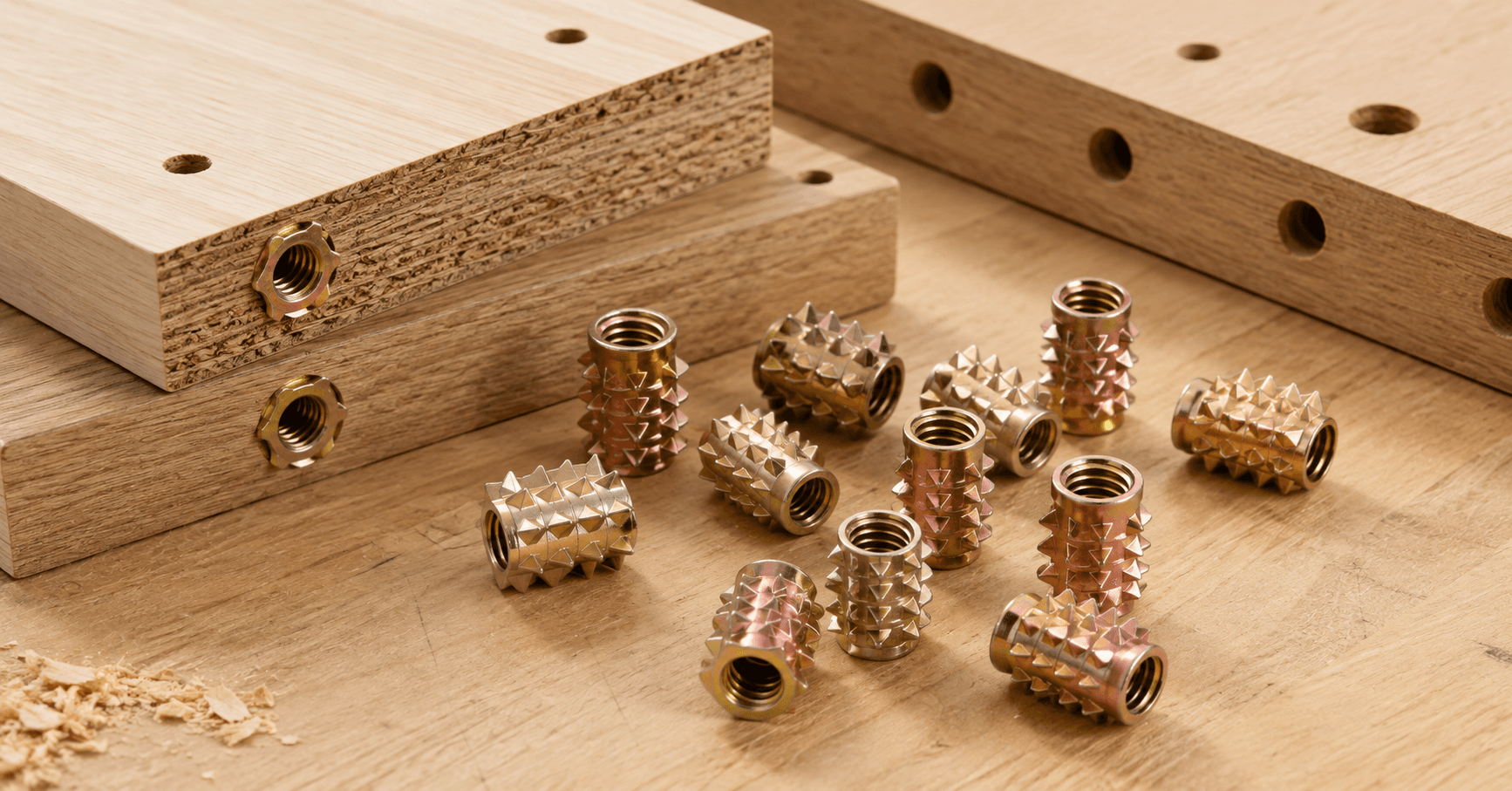
How to Choose Spiked T-Nuts for Construction, Woodworking, and Furniture Assembly
A spiked T-nut is one of those small hardware parts that many people only notice after something goes wrong.
When it works, the bolt threads smoothly into place. The nut bites into the wood. The panel holds firm. The user can assemble a shelf, cabinet, frame, jig, platform, or wooden structure without thinking too much about the fastening point.
When it fails, the problem becomes obvious.
The T-nut spins.
The spikes do not grip.
The bolt does not thread cleanly.
The wood fibers crush.
The joint loosens after use.
The customer starts wondering why such a small part was not chosen more carefully.
That is why consumers, contractors, furniture makers, woodworking shops, and B2B buyers should not choose spiked T-nuts only by price or product image.
A good spiked T-nut must match the wood material, bolt size, installation method, load direction, surface coating, and final application. It should also come from a supplier that understands repeat production, packaging, and quality control.
The JHFix product page describes spiked T-nuts as fasteners with a star-shaped exterior and sharp protrusions that embed into wood, with available nut screw sizes from small M4 to M12 diameters. The page also mentions precision internal threading, corrosion-resistant coating, woodworking, construction, DIY projects, custom cabinets, heavy-duty shelving, and deck reinforcement as application directions.
Product direction from the JHFix page
| Product Point | What the Page Supports |
|---|---|
| Product Type | Spiked T-nuts |
| Size Direction | M4 to M12 mentioned |
| Key Feature | Star-shaped exterior with sharp protrusions for wood grip |
| Thread Feature | Precision internal threading for bolt insertion |
| Surface Direction | Corrosion-resistant coating mentioned |
| Application Direction | Woodworking, construction, DIY, custom cabinets, heavy-duty shelving, deck reinforcement |
| Buyer Type | Builders, creators, industrial professionals, online buyers |
| Contact Shown on Page Footer | +86 13322893939 / sharon@hkhomeideas.com |
This information is useful, but buyers still need to confirm the final drawing, material, coating type, thread pitch, thickness, outer diameter, spike form, and packaging before placing a bulk order.
A product page can help with sourcing direction.
It should not replace technical approval.
What spiked T-nuts are used for
A spiked T-nut is commonly used when a wood or wood-based part needs a threaded connection point.
Instead of driving a screw directly into wood, the T-nut provides a metal internal thread. A bolt can then be inserted from the opposite side. The spikes help the nut grip into the wood surface and resist turning during tightening.
Typical use cases include:
- wooden furniture frames
- cabinet panels
- bed frames
- chair and table structures
- shelving systems
- speaker boxes
- jigs and fixtures
- display stands
- wooden platforms
- construction formwork
- equipment mounting panels
- repair and replacement hardware kits
For consumers, the benefit is simple: a stronger, reusable thread in wood.
For B2B buyers, the benefit is more systematic. The same nut can be used across repeat production if the hole size, panel material, bolt size, and installation process are controlled.
That repeatability is what makes the difference between a loose repair part and a production-ready fastener.
Start with the wood material
A spiked T-nut does not work in empty space. It works by gripping the wood or wood-based panel around it.
That means the first buying question should be about the base material.
Is the part made from solid wood?
Is it plywood?
Is it MDF?
Is it particleboard?
Is it laminated board?
Is it a softwood or hardwood component?
Is the nut installed near the edge?
Will the joint carry load?
Different materials behave differently. Solid wood may hold spikes well, but grain direction matters. Plywood can offer good holding strength in some situations, but layer quality and thickness affect the result. MDF and particleboard can be more sensitive to crushing, splitting, or pull-out if the wrong nut or installation method is used.
A spiked T-nut that works well in one panel may not perform the same way in another.
Consumers should test one piece before installing the full set. B2B buyers should test the nut in the actual production panel, not in a random sample board.
Check the size: M4 to M12 is a range, not a final specification
The product page mentions nut screw sizes from M4 to M12.
That gives buyers a useful size range, but it does not define the exact order.
An M4 T-nut and an M12 T-nut are used for very different loads, bolts, hole sizes, and panel thicknesses. A small furniture accessory may only need a smaller size, while a heavy shelving or construction support application may require a larger one.
Before ordering, confirm:
- thread size
- thread pitch
- bolt compatibility
- hole diameter
- flange diameter
- spike height and shape
- panel thickness
- installation direction
- expected load
- whether the nut is visible after installation
Do not order “M6 T-nuts” without confirming the mating bolt and installation hole.
A close size is not enough. Fasteners need to match.
Why the spiked design matters
The product page highlights sharp protrusions that embed into wood and provide holding power compared with traditional designs.
This is the main reason buyers choose spiked T-nuts.
The spikes help prevent rotation when the bolt is tightened. They also help the nut seat into the wood surface. In many wood assemblies, this makes installation easier and gives the connection a cleaner, more controlled threaded point.
However, spike design must match the material.
If the spikes are too shallow, the nut may spin. If they are too aggressive for a thin or brittle board, the panel may split or deform. If the installation force is uneven, the nut may sit crooked.
A good supplier should be able to discuss the spike form, flange shape, and installation method.
A good buyer should test the nut under real assembly conditions.
Coating and corrosion resistance
The JHFix page mentions a corrosion-resistant coating developed to protect against environmental wear, especially in humid or outdoor settings.
For consumers and construction buyers, this sounds attractive. But coating selection should still be confirmed.
Ask:
What is the coating type?
Is it zinc plated, galvanized, black oxide, nickel, or another finish?
Is the product used indoors or outdoors?
Will it face moisture?
Will it contact treated wood?
Will it be used near salt air or chemicals?
Does the finish need a test report?
Will the coating be scratched during installation?
A coating that is suitable for indoor furniture may not be enough for outdoor decking or humid construction environments.
Do not treat “corrosion resistant” as a complete specification.
It should become a written finish requirement.
Where consumers should use spiked T-nuts
From a consumer point of view, spiked T-nuts are useful when a project needs a threaded point in wood and the connection may need stronger holding than a normal screw in wood.
Possible consumer uses include:
- repairing a chair or table
- assembling a custom cabinet
- mounting legs onto a wooden panel
- building a shelving unit
- installing threaded knobs into a jig
- reinforcing a DIY workbench
- fixing equipment to a wooden base
- adding removable bolts to a wooden frame
The product page also mentions custom cabinets and reinforcing a deck as examples.
For home repair, the best advice is to match the old hardware if possible. If it is a new project, choose the T-nut size according to the bolt and the strength needed. Drill carefully. Seat the nut evenly. Test the bolt before final assembly.
Where B2B buyers should use spiked T-nuts
For B2B buyers, spiked T-nuts can be useful in repeat production:
- furniture manufacturing
- flat-pack hardware kits
- wooden frame production
- construction accessory kits
- shelving systems
- woodworking hardware distribution
- repair hardware assortments
- fixture and jig production
- OEM cabinet and bed frame kits
The sourcing focus is different from a consumer repair job.
A factory buyer needs stable specifications, packaging, inspection, and repeat supply. If a T-nut changes slightly between batches, the panel drilling or bolt fit may no longer work.
That is why B2B buyers should request drawings, samples, batch control, and packaging details.
How to choose a T-nut supplier
A reliable T-nut manufacturer should do more than quote a price.
Buyers should check whether the supplier can support:
| Supplier Checkpoint | Why It Matters |
| Size Range | M4 to M12 or project-specific size options should match buyer demand |
| Drawing Review | Confirms thread, flange, spike, and hole compatibility |
| Material Confirmation | Prevents unclear strength or coating expectations |
| Coating Options | Helps match indoor, humid, or outdoor applications |
| Sample Testing | Verifies grip in real wood or panel material |
| Packaging Control | Prevents mixed sizes and damaged spikes |
| Repeat Supply | Future batches should match approved samples |
| OEM Support | Useful for furniture kits, construction kits, and private label hardware |
A company that only sells loose fasteners may be fine for simple orders. But for production furniture, construction kits, or distributor supply, buyers should choose a supplier that can discuss application, documentation, and repeat-order consistency.
Product advantages to highlight
The product’s main advantages are its functional grip and application versatility.
According to the product page, the spiked T-nut design uses sharp protrusions to embed into wood, precision internal threading for smooth bolt insertion, and coating protection against environmental wear. The page also positions the product for woodworking, construction, DIY, furniture, heavy-duty shelving, and deck-related applications.
For a B2B factory website, these points can be presented as buyer benefits:
- stronger grip in wood than a plain nut
- cleaner threaded point for bolts
- useful for furniture and construction assemblies
- available size direction from M4 to M12
- suitable for custom cabinets, shelving, and wood projects
- coating direction for longer service life
- useful for both repair and OEM hardware kits
The advantage is not only the part shape. It is the ability to make wood assemblies easier to build, repair, and repeat.
Common buying mistakes
One common mistake is buying only by thread size. The T-nut must also match hole size, flange diameter, spike form, and panel thickness.
Another mistake is installing the nut into weak or damaged wood. If the surrounding material cannot hold, the nut will not solve the problem.
A third mistake is ignoring coating. Indoor and outdoor applications should not be treated the same.
Consumers also sometimes hammer the nut in unevenly, causing the spikes to sit crooked. For production use, factories should use a controlled installation method.
B2B buyers sometimes skip sample testing. That is risky. A T-nut should be tested with the real bolt and real panel before bulk orders.
Frequently Asked Questions
What is a spiked T-nut used for?
A spiked T-nut is used to create a threaded fastening point in wood or wood-based panels. It is commonly used in furniture, cabinets, shelving, woodworking, and construction-related assemblies.
What sizes are mentioned on the JHFix page?
The product page mentions nut screw sizes from M4 to M12. Buyers should still confirm the exact size, thread pitch, and drawing before ordering.
Why do spiked T-nuts grip wood well?
The page describes a star-shaped exterior with sharp protrusions that embed into wood, helping the nut resist rotation and improve holding power.
Can spiked T-nuts be used outdoors?
The page mentions corrosion-resistant coating and humid or outdoor settings, but buyers should confirm the exact coating and environmental requirement before outdoor use.
What should buyers ask before ordering?
Buyers should confirm thread size, hole size, panel material, flange diameter, spike design, coating, packaging, sample testing, and repeat-order control.
Final takeaway
A spiked T-nut is small, but it can decide whether a wood assembly feels secure or unreliable.
The thread must match.
The spikes must grip.
The panel must hold.
The coating must suit the environment.
The packaging must protect the parts.
The supplier must repeat the approved specification.
For spiked T-nuts, construction T-nuts, woodworking T-nuts, furniture insert nuts, industrial nut screws, M4 to M12 nut options, and OEM nut hardware, Jiangmen Jinhe Hardware can discuss samples, sizing, coating, packaging, and repeat supply.
For direct inquiries:
Tel/WhatsApp: +86 13322893939
Email: sharon@hkhomeideas.com
Start with the wood material, bolt size, hole diameter, panel thickness, load expectation, coating requirement, and packaging method. Once those details are clear, the right spiked T-nut becomes much easier to choose and repeat.