
Fastener weight per 1000 pieces is the mass of one thousand identical parts, normally quoted in pounds or kilograms, and you calculate it by multiplying one part's volume by its material density and then multiplying by 1,000. Buyers need that number for three decisions: freight cost, piece count verification and carton design. A figure that is 10% wrong is not a rounding error — on a dense hardware shipment it changes the payable weight, and on a counted carton it can hide a short shipment until your assembly line stops.
This guide shows how to calculate screw weight step by step, explains why a calculated figure never matches the scale exactly, and sets out how to turn weight into a contract term you can actually enforce.
What "weight per 1,000 pieces" measures — and what it does not
Fastener weight per 1000 pieces is a nominal mass. It describes a part built to a drawing or a standard, at nominal dimensions, in one material, with one finish. It is not a guarantee for any individual carton, because no production lot is built at exactly nominal dimensions.
Three related numbers get confused in quotations, and they answer different questions:
- Nominal piece weight — calculated from the drawing. Used for freight estimates, carton design and quoting.
- Weighed piece weight — the average of a sample weighed on a calibrated scale. Used to verify the nominal figure and to count by weight.
- Packed weight — the gross weight of a carton, bag or kit including packaging. This is the number the carrier charges you for.
If a supplier quotes only one of these three, you do not yet know what you are buying. Ask which one, and in what unit.
How to calculate fastener weight per 1000 pieces in four steps
The method is simple arithmetic. The difficulty is in the inputs, not the maths.
Step 1: Fix the dimensions to a standard
You cannot calculate weight from a product name. "1/4-20 x 1 inch hex cap screw" is not a specification until you say which standard defines the head, the thread and the length convention. For inch-series fasteners, ASME B18.2.1 defines the head dimensions, width across flats and the length measurement convention for hex cap screws. For metric fasteners, the equivalent dimensional family sits in the ISO 4014 / 4017 series, with ISO 898-1 covering mechanical properties.
Two conventions cause most of the errors:
- Length is measured under the head for hex cap screws and most machine screws — the head is not included in the stated length.
- Length includes the head for flat countersunk screws, because the head sits below the surface.
Get that wrong and every downstream number is wrong by the mass of a head.
Step 2: Split the part into simple volumes
Break the fastener into a shank and a head, and calculate each as a cylinder or a prism. Two practical rules keep the result honest:
- For a threaded length, use the pitch diameter, not the nominal (major) diameter. The thread is not a full cylinder, and using the major diameter overstates mass by roughly 15–25% on a coarse thread.
- For an unthreaded shank, use the nominal diameter. A plain shank really is a cylinder.
For a hexagon, the cross-sectional area from the width across flats s is 0.8660 × s². For a cylinder it is 0.7854 × d². Multiply by length and you have volume.
Step 3: Apply material density
Fastener density is the only place where material grade enters the calculation, and it is the input buyers most often guess. Use the table below and write the value into your RFQ so every supplier calculates on the same basis.
Step 4: Add coating and packing allowances
Coating mass is usually small but not always negligible, and packaging mass is never negligible at container scale. Electroplated zinc at typical thickness adds well under 1% to a small screw. Hot-dip galvanizing is a different case: the coating is thick enough to change thread allowance and can add several percent to mass, which is why hot-dip parts are specified with a coating class rather than a thickness alone. Add the packaging separately — carton, bag, insert and label — and keep it as its own line so you can see what you are paying for.
Online tools will do the arithmetic for you, but a bolt weight calculator is only as good as the diameter, length and density you type into it. Feed it a nominal diameter for a threaded shank and it returns a number that is 15–25% too high, with no warning.
Material density reference
| Material | Density (lb/in³) | Density (g/cm³) | When it matters |
|---|---|---|---|
| Carbon steel | 0.2836 | 7.85 | Default for most screws, bolts and nuts |
| Alloy steel | 0.2836 | 7.85 | Property classes 8.8, 10.9, 12.9 |
| 304 stainless steel | 0.2860 | 7.93 | Corrosion-resistant furniture and outdoor hardware |
| 316 stainless steel | 0.2890 | 8.00 | Chloride and marine exposure |
| Brass | 0.3070 | 8.50 | Insert nuts, decorative fittings |
| Aluminum | 0.0975 | 2.70 | Rivets, lightweight assemblies |
| Zinc (coating) | 0.2580 | 7.14 | Estimating coating mass |
Note that 304 and 316 are not interchangeable in a weight calculation: 316 is about 1% denser, which is small per piece and visible per container.
Worked example: 1/4-20 x 1 in hex cap screw, steel, zinc plated
Take a 1/4-20 UNC hex cap screw, 1 inch long under the head. From ASME B18.2.1 the head is 7/16 inch across flats and 5/32 inch high. The 1/4-20 pitch diameter is 0.2175 inch.
| Step | Calculation | Result |
|---|---|---|
| Threaded shank volume | 0.7854 × 0.2175² × 1.000 | 0.0372 in³ |
| Head volume | (0.8660 × 0.4375²) × 0.15625 | 0.0259 in³ |
| Total volume | 0.0372 + 0.0259 | 0.0631 in³ |
| Mass per piece | 0.0631 × 0.2836 | 0.0179 lb (8.1 g) |
| Mass per 1,000 pieces | 0.0179 × 1,000 | 17.9 lb (8.1 kg) |
So the nominal figure is about 18 lb per 1,000 pieces, which is a screw weight per thousand of roughly 8.1 kg. A supplier's published chart may show a number 10% or more away from this, and that is expected — charts are built from different assumptions about thread form, head style and tolerance. Treat the calculation as a cross-check on a quotation, never as a substitute for weighing a sample. If you want to see how a per-thousand price is built up around that mass, the breakdown in what a cheap screw quote really cuts is the natural next read.
Why your calculated figure will not match the scale
Thread form
Rolled threads and cut threads do not remove the same amount of material. Rolled threads displace metal and leave the major diameter at or slightly above nominal; cut threads remove it. On a coarse thread this alone can move the weighed mass by a few percent against a calculation that assumed a plain cylinder.
Dimensional tolerance
Every dimension on the drawing has a tolerance band, and the mass follows the band. A screw produced at the top of the diameter tolerance and the bottom of the length tolerance is a different weight from one at the opposite corner, even though both conform. This is why weight-counted cartons need an agreed tolerance rather than an absolute number.
Coating mass
Electroplated zinc is thin and light. Zinc flake coatings are heavier per unit area than electroplating. Hot-dip galvanizing is heaviest and also changes the thread fit. If you are comparing a bare-steel chart against a hot-dip quotation, you are comparing two different parts.
Moisture and packaging
Steel hardware in a humid container gains surface moisture and, in the worst case, corrosion product. Packaging adds its own mass. Both show up in the gross weight the carrier charges, and neither belongs in the piece weight. Keep the two columns separate in your own records or you will spend the next three shipments arguing about a number nobody can reproduce.
Where the number decides money
Freight and chargeable weight
Fasteners are dense, and density is what makes freight pricing unforgiving. Ocean LCL is charged on weight or measure, whichever is greater, so a heavy hardware pallet is almost always charged on weight. Air and express freight use volumetric weight, which means a badly packed carton can be charged as if it were larger than it is. Either way, a 10% error in fastener shipping weight on a multi-tonne order is a real cost line, and freight class for fasteners is set by packed density rather than by the part name on the drawing. The interaction between packing density and mode is covered in LCL vs FCL for fasteners.
Piece count verification by weight
Weight counting is the cheapest incoming check you can run, and it catches the failure that dimensional inspection misses: the carton that is 3% short. Piece count verification by weight is straightforward:
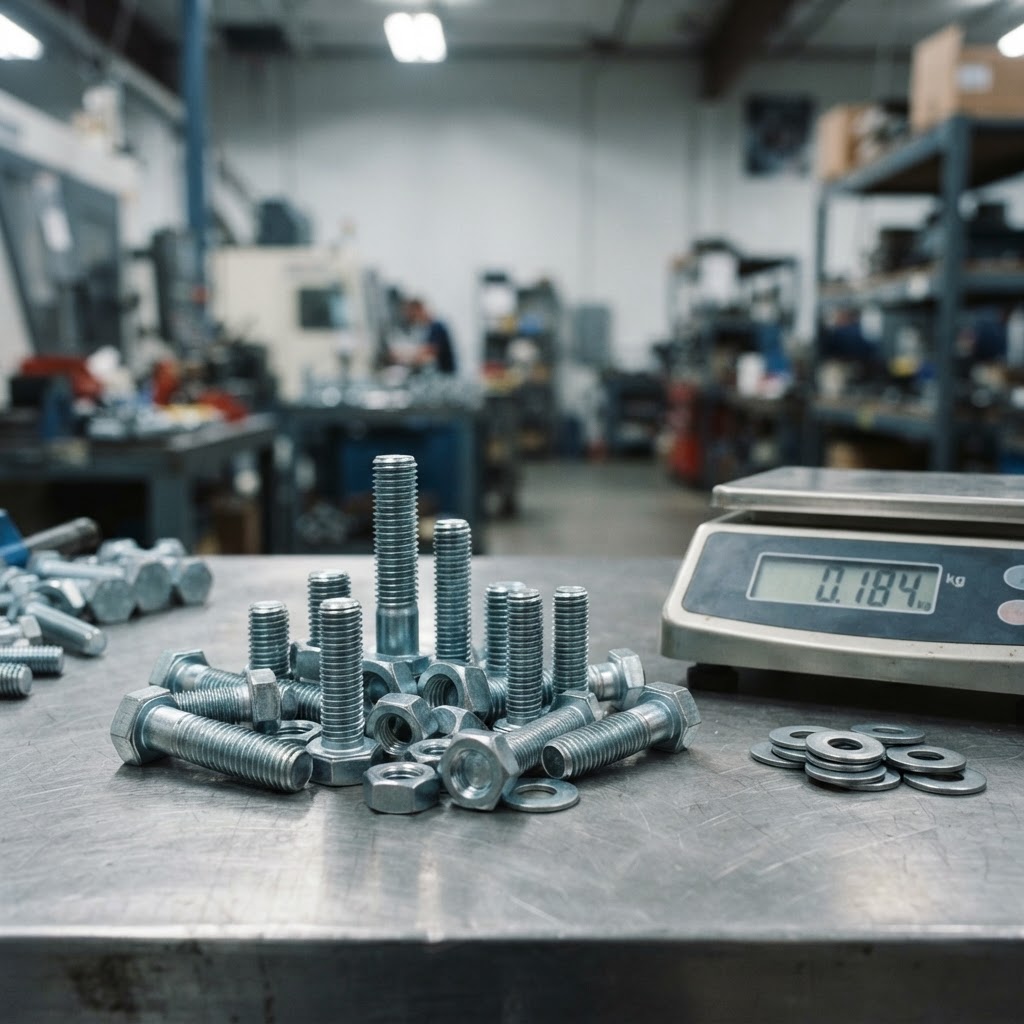
- Weigh 100 pieces on a calibrated scale and record the average piece weight.
- Weigh each carton and divide by the average.
- Compare the result with the declared count and the tolerance you wrote into the purchase order.
- Investigate any carton outside the tolerance before you release the lot.
Weight counting cannot detect a mixed carton — right weight, wrong parts. Pair it with a visual check and, for critical parts, a dimensional sample. The full packaging specification that makes this enforceable is set out in the twelve fields of a working fastener packaging specification.
Carton and kit design
Weight per 1,000 pieces sets the maximum carton quantity your warehouse and your customer can handle. A carton that is technically legal but weighs more than a handler should lift becomes a damage claim and a safety issue. Bulk screw packaging weight also decides whether a pallet stays inside a container payload limit, and for kits the piece weight of every component feeds the kit weight, which feeds the freight, which feeds the landed cost. Get one component weight wrong and the whole kit quotation is wrong. Our product range is organised by packaging format for exactly this reason — counted bags, boxes and contractor cartons are specified, not assumed.
A supplier weight-claim checklist
Before you accept a weight figure in a quotation or a certificate, confirm these seven points:
- Standard and edition — which standard defines the part, and which edition.
- Length convention — under head or including head.
- Material grade — not "steel", but the grade and, where relevant, the property class.
- Finish and coating class — including whether the weight is before or after coating.
- Unit and basis — lb per 1,000 pieces, kg per 1,000, or g per piece.
- Sample basis — calculated, or weighed, and on how many pieces.
- Tolerance — the band within which a carton is accepted.
If a supplier cannot answer these seven questions, the weight figure is decoration. The same discipline applies when you compare custom screw quotes line by line, because a per-thousand price is meaningless without a mass basis.
Common mistakes
- Using the major diameter for a threaded shank. Overstates mass by 15–25% on coarse threads and makes every freight estimate pessimistic.
- Forgetting the head. On a short screw the head can be a third of the total volume.
- Mixing units. lb/in³ and g/cm³ differ by a factor of 27.68. A unit slip produces a number that looks plausible and is wrong by an order of magnitude.
- Quoting gross weight as piece weight. Packaging is not product, and a customer who discovers the difference will question every other number on the quotation.
- Accepting a chart value as a contract value. Charts are guidance. The contract value should be a weighed figure with a stated tolerance.
- Ignoring coating. Small on electroplated parts, material on hot-dip, and it changes thread fit as well as mass.
Frequently asked questions
How do I calculate fastener weight per 1000 pieces?
Multiply one part's volume by its material density to get the piece weight, then multiply by 1,000. Use the pitch diameter for threaded lengths and the nominal diameter for plain shanks, and add the head as a separate volume.
Why does my calculated weight differ from the supplier's chart?
Charts use different assumptions about thread form, head style, tolerance position and coating. A difference of 10% or more between a hand calculation and a published chart is normal. The weighed sample is the number that governs.
What is the density of steel used for fasteners?
About 0.2836 lb/in³, or 7.85 g/cm³, for both carbon and alloy steel. Stainless steel is slightly denser at roughly 7.93 g/cm³ for 304 and 8.00 g/cm³ for 316.
Does plating change the weight of a screw?
Electroplated zinc adds well under 1% at typical thickness. Zinc flake is heavier per unit area, and hot-dip galvanizing can add several percent while also changing the thread allowance.
Can I count pieces by weighing cartons?
Yes, and it is the cheapest incoming check available. Weigh 100 pieces for the average, weigh each carton, and compare with the declared count against a tolerance written into the purchase order. It will not detect a mixed carton.
Is weight per 1,000 pieces the same as gross weight?
No. Piece weight covers the parts only. Gross weight includes packaging, and for freight purposes it is the gross weight that is charged.
Which unit should a purchase order use?
State the unit explicitly — lb per 1,000 pieces, kg per 1,000, or g per piece — and state the tolerance. A number without a unit and a tolerance is not a specification.
Does thread pitch affect weight per 1,000 pieces?
Yes, indirectly. A finer pitch leaves a larger average cross-section than a coarse pitch of the same nominal diameter, so a fine-thread screw of the same size is slightly heavier.
Conclusion
Fastener weight per 1000 pieces is arithmetic wrapped in specification. Fix the standard, split the volume, apply the right density, add coating and packaging as separate lines, and then verify the result on a scale. Do that and the number becomes a contract term you can enforce — on freight, on piece count and on carton design. Skip it and you are negotiating with a figure nobody can reproduce.
If you are building a weight and packaging basis for a new screw, bolt or furniture hardware program, our team can work from your drawing and target count. Send the drawing and the required carton quantity and we will confirm the mass basis, the packaging format and the tolerance before quoting.