
Short answer: A galvanic corrosion chart ranks metals by electrochemical potential so you can predict which one will corrode when two different metals touch in the presence of moisture. Stainless steel sits toward the noble end and aluminum toward the active end, so in a wet aluminum joint the aluminum becomes the anode and gives up metal, usually as white oxide around the screw hole. Changing the screw alone does not fix it: you need a smaller potential gap, a real insulating barrier at the contact, a sealed crevice and a path for water to leave.
This guide is for buyers and engineers who specify stainless screws into aluminum frames, panels, extrusions and castings, and who have to defend the decision on a drawing rather than in a catalog. It covers what a galvanic corrosion chart does and does not tell you, the metal pairs that need isolation, and the fields to add to an RFQ so the supplier quotes the joint you actually designed.
What a galvanic corrosion chart actually measures
A galvanic series lists metals and alloys in order of corrosion potential measured in a specific electrolyte, usually seawater or a chloride solution. The anodic index version of the same data normalizes those potentials against a reference metal so the numbers can be compared. Metals near the noble end (graphite, titanium, passive stainless steel) hold their electrons; metals near the active end (magnesium, zinc, aluminum, cadmium) release them and corrode first.
Galvanic corrosion chart metals are ranked by potential, not by quality. The list tells you which side of the couple will be eaten, not whether your specific joint will fail. Two identical metals cannot form a couple. Two metals far apart on the chart in a dry indoor cabinet may never show a problem, while the same pair on a coastal façade can fail within a season. ASTM G82, the standard guide for developing and using a galvanic series, exists because the ranking has to be tied to an environment and a measurement method before it means anything (ASTM G82).
Why the same pair behaves differently in different places
Galvanic attack needs an electrolyte: a continuous film of water that can carry ions between the two metals. That is why the practical question is rarely "are these two metals compatible" and usually "how long is this joint wet, and with what". Rain that drains is far less damaging than condensation that sits. Chloride raises conductivity and breaks down passive films, which is why coastal, marine, road-salt and food-processing environments punish marginal pairs that perform acceptably inland.
ISO 9223 corrosivity categories (C1 to C5 and CX) are a useful way to state the environment on a drawing instead of arguing about "outdoor". A C3 urban atmosphere and a C5 coastal atmosphere are not the same specification, and the finish and isolation detail should not be the same either.
How to Read a Galvanic Corrosion Chart: Four Steps
Here is how to read galvanic corrosion chart data without over-reading it.
- Locate both metals, not both parts. A zinc-plated screw in an aluminum extrusion is a zinc-to-aluminum couple until the plating is damaged, and a steel-to-aluminum couple after it. Plated, coated and anodized parts behave as the substrate at a scratch, thread flank or cut edge.
- Rank the separation. The further apart the two entries, the stronger the driving force. Practical guidance often uses the potential difference as a coarse screen: keep couples within about 0.25 V for harsh or marine service, about 0.50 V for moderate outdoor exposure, and about 0.75 V for dry indoor service. Those bands are a widely used rule of thumb, not a guarantee; confirm them against the corrosion standard your project is held to.
- Check the area ratio. A small anode against a large cathode is the worst geometry. A thin aluminum sheet fastened by large stainless bolts concentrates the corrosion current into a small anodic area and pits quickly. A large aluminum plate with small screws is more forgiving, though still not immune.
- Add the real conditions. Standing water, trapped moisture in a closed section, salt, acid cleaners, dissimilar contact at a weld and coating damage at the thread all move the joint toward failure. The chart gives the couple; these factors decide the rate.
| Potential separation | Typical reading | Reasonable action |
|---|---|---|
| Under ~0.25 V | Low driving force in most environments | Use the pair as designed; still drain trapped water |
| ~0.25–0.50 V | Noticeable attack in wet or humid service | Isolate or coat the contact, seal the joint |
| ~0.50–0.75 V | Strong couple; aluminum or zinc side suffers | Isolate, seal and drain; inspect on a schedule |
| Above ~0.75 V | Severe; short life when wet | Change one material rather than protect the pair |
Read those bands as screening numbers. The chart entry for "stainless steel" also hides a real spread between a passivated 316 in clean seawater and a 304 that has been scratched, contaminated with free iron, or left with machining residue on the surface.
Fastener-to-base-metal compatibility at a glance
A galvanic corrosion compatibility chart is only useful once it is reduced to the couples on your drawing. A fastener galvanic corrosion chart should also say which side is sacrificial, because the part that fails is rarely the one being inspected.
| Fastener | Base metal | Dry indoor | Wet / outdoor | Note |
|---|---|---|---|---|
| 304 stainless | Aluminum | Acceptable with a barrier | Isolate | Aluminum is the anode; white oxide and seized threads are the first symptoms |
| 316 stainless | Aluminum | Acceptable with a barrier | Isolate | Better in chloride, but molybdenum does not remove the couple |
| Zinc-plated steel | Aluminum | Acceptable | Conditional | Zinc is sacrificial; once consumed, steel becomes the cathode |
| Stainless | Galvanized steel | Acceptable | Isolate or avoid | Zinc coating near a stainless cathode consumes faster in trapped moisture |
| Stainless | Carbon steel | Acceptable | Conditional | Steel rusts first, so the joint looks fine while it thins |
| Stainless | Brass / bronze | Acceptable | Usually acceptable | Small gap; watch dezincification of brass in chloride |
| Stainless | Zinc die casting | Acceptable | Isolate | Common in furniture hardware; the casting is the anode |
| Stainless | Magnesium | Avoid | Avoid | Very large gap; magnesium corrodes rapidly |
On the galvanic corrosion chart aluminum-to-stainless is one of the widest gaps in common hardware, which is why this pair gets so much attention in furniture, enclosure and light structural work.
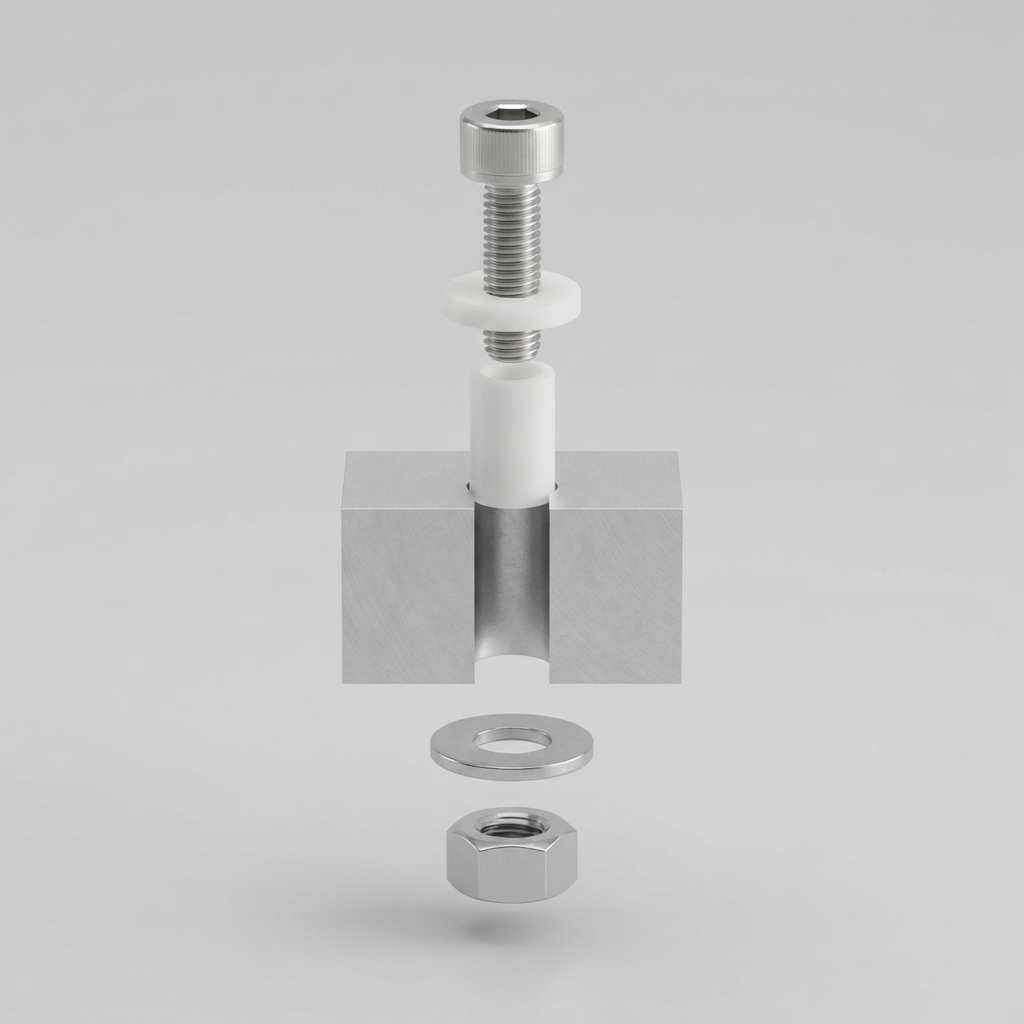
What happens when a stainless screw meets aluminum
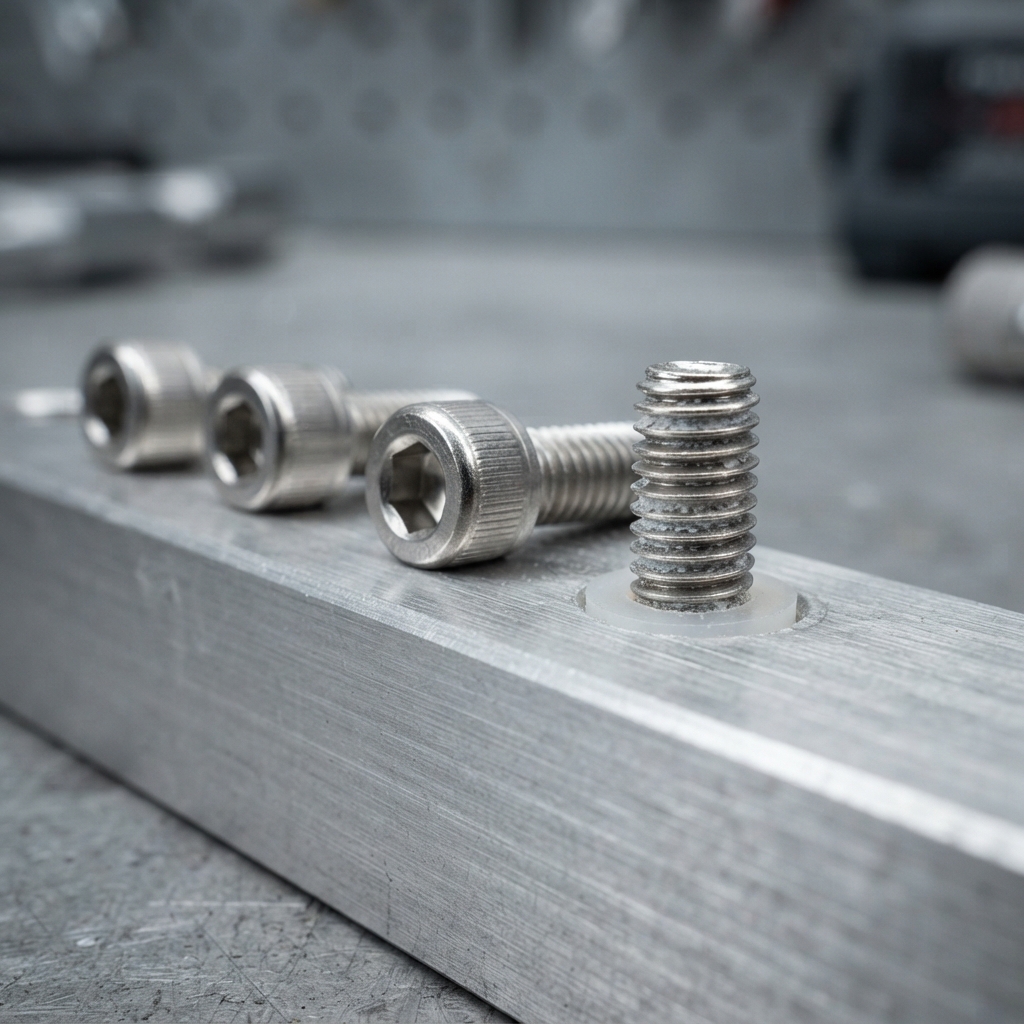
Aluminum alloys sit well toward the active end of the series; passive stainless sits far toward the noble end. Add a film of water in the thread or under the head and the pair becomes a small battery. Aluminum dissolves at the anodic sites, and the corrosion product, an aluminum oxide hydrate, occupies more volume than the metal it came from. In a confined thread that expansion creates pressure, and the screw begins to bind.
The crevice, not the open surface, is the problem
Open aluminum surfaces dry and re-passivate. Thread engagement, the counterbore under a flat head, the overlap between two extrusions and the gap under a washer do not dry. Oxygen is consumed inside the crevice faster than it can be replaced, local chemistry shifts, and attack concentrates where the joint carries load. A joint that looks clean outside can have a thread full of white deposit and a hole that has grown measurably.
304 or 316 does not change the direction
Both grades are cathodic to aluminum, so the aluminum corrodes either way. What changes is how well the stainless survives. Type 316 adds roughly 2–3% molybdenum, which improves resistance to chlorides and pitting in coastal and de-icing-salt exposure; type 304, the 18-8 grade, is the general-purpose option. If the fastener is the visible, inspected side of a coastal joint, 316 is the more defensible choice, and the trade-off is covered in our guide to 304 versus 316 stainless furniture screws.
Anodizing is not a full barrier
Anodized aluminum carries a thick insulating oxide layer on its faces, which is why anodized frames often look trouble-free. Threads cut through that layer, and so do drilled holes, punched slots and field touch-up. The thread flank is bare metal against bare metal, which is where the couple forms.
Galling is a different failure that gets blamed on corrosion
Stainless screws can seize because of galling, a cold weld between surfaces under pressure, with no corrosion involved. If a joint seizes on assembly rather than after months in service, look at thread lubrication, engagement length and installation speed before ordering a corrosion investigation.
Six controls that hold up in service
1. Isolate every contact surface
A nylon, PTFE, fiber or EPDM washer under the head is the standard answer, and it is half a solution if the thread is still bare in the aluminum hole. For a joint that will see weather, specify an isolating sleeve or shoulder washer so the shank is separated from the hole wall, and confirm the washer material's temperature and creep limits for the service temperature.
2. Seal the crevice and let water leave
Sealant or a wet-assembly compound at the thread and under the head reduces electrolyte access. It works best with a design that drains: place the joint where water runs off, avoid upward-facing cups and closed boxes that hold condensation, and never rely on sealant to compensate for a pocket that stays wet for weeks.
3. Choose the coating for the joint, not just the part
A coating protects by keeping electrolyte off the couple and, with zinc or zinc-aluminum flake systems, by sacrificing itself. Coating quality at edges and thread roots matters more than the flat-surface thickness in a report. If corrosion resistance is the acceptance criterion, tie it to a test method, duration and atmosphere, and read the report for the standard used; our guide to reading salt spray test results explains why hours from different setups are not interchangeable.
4. Fix the area ratio before arguing about material
Where you can, increase the anodic area or reduce the cathodic area. A thin aluminum panel held by large stainless bolts is the worst case; a smaller screw, a wider aluminum bearing area or an insulating washer that spreads load all reduce current density at the anode. This is a design change, not a purchasing change, and it usually costs less than upgrading the alloy.
5. Match the grade and finish to the stated environment
Write the environment on the drawing, not in an email. "Interior, heated, C2" and "exterior coastal, C5" should produce different grades, different isolation details and different inspection intervals. If the environment is not stated, the supplier is entitled to quote the cheapest configuration that meets the mechanical dimensions.
6. Plan the inspection, not just the launch
Galvanic damage is progressive and easy to miss early. A first-article check plus a scheduled field inspection at a defined interval, photographing the same locations, turns a vague worry into a trend. Retire the design when the trend shows loss of section, not when a customer complains.
What to put on the drawing and in the RFQ
Most galvanic failures in purchased hardware are documentation failures: the parts were made correctly to a drawing that never described the joint. Add these fields:
- Base metal and alloy of the mating part, with temper or condition where it affects corrosion behavior.
- Service environment as an ISO 9223 category plus any specific exposure: salt spray, cleaning chemicals, condensation, food contact.
- Fastener grade and finish, with the standard the finish is measured against and the minimum thickness at a stated location.
- Isolation components with material, temperature rating and whether a sleeve is required or only a washer.
- Sealant or wet-assembly requirement, if the joint is assembled wet, and who supplies it.
- Thread engagement and hole condition, since a damaged hole breaks the coating and the oxide layer at once.
- Acceptance evidence: which certificate or test report is required per lot, and what a reject looks like.
Conditional wording helps when the requirement is real but the solution belongs to the supplier: for example, "fastener and isolation system to suit aluminum 6061-T6 in C4 exterior exposure; supplier to state grade, coating system and isolation material, with evidence of compatibility". That gives the supplier room to engineer while the performance requirement stays fixed.
Evidence to request before releasing a lot
Three documents do most of the work. A material certificate that identifies the grade actually melted and processed, not just the grade ordered. A coating report that names the method, measurement locations and acceptance values, since one thickness number proves very little. And a specification for the isolation component that states material and temperature rating, because a washer swapped for unidentified plastic is a silent change to the corrosion design.
Where the application is safety-relevant, add a joint-level test: an assembly pulled or torque-tested after environmental exposure, or a corrosion test on the assembled joint rather than on loose fasteners. Fasteners tested alone can pass while the assembly fails, because the failure mode lives at the interface. The wider exposure logic is set out in our article on corrosion-resistant screws and exposure specification.
Common mistakes buyers make
- Treating stainless as corrosion-proof. It is the cathode in most aluminum joints, so the aluminum fails while the screw looks new.
- Isolating the head but not the thread. The thread is the wettest, tightest, least inspectable part of the joint.
- Assuming anodized aluminum is insulated. Cut threads and drilled holes expose bare metal.
- Comparing salt spray hours across coating systems. Different methods, durations and criteria do not convert into each other.
- Choosing the cheapest washer. Unidentified plastic with unknown temperature limits is a design change, not a saving.
- Ignoring the area ratio. A large stainless bolt in thin aluminum sheet concentrates attack in the worst place.
- Leaving the environment off the drawing. The supplier then optimizes for price against an unstated requirement.
Stainless fastener assortments from our production
Our stainless and custom fastener programs are built to a confirmed bill of materials rather than to a photograph. For example, the metric socket screw, nut and washer assortment kit is supplied as a 304 stainless steel configuration with socket head screws, hex nuts, flat washers, lock washers and hex keys in a divided organizer case; component mix, dimensions, material confirmation and compartment layout are agreed against an approved drawing or sample before production, at a minimum order quantity of 10,000 pieces per confirmed specification. Packaging can be reviewed as bulk, counted bags, retail bags, blister packs, compartment cases or private-label cartons once part identity, protection and label artwork are approved.
If your joint pairs stainless fasteners with aluminum, the useful starting point is the drawing, not the catalog: base metal, exposure category and whether isolation is required. Our team reviews those details with custom screw and hardware inquiries through the contact page.
FAQ
Can I use stainless steel screws in aluminum?
Yes, with conditions. They work mechanically, but the pair forms a galvanic couple whenever moisture bridges it, and the aluminum corrodes. Isolate the contact, seal the crevice and keep water from standing in the joint; dry indoor service carries much less risk than outdoors or near salt.
Will stainless steel screws corrode aluminum?
They can accelerate it. Because stainless is cathodic to aluminum, the aluminum becomes the anode and loses metal at scratches, thread flanks and crevices. The stainless usually stays intact, which is why the damage is found late.
Is 316 stainless safe against aluminum?
316 resists chloride better than 304, so the fastener survives longer, but the galvanic direction does not change: aluminum is still the anode. Treat 316 as a better cathode, not as an electrically neutral part.
Do nylon washers solve galvanic corrosion?
They help by breaking the contact under the head, but a washer alone leaves the thread bare. For wet or coastal joints, specify a sleeve or shoulder washer so the shank and hole wall are separated too, and confirm the material suits the service temperature.
Does anodizing prevent the problem?
Only where the oxide layer stays intact. Threads, drilled holes, cut edges and assembly damage expose bare aluminum, which is where the couple forms.
Are galvanized screws better than stainless in aluminum?
Sometimes, in moderate exposure, because zinc is sacrificial and closer to aluminum on the series than stainless is. The advantage disappears when the coating is damaged, the joint stays wet, or the zinc is consumed; in chloride service an isolated stainless fastener is often more predictable.
How do I verify a supplier's corrosion claim?
Ask for the standard, the test duration, the acceptance criterion and the report for the specific lot. Then confirm the report matches the finish supplied, and that any isolation component has its own material specification. A claim without a method cannot be compared with another supplier's claim.
Conclusion
A galvanic corrosion chart is a screening tool: it tells you which metal will be sacrificed and roughly how hard the couple will push. In stainless-to-aluminum joints the answer is consistent, the aluminum is the anode, and no grade of stainless changes that. What changes the outcome is the detail: an insulating barrier that covers the thread as well as the head, a sealed and draining crevice, a stated environment on the drawing, and lot-level evidence that the parts match it.
If you are specifying stainless fasteners into aluminum components and want the joint reviewed against your drawing, send the base metal, exposure category and isolation requirement to our team through the contact page and we will confirm what the current production configuration can support.