
A salt spray test is a comparative laboratory test, not a service-life forecast. The hours printed on a report describe how long one sample resisted one defined corrosion criterion under one fixed set of chamber conditions — nothing more. A claim like "480 hours salt spray" only becomes evidence when you know which standard was used, whether white rust or red rust was being judged, what acceptance criterion applied, and whether the parts tested were production parts from your lot.
That is why two quotations can both say "48 hours" and describe completely different coatings. This guide explains how to interpret salt spray test results, what to demand in the report, and where salt spray test hours stop being useful.
What a salt spray test actually measures
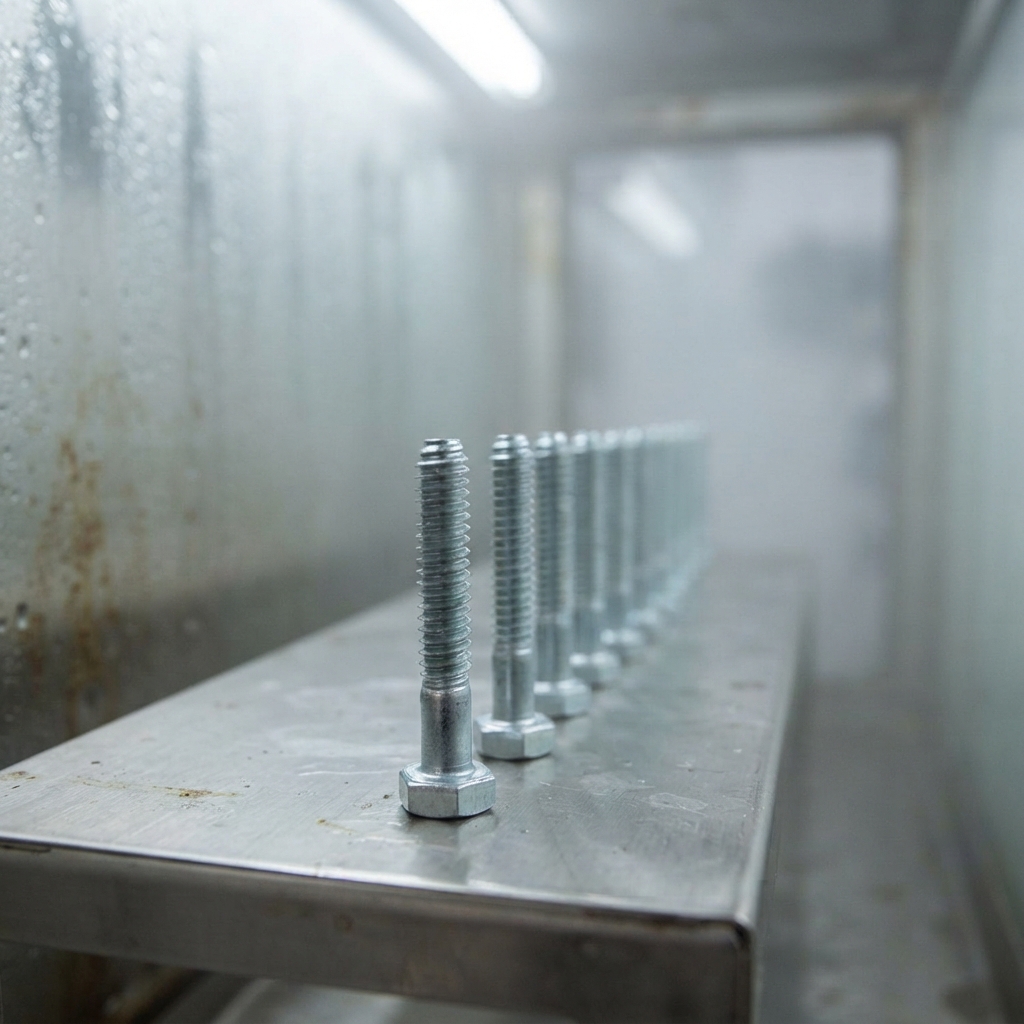
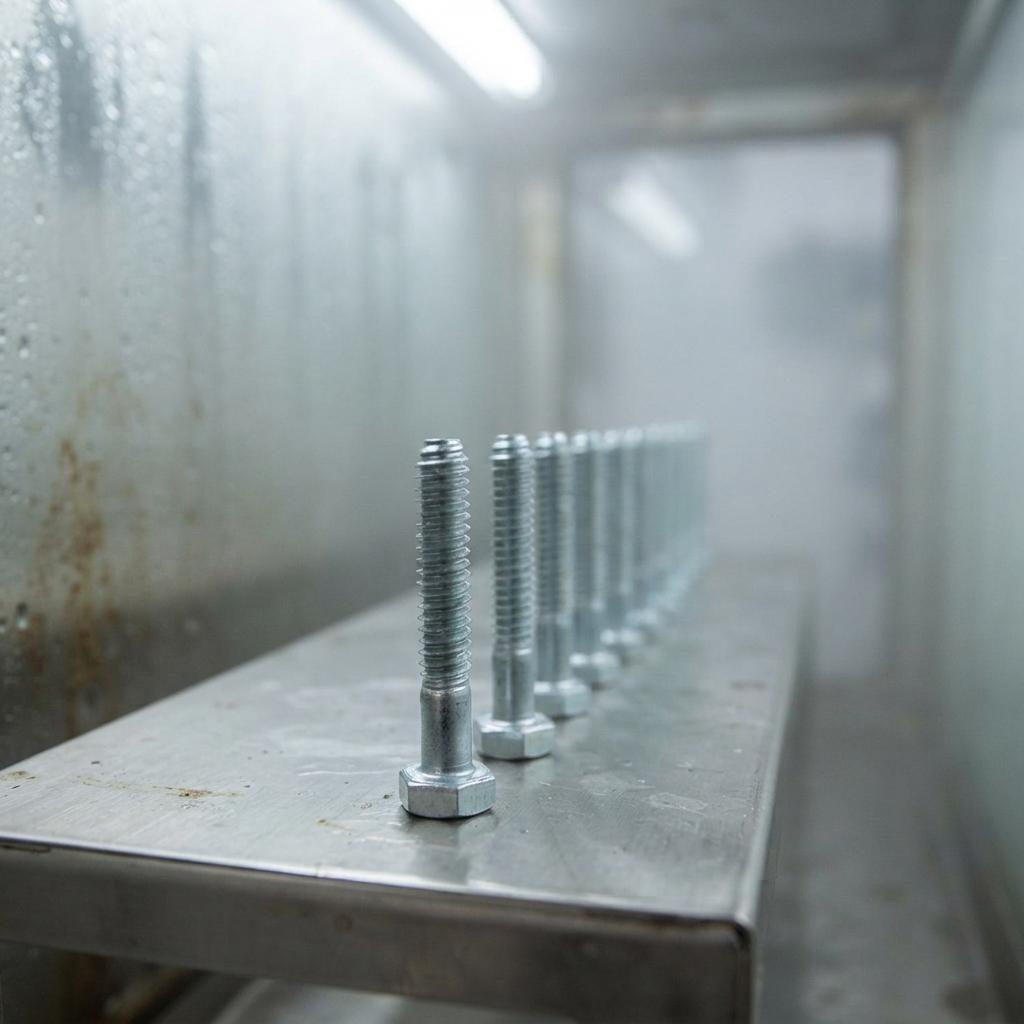
The common fastener test is neutral salt spray (NSS). Both the ISO 9227 salt spray test and the ASTM B117 salt spray test immerse samples in a continuous fine salt fog at elevated temperature, then ask one question: how long until visible corrosion appears, and how much of the surface is affected. Because the chamber conditions are tightly defined, results from different laboratories can be compared — provided the duration and the pass/fail rule are the same.
| Test parameter | Neutral salt spray condition |
|---|---|
| Salt solution | 50 g/L ± 5 g/L sodium chloride in water |
| pH of the collected solution | 6.5 to 7.2 |
| Chamber temperature | 35 °C ± 2 °C |
| Fog | Continuous; specimens are positioned so the spray does not impinge on them directly |
| Duration | Not fixed by the method. It is agreed between buyer and supplier, or set by the product specification |
| Evaluation | Defined separately: which corrosion product counts, how much area is allowed, which rating scale is used |
ISO 9227:2022 defines the apparatus, reagents and procedure for NSS as well as the acetic acid (AASS) and copper-accelerated acetic acid (CASS) variants. ASTM B117 is a practice covering the apparatus, procedure and conditions needed to create and maintain the salt fog environment — it deliberately does not set a duration or an acceptance criterion. Those two decisions belong to the buyer's specification. For the standards themselves, see ISO 9227:2022 and ASTM B117.
This is the first place buyers get misled. A report headed "ASTM B117" tells you the chamber was run correctly. It tells you nothing about what the supplier promised, because the standard never said.
Why two suppliers can both quote "48 hours"
Six variables move the number far more than coating quality does. Unless all six are fixed in writing, comparing salt spray test hours is comparing nothing.
| Variable | How it changes the result |
|---|---|
| Rust type judged | Stopping the clock at the first white rust on a zinc coating is a much easier target than waiting for red rust from the steel underneath |
| Acceptance criterion | "No red rust on any sample" and "no more than 5% of the surface affected" give different answers on the same parts |
| Specimen | A flat polished coupon coated in the same bath usually outperforms a real screw with thread crests, edges and recesses |
| Coating thickness | Within one coating family, more thickness generally buys more hours; the hour figure is meaningless without the thickness class |
| Orientation and runoff | Parts that shed the film or trap it in a recess corrode at different rates in the same chamber |
| Test start and stop rule | Some reports start at fog-on and stop at the first inspection interval; others quote the last interval that passed |
A supplier quoting "48 hours" with no thickness, no rust type and no specimen description has given you a marketing figure. A supplier quoting "NSS to ISO 9227, 96 h, production screws, zinc plating class as drawing, no red rust, evaluated at 24 h intervals" has given you a testable commitment.
White rust and red rust are not the same failure
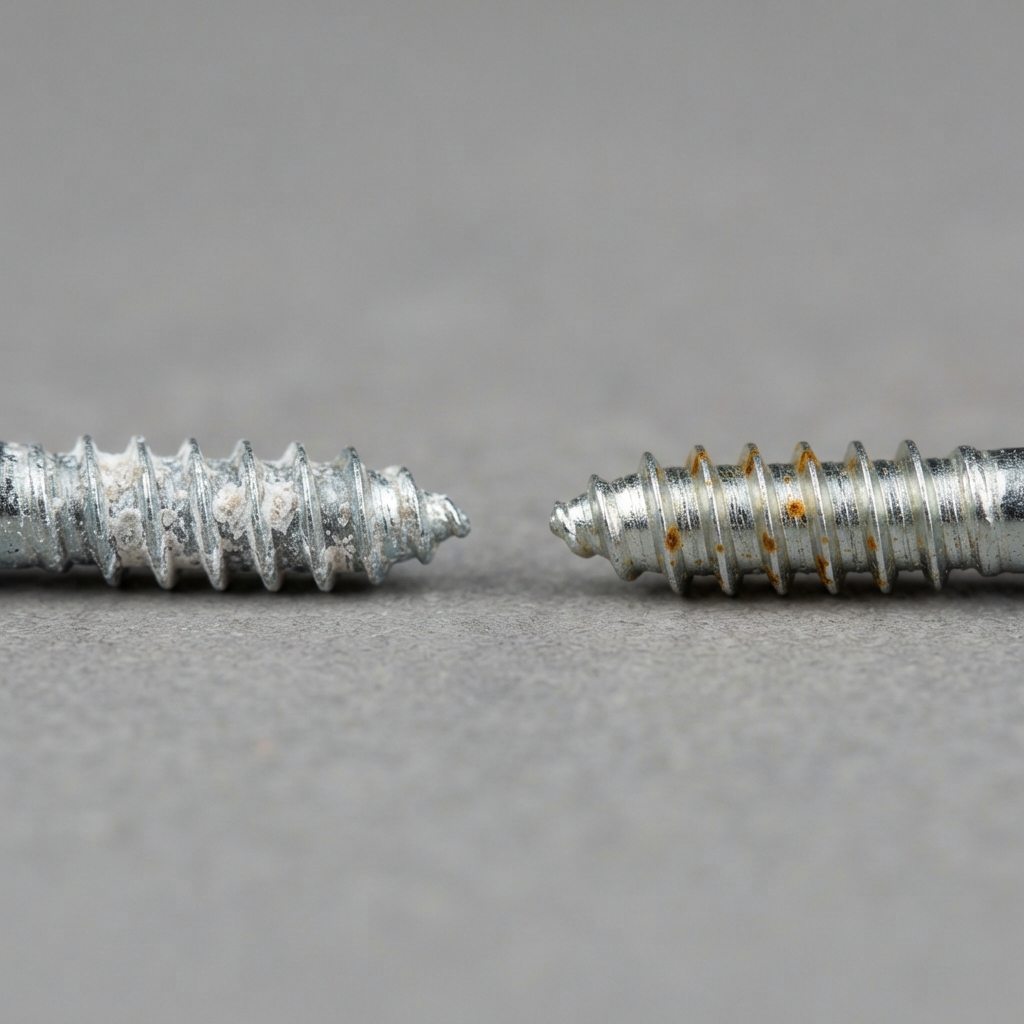
The white rust vs red rust distinction is the single most common source of confusion in a salt spray test for zinc plating. On zinc-coated steel the coating protects the steel sacrificially: the zinc corrodes first, and its corrosion product is a white or grey deposit. Red rust appears only when the coating has been breached locally and the steel substrate is attacking. Buyers routinely compare a white-rust claim from one supplier with a red-rust claim from another and conclude that one coating is twice as good, when the two numbers never measured the same event.
| White rust | Red rust | |
|---|---|---|
| What is corroding | The zinc or zinc-alloy coating | The steel substrate |
| What it means | Coating is being consumed; the part is still protected | Local protection has failed; section loss and seizing follow |
| Typical claim | "No white rust for X hours" | "No red rust for X hours" |
| Buyer use | Screening and cosmetic control, especially for stored or shipped parts | The more meaningful acceptance criterion for structural or outdoor joints |
Practical rule: specify both. "No white rust at 24 h, no red rust at 96 h" is a stricter and more informative requirement than a single headline number, and it removes the ambiguity that lets two suppliers quote the same hours for different promises.
How to read a salt spray test report: ten fields to check
A salt spray test for fasteners is only as good as its traceability. Ten fields carry almost all of the evidential value; if any of the first six are missing, treat the result as indicative rather than a release document.
| # | Field | What good looks like | Red flag |
|---|---|---|---|
| 1 | Laboratory and accreditation | Named lab, with its accreditation scope covering salt spray | No lab name, or a lab with no corrosion scope |
| 2 | Standard and edition | "ISO 9227:2022 NSS" or "ASTM B117-19", stated explicitly | "Salt spray test" with no standard |
| 3 | Sample identity | Part number, drawing revision, lot or batch code that matches your shipment | A generic "zinc plated screw" description |
| 4 | Coating specification and thickness | Coating type and measured thickness in µm, with the measurement method | Hours quoted with no thickness anywhere |
| 5 | Duration and inspection intervals | Total hours plus the intervals at which samples were examined | A single end-point with no interim checks |
| 6 | Evaluation criterion and result | Rust type, area affected and the rating scale used, per sample | "Pass" with no criterion stated |
| 7 | Sample quantity | More than one part, with the number stated | One sample presented as a lot result |
| 8 | Specimen preparation | Degreased, not abraded; edges and threads left as produced | Polished or cut coupons standing in for screws |
| 9 | Photographs | Dated images of the actual samples at each interval | Stock photos or no images |
| 10 | Dates and signature | Test start and end dates, operator and approver identified | No dates, or an end date before the duration allows |
Field 10 deserves a separate look, because it is arithmetic. A 480-hour continuous test cannot finish in less than 20 days of chamber time. If a certificate shows a 480-hour result with a start and end date eight days apart, the document did not come from that chamber.
Seven signs the hours are not evidence
- No standard or edition. Without a method there is no basis for comparison, and no way to audit the lab.
- No rust type. "500 hours" that does not say white or red cannot be compared with any other claim.
- Coupons instead of production parts. Thread crests, recesses and cut edges are where coatings fail first; a flat panel hides exactly the failure you care about.
- No coating thickness. Hours without thickness cannot be reproduced, so the next lot cannot be held to the same number.
- Single sample. One part proves one part. Corrosion is a distribution, and the interesting question is the tail.
- Pass with no criterion. "Passed salt spray" without a stated acceptance rule is an opinion, not a result.
- Hours that predate the order. A report dated before your production lot was made describes someone else's parts.
Salt spray test vs real life: what the chamber leaves out
The chamber holds one condition: constant 35 °C, constant salt concentration, constant wetting. Real service does none of that. It adds ultraviolet light, wet and dry cycles, temperature swings, mechanical load, abrasion in the joint, contact with other metals, and a chloride concentration that is usually far lower than the test — or, at a coastal site or on a winter road, locally much higher.
Because of that gap, salt spray test hours are best used for three jobs: qualifying a coating system against a written specification, comparing two suppliers who tested the same part to the same rule, and monitoring batch-to-batch consistency. They are a poor tool for promising that a screw will last a stated number of years outdoors. Any supplier who converts salt spray test hours into a service life in years is extrapolating beyond what the method supports — and the conversion is not linear.
Match the test to the exposure, not to a competitor's datasheet
The right requirement follows the environment the fastener actually sees. Start from the end customer's specification where one exists; where it does not, use the failure mode to choose what to test and what to inspect.
| Service environment | Dominant attack | What the requirement should address |
|---|---|---|
| Dry indoor assembly, furniture, electronics | Handling and storage humidity, not service corrosion | Coating presence and cosmetic consistency; short screening test; packaging protection |
| Humid indoor, unheated buildings, shipping containers | Condensation and white rust in transit | White-rust criterion at a short duration, plus desiccant or barrier packaging |
| Outdoor sheltered, non-coastal | Cyclic wetting and drying | Red-rust criterion, coating thickness class, and a cyclic or mixed test if the spec allows |
| Coastal or de-icing salt exposure | High chloride load, galvanic contact | Higher-thickness or zinc-flake / stainless systems, red-rust criterion, isolation from dissimilar metals |
| Food, washdown or chemical cleaning | Detergent and sanitizer attack, not just chloride | Grade selection first; salt spray is secondary to the chemical compatibility question |
Two cautions. A longer test is not automatically a better test: an inappropriate coating run for 1,000 hours still fails in the field. And on stainless fasteners the useful questions are grade and passivation state, not salt spray hours — austenitic stainless can show staining in the chamber without losing function, and a low hour figure is sometimes quoted to make a competitor's zinc coating look stronger.
How to put the requirement into an RFQ and a purchase order
Vague requirements produce vague certificates. A corrosion clause needs five elements: method, duration, specimen, criterion and evidence. An example, to be adapted to your drawing and your customer's specification:
Corrosion resistance: Neutral salt spray to ISO 9227 (current edition). Test on production parts from the supplied lot, coating thickness as specified on the drawing. Duration 96 h, samples examined at 24 h intervals. Acceptance: no red rust on any sample; white rust limited to thread roots and recesses. Report to state part number, lot code, coating thickness measurements, method, duration, inspection intervals, result per sample and photographs.
Two practical additions. Ask for the report to be issued against the lot code that appears on the carton label, so the document and the goods can be matched at receiving. And state the consequence — sorting, replacement or credit — before the order is placed, not after the claim. The documentation set that supports this is the same one that proves material and dimensional conformity, covered in our guide to screw manufacturer certification documents.
What this means for the fasteners we supply
We do not publish a single salt spray hour figure for a product family, because the number depends on the coating system, the thickness and the acceptance criterion agreed for that order. What we do is fix those three things before quoting, against the drawing or the approved sample.
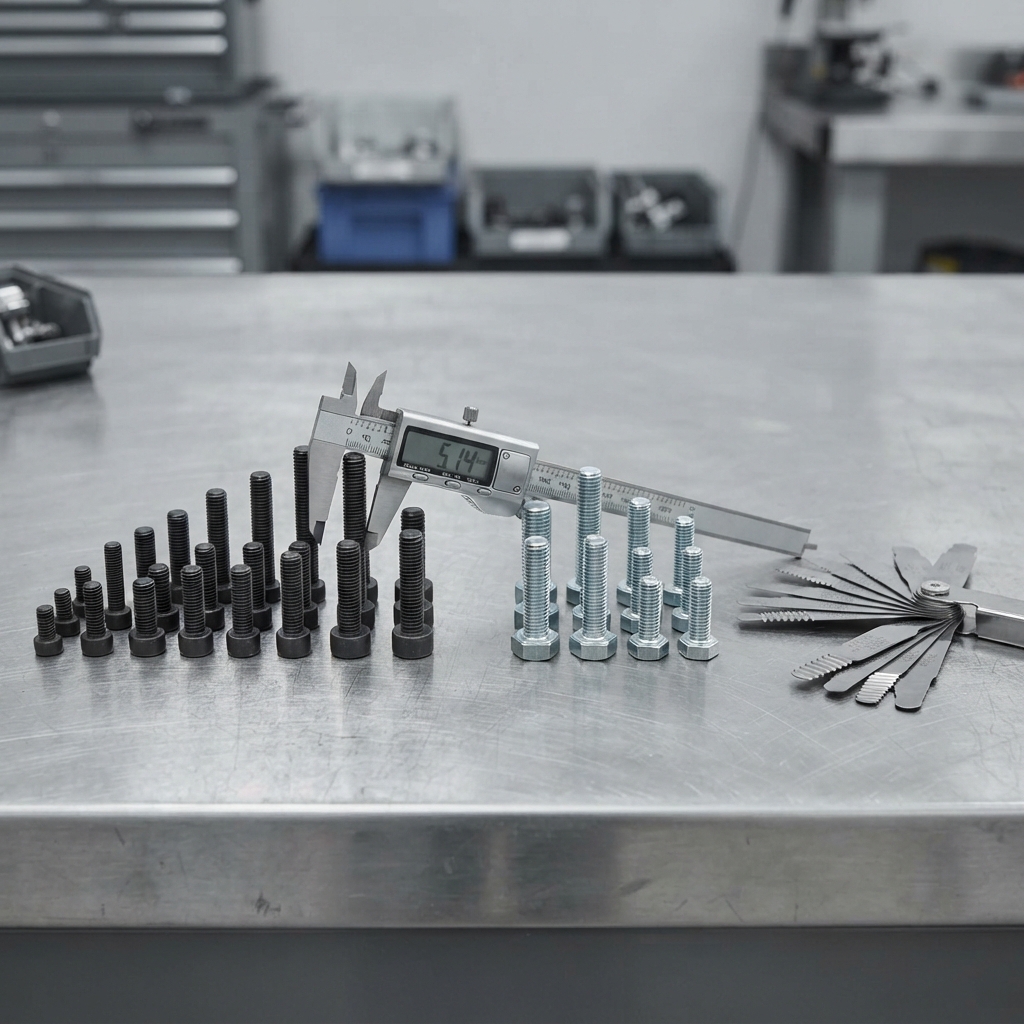
Two examples from the range. The silver cross-drive countersunk self-tapping screw is shown in an M3.5 × 25 mm configuration with a countersunk head, cross recess, coarse full-length thread and sharp point. Finish is not fixed by the photograph: zinc plating, Ruspert coating, spray painting, electrophoretic coating, blackening, gold, silver and copper plating can be reviewed against the confirmed material, service environment and acceptance requirements. Confirmed specifications carry a minimum order quantity of 10,000 pieces, and thread sizes from M1 to M12 with lengths from 3 mm to 200 mm can be reviewed where they suit the subtype and mating part.
The black hex-socket low-profile wide-head machine screw is available in M6 and M8 with lengths from 12 mm to 150 mm, with a low wide bearing head and a blunt end. Its appearance in the photographs is black, and the finish specification for an order is confirmed at review rather than assumed from the image.
Both are made-to-drawing or made-to-sample items. If you are writing a corrosion clause and want to know what a given finish can realistically be held to on your part geometry, send the drawing and the service environment through our contact page and we will review the finish options against it. For the coating-behaviour background behind those choices, see how anti-rust protection works and why it fails.
Common mistakes buyers make
- Comparing hours across standards. AASS and CASS results are not interchangeable with NSS, and neither is a cyclic test.
- Using the number as a price lever. Doubling the hour target without changing thickness, coating system or criterion usually buys a longer test, not a better part.
- Skipping the thickness measurement. Without it, a "better" result cannot be reproduced on the next order.
- Testing the wrong surface. Approving a coupon and receiving screws means the approval never covered the geometry that fails.
- Ignoring hydrogen embrittlement. Higher-strength plated parts carry a baking requirement that a salt spray report says nothing about; see hydrogen embrittlement in fasteners.
- Forgetting the sampling plan. A corrosion result means little without an agreed sampling and inspection level; our guide to AQL sampling for fasteners covers how to set one.
- Treating one report as a permanent approval. Coating baths drift. The report qualifies a lot, and batch-level coating checks are what keep it true.
FAQ
What does "480 hours salt spray" actually mean?
It means the samples were exposed to a continuous salt fog for 480 hours under a named standard, and at the end of that period they still met whatever acceptance criterion the specification set. It does not mean the part will resist corrosion for 480 hours, 480 days or any period in service.
Is ASTM B117 the same as ISO 9227?
No. ASTM B117 is a practice for operating the salt fog apparatus: apparatus, procedure and conditions. ISO 9227 defines NSS, AASS and CASS test methods and includes evaluation guidance. The NSS chamber conditions are very similar, but the documents are not interchangeable, and duration and acceptance criteria must be agreed separately in both cases.
Does a higher hour figure mean a better screw?
Only when the coating system, thickness, specimen and criterion are identical. A 240-hour result on production parts judged to red rust is a stronger claim than a 480-hour result on polished coupons judged to white rust.
Should stainless steel screws be salt spray tested?
Usually not as the primary criterion. Grade and passivation state determine stainless performance, and austenitic grades can stain in the chamber without losing function. Salt spray is more useful for comparing coating systems on carbon steel fasteners.
Why do zinc plated screws show white rust in the carton?
Because condensation formed during transit or storage and the zinc coating began to corrode. It is a packaging and drying problem as much as a coating problem, which is why barrier packaging and desiccant belong in the specification alongside the plating requirement.
How long does a 480-hour salt spray test take?
At least 20 days of continuous chamber time, plus preparation, inspection and reporting. Any certificate claiming that duration with a shorter calendar span between start and end dates should be questioned.
Can salt spray hours be converted into years of service life?
No reliable conversion exists. The chamber omits ultraviolet light, wet-dry cycling, mechanical stress and the real pollutant mix, and the relationship between hours and field life is not linear. Use the result to compare and to qualify, not to forecast.
What should I ask for in the report?
The standard and edition, the lab and its accreditation, the part number and lot code, coating type and measured thickness, duration with inspection intervals, the evaluation criterion and per-sample result, sample quantity, photographs, and the test dates with the approver's name.
Conclusion
A salt spray test is a useful, reproducible screening tool and a poor marketing number. It becomes evidence only when the standard, the rust type, the specimen, the coating thickness, the duration and the acceptance criterion are all fixed in writing — and when the report can be matched to the lot you received. Buyers who specify those six things stop arguing about hours and start comparing coatings that were actually tested the same way.
If you are finalising a corrosion requirement for a screw or fastener program, send the drawing, the service environment and your target criterion to our team through the contact page, and we will review the finish options and the acceptance wording against the part you actually need to make.