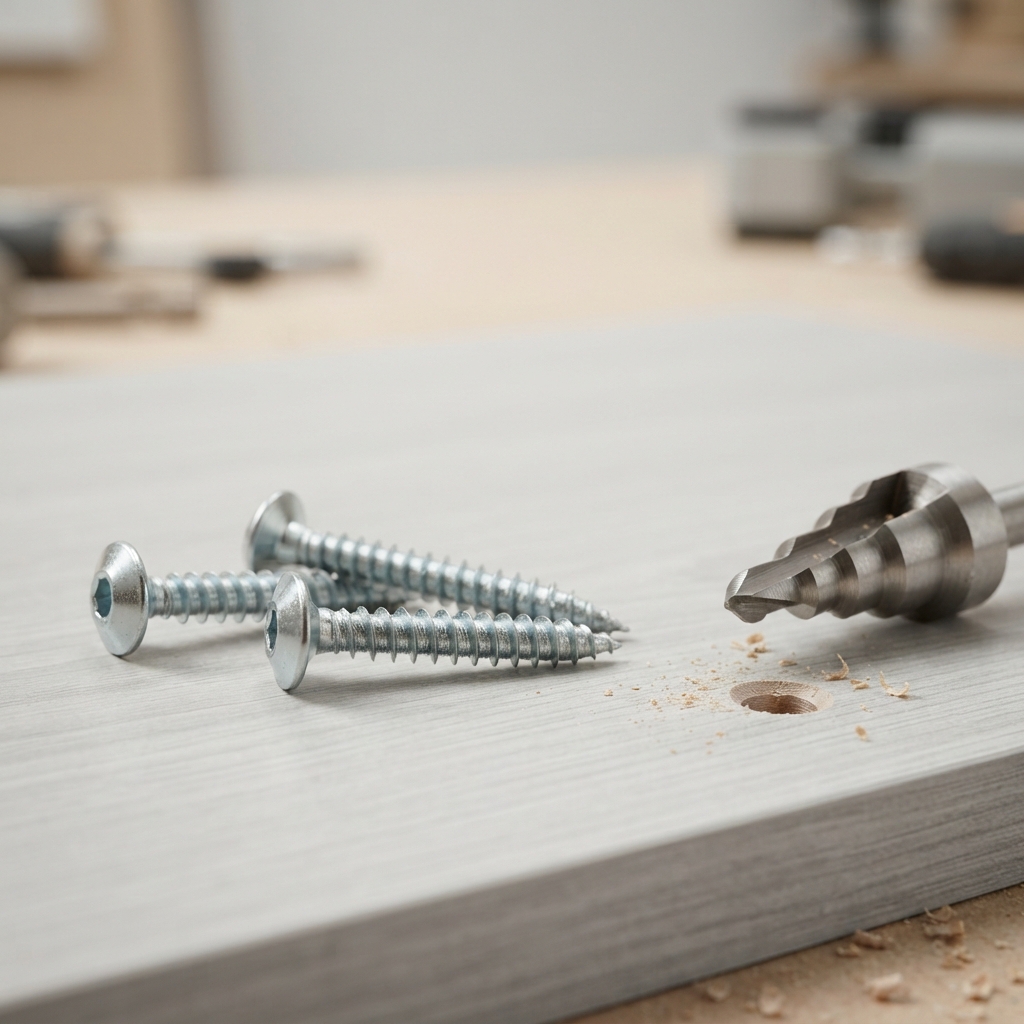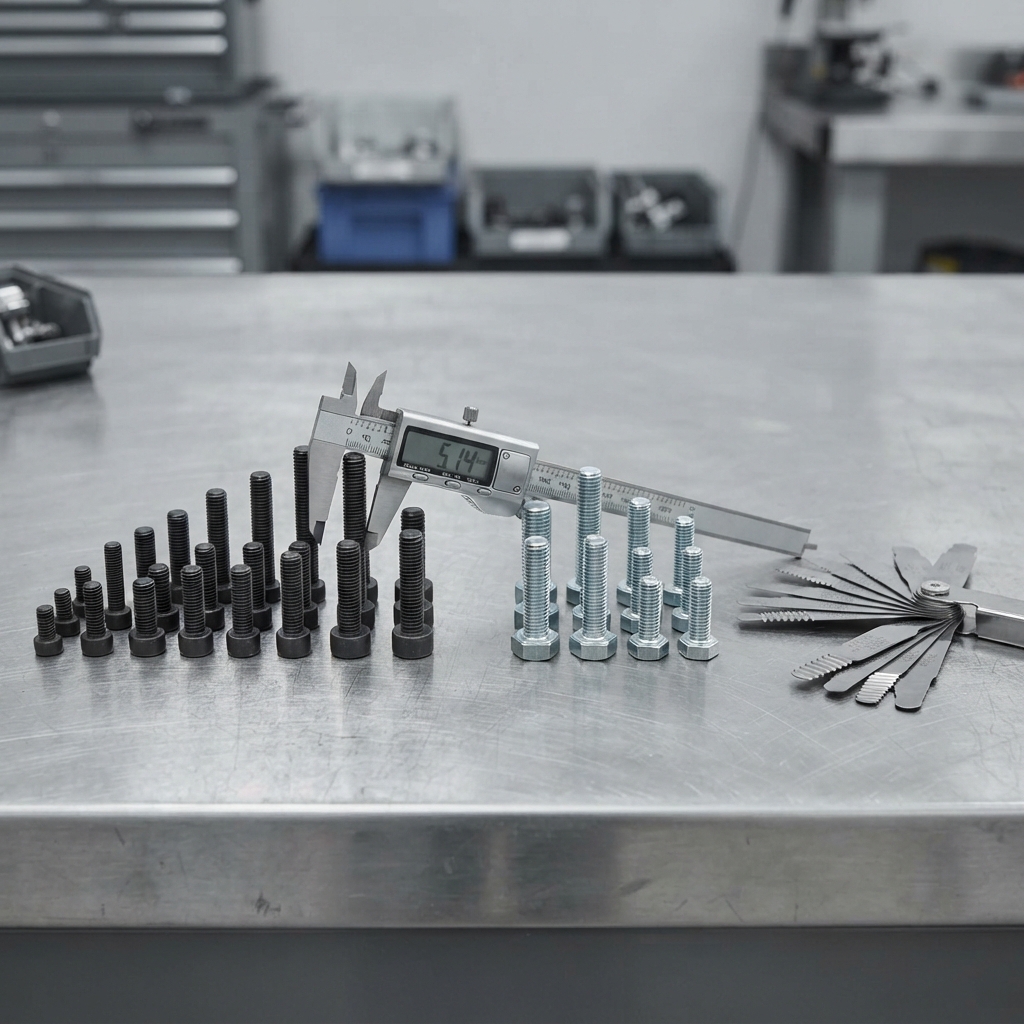
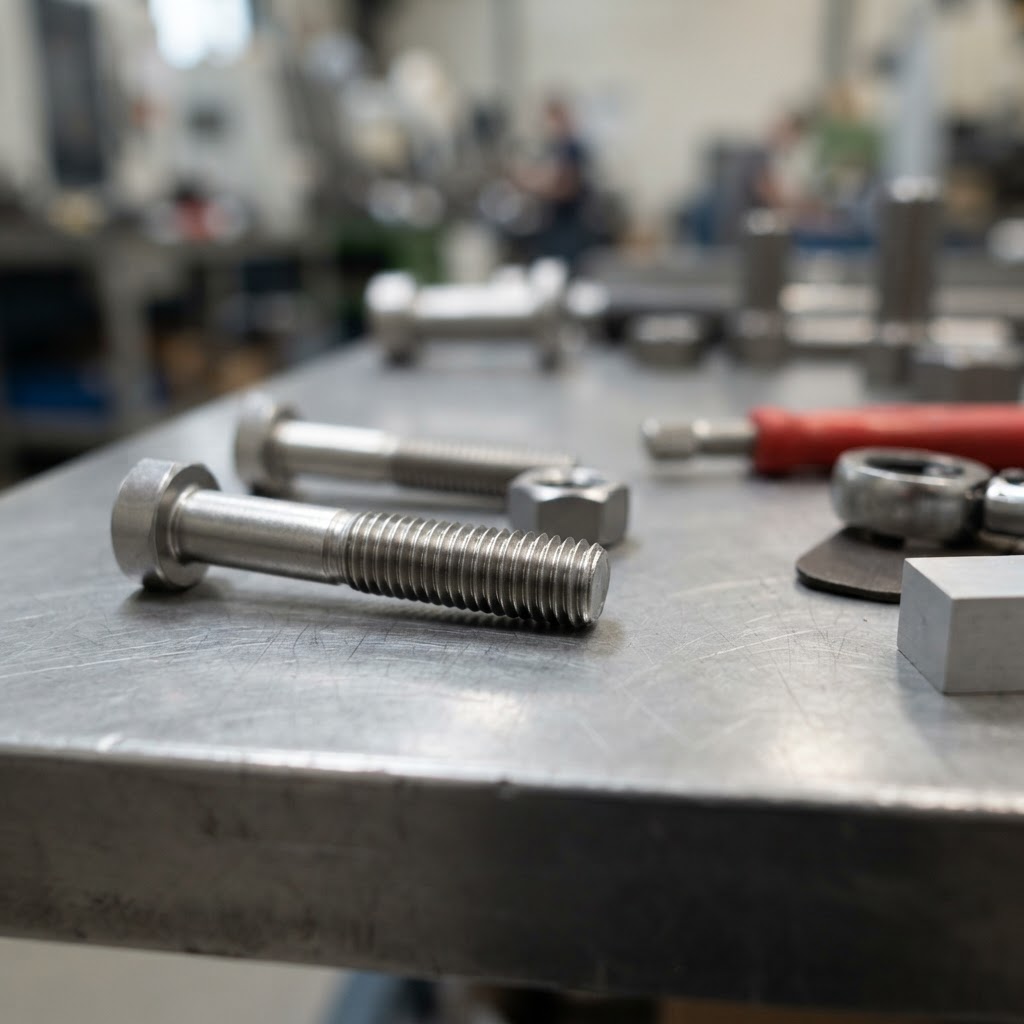

Screw galling is adhesive wear between mating threads: the protective oxide film on a stainless steel screw and nut is torn away, clean metal cold-welds, and the assembly seizes before it reaches the specified clamp load. It is not a tightening error, and it is not corrosion. It is a materials-and-procedure problem that a buyer can specify out of a purchase order — but only when the drawing, the finish and the assembly instruction all describe the same thread system.
This guide is written for OEM buyers, quality engineers and hardware importers who have already had a stainless assembly seize on the line, or who are about to approve one. It covers what screw galling actually is, how to separate it from four other thread failures that look similar, the five variables you control as a buyer, and the checks to run before the first carton ships.
What Is Screw Galling?
Galling is a form of severe adhesive wear that occurs when two metal surfaces slide against each other under load and local high points weld together. In a threaded joint, the flanks of the male and female threads are in sliding contact while carrying increasing load. If contact stress and friction rise far enough, microscopic asperities on one surface adhere to the mating surface, then tear away material as rotation continues. Friction climbs, damage accelerates, and the nut or screw stops turning.
Four conditions usually have to line up before a joint galls:
- Similar or identical alloys in sliding contact — the most common trigger in austenitic stainless.
- Clean, oxide-free metal exposed — the passive film is disrupted and cannot rebuild fast enough.
- High local contact stress — tight thread fit, small bearing area, or an over-driven power tool.
- No separating film — dry threads, or a lubricant that has dried out, washed off or was never applied.
Material couples can be ranked for galling resistance in a laboratory using the button-on-block method of ASTM G98-17(2022), Standard Test Method for Galling Resistance of Materials (ASTM G98). Most production problems, however, are decided long before a laboratory is involved — by what the drawing and the purchase order failed to state.
The commercial consequence is the part buyers underestimate: a seized assembly can feel tight while carrying almost no clamp load. The joint passes a visual check, ships, and fails in service. That is why galling belongs in the purchase specification, not only in the assembly cell.
Why Stainless Steel Screws Gall More Than Coated Steel
Austenitic grades such as 304 (A2) and 316 (A4) are the default choice for corrosion-resistant furniture hardware, cabinet connectors and machine screws. They are also the grades most associated with thread galling, for three reasons.
First, austenitic stainless is ductile and work-hardens quickly. Under sliding contact it deforms rather than shearing cleanly, which widens the contact area and promotes transfer of material from one thread to the other. Second, the chromium oxide passive film that provides corrosion resistance is extremely thin — nanometres, not micrometres. Once rubbed away, it reforms almost instantly, and that continuous reformation is exactly the mechanism that lets two clean surfaces bond. Third, stainless is often assembled dry and at speed, because the parts are specified as corrosion-resistant and nobody thinks to lubricate them.
Stainless steel screw galling is therefore not a grade defect. It is a consequence of how these alloys behave under load, and it appears wherever the assembly method ignores that behaviour.
Aluminium and titanium behave the same way for the same reason. Zinc-plated carbon steel galls far less often, because the coating is a sacrificial layer that shears instead of welding — which is why a change from zinc-plated to stainless fasteners frequently surfaces a galling problem that was always latent in the design.
Galling vs Other Thread Failures: How to Tell Them Apart
Before you accept a supplier's explanation, confirm which failure you actually have. The evidence left on the part is different in each case.
| Failure mode | What you see | When it appears | Typical root cause |
|---|---|---|---|
| Thread galling | Torn, smeared or ripped thread flanks; material transferred from one part to the other; nut locked part-way down | During tightening, often within the first few turns under load | Similar alloys, dry threads, high contact stress, high speed |
| Cross-threading | Flattened or sheared crests on both threads, starting at the first engaged turn | Immediately on start | Misalignment, damaged lead-in chamfer, no free-running start |
| Hydrogen embrittlement | Brittle fracture across the shank or at the head fillet, often hours or days after assembly | Delayed — after plating and baking, in service | High-strength steel, acid pickling or electroplating, inadequate baking |
| Corrosion seizure | Rust or white/green corrosion product in the thread; gradual increase in removal torque | Weeks to months in service | Incompatible materials, chloride exposure, failed coating |
| Under-torque / relaxation | No visible thread damage; joint loose | In service, after vibration or thermal cycling | Wrong torque value, no prevailing torque feature, joint settling |
Only the first row is galling. If the thread flanks are torn and material has transferred, the argument is about specification and assembly, not about a defective lot. If the fracture is brittle and delayed, you are looking at a plating and baking problem instead — a different document trail entirely.
The Five Variables Buyers Actually Control
Screw galling is not inevitable, and it is rarely solved by one product. The Australian Stainless Steel Development Association (ASSDA) sets out the control measures in Technical FAQ 5, and the useful part for buyers is that four of the five are specification decisions made before the purchase order is signed.
- Material pairing and hardness difference — which two grades meet, and how far apart their hardness sits.
- Thread fit and surface condition — tolerance class, thread profile, burrs and finish roughness.
- Lubrication and coating — whether a separating film exists and survives to the assembly line.
- Installation speed, tooling and torque — how the joint is driven and to what value.
- Cleanliness and handling — whether abrasive debris reaches the threads before assembly.
1. Material pairing and hardness difference
The rule of thumb in stainless practice is a hardness difference of at least 50 HB between the internally and externally threaded parts. Two identical 304 components, both annealed, sit at the same hardness and have no such margin. Where the governing specification allows it, pairing a 304 screw with a 316 nut — or specifying a higher property class on one half — introduces a hardness and work-hardening difference that measurably reduces adhesion.
Do not change one half of a joint for anti-galling reasons without re-checking corrosion resistance, mechanical properties and the applicable standard. A harder nut that fails in a chloride environment is not an improvement.
2. Thread fit and surface condition
Galling risk rises at both ends of the finish spectrum. Mirror-polished threads (roughly Ra below 0.25 µm) present very high real contact area and gall readily; heavily roughened threads do the same because the asperities interlock. A clean, cold-rolled or carefully deburred surface sits in the workable middle. Machined threads should be deburred before assembly, and a simple shop-floor check works well: if a cloth snags when wiped along the thread, that thread is likely to gall.
Thread tolerance class matters too. An external 6g thread in a 6H internal thread gives a defined clearance. A thread rolled at the tight end of tolerance, or a plated thread whose coating has closed the clearance, raises contact stress and galling risk. This is the same dimensional logic covered in screw thread tolerance: 6g vs 6h classes, applied to a different failure.
3. Lubrication and coating
Lubrication is required even when the joint is intended to be permanent. A separating film of nickel, molybdenum disulphide, copper, silver, graphite or PTFE reduces direct metal-to-metal contact and drops the friction coefficient at the thread interface. Screw galling risk falls sharply the moment a film of this kind is present and stays present through handling, storage and assembly.
The critical buyer point is that lubrication changes the torque–preload relationship. A torque value validated on dry threads will over-preload a lubricated joint. If you approve a lubricant, you must approve the corresponding torque value at the same time, ideally verified by a torque/clamp force test to ISO 16047. Torque tables and the coefficient of friction are covered in more depth in screw torque specification.
4. Installation speed, tooling and torque
High-speed impact drivers and high-rpm assembly guns generate heat at the thread interface and give friction less opportunity to stabilise. For galling-sensitive stainless, controlled installation speed beats maximum speed. There is no universal correct rpm — diameter, pitch, material pair, lubricant, tool type and target preload all move it — so the assembly procedure should be qualified on the actual joint rather than copied from another product.
Repeated assembly and disassembly cycles also raise risk, because each cycle disturbs the passive film again. If the product is designed for service access, specify a thread lubricant and a re-torque procedure in the service documentation.
5. Cleanliness and handling
Dirt, metal particles, machining debris and corrosion product all create concentrated contact points. Unpackaged stainless fasteners dragged across a fabrication bench pick up abrasive particles that then sit between the threads. Good housekeeping is a genuine control measure, not a housekeeping slogan.
Material Pairing: What to Specify and What to Avoid
The pairing decision is the single largest lever on screw galling risk, and it is the one most often left to the supplier. State both halves of the joint, not just the screw.
| Screw | Nut / mating part | Galling risk | Buyer note |
|---|---|---|---|
| 304 (A2-70) | 304 (A2-70) | High | Default combination for furniture hardware, and the most common source of seizures. Lubricate and control speed. |
| 304 (A2-70) | 316 (A4-70) | Moderate | Hardness and composition difference helps; 316 also improves chloride resistance. Confirm the standard permits mixed grades. |
| 316 (A4-70) | 316 (A4-70) | High | Molybdenum improves corrosion resistance but does not prevent adhesion. Same controls apply. |
| 304 (A2-80) | 304 (A2-70) | Moderate | Higher property class means more cold work and higher hardness; check that the joint still meets ductility requirements. |
| Zinc-plated carbon steel (8.8) | Zinc-plated nut | Low | Coating shears instead of welding. Watch hydrogen embrittlement instead at high property classes. |
| 304 / 316 | Aluminium | High | Both form tough oxide films. Also check galvanic corrosion risk, covered in the galvanic corrosion chart guide. |
304 vs 316 stainless: what actually changes
304 and 316 are both austenitic, both work-harden, and both gall. The difference is molybdenum: 316 contains roughly 2–3% molybdenum, which improves resistance to chlorides and to pitting in coastal, de-icing and cleaning-chemical exposure. That makes 316 the better choice for exterior and wet-service hardware, but it does nothing for adhesion. A 316-to-316 joint galls as readily as a 304-to-304 joint, which is why specifying 316 for corrosion reasons and then assembling it dry solves one problem and creates another. Grade selection for corrosion is covered in stainless steel fastener manufacturer: grades and quality control.
Lubrication and Coating Options Compared
| Option | How it works | Best fit | Watch out for |
|---|---|---|---|
| Nickel or copper anti-seize paste | Solid particles form a physical barrier between threads | High-temperature joints, maintenance access | Messy in production; copper is incompatible with some process fluids |
| Molybdenum disulphide (MoS2) grease | Lamellar solid lubricant shears easily under load | General industrial assembly | Can dry out; not for clean or vacuum service |
| Wax or oil-based dry film | Thin film lowers friction without wet residue | High-volume automated assembly | Film thickness must be specified and audited |
| PTFE / fluoropolymer coating | Low-friction coating bonded to the thread | Repeated assembly, clean environments | Adds coating thickness; re-check thread fit |
| Silver plating | Soft, ductile metal layer | Specialist and high-temperature service | Cost; not a general furniture-hardware solution |
| Passivation only | Restores the chromium oxide film | Corrosion resistance after machining | Does not prevent galling — a common misconception |
Incoming Inspection: A Ten-Point Galling Risk Checklist
Screw galling is a process capability issue, so fastener quality control should test the system rather than the part. Ten checks that catch most of the risk:
- Confirm the grade marking on the head or the material certificate matches the drawing — 304 and 316 are routinely confused at goods-in.
- Check the property class against the purchase order, and confirm the certificate is lot-specific.
- Run go/no-go thread gauges on a sample from each lot; record the result against the lot number.
- Inspect thread flanks at 5–10× for torn crests, laps and burrs.
- Wipe a thread with a cloth; if it snags, escalate the lot.
- Confirm the coating or lubricant is present, and measure film or plating thickness where specified.
- Assemble a representative sample dry and by hand — a nut that will not run down freely by hand is a warning, not a challenge.
- Torque one sample to the specified value on a calibrated wrench and record the result.
- Disassemble the sample and inspect the flanks for transfer or smearing.
- Retain the assembled and disassembled samples with the lot number for the claim file.
Sampling levels and acceptance numbers should be agreed before production, not negotiated after a failure. The mechanics of setting them are covered in AQL sampling for fasteners.
What to Write Into the Purchase Order
Every field below exists because leaving it blank is how screw galling reaches the assembly line. A supplier will fill a gap with whatever is cheapest.
| PO field | What "good" looks like |
|---|---|
| Material and grade | Named grade with the governing standard, e.g. 304 to ISO 3506-1, not "stainless steel" |
| Property class | Stated class such as A2-70 or A4-80, with the tensile requirement it implies |
| Thread specification | Thread size, pitch and tolerance class (for example M6 6g external / 6H internal), plus the gauging method |
| Surface condition | Finish type, thickness range, and whether threads are to be deburred or coated after threading |
| Lubrication | Whether a lubricant is applied, which type, and the applied quantity or film thickness |
| Torque basis | The tightening torque and the friction condition it was validated under |
| Inspection | Sampling standard, defect classes, acceptance numbers and the documents that must accompany each lot |
| Packaging | Count method, protection against movement and moisture, and label content |
Common Mistakes That Cause Seized Assemblies
- Specifying "stainless" instead of a grade and property class. The supplier cannot control hardness difference if the requirement is not stated.
- Assuming passivation is a lubricant. Passivation restores corrosion resistance; it does nothing to stop adhesion.
- Reusing a dry-thread torque value on a lubricated joint. The joint is now over-preloaded, and the failure looks like a strength problem.
- Driving stainless with a high-speed impact tool because it is faster. Speed is the variable most likely to convert a marginal joint into a seized one.
- Approving a sample that was hand-assembled. The production cell uses a power tool at a different speed and torque. Approve the process, not just the part.
- Blaming the lot before checking the drawing. Most screw galling claims end with a specification gap, not a manufacturing defect.
- Forgetting the mating part. A screw that galls against one nut may run cleanly against another. Specify the pair.
A carton of galling screws is usually a symptom rather than the disease. The parts are typically inside tolerance; what is missing is the requirement that would have separated the two surfaces in the first place.
Stainless Steel Screws and Connectors From JHFIX
JHFIX manufacturing — operated by Jiangmen Jinhe Hardware Products Co., Ltd. in Jiangmen City, Guangdong Province — produces custom screws, machine screws, furniture connectors and assortment kits for OEM and distributor programs, with international sales and export handled by the authorized partner Jiangmen Shenxin Trading Co., Ltd. Production covers cold heading, tapping, punching, injection moulding, assembly and packing, with an on-site inspection room.
Two product families are directly relevant when a joint is galling-sensitive:
- Metric socket screw, nut and washer assortment kit — a multi-component metric fastening assortment supplied in a divided clear organizer case, with made-to-drawing and made-to-sample review, and packaging available as bulk, counted bags, retail bags, blister packs, compartment cases or private-label cartons. Minimum order quantity is 10,000 pcs per confirmed specification.
- Silver internal-hex male-female furniture connector — a two-piece male screw and internally threaded barrel connector for through-panel furniture joints, with internal-hex drive. Machine-thread components from M1 to M12 and lengths from 3 mm to 200 mm can be reviewed, with finish options including zinc plating, Ruspert coating, spray painting, electrophoretic coating, blackening and gold, silver or copper plating. Minimum order quantity is 10,000 pcs per confirmed specification.
Both are custom configurations: geometry, thread, material, finish and packaging are confirmed against an approved drawing or sample before production, so the thread pairing and lubrication question above can be settled at quotation stage rather than at the assembly line.
Frequently Asked Questions
What is screw galling in simple terms?
Screw galling is cold welding between two mating threads. The oxide layer on the metal is rubbed away, clean metal bonds to clean metal, and the nut or screw seizes. The joint often feels tight without carrying the intended clamp load.
Why do stainless steel screws gall but zinc-plated screws usually do not?
Austenitic stainless such as 304 and 316 is ductile, work-hardens fast and rebuilds its thin passive film almost immediately, which is exactly what allows two clean surfaces to bond. A zinc coating is a sacrificial layer that shears instead of welding, so it acts as a built-in separating film.
Does using a 316 nut on a 304 screw stop galling?
It reduces the risk, because the two grades differ in hardness and work-hardening behaviour, but it does not eliminate it. The change must still satisfy the corrosion, mechanical and dimensional requirements of the governing standard.
Will passivation prevent thread galling?
No. Passivation removes free iron and restores the chromium oxide film for corrosion resistance. It does not provide a lubricating film, and treating it as a galling fix is one of the most common specification errors.
What lubricant should I specify for stainless fasteners?
Choose by service condition: nickel or copper anti-seize for high temperature, molybdenum disulphide for general industrial assembly, dry-film or PTFE coatings for clean and high-volume automated assembly. Whatever you choose, approve the corresponding torque value at the same time.
Does galling mean the fastener lot is defective?
Usually not. Galling is normally a system issue — similar alloys, dry threads, tight fit, high assembly speed — rather than a manufacturing defect. Torn thread flanks prove the mechanism; they do not by themselves prove the lot was out of specification.
How much torque should a stainless screw be tightened to?
There is no universal value. Torque depends on diameter, pitch, property class, friction condition and the clamp load the joint needs. It should be calculated for the joint and verified by a torque/clamp force test to ISO 16047 rather than copied from a table.
Can galling be repaired on site?
No. Once material has transferred and the thread flanks are torn, the thread geometry is compromised. Replace both halves of the joint, then correct the material pairing, lubrication or assembly speed that caused it.
Does thread galling affect furniture connectors as well as machine screws?
Yes. Any stainless male-female threaded pair is exposed, including barrel connectors and insert nuts used in flat-pack furniture. The same controls — grade pairing, lubrication, controlled assembly speed — apply.
How do I audit a supplier's galling control before ordering?
Ask for the grade and property class on the certificate, the thread tolerance class on the drawing, the finish or lubricant specification, and a torque value with the friction condition it was validated under. Then request a hand-assembly and torque trial on a representative sample.
Conclusion
Screw galling is a specification problem dressed up as a quality complaint. The parts that seize are usually within tolerance; what is missing is a stated grade pairing, a defined thread fit, a lubricant that survives to the assembly line, and a torque value validated against that friction condition. Fix those four fields in the purchase order and most stainless thread seizures disappear before the first carton is opened.
If you are specifying a new stainless joint, or trying to close out a seizure that has already happened, send the drawing, the mating part and the assembly method to our team through the contact page. We will review the thread system with you and confirm what the production route can hold.