
What Should OEM Buyers Look for in a Threaded Insert Manufacturer?
A threaded insert manufacturer should be evaluated on its ability to produce or supply an insert that matches the intended host material, installation method, mating fastener, and required joint performance—not simply on its ability to quote an internal thread size.
For OEM purchasing, the most important requirements are:
-
The correct threaded insert design for the application
-
Verified internal thread dimensions and compatibility
-
Suitable external geometry and installation features
-
Defined material and surface requirements
-
Compatibility with the host material and prepared hole
-
Controlled manufacturing and inspection processes
-
Sample approval using representative assemblies
-
Functional validation where required
-
Traceable part specifications and revision control
-
Reliable packaging and repeat-order identification
A supplier may produce a component that meets its drawing while the final joint still performs poorly.
For example, a threaded insert may have an accurate M6 internal thread but fail because the pilot hole is unsuitable for the surrounding particleboard. Similarly, a rivet nut may pass dimensional inspection before installation but develop insufficient retention after setting in a thin metal panel.
This distinction is essential.
Threaded insert quality is not just a property of the loose metal component. It is also a property of the installed connection.
For buyers sourcing reusable threaded connections, JHFIX provides several threaded nut configurations within its nut and threaded insert product range, with product-specific drawing, sample, installation, quality, and packaging review.
The most effective sourcing process begins by defining the entire joint and then selecting the appropriate insert.
Why Threaded Insert Manufacturing Requires More Than Thread Accuracy
The primary purpose of a threaded insert is to create a usable internal thread in a compatible host material or structure.
Depending on the application, this may allow a machine screw or bolt to be installed in a wooden panel, plastic component, or thin metal sheet.
The insert creates two critical interfaces.
The first interface is internal: the machine screw engages the insert's female thread.
The second interface is external: the insert engages, locks into, or becomes retained by the surrounding material.
The connection works only when both interfaces satisfy the application's requirements.
A thread gauge may verify the internal thread. It does not prove that the insert will remain secure inside the intended host material.
A pull-out test may demonstrate axial retention. It does not necessarily prove that the insert will resist rotation during bolt tightening.
A visual inspection may confirm an attractive surface finish. It does not establish a particular base material or corrosion resistance.
For a purchasing manager, this means the supplier qualification process must consider more than a catalog specification.
A professional manufacturer should understand which features control the component's actual function.
In some applications, internal thread tolerance is the dominant requirement. In others, the external rib geometry, flange, installation depth, or material compatibility may be equally important.
The correct priorities depend on the joint design.
Understanding Different Types of Threaded Inserts
The phrase "threaded insert" covers several distinct fastening products.
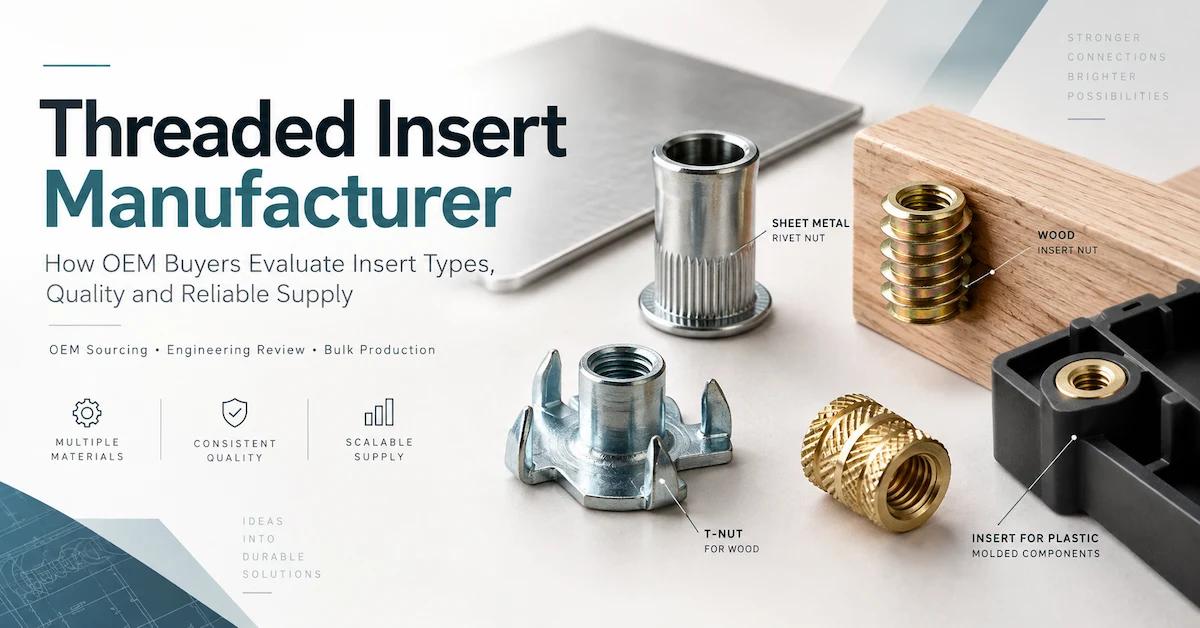
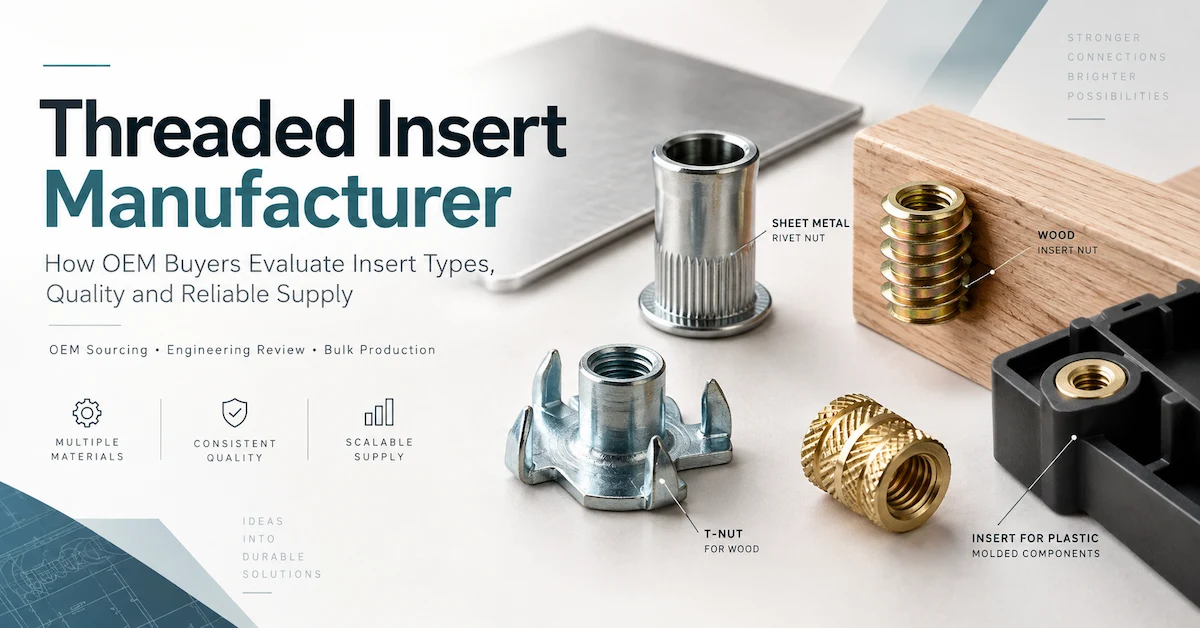
Some are designed for wooden furniture panels. Others are intended for injection-molded plastic components. Rivet nuts provide threaded points in suitable sheet-metal assemblies. Pronged T-nuts use another installation and retention method.
They share a common objective—providing an internal thread—but they are not interchangeable.
Threaded Insert Type Comparison
| Insert Type | Typical Host Material | Installation Principle | Important Buying Considerations |
|---|---|---|---|
| Hex-drive wood insert | Solid wood, MDF, particleboard or compatible board | Installed into a prepared panel hole | Internal thread, drive, external ribs, hole fit |
| Externally threaded furniture insert | Wood and engineered panels | Outside thread engages substrate | External thread, pilot hole, seating depth |
| Tapered insert nut | Suitable wood-based panels | Tapered exterior engages prepared hole | Taper, rib geometry, installation stress |
| Pronged T-nut | Wood and suitable board panels | Prongs engage the panel | Flange, barrel, prongs, installation access |
| Blind rivet nut | Suitable sheet-metal or hollow-section assembly | Body deforms during setting | Grip range, hole geometry, setting process |
| Heat-set insert | Compatible thermoplastics | Controlled heat allows plastic flow around insert | Resin, boss, temperature, retention features |
| Ultrasonic insert | Compatible thermoplastics | Ultrasonic installation creates localized plastic flow | Equipment, material, geometry, process |
| Molded-in insert | Suitable molding applications | Insert is incorporated during molding | Positioning, orientation, sealing, retention |
The correct question is not "Which threaded insert is strongest?"
It is:
Which insert creates the most suitable connection in the actual substrate, installation process, and service environment?
That question should guide product selection before supplier pricing begins.
Threaded Inserts for Wood and Engineered Furniture Panels
Wood-based furniture applications are an important segment of the threaded insert market.
Furniture manufacturers often use inserts where a machine-thread connection is preferable to repeatedly driving a screw directly into the surrounding panel.
Applications include:
-
Detachable table legs
-
Cabinet components
-
Furniture frames
-
Modular shelving
-
Wardrobe assemblies
-
Removable fittings
-
Furniture repair systems
-
RTA and knock-down furniture
-
Selected adjustable furniture components
The value of a threaded insert is especially apparent when a joint needs to be serviced or assembled more than once.
However, a metal insert does not automatically make every wooden joint stronger.
Its performance depends heavily on the material surrounding it.
MDF Applications
Medium-density fiberboard can provide a relatively consistent engineered panel, but the insert must be matched to its actual grade and drilling condition.
Buyers should examine:
-
Panel density
-
Panel thickness
-
Pilot-hole diameter
-
Hole depth
-
Insert body geometry
-
Installation method
-
Distance from panel edges
-
Required pull-out and rotational retention
An insert that fits one MDF specification should not automatically be approved for every MDF panel.
Particleboard Applications
Particleboard is widely used in cabinets, wardrobes, and flat-pack furniture.
Its internal structure and density can influence how external ribs or threads engage the panel.
A component may appear properly seated while providing insufficient retention during tightening.
The buyer should therefore qualify the insert using representative production panels.
Plywood Applications
Plywood introduces a layered structure.
The insert's location, pilot hole, and insertion direction may affect local veneer integrity.
Cracking, delamination, and inconsistent seating should be considered during design validation.
Solid Wood Applications
Wood species, grain direction, and moisture conditions can affect installation.
A threaded insert manufacturer should not recommend one universal pilot-hole size for every solid wood application.
The correct hole geometry must be established for the approved material and insert.
Threaded Inserts for Plastic Components
Plastic applications introduce different engineering conditions.
Threaded inserts are commonly used in suitable plastic housings, appliance components, electrical enclosures, equipment covers, and other products requiring reusable machine threads.
Depending on the design, installation may involve:
-
Heat insertion
-
Ultrasonic insertion
-
Press fitting
-
Self-tapping engagement
-
In-mold placement
The selected method should match the plastic material and the part geometry.
Heat-Set Threaded Inserts
Heat-set installation is commonly used with compatible thermoplastics.
The process softens surrounding plastic material so it can flow around the insert's external retention features.
After cooling, the material helps retain the component.
Critical variables include:
-
Resin grade
-
Filler content
-
Boss geometry
-
Pilot-hole size
-
Insert exterior features
-
Temperature
-
Insertion force
-
Process timing
-
Seating depth
The installation process must be validated for the actual material.
Ultrasonic Threaded Inserts
Ultrasonic installation uses mechanical vibration to generate localized heat in compatible plastic.
The result depends on the equipment settings, insert geometry, and host material.
It should not be treated as automatically superior to heat insertion.
Molded-In Inserts
Molded-in inserts are positioned during the molding process.
Important considerations include mold retention, insert alignment, thread protection, and control of material flow.
The buyer should confirm that the production process can repeatedly maintain the specified insert location.
A Supplier Qualification Boundary
Plastic insert manufacturing and installation capabilities are not identical to wood insert manufacturing.
A company supplying threaded inserts for furniture panels should not automatically be assumed to manufacture every heat-set, ultrasonic, or molded-in insert configuration.
The buyer should verify the exact product family and production process before awarding the project.
Threaded Inserts for Sheet Metal: When Rivet Nuts Are Appropriate
Thin sheet metal creates another fastening challenge.
In many applications, the sheet is not thick enough to provide the required thread engagement directly.
A rivet nut can provide an internal machine thread without requiring a separate loose nut behind the joint.
For suitable designs, installation can be performed from one accessible side.
This can be useful for:
-
Metal enclosures
-
Sheet-metal cabinets
-
Equipment panels
-
Metal frames
-
Mounting brackets
-
Certain hollow-section assemblies
How Rivet Nuts Differ From Wood Inserts
A rivet nut is generally retained through controlled body deformation during installation.
A wood insert relies on a different form of engagement with the surrounding substrate.
Therefore, their installation conditions are not interchangeable.
A rivet nut specification may require:
-
Body geometry
-
Flange dimensions
-
Grip range
-
Prepared-hole dimensions
-
Sheet material
-
Sheet thickness
-
Installation tool
-
Mandrel compatibility
-
Setting stroke or force
-
Post-setting thread condition
These are different from the pilot-hole and panel-density requirements of wood inserts.
JHFIX displays a Full-Hex Flat-Head Rivet Nut intended for review in suitable sheet-metal threaded connections.
Its full-hex body requires matching prepared-hole geometry.
The component should be evaluated using the actual sheet stack and setting procedure.
JHFIX Threaded Insert Product Types: What Buyers Can Compare
JHFIX's published nut category contains several insert configurations that illustrate different fastening requirements.
The following products should be treated as distinct engineering options rather than interchangeable catalog items.
Hex-Drive Threaded Wood Insert Nut
The Hex-Drive Threaded Wood Insert Nut features an internal installation drive, an internal machine-thread bore, a flanged entry face, and external engagement features.
For sourcing, buyers should confirm:
-
Internal thread diameter and pitch
-
Usable engagement depth
-
Hex-drive geometry
-
Flange dimensions
-
Body and rib profile
-
Panel and pilot-hole requirements
-
Material and finish
The product is suitable for evaluation in furniture applications requiring a reusable machine-thread interface.
Final specifications must be confirmed against the approved drawing or sample.
Tapered Hex-Drive Wood Insert Nut
The Tapered Hex-Drive Wood Insert Nut combines an internal machine thread, hex-drive installation interface, tapered body, and external ribs.
Its geometry should be reviewed in relation to the panel material and hole preparation.
The tapered form should not be assumed to provide superior retention under every condition.
Installation testing is required where performance matters.
Round-Body Threaded Insert Nut
The Round-Body Threaded Insert Nut presents a generally cylindrical body, internal thread, installation drive, and external ribs.
It can be evaluated for applications such as knock-down furniture joints, adjustable feet, and selected cabinet mounting requirements.
Again, the product's appearance does not define the final production material or dimensions.
Hex-Socket Furniture Threaded Insert
The Hex-Socket Furniture Threaded Insert Nut uses a coarse outside thread with an internal machine thread and hexagonal installation interface.
Both thread systems matter.
The inner thread must match the bolt. The exterior thread must suit the panel and installation method.
Approving one without the other creates unnecessary sourcing risk.
Pronged T-Nut
The Pronged T-Nut for Wood Panels provides a female-threaded barrel with a flange and projecting prongs.
The prongs are intended to engage the host panel during installation.
The buyer should review the flange, barrel, prong geometry, insertion direction, and available access.
A T-nut should not automatically replace a threaded wood insert if the assembly does not provide access for its installation.
How to Select the Correct Threaded Insert for an OEM Project
The selection process should begin with the application.
A useful decision sequence is:
-
Identify the host material.
-
Determine why a machine-thread connection is required.
-
Define the joint load and service conditions.
-
Establish installation access.
-
Select a compatible insert family.
-
Confirm internal thread requirements.
-
Review external retention geometry.
-
Define hole preparation.
-
Validate the installed joint.
-
Freeze the approved specification.
The most important distinction is between choosing a product by appearance and choosing it by function.
A silver-colored insert and a yellow-colored insert may have different base materials or surface finishes.
Two products with the same internal thread may have different external retention systems.
A longer component may provide no advantage if it cannot be installed correctly in the available material thickness.
A successful insert design must match the host, hole, mating fastener, installation process, and service load simultaneously.
Internal Thread Specifications: What Must Be Controlled?
Threaded insert manufacturers must control internal thread characteristics because they determine compatibility with the mating screw or bolt.
Nominal Thread Diameter
Examples of metric designations used in industrial fastening include M4, M5, M6, and M8.
These are examples, not a claim that every JHFIX insert model is available in every size.
Thread Pitch
Thread pitch must match the mating fastener.
The same nominal diameter does not necessarily mean the same pitch.
Thread Tolerance
Buyers should define the required tolerance class.
For ISO general-purpose metric threads, ISO 965-1:2026 provides the relevant tolerance-system principles and basic data.
Its existence does not mean that a particular insert is certified or manufactured to a specific tolerance class without evidence.
Usable Thread Depth
The buyer must account for the actual length of thread available for engagement.
Mating Bolt Length
A screw that bottoms out inside a blind insert can create unwanted loading.
Check the complete joint stack and bottoming clearance.
Entry Condition
Chamfers, burrs, or thread damage can influence assembly.
A product may be dimensionally acceptable in other respects yet cause repeated cross-threading if the entry condition is poor.
Thread Verification
The appropriate inspection method can include agreed thread gauges, dimensional measurement, and trial assembly with a controlled mating fastener.
The test method should match the drawing requirements.
External Geometry: The Part Buyers Often Under-Specify
The exterior of the insert controls its interaction with the host material.
Depending on the product, important features may include:
-
External thread
-
Ribs
-
Knurls
-
Taper
-
Flange
-
Prongs
-
Barrel diameter
-
Grip section
-
Entry profile
-
Body length
Each serves a particular purpose.
For example, the external thread of a furniture insert engages the prepared panel. A pronged T-nut uses its prongs and flange. A rivet nut requires a setting process and controlled deformation.
These features should be included in a formal specification.
Do not assume that a supplier can reproduce the correct part from a photograph.
A drawing should identify the critical dimensions and the interfaces that affect installation.
Where a physical sample is provided, a controlled drawing or documented inspection criteria should be developed before repeat production.
Material Selection: Steel, Stainless Steel, Brass and Zinc Alloy
Different materials are used in threaded insert applications.
The appropriate choice depends on manufacturing method, mechanical requirements, environmental conditions, and cost.
| Material | Common Engineering Considerations | What Buyers Should Confirm |
|---|---|---|
| Carbon steel | Mechanical properties, manufacturability, surface protection | Grade, condition, finish |
| Stainless steel | Corrosion resistance and grade-dependent mechanical properties | Grade, application compatibility |
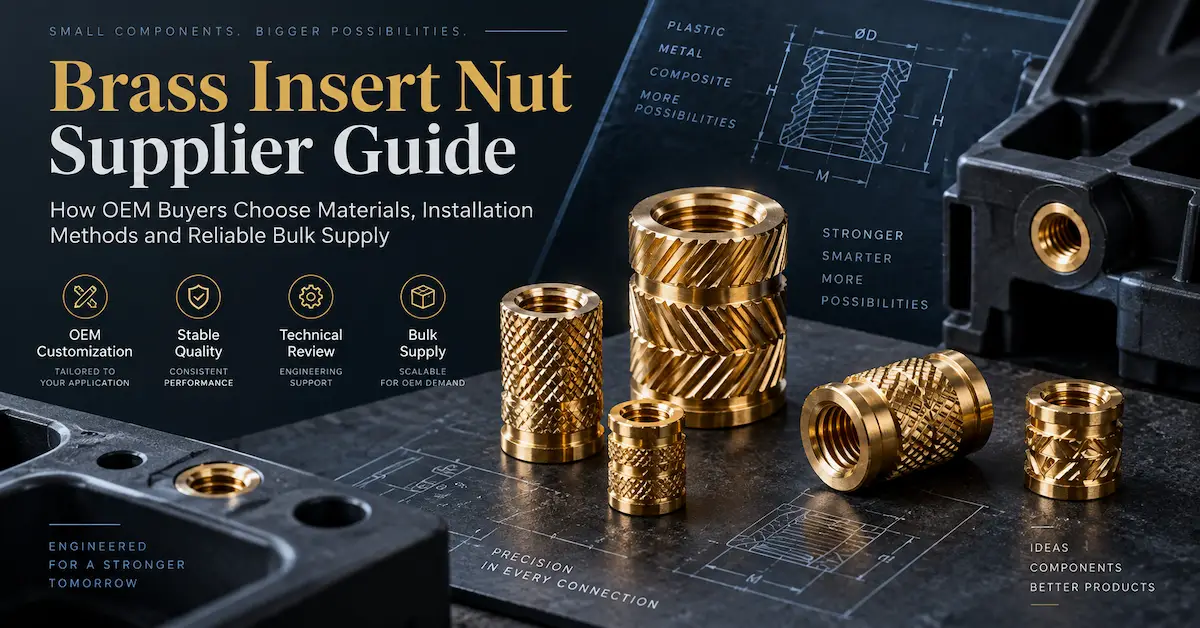
| Brass | Machinability and suitability for certain insert designs | Alloy, composition, installation method |
| Zinc alloy | Suitable for certain furniture hardware geometries | Alloy, mechanical requirements, manufacturing process |
Material selection should be tied to the product's engineering requirements.
A brass-colored component should not automatically be treated as solid brass.
Likewise, a silver-colored component is not necessarily stainless steel.
For OEM threaded inserts, the purchase specification should identify both base material and finish.
When Finish Selection Matters
A threaded insert inside a dry indoor cabinet may have different corrosion considerations from a component installed in a humid environment.
Finish selection may involve:
-
Zinc plating
-
Nickel plating
-
Black finish
-
Other specified coatings
The required finish should be defined by the application.
If corrosion testing is necessary, the method and acceptance criteria should be agreed before production.
Threaded Insert Manufacturing Processes and DFM
Design for Manufacturability (DFM) is important when buyers request custom inserts.
The proposed manufacturing route depends on the geometry and material.
Potential processes include:
-
Material preparation
-
Forming
-
Machining
-
Drilling
-
Tapping
-
External threading
-
Knurling
-
Stamping
-
Surface treatment
-
Inspection
-
Assembly and packaging
Not every insert follows the same process route.
A turned brass insert and a formed steel insert may require different production methods.
A pronged T-nut introduces flange and prong geometry that differs from a cylindrical insert.
A rivet nut must be manufactured with features appropriate for its setting behavior.
What Should an Engineering Review Cover?
A useful review asks:
-
Can the selected material support the geometry?
-
Which dimensions are function-critical?
-
Are the proposed tolerances manufacturable?
-
Can the internal thread be inspected effectively?
-
Will finishing affect mating-thread fit?
-
Does the design require special tooling?
-
Can the part be produced consistently at the planned volume?
-
Are the specified tests appropriate for the actual assembly?
A capable threaded insert manufacturer should distinguish required engineering features from dimensions that can be adjusted without compromising the function.
This supports more accurate quotations and more controlled production development.
Threaded Insert Quality Control: What Should Be Inspected?
A reliable quality plan starts with the approved specification.
For most OEM projects, useful inspection stages include material verification, in-process checks, final dimensional inspection, and application testing where needed.
Incoming Material Review
Confirm material designation and any required documentation.
Dimensional Inspection
Review the features that determine fit:
-
Body diameter
-
Body length
-
Flange
-
External ribs or threads
-
Taper
-
Prongs
-
Tool interface
-
Internal bore
-
Thread depth
Thread Inspection
Check diameter, pitch, tolerance, usable depth, and mating compatibility.
Surface Inspection
Look for unacceptable burrs, damage, contamination, and finish defects.
Functional Inspection
Where required, install the component into representative host material.
Check seating, alignment, retention, and assembly behavior.
Packaging Inspection
Confirm item identification, thread variant, quantity, labels, and protection.
Quality control should not stop once the loose component passes dimensional inspection.
The finished packed product also needs to meet the buyer's requirements.
Pull-Out, Torque-Out and Installation Testing
A threaded insert may pass dimensional inspection but still fail in service.
Functional validation can reveal risks that loose-part inspection cannot identify.
Pull-Out Testing
Pull-out testing evaluates resistance to extraction under defined conditions.
Results depend on the insert, host material, hole, installation, and loading method.
Torque-Out Testing
Torque-out testing evaluates resistance to unintended rotation within the host material.
This can be especially important where a machine screw is tightened or removed repeatedly.
Thread Performance
The internal thread and mating bolt should be evaluated for the required assembly conditions.
Installation Testing
Review:
-
Insertion method
-
Required force or torque
-
Seating depth
-
Alignment
-
Tool engagement
-
Host-material damage
Rivet Nut Setting Tests
For rivet nuts, the installation trial should examine the prepared hole, setting tool, body deformation, flange seating, and post-setting thread condition.
Standards and Test Scope
ASTM D1037 is relevant to evaluating properties of wood-based fiber and particle-panel materials and includes specified fastener-holding tests.
However, its direct screw-withdrawal procedures should not be represented as universal certification tests for every threaded insert design.
A project-specific insert retention test may require a separately defined procedure.
The buyer and supplier should agree on the test method, specimen, conditioning, sample size, and acceptance criteria before testing.
Common Threaded Insert Failures and Their Causes
Understanding failure modes helps buyers define more effective quality requirements.
| Failure | Possible Cause | Recommended Investigation |
|---|---|---|
| Insert spins in wood | Poor external engagement or hole fit | Check panel, hole and installation |
| Insert pulls out | Insufficient retention or unsuitable load | Review substrate, geometry and loading |
| Panel cracks | Excessive installation stress | Check hole and edge distance |
| Bolt cross-threads | Thread mismatch, damage or misalignment | Inspect internal thread and bolt |
| Insert sits too high | Incorrect seating or installation | Review flange and body geometry |
| Plastic boss deforms | Unsuitable process or boss design | Check resin, hole and insertion settings |
| Rivet nut rotates | Hole or setting problem | Check hex geometry, grip and installation |
| Internal thread strips | Excessive loading or incorrect mating fastener | Evaluate thread and assembly conditions |
| Batch performance changes | Process or material variation | Compare approved specifications and samples |
Failure analysis should focus on identifying the actual mechanism.
Changing to a larger insert or harder material does not necessarily solve the underlying problem.
For example, an oversized insert may create additional stress in a thin panel.
The correct corrective action could involve hole preparation, installation control, material selection, or joint redesign.
How to Qualify a Threaded Insert Manufacturer Before Bulk Ordering
Manufacturer qualification should combine engineering, quality, commercial, and supply-chain evaluation.
Engineering Capability
Ask whether the supplier can:
-
Review a drawing or sample
-
Identify the correct product family
-
Evaluate the mating screw
-
Discuss hole and host-material requirements
-
Identify missing technical information
-
Support controlled sample approval
Manufacturing Capability
Confirm which operations are performed internally and which are outsourced.
The buyer should understand who is responsible for controlling critical dimensions and production changes.
Quality Capability
Ask about:
-
Dimensional inspection
-
Thread verification
-
Material controls
-
Surface inspection
-
Application testing
-
Batch identification
-
Nonconforming product handling
Commercial Capability
Confirm:
-
MOQ
-
Tooling
-
Sample costs
-
Sample lead time
-
Production lead time
-
Payment terms
-
Packaging
-
Delivery conditions
Long-Term Supply Capability
Evaluate how the supplier will maintain the approved specification across repeat orders.
A manufacturer that produces a good first sample but cannot control later changes creates ongoing risk.
A Practical Threaded Insert Supplier Scorecard
Procurement teams can use the following framework to compare suppliers consistently.
| Evaluation Area | Weight | What to Review |
|---|---|---|
| Technical understanding | 20% | Insert type, interfaces, drawing review |
| Product quality control | 20% | Dimensions, threads, material and inspection |
| Functional validation | 15% | Installation, retention and assembly testing |
| Manufacturing and capacity | 15% | Process control and repeat-production planning |
| Commercial competitiveness | 10% | Price, MOQ and tooling scope |
| Packaging and logistics | 10% | Identification, protection and delivery |
| Communication and documentation | 10% | Revision control, RFQ clarity and responsiveness |
These weights are an illustrative procurement tool, not a universal industry standard.
Buyers should adjust them according to product criticality.
For example, a safety-relevant industrial assembly may require heavier emphasis on engineering validation and documented quality controls.
For a standard retail hardware assortment, packaging accuracy and repeat-order consistency may deserve greater attention.
OEM Threaded Insert Development: From Drawing to Mass Production
Custom development should follow a controlled approval process.
Step 1 — Define the Application
Identify the host material, joint function, service environment, and installation method.
Step 2 — Prepare the Specification
Provide the insert drawing, mating fastener, hole geometry, material, finish, and acceptance criteria.
Step 3 — Complete Engineering Review
The supplier evaluates manufacturing feasibility and identifies missing information.
Step 4 — Confirm the Quotation Scope
Agree on tooling, samples, quantities, commercial conditions, and packaging.
Step 5 — Develop Samples
Produce representative components according to the proposed specification.
Step 6 — Validate the Installed Joint
Test the components in the real or production-representative assembly.
Step 7 — Approve the Golden Sample
Freeze the drawing revision, sample reference, material, finish, and critical requirements.
Step 8 — Begin Controlled Production
Manufacture against the approved documentation.
Step 9 — Inspect and Pack
Verify component quality, quantity, identification, and packaging.
Step 10 — Control Repeat Orders
Use the approved specification and documented change process for subsequent orders.
JHFIX describes its manufacturing workshops, engineering support, quality controls, and international supply activities on its About Us page.
For custom threaded insert projects, the exact production route, material, tooling, testing, and commercial requirements should be confirmed during engineering review.
Why Golden Samples and Revision Control Matter
A golden sample is an approved physical reference associated with a controlled specification.
It helps the buyer and supplier maintain consistency over time.
For an insert project, the approval package may include:
-
Drawing number
-
Revision
-
Approved sample
-
Material specification
-
Finish requirement
-
Critical dimensions
-
Mating fastener
-
Host material
-
Hole and installation information
-
Test criteria
-
Packaging reference
This is particularly important when sourcing replacement inserts.
A supplier may receive an old sample with no drawing.
The buyer and manufacturer should document the agreed dimensions and functional interfaces before repeat production begins.
Without revision control, purchasing teams may unknowingly order slightly different versions of the same component.
A change to an internal thread, flange thickness, external rib geometry, or finish can affect assembly compatibility.
Threaded Insert MOQ, Lead Time and Manufacturing Cost
MOQ is a commercial question, but the answer depends on technical requirements.
A custom threaded insert may involve tooling, material preparation, process setup, inspection, and packaging.
The supplier must review those conditions before confirming the order minimum.
What Affects MOQ?
Potential factors include:
-
Standard or custom geometry
-
Material grade
-
Manufacturing method
-
Tooling
-
Required finish
-
Inspection scope
-
Variant count
-
Packaging
-
Production quantity
Several current JHFIX threaded insert and rivet nut product pages list 10,000 pieces per confirmed specification.
This is a product-page condition, not a guarantee that every insert design has the same MOQ.
A custom brass insert, for example, should be quoted separately rather than assigned the MOQ from an unrelated wood insert.
What Affects Unit Price?
A useful cost model considers:
Material + manufacturing + tooling allocation + inspection + packaging + logistics.
The lowest unit price may not produce the lowest total purchasing cost.
If a low-cost component creates rework, sorting, installation failures, or replacement claims, those costs can exceed the original price difference.
What About Lead Time?
Buyers should separate:
-
Engineering review
-
Tooling development
-
Sample production
-
Sample approval
-
Mass production
-
Inspection and packaging
-
Shipping
The schedule should reflect the actual scope.
Avoid relying on a generic delivery promise for a custom component that has not yet been approved.
Threaded Insert Packaging and Hardware Kit Supply
Packaging is part of product control.
A furniture manufacturer may use several inserts with similar appearances but different internal threads or body lengths.
An industrial OEM may require multiple rivet nut grip variants.
If these components are mixed, the assembly line may receive a part that looks correct but does not fit.
Important Packaging Requirements
Buyers should specify:
-
Item number
-
Thread designation
-
Length or body variant
-
Material and finish
-
Quantity per package
-
Batch identification
-
Barcode or label
-
Inner packaging
-
Master carton
-
Protection requirements
For assembly kits, the packaging specification should also identify mating fasteners and component ratios.
JHFIX provides custom bag packaging for hardware components and kit-oriented supply.
This is relevant for furniture manufacturers, industrial OEMs, hardware importers, and private-label distributors.
The objective is not simply attractive packaging.
It is accurate identification and reliable downstream handling.
How to Prepare a Complete Threaded Insert RFQ
A complete RFQ helps buyers obtain comparable quotations and reduces unnecessary engineering revisions.
The following checklist can be used for standard or customized projects.
| RFQ Item | Information Required |
|---|---|
| Insert type | Wood insert, rivet nut, T-nut, plastic insert or other |
| Drawing/sample | Controlled drawing or existing component |
| Internal thread | Diameter, pitch, tolerance and depth |
| External geometry | Body, ribs, prongs, flange, taper or grip range |
| Material | Base material and grade |
| Finish | Plating, coating or appearance requirement |
| Host material | Wood, MDF, particleboard, plastic, sheet metal |
| Host dimensions | Thickness, density or other relevant properties |
| Hole | Diameter, shape, depth and tolerances |
| Installation | Tool, direction, method and conditions |
| Mating fastener | Thread, length, engagement and joint stack |
| Testing | Required methods and acceptance criteria |
| Order quantity | Sample quantity, initial order and forecast |
| Packaging | Bulk, counted packs, kits or private label |
| Documentation | Material, inspection or test reports as required |
The RFQ should explicitly identify any open questions.
If the buyer does not know the correct pilot-hole size, the inquiry should request an engineering review rather than inventing a number.
Example RFQ for an OEM Threaded Insert Project
Subject: Custom Threaded Insert RFQ for Furniture Assembly
Dear JHFIX Team,
We are developing a modular furniture product that requires threaded inserts for detachable machine-bolt connections.
Our engineering team can provide the existing insert sample, proposed drawing, mating bolt, panel material, pilot-hole details, and joint assembly information.
Please review the proposed insert geometry and advise whether your current production capabilities can support the project.
We would also like confirmation of material and finish options, sample requirements, critical inspection dimensions, MOQ, production lead time, and packaging possibilities.
The finished hardware will be supplied in model-specific assembly kits, so component identification and quantity control are important.
Please let us know which additional technical details are required to prepare an accurate quotation.
Best regards,
OEM Purchasing Department
A structured inquiry helps establish a technical discussion before price negotiation begins.
When Should You Choose a Different Fastening Solution?
Threaded inserts are useful, but they are not suitable for every connection.
A different approach may be better when:
-
The host material cannot provide adequate retention.
-
The available wall or panel thickness is insufficient.
-
The joint does not require repeated machine-thread assembly.
-
Installation access does not support the selected insert type.
-
The expected load exceeds the validated connection.
-
The required material or finish is unsuitable for the environment.
-
A through-bolt or alternative connector provides a more appropriate design.
In some furniture applications, cam lock systems, connector bolts, or brackets may be better suited to the intended joint.
The JHFIX furniture hardware range includes alternative fastening and connecting components that can be considered according to the product design.
The goal should be to select the right fastening system, not to force a threaded insert into every application.
Why Consider JHFIX for Threaded Insert and OEM Hardware Sourcing?
JHFIX, operated by Jiangmen Jinhe Hardware Products Co., Ltd., is a China-based fastener and furniture hardware manufacturer.
The company states that it began operating in 2004 and serves international markets.
Its published operations include cold heading, tapping, stamping, injection molding, assembly, packing, inspection, and warehousing.
These capabilities are relevant to projects requiring several related fastener and furniture hardware components.
Multiple Nut and Insert Configurations
The current product catalog contains wood insert nuts, round-body inserts, externally threaded furniture inserts, rivet nuts, and pronged T-nuts.
Drawing and Sample Review
Product pages describe made-to-drawing and made-to-sample review for custom configurations.
Related Hardware Supply
Buyers can consider compatible screws, bolts, furniture connectors, and other hardware within the same sourcing discussion.
Packaging Integration
Bulk packaging, counted hardware packs, and private-label requirements can be reviewed alongside component specifications.
Application-Based Quality Review
Current product information emphasizes dimensions, mating threads, hole preparation, installation, and buyer-defined functional testing.
These are useful foundations for a controlled OEM sourcing project.
However, buyers should confirm the exact manufacturing route, available materials, testing capabilities, MOQ, and capacity for their specific insert design.
A product category alone does not establish universal manufacturing capability for every threaded insert technology.
For project-specific review, buyers can contact JHFIX with their technical drawings and purchase requirements.
Frequently Asked Questions About Threaded Insert Manufacturers
1. What does a threaded insert manufacturer do?
A threaded insert manufacturer produces components designed to provide internal machine threads within compatible host materials or assemblies.
Depending on the supplier's specialization, products may include wood inserts, furniture insert nuts, plastic inserts, rivet nuts, and other threaded fastening components.
Manufacturing capability should be confirmed for the exact product type.
2. How do I choose a reliable threaded insert manufacturer?
Evaluate the supplier's product specialization, material control, manufacturing processes, dimensional inspection, thread accuracy, application knowledge, sample approval procedures, and repeat-order documentation.
The supplier should understand the complete installed joint rather than only the loose component.
3. What is the difference between threaded inserts and regular nuts?
A regular nut typically engages a mating bolt as a separate component.
A threaded insert is designed to be retained within another material or structure, creating a machine-thread interface at the required location.
The installation and external retention method are important parts of the design.
4. Which materials are used for threaded inserts?
Common materials include carbon steel, stainless steel, brass, and certain zinc alloys, depending on the design.
The specific grade should be selected according to manufacturing requirements, mechanical performance, environment, and cost.
A metallic color does not reliably identify the base material.
5.Can threaded inserts be used in MDF and particleboard?
Yes, suitable threaded inserts can be used in engineered furniture panels when the panel specification, external geometry, pilot hole, and installation method have been validated.
Performance should be checked in representative production material.
6. Are threaded inserts suitable for plastic?
Certain threaded inserts are designed specifically for compatible plastics.
Installation methods may include heat setting, ultrasonic insertion, pressing, or molding-in.
A wood insert should not automatically be treated as suitable for a plastic application.
7. What is the difference between a threaded wood insert and a rivet nut?
A threaded wood insert engages a prepared wooden or engineered-board hole through its exterior geometry.
A rivet nut is generally designed for suitable sheet-metal assemblies and is retained by controlled deformation during setting.
They require different installation procedures and qualification methods.
8. Can threaded inserts be customized from drawings?
Yes, subject to supplier capability and manufacturing feasibility.
Customization may involve thread, length, body geometry, flange, external features, material, finish, and packaging.
A complete drawing and application information should be submitted before quotation.
9. Why does a threaded insert rotate inside the host material?
Possible causes include poor hole fit, unsuitable external retention geometry, incorrect installation, host-material damage, or excessive assembly torque.
The cause should be identified through inspection and representative testing.
10. How is threaded insert pull-out strength tested?
Pull-out performance is evaluated using a defined assembly, host material, load direction, and test method.
The result depends on the complete test configuration.
Numerical performance values from unrelated materials or test methods should not be compared directly.
11. What thread sizes can manufacturers supply?
Available thread sizes depend on the insert type and supplier.
Common metric designations include M4, M5, M6, and M8, but product-specific availability, pitch, tolerance, and thread depth must be confirmed.
12. What is the MOQ for custom threaded inserts?
MOQ depends on material, geometry, manufacturing route, tooling, quantity, inspection, and packaging.
Several JHFIX product pages list 10,000 pieces per confirmed specification, but custom projects require separate confirmation.
13. Should threaded inserts be tested with the actual mating bolt?
Yes. The mating bolt and complete joint should be reviewed where compatibility and performance matter.
A dimensionally acceptable insert may still cause assembly problems if the bolt length, thread, engagement, or installation conditions are unsuitable.
14. Can threaded inserts be packaged with matching fasteners?
Depending on the supplier and project scope, threaded inserts may be supplied with matching bolts, screws, and other components in counted hardware packs.
Buyers should provide the BOM, quantities, item identification, labels, and packaging requirements.
15. What should I include in a threaded insert RFQ?
Provide the product drawing or sample, internal thread, external geometry, material, finish, host material, hole specifications, installation method, mating bolt, testing requirements, order quantity, and packaging needs.
This information allows the supplier to evaluate manufacturing feasibility and prepare a more accurate quotation.
Conclusion
Choosing a threaded insert manufacturer requires evaluating the complete fastening system—from internal thread accuracy and external retention geometry to host-material compatibility, installation methods, quality control, and repeat-order consistency.
The best sourcing decisions are based on approved drawings, representative samples, defined testing requirements, and clear commercial specifications.
JHFIX offers several threaded insert and nut configurations alongside related fasteners, furniture hardware, and custom packaging solutions. If you are developing a new insert, replacing an existing component, or sourcing a complete OEM hardware kit, contact JHFIX with your drawings, application requirements, and expected order quantity to discuss technical feasibility, sampling, and quotation.