
What Should a Cam Lock Manufacturer Control Before Bulk Production?
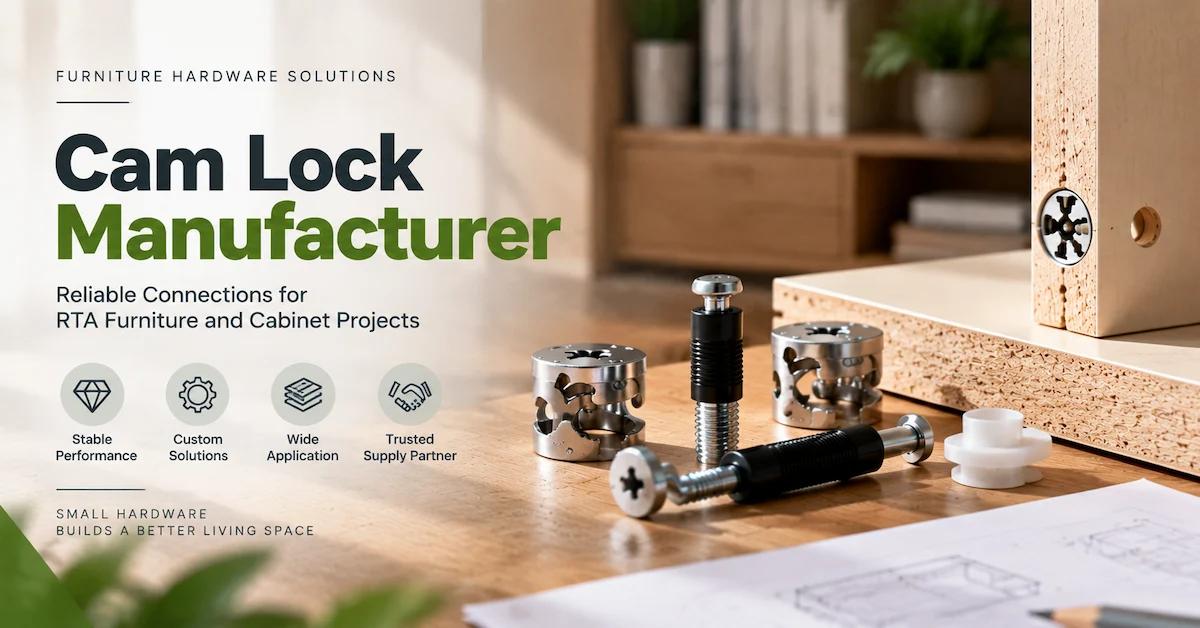
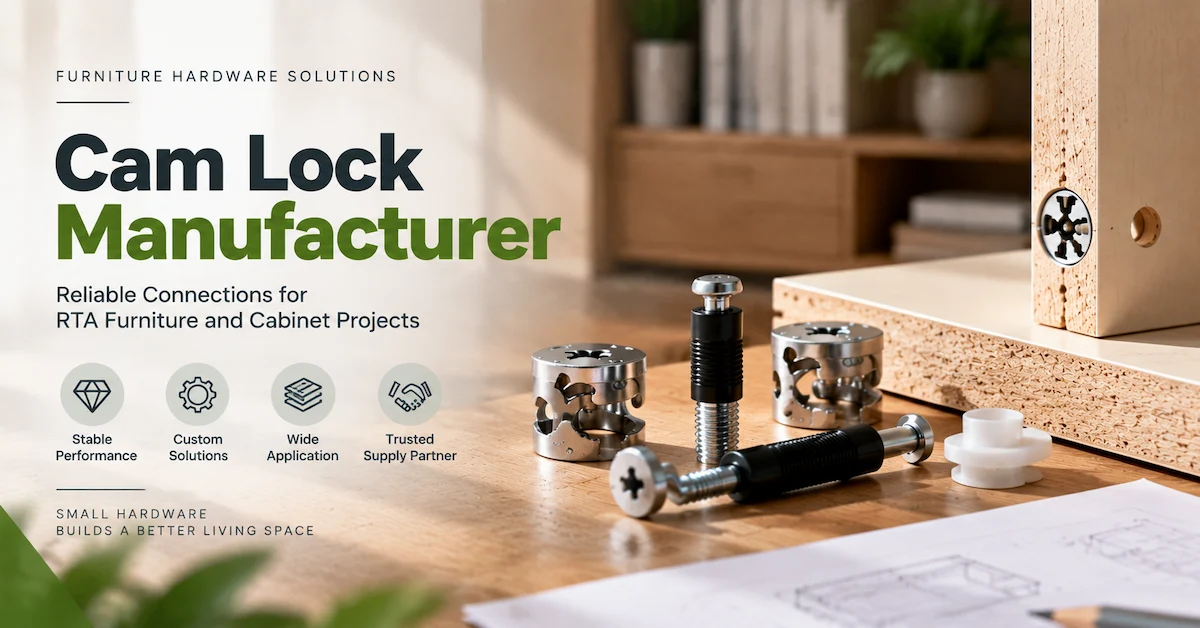
A cam lock manufacturer should control more than the round cam fitting itself. In cabinet and ready-to-assemble furniture, the working connection normally depends on the cam, its matching connecting bolt, accurately prepared furniture panels, and a defined installation sequence. For an OEM buyer, the useful purchasing unit is therefore the approved connection system rather than an isolated metal component.
JHFIX currently groups 2-in-1 and 3-in-1 furniture cam locks, eccentric connectors, Minifix fittings, and related connector sets within its Cam Locks & Connector Sets category. The category is intended for cabinets and flat-pack furniture, while individual product pages repeatedly advise buyers to confirm panel material, drilling pattern, mating hardware, and assembly drawings before placing an order.
That distinction matters because two cams that look nearly identical are not automatically interchangeable. A change in cam geometry, bolt position, hole depth, or panel drilling can affect whether the parts engage correctly. A professional sourcing process should therefore move through four stages: specify the joint, identify the matched parts, validate the assembly, and then release the approved configuration for production.
Which Buyers Should Work Directly With a Cam Lock Manufacturer?
Direct manufacturer evaluation is particularly useful for cabinet producers, wardrobe factories, modular-storage manufacturers, office-furniture companies, flat-pack furniture brands, private-label importers, and distributors purchasing furniture connectors repeatedly.
These buyers normally need more than a small quantity of generic replacement fittings. They need components that can be linked to a furniture SKU, drawing revision, hardware bill of materials, and repeat-order specification. A kitchen cabinet factory, for example, may require the same cam-and-bolt combination across thousands of panel sets. A furniture brand may need those components counted into one hardware bag for every finished carton. A distributor may require several lengths or configurations under controlled product codes.
A one-time DIY replacement is different. If the buyer only has a photograph of an unknown fitting, the first task is identification rather than bulk qualification. For production sourcing, provide measurements, drawings, existing samples, mating components, and panel information so the proposed connector can be compared with the actual assembly.
How Does a Furniture Cam Lock System Work?
A typical cam-lock connection uses an eccentric cam and a connecting bolt installed into two prepared furniture panels. During assembly, the cam engages the bolt head or neck and rotates to draw the panels together. JHFIX describes this type of system across its cabinet and furniture connector content, particularly for kitchen cabinets, wardrobes, shelving, modular furniture, and RTA products.
The principle is simple, but the dimensions are interdependent. The buyer should not select a cam based solely on diameter, or a connecting bolt based only on overall length. The final relationship depends on where the bolt sits after installation, where the cam bore is machined, how the cam engages the bolt, and whether the furniture panels align when the joint is locked.
This is why a cam lock manufacturer should ask questions about the furniture before recommending a bulk-production configuration.
What Cam Lock Specifications Should OEM Buyers Define?
Use a controlled specification sheet before comparing quotations. The following fields are not universal cam-lock dimensions; they are the information that should be defined or confirmed for the individual furniture project.
| Specification Area | Information to Confirm | Why It Matters |
|---|---|---|
| Furniture application | Cabinet, wardrobe, shelf, desk, storage unit or other RTA furniture | Defines the joint and installation environment |
| Panel material | Particleboard, MDF, wood-based panel or specified material | Influences drilling and installation conditions |
| Panel thickness | Actual finished thickness | Affects connector location and available drilling depth |
| Cam body | Required type and key dimensions | Determines fit inside the prepared cam bore |
| Cam bore | Diameter, depth and center location | Must correspond with the selected cam |
| Connecting bolt | Type, overall length, thread/anchoring section and head geometry | Determines mating compatibility |
| Installed bolt position | Required projection after installation | Helps position the bolt relative to the cam |
| Mating parts | Cam, bolt, nut, sleeve, dowel or plastic element | Defines the complete approved system |
| Material | Material specified for each component | Prevents ambiguous mixed-material descriptions |
| Finish | Required finish and appearance | Separates surface specification from base material |
| Installation | Tool, orientation and assembly sequence | Helps validate production and end-user assembly |
| Packaging | Loose parts, matched set or complete furniture kit | Determines the delivered purchasing unit |
| Inspection | Critical dimensions, visual checks, mating fit and pack count | Creates measurable acceptance criteria |
JHFIX’s current product guidance similarly tells buyers to review board thickness, hole diameter, installation depth, joint position, load direction, and related connector components, and recommends trial assembly before volume production.
Why Cam and Bolt Compatibility Matters More Than a Catalog Name
A common sourcing error is to treat the words “cam lock,” “Minifix,” or “3-in-1 connector” as a complete specification. These names describe a general connection concept, not necessarily one interchangeable dimensional standard.
Consider the connecting bolt. Overall length is useful for identification, but the manufacturer and buyer also need to understand the features that actually interact with the cam and panel. The installation depth, working projection, anchoring geometry, thread configuration where applicable, and bolt-head relationship can all matter.
JHFIX’s JH-18 listing, for example, identifies an M6 furniture connecting bolt available in published lengths of 24, 28, 32, and 34 mm, with an 8 mm thread length. The page also lists pan-head/countersunk options and zinc-plated or nickel finishes. These published values are useful starting information, but the page still recommends confirming the exact configuration against panel material, drilling, mating hardware, and assembly drawings.
For an OEM program, that is the correct approach: treat the catalog item as a candidate and the assembled sample as the approval reference.
How Do 2-in-1, 3-in-1, and Cam-Bolt Configurations Differ?
JHFIX’s current cam-lock category includes 2-in-1, 3-in-1, eccentric, and Minifix-style product directions. These names are useful for organizing sourcing discussions, but the exact contents of a set should always be documented in the BOM.
| Supply Configuration | Typical Purchasing Logic | What Buyers Need to Confirm |
|---|---|---|
| Cam + connecting bolt | Basic matched connection between prepared panels | Cam geometry, bolt configuration, drilling and installed position |
| 2-in-1 connector set | Two coordinated connector elements supplied as one set | Exact two components, quantity definition and panel compatibility |
| 3-in-1 connector set | Connector system containing three defined pieces | Identity and specification of every component in the set |
| Minifix/eccentric system | Concealed or semi-concealed RTA furniture connection | Manufacturer-specific geometry and drilling relationships |
| Connecting bolt only | Replacement or component-level bulk sourcing | Exact mating cam and existing panel requirements |
JHFIX’s HI-CB0012 listing is a useful example of why BOM definition matters. The product page lists a three-part combination of bolt, cam, and nut, with carbon steel, zinc alloy, and plastic stated within the product specification. The page lists M6.1 and a 45 mm length as customizable specifications. A buyer should therefore identify which material and dimension belongs to each component rather than recording the entire assembly simply as “one metal cam lock.”
What Materials and Finishes Should a Cam Lock Manufacturer Clarify?
A furniture cam-lock assembly can contain different materials. Depending on the selected product, the connection may combine steel, zinc-alloy, or plastic elements. The material specification should therefore be recorded component by component.
Finish should be managed separately. A silver-colored connector does not establish the base material, coating thickness, corrosion behavior, or suitability for a particular environment. JHFIX product listings include zinc and nickel finish options on several connector products, but buyers should still define the actual finish required for the approved order.
For kitchen furniture, bathroom cabinetry, humid storage environments, or projects with specific customer requirements, explain the intended environment during RFQ review. If a defined corrosion test or surface requirement applies, include the method and acceptance criteria in the purchase specification. Do not infer a performance level merely from the finish name.
Which Manufacturing Capabilities Matter When Evaluating a Cam Lock Manufacturer?
A factory tour or company profile should be connected to the product you intend to purchase. JHFIX states that its manufacturing system covers cold heading, tapping, stamping or punching, injection molding, assembly, packing, inspection, warehousing, and related production operations. The company also identifies cam-lock systems and furniture connectors among its product specialties.
For a cam lock manufacturer, the useful qualification questions are more specific:
Which operations produce the cam body? Which operations produce the connecting bolt? Which dimensions are considered critical? How are mating parts checked? Which plastic components, if any, are molded internally? At what stage are the parts assembled or grouped into sets? How is the approved sample linked to production inspection?
Not every listed factory process necessarily applies to every cam-lock model. Buyers should ask the manufacturer to map the actual production route for the selected part instead of assuming that an equipment list describes every product.
How Should Cam Locks Be Tested Before Mass Production?
1. Inspect the Individual Components
Begin by checking the parts against the agreed drawing or specification. Depending on the design, relevant checks may include cam dimensions, bolt dimensions, thread or anchoring features, head geometry, finish appearance, and component identification.
2. Test the Matched Cam and Bolt
The cam and connecting bolt should then be evaluated as a mating pair. Confirm engagement, rotation, seating, and whether the joint closes in the expected position.
3. Assemble Representative Furniture Panels
Use representative panel material and the intended drilling pattern. JHFIX’s product guidance recommends trial assembly with the actual board and mating components before volume production to verify fit, alignment, appearance, and assembly efficiency.
4. Approve the Packed Set
If the parts will be supplied as a kit, inspect the packed configuration as well as the loose hardware. Verify the number of cams, bolts, additional components, labels, and any assembly instructions.
This sequence separates four different questions: Is the individual component correct? Do the mating parts work together? Does the connection work in the furniture? Is the correct hardware actually delivered to the customer?
What Quality Problems Should Buyers Investigate?
If a cam-lock joint will not close correctly, avoid changing several variables at once. Investigate the system logically.
First compare the candidate cam and bolt with the approved sample. Then measure the prepared furniture panel. Check whether the cam bore diameter and depth match the drawing, whether the center position is correct, whether the connecting bolt has been installed to the intended position, and whether the correct mating components were used.
If an approved hardware set works in the same panel while the candidate set does not, the connector configuration deserves closer investigation. If both sets fail in the new panels but work in reference panels, panel drilling or panel preparation becomes a stronger area for investigation.
These observations guide troubleshooting; they do not prove the cause by themselves. Record measurements and part identities before modifying the design. JHFIX also advises buyers to confirm drilling accuracy, remove debris that can affect fit, follow the agreed installation sequence, and avoid excessive force that could damage the board or hardware.
How Should Buyers Compare Cam Lock Products?
Use product pages to identify candidate configurations, then compare them against the actual furniture drawing. The examples below are not a performance ranking and should not be treated as interchangeable products.
| JHFIX Reference | Published Information | Useful Starting Point | Still Requires Approval |
|---|---|---|---|
| JH-18 furniture connecting bolt | M6; 24/28/32/34 mm published lengths; 8 mm thread length | Projects requiring a choice among listed bolt lengths | Actual mating cam, drilling, installation depth and joint fit |
| Φ6.1 × 34 mm connecting bolt | 34 mm length; carbon steel + plastic listed; zinc/nickel options | Mini-fix or cam-lock furniture connection review | Mating cam, panel preparation and accepted joint configuration |
| HI-CB0012 3-in-1 connector | Bolt + cam + nut; M6.1 and 45 mm listed as customizable | Buyers needing a defined multi-part connector set | Exact specification of each component and panel fit |
| Cam Locks & Connector Sets | 2-in-1, 3-in-1, eccentric and Minifix product range | New projects that have not yet selected a model | Final dimensions, material, mating parts and sample approval |
The important purchasing principle is consistency: compare proposed connectors against one defined application rather than comparing catalog specifications without reference to the furniture design.
How Should MOQ, Capacity, and Lead Time Be Discussed?
Do not assume one MOQ or lead time applies to every cam-lock configuration. Standard connecting bolts, customized cam geometry, mixed-material sets, special finishes, and pre-counted hardware kits can involve different manufacturing and packing requirements.
Ask your cam lock manufacturer to separate technical approval and production timing. A useful schedule may include specification review, sample preparation, trial assembly, sample approval, bulk production, finishing, kit assembly, inspection, and shipment preparation.
Also establish when the quoted lead time begins. If production cannot start until the drawing and sample are approved, that approval point should be visible in the schedule.
For repeat orders, identify the approved part number, drawing revision, sample, finish, and packaging version. This avoids treating a general product description such as “M6 cam connector” as a complete repeat-order specification.
Why Packaging Matters for Cam Lock Sets
Cam-lock hardware is small, multi-part, and easy to mix. For flat-pack furniture, packaging therefore becomes part of the product specification.
A typical furniture kit may contain cams, connecting bolts, dowels, screws, shelf supports, brackets, plastic accessories, and spare pieces. JHFIX supports packaging categories including bag packaging, while its wider furniture-hardware content discusses BOM-based kits and model-specific packaging for RTA furniture.
For cam-lock projects, define:
- the number of cams per furniture unit;
- the number of matching bolts;
- whether the quantity is counted as pieces or sets;
- any additional nuts, sleeves, or dowels;
- spare quantity, if specified;
- furniture model or kit code;
- label and barcode requirements;
- assembly instructions where required.
Approve a finished sample pack before volume packing. A correct cam inside the wrong furniture kit is still a supply problem.
How Should OEM Cam Lock Development Be Managed?
OEM customization should begin with a functional reason. Changing a connector only to make it different can create new tooling, qualification, and inventory complexity without solving a furniture problem.
Customization becomes meaningful when the standard connector does not fit the required panel structure, bolt position, installation method, finish, packaging, or mating system. JHFIX states that it can discuss dimensions, materials, surface finishes, compatible parts, packaging, carton labeling, and inspection requirements for connector products, with samples arranged for evaluation before mass production.
A controlled development sequence is:
Furniture requirement → drawing/sample review → proposed connector → sample production → representative assembly → specification approval → packaging approval → bulk production.
If any component changes later, document the revision and decide whether revalidation is required. That process matters especially when the connector is expected to remain compatible with old furniture inventory or existing mating parts.
What Does Cam Lock Cost Really Include?
Unit price is important, but it should be compared on an equivalent basis.
One quotation may cover only loose cams. Another may include the cam, matching bolt, additional connector pieces, inspection, counting, labeling, and one-bag-per-furniture-unit packaging. Comparing those quotations only by the price of one metal piece can lead to the wrong conclusion.
For B2B evaluation, compare the cost of the approved connection or complete furniture kit. Include the specified components, any agreed custom tooling, finish, inspection, packaging, and the internal sorting or kitting work your factory must still perform.
Also consider specification risk. A cheaper connector that requires panel re-drilling, additional sorting, or repeated production adjustment may create costs elsewhere. Use your own manufacturing and after-sales data when assigning a monetary value to those risks rather than relying on generic savings claims.
What Should You Send a Cam Lock Manufacturer for a Quote?
A strong RFQ should let the supplier understand both the component and the furniture application. Send the furniture type, panel material, panel thickness, drilling drawing, existing cam and bolt samples if available, target dimensions, required materials and finishes, expected quantity, first-order volume, repeat forecast, packaging requirements, destination market, and any defined inspection or test conditions.
If you are replacing an existing connector, send the mating hardware as well. If you are developing a new joint, identify which dimensions are fixed by the furniture design and which can still be adjusted.
You can review the full JHFIX Cam Locks & Connector Sets range and then submit the project through Contact Us. Ask the quotation to separate confirmed specifications from open technical points so neither side mistakes an assumption for an approved requirement.
FAQ
1. What products does a cam lock manufacturer supply?
A cam lock manufacturer may supply eccentric cams, connecting bolts, 2-in-1 or 3-in-1 connector sets, Minifix-style fittings, and related furniture components. JHFIX currently groups these products within its cam-lock and connector-set category.
2. What information is needed to select a furniture cam lock?
Provide the panel material and thickness, cam-bore dimensions, drilling position, connecting-bolt specification, installation depth, mating components, and assembly conditions. Drawings or existing samples make the review more reliable.
3. Are all furniture cam locks interchangeable?
No interchangeability should be assumed from appearance or product name alone. The cam geometry, connecting bolt, drilling, installed bolt position, and panel conditions should be reviewed as one connection and validated through assembly.
4. What is the difference between a 2-in-1 and 3-in-1 cam connector?
The description refers to how many defined components are included in the connector system. Because suppliers may organize sets differently, list every part and quantity in the BOM rather than relying only on “2-in-1” or “3-in-1.”
5. Can JHFIX customize cam lock connectors?
JHFIX product information states that dimensions, materials, finishes, compatible parts, packaging, and related order requirements can be discussed for OEM projects. Feasibility and commercial terms should be confirmed for the specific connector before ordering.
6. Should I test cam locks using the actual furniture panel?
Representative assembly is recommended because individual component measurements do not demonstrate the entire joint. JHFIX product guidance recommends testing with the actual board and mating components to evaluate fit and alignment before volume production.
7. Which material is best for a furniture cam lock?
There is no single material that should be assumed best for every project. Define the connector function, furniture design, environment, cost target, and required finish, then approve the material for each component in the specific set.
8. How should cam lock quality be checked?
Quality checks can include critical dimensions, surface condition, matching components, thread or locking function where relevant, representative assembly, and package count. The final inspection plan should follow the approved product specification.
9. Is there one MOQ for every cam lock product?
A universal MOQ should not be assumed. Minimum quantities can depend on the model, dimensions, finish, customization, packaging, and production arrangement. Confirm the MOQ against the final quotation.
10. How can I control cam lock consistency on repeat orders?
Use a controlled part number, drawing revision, approved sample, mating-component reference, panel specification, finish, and packaging version. Proposed substitutions or design changes should be reviewed before they are introduced into production.
Conclusion
Choosing a cam lock manufacturer is not simply a matter of finding the lowest-priced round fitting. Furniture OEM buyers should qualify the complete cam-bolt connection by defining panel drilling, mating geometry, materials, finishes, sample acceptance, production checks, and packaging before bulk release. The strongest purchasing record links the approved components to the furniture drawing and keeps that configuration controlled across repeat orders. JHFIX offers cam locks and connector sets, related furniture connecting hardware, OEM discussion, and packaging support for cabinet and RTA furniture programs. For a project-specific review, contact JHFIX with your drawings, samples, panel information, quantities, and packaging requirements.