
Why Choosing the Right Furniture Insert Nut Manufacturer Matters
A furniture insert nut may cost very little compared with the finished cabinet, wardrobe, table, or desk. Yet the wrong insert can create a problem that becomes expensive only after the furniture reaches the assembly line—or the customer.
Imagine a production team assembling a detachable table leg. The machine bolt enters the threaded insert smoothly, but the insert begins turning inside the panel before the joint reaches its required tightening condition. The operator cannot complete the connection. Replacing the bolt does not solve the problem because the failure is occurring between the insert nut and the surrounding panel.
This is why selecting a furniture insert nut manufacturer is not simply a purchasing exercise.
It is a decision involving component design, panel engineering, assembly processes, manufacturing consistency, quality assurance, and supply management.
For furniture manufacturers and OEM buyers, the correct insert nut must satisfy three separate interfaces:
-
The internal thread: It must match the machine screw or bolt.
-
The external body: It must engage the surrounding furniture panel correctly.
-
The assembly system: It must maintain the intended joint performance under actual installation and service conditions.
A component can meet its nominal dimensional specification and still perform poorly if the panel hole, installation method, or mating bolt has not been properly considered.
JHFIX supplies various threaded nuts and furniture fastening components through its Nut product range, supporting projects that require coordinated component specifications, OEM customization, and furniture hardware packaging.
For professional buyers, the objective should be clear: source an insert nut that works reliably in the actual furniture joint, can be manufactured consistently, and can be reordered without unnecessary engineering changes.
What Is a Furniture Insert Nut?
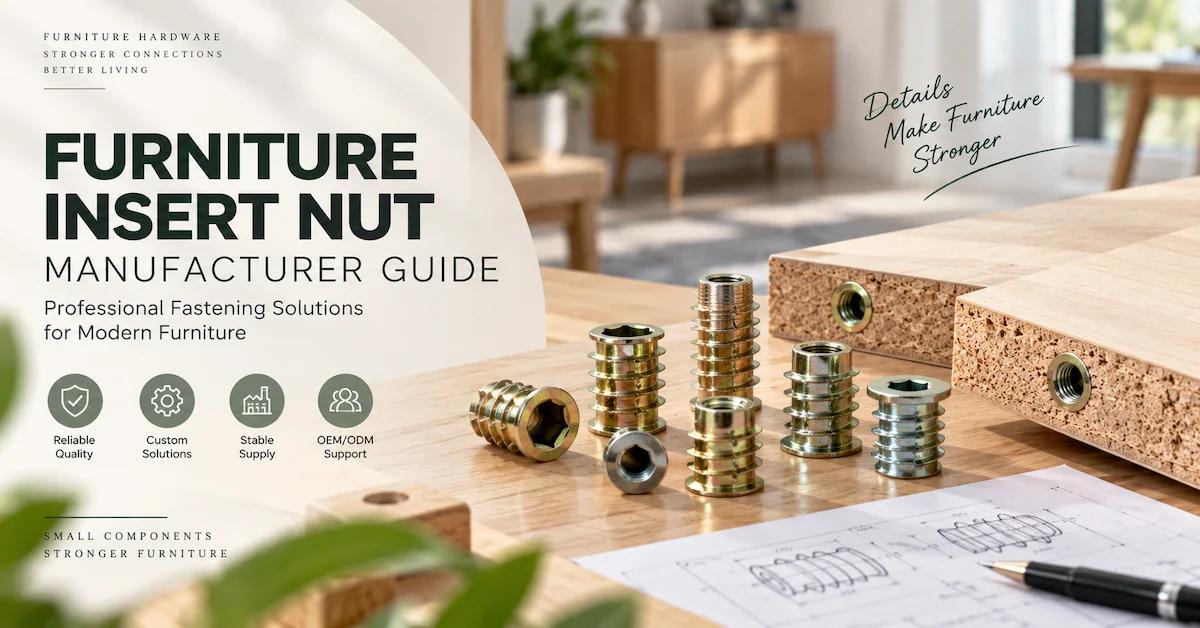
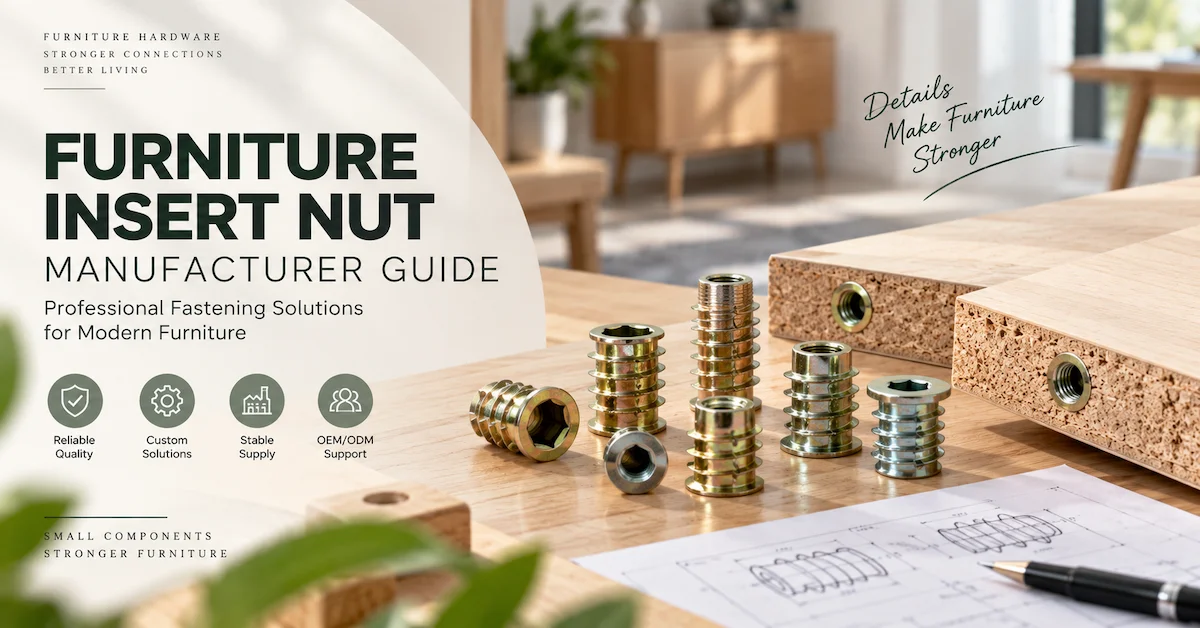
A furniture insert nut is a fastening component installed into wood, engineered wood, or another compatible furniture material to create a defined internal thread for a machine screw or bolt.
Unlike an ordinary wood screw, which engages directly with the surrounding wood-based material, a threaded insert provides a separate machine-thread interface.
The outer body of the insert engages the panel. Its internal thread accepts the mating fastener.
This arrangement can be valuable in furniture designed for:
-
Repeated assembly and disassembly
-
Detachable table legs
-
Removable furniture frames
-
Knock-down cabinet structures
-
Replaceable hardware
-
Adjustable furniture components
-
Modular furniture systems
-
Maintenance and repair access
However, the presence of a metal insert does not automatically guarantee higher joint strength.
The installed connection is only as reliable as the insert-to-panel engagement, internal thread, mating bolt, and surrounding furniture structure.
A properly specified insert can improve serviceability and fastening consistency. An improperly installed insert can rotate, pull out, damage the board, or fail to hold the intended joint.
That distinction is fundamental when evaluating manufacturers.
What Should a Professional Furniture Insert Nut Manufacturer Provide?
For an OEM project, the manufacturer should be capable of reviewing more than an individual product photograph.
A useful supplier evaluation starts with six capabilities.
1. Product and Geometry Understanding
The supplier should understand how different insert designs interact with furniture panels.
Important design features include:
-
Internal thread
-
External thread or rib geometry
-
Body diameter
-
Body length
-
Flange
-
Entry profile
-
Taper
-
Installation drive
-
Seating depth
These characteristics influence how the component is installed and how it interacts with the surrounding material.
2. Material and Finish Review
The supplier should be able to discuss suitable materials and surface treatments according to the application's mechanical and environmental requirements.
Material selection should never rely entirely on appearance.
3. Drawing and Sample Support
An OEM project may begin with a controlled engineering drawing, an existing component, or a physical sample.
The supplier should help identify dimensions or conditions that still require confirmation before manufacturing.
4. Installation Compatibility
The supplier should ask about panel thickness, substrate density, pilot-hole geometry, insertion method, and mating hardware.
A supplier that quotes an insert without considering these details may be overlooking significant installation risks.
5. Quality Control
Inspection should address component dimensions, internal thread fit, external body features, surface condition, and functional installation where required.
6. Packaging and Repeat-Order Control
For furniture factories and private-label brands, consistent quantities, accurate labeling, and controlled item identification are essential.
JHFIX's broader Furniture Hardware and packaging categories allow buyers to consider insert nuts alongside related bolts, screws, connectors, and hardware kits.
Main Types of Furniture Insert Nuts
Not all furniture insert nuts have the same external geometry or installation behavior.
Understanding the main design differences helps buyers avoid selecting products based solely on nominal internal thread size.
Hex-Drive Threaded Wood Insert Nuts
A hex-drive insert nut uses an internal hexagonal installation interface.
Depending on its external design, the component may be installed through a controlled driving or insertion process into a prepared panel hole.
JHFIX's Hex-Drive Threaded Wood Insert Nut product information identifies a short metal insert with an internal hex drive, flanged entry face, external ribs, and internal threaded bore.
Important selection factors include:
-
Hex-drive dimensions
-
Body length
-
Flange diameter
-
External rib geometry
-
Internal thread
-
Panel hole
-
Driver compatibility
-
Installation depth
The hex-drive feature provides a defined tool interface, but the allowable installation torque depends on the insert design and panel conditions.
Tapered Wood Insert Nuts
Tapered insert nuts feature a changing external body profile.
JHFIX also displays a Tapered Hex-Drive Wood Insert Nut with a low flange, internal hex drive, tapered body, and coarse interrupted external ribs.
This geometry should be evaluated against the prepared hole and the intended insertion method.
The presence of a taper does not establish a universal pilot-hole size or installation force.
Those conditions require validation in the actual substrate.
Round-Body Threaded Insert Nuts
Round-body designs feature a generally cylindrical outer form.
The JHFIX Round-Body Threaded Insert Nut is presented as a flanged insert with coarse external ribs, an internal hex drive, and an internal machine thread.
Its product information includes applications such as knock-down furniture joints, adjustable furniture feet, and cabinet hardware mounting.
The correct design should be selected based on panel engagement, mating bolt compatibility, installation, and required joint performance.
Other Furniture Threaded Insert Designs
The wider furniture hardware market also includes alternatives such as pronged T-nuts, externally threaded screw-in inserts, and specialized press-in inserts.
They are not interchangeable merely because their internal thread sizes match.
A pronged T-nut, for example, uses a different retention arrangement from a screw-in insert. Its installation direction, access requirements, and panel geometry may make it suitable for one assembly but unsuitable for another.
Buyers should distinguish these general industry alternatives from the specific JHFIX models available for quotation.
Furniture Insert Nut Type Comparison
| Insert Nut Type | Main Design Characteristic | Typical Application | Key Selection Risk |
|---|---|---|---|
| Hex-drive wood insert | Internal hex tool interface and panel-engaging exterior | Cabinet panels, furniture connections | Drive damage, panel fit, seating |
| Tapered insert | Tapered outer body with defined engagement features | Wood-based furniture joints | Excessive insertion stress or poor retention |
| Round-body ribbed insert | Cylindrical body with exterior ribs | Furniture frames, detachable connections | Incorrect hole size or insufficient retention |
| Externally threaded insert | Outer thread engages prepared substrate | Wood and engineered-board connections | Installation torque and substrate damage |
| Pronged T-nut | Flange and prongs provide retention | Accessible through-hole assemblies | Insufficient rear access or poor prong seating |
The correct choice depends on the complete joint—not the insert style alone.
Furniture Insert Nuts for MDF, Particleboard, Plywood and Solid Wood
One of the most important engineering questions is often overlooked:
What material will the insert nut actually be installed into?
An insert that works well in one panel material may not perform the same way in another.
Panel structure, density, manufacturing method, thickness, hole quality, and local material condition all affect installation and retention.
MDF Furniture Panels
Medium-density fiberboard is widely used in furniture and cabinet manufacturing.
MDF can provide a comparatively uniform engineered structure, but insert installation still requires careful hole and external-geometry selection.
Potential problems include:
-
Local fiber damage during insertion
-
Excessive hole enlargement
-
Insert rotation
-
Inadequate pull-out resistance
-
Panel cracking near unsupported edges
-
Surface swelling in unsuitable moisture conditions
For MDF, buyers should provide the actual board grade and production thickness.
Testing should use representative panels from the intended production supply, not an unrelated sample material.
Particleboard Furniture Panels
Particleboard is common in RTA furniture, wardrobes, cabinets, and storage systems.
Its internal structure can differ from MDF.
The relationship between the insert's external geometry and the panel material is especially important.
An insert may appear to seat correctly while failing to obtain sufficient retention within the surrounding board.
Buyers should confirm:
-
Panel density or grade
-
Face or edge installation
-
Pilot-hole size
-
Insertion depth
-
Distance from panel edges
-
Required holding performance
-
Repeated tightening requirements
For particleboard projects, a real-panel installation trial is particularly valuable.
Plywood Furniture Panels
Plywood contains multiple bonded veneer layers.
Its behavior around an insert can differ from MDF or particleboard because of the layered construction.
Selection should consider the local veneer arrangement, thickness, hole quality, and position relative to panel edges.
Potential concerns include:
-
Veneer damage
-
Splitting or delamination near the hole
-
Incomplete seating
-
Uneven retention
-
Damage from excessive installation force
Plywood should not automatically be treated as a stronger substitute for every insert-nut connection.
The relevant performance must be verified for the selected panel and joint.
Solid Wood Furniture
Solid wood introduces additional variables.
Wood species, grain direction, moisture condition, and local defects may affect installation behavior.
An insert suitable for one wood species may not produce identical results in another.
For furniture manufacturers using solid wood, the approval process should include the intended material and installation direction.
Panel Material Selection Summary
| Panel Material | Important Variables | Recommended Buyer Validation |
|---|---|---|
| MDF | Density, thickness, fiber condition, hole quality | Insertion, seating, torque resistance, pull-out |
| Particleboard | Internal structure, density, edge distance | Retention and panel damage evaluation |
| Plywood | Veneer layers, hole condition, thickness | Seating, splitting, pull-out |
| Solid wood | Species, grain direction, moisture | Insertion behavior and retention |
| Laminated engineered board | Core material, laminate, drilling condition | Panel integrity and functional assembly |
The appropriate insert specification should be confirmed using the buyer's actual production material.
Critical Technical Specifications for Furniture Insert Nuts
The most useful specification sheet is not necessarily the one containing the greatest number of dimensions.
It is the one identifying the features that control the installed joint.
Internal Thread Diameter and Pitch
Internal thread size is a primary selection factor.
Furniture inserts may be specified with metric machine threads such as M4, M5, M6, or M8, depending on the product design.
These examples are common engineering references, not a claim that every size is available in every JHFIX insert configuration.
An M6 designation identifies a nominal metric thread diameter, but buyers should also confirm the intended pitch and tolerance requirements.
Two parts should not be approved as a matched connection based only on the word “M6.”
The mating bolt must be checked against the insert's approved internal thread.
Internal Thread Depth
The useful threaded depth affects how much engagement is available to the bolt.
An insert can have the correct overall length but insufficient usable internal thread for a particular assembly.
The buyer should confirm:
-
Thread depth
-
Bolt length
-
Effective engagement
-
Joint stack thickness
-
Bottoming clearance
-
Blind-hole requirements
The bolt should tighten the intended joint without bottoming out inside the insert.
External Body Diameter
External diameter affects the relationship between the insert and the panel hole.
An unsuitable relationship can cause difficult installation, panel damage, or inadequate retention.
External Rib or Thread Geometry
The outside of the insert determines how the component interacts with the substrate.
Relevant features may include:
-
Rib height
-
Rib spacing
-
External thread form
-
Taper
-
Entry profile
-
Surface condition
These features must be coordinated with the panel and installation method.
Flange Diameter and Thickness
A flange can influence how the insert seats against the panel surface.
Its dimensions may also affect clearance for adjacent hardware.
A flange that is too large can interfere with nearby components. Incorrect flange seating may prevent the connected fitting from sitting flat.
Insert Body Length
The body must fit within the available panel depth while preserving the required material behind the blind hole.
A longer insert is not necessarily better if the surrounding board is too thin.
Installation Drive
For a hex-drive insert, the tool interface should be controlled.
Check:
-
Hex size
-
Hex depth
-
Tool access
-
Driver engagement
-
Expected installation method
Technical Specification Checklist
| Parameter | What the Buyer Should Confirm | Why It Matters |
|---|---|---|
| Internal thread | Diameter, pitch, class | Mating bolt compatibility |
| Thread depth | Usable engagement length | Prevents poor engagement or bottoming |
| Body diameter | Approved outside dimension | Controls hole fit |
| Body length | Overall insertion depth | Prevents panel breakthrough |
| External profile | Ribs, taper or external thread | Controls substrate engagement |
| Flange | Diameter and thickness | Controls seating |
| Drive | Hex or other installation interface | Tool compatibility |
| Material | Approved base material | Mechanical and environmental requirements |
| Finish | Plating or coating specification | Appearance and corrosion considerations |
| Pilot hole | Diameter, depth and tolerance | Installation and retention |
| Panel | Material, density and thickness | Functional performance |
| Testing | Method and acceptance criteria | Objective approval |
For OEM purchasing, these items should form part of a controlled drawing or technical specification.
How to Select the Correct Pilot Hole
Pilot-hole selection is one of the most important steps in threaded insert installation.
There is no responsible universal pilot-hole diameter for all M6 furniture insert nuts.
The correct size depends on the external insert design, panel material, drilling method, and installation process.
What Happens When the Hole Is Too Small?
Depending on the insert and substrate, possible outcomes include:
-
Excessive installation torque
-
Fiber crushing
-
Panel cracking
-
Surface bulging
-
Driver damage
-
Incomplete seating
-
Misalignment
The insert may appear secure initially while leaving damaged material around the connection.
What Happens When the Hole Is Too Large?
Potential problems include:
-
Reduced external engagement
-
Insert rotation
-
Lower retention
-
Unstable seating
-
Pull-out during tightening
-
Variation between assemblies
A hole that allows easy insertion is not necessarily a good hole.
A Better Hole-Approval Method
For an OEM project, establish a controlled trial using the actual panel material.
The engineering team can compare proposed hole configurations while holding other variables constant.
For each candidate, record:
-
Hole diameter and depth
-
Panel material and condition
-
Insert model and revision
-
Installation tool
-
Insertion process
-
Seating condition
-
Visible panel damage
-
Rotation resistance
-
Pull-out performance, where required
-
Functional performance with the mating bolt
The selected configuration should be documented before production.
This is more reliable than copying a drill size from an unrelated product listing.
Insert Nut Pull-Out Strength: What Actually Determines Performance?
Pull-out resistance describes the connection's ability to resist extraction under a defined loading arrangement.
It is not an inherent fixed number that applies to an insert regardless of where it is installed.
Several factors influence the result.
Panel Material
MDF, plywood, particleboard, and solid wood can behave differently under the same loading conditions.
Insert Geometry
The exterior profile, insertion depth, and contact with the surrounding material affect retention.
Hole Preparation
Hole diameter, drilling quality, and local material damage are important.
Installation Method
An incorrectly installed insert may not develop the intended engagement.
Load Direction
The actual direction of force matters.
A direct axial withdrawal test does not necessarily represent every load experienced by a furniture joint.
Joint Configuration
The bolt, bracket, panel thickness, and surrounding furniture structure influence how forces reach the insert.
This is why generic statements such as “an M6 insert nut supports a certain load” should be treated cautiously.
A meaningful performance requirement identifies the complete test configuration.
For example, a furniture manufacturer may specify:
Evaluate the installed insert's axial pull-out performance in the approved 18 mm particleboard using the confirmed hole, installation procedure, mating fastener, conditioning protocol, and acceptance criteria.
The 18 mm thickness in this example is a hypothetical furniture design condition, not a universal recommendation.
The buyer must define the actual acceptance value according to the product's engineering requirements.
Pull-Out Resistance vs Torque-Out Resistance
These two concepts are related but should not be confused.
Pull-Out Resistance
This concerns the force required to withdraw the installed insert from the surrounding substrate under the specified test arrangement.
Torque-Out Resistance
This concerns the insert's resistance to unintended rotation within the panel.
A component may show acceptable axial retention while still rotating during bolt tightening.
Conversely, an insert may resist rotation but have insufficient pull-out performance for the intended joint.
For furniture designed for repeated assembly, both characteristics may be relevant.
Thread Stripping Is a Separate Failure
A third failure mechanism occurs when the internal thread or mating bolt is damaged.
The insert may remain firmly seated while the machine-thread connection fails.
Quality planning should therefore distinguish:
-
Insert-to-panel pull-out
-
Insert-to-panel rotation
-
Internal thread stripping
-
Mating bolt damage
-
Panel splitting
-
Joint movement or loosening
These are different failure mechanisms and may require different tests.
Why Furniture Insert Nuts Spin During Installation
An insert that rotates inside a panel is a common source of assembly trouble.
The problem can occur during initial installation or later when the mating bolt is tightened.
Potential causes include:
Oversized pilot hole
The external profile may not engage the substrate sufficiently.
Incorrect insert geometry
The selected external ribs or threads may be unsuitable for the panel material.
Damaged surrounding material
Excessive insertion force or incorrect drilling can weaken the area around the insert.
Incorrect installation depth
The insert may not seat in the intended position.
Excessive bolt tightening torque
The torque applied during joint assembly may exceed the insert's available rotational retention.
Uncontrolled panel variation
Different board grades or production batches may produce different engagement behavior.
A proper corrective action should identify the mechanism rather than simply replacing the insert with a larger-looking part.
Common Furniture Insert Nut Failures and Solutions
| Problem | Possible Cause | Recommended Investigation |
|---|---|---|
| Insert spins in panel | Poor hole fit or external engagement | Check hole diameter, panel grade and torque resistance |
| Insert pulls out | Insufficient retention or unsuitable joint load | Review panel, insertion depth and test arrangement |
| Panel cracks | Excessive insertion stress or inadequate edge distance | Review hole size, installation method and panel geometry |
| Bolt will not start | Thread mismatch or damaged entry | Verify thread designation and mating bolt |
| Bolt tightens but joint remains loose | Bolt bottoms out or joint stack is incorrect | Check bolt length and usable thread depth |
| Insert sits above surface | Incorrect seating or installation procedure | Check flange and body geometry |
| Internal hex becomes damaged | Tool mismatch or excessive installation torque | Review driver engagement and installation settings |
| Joint loosens after assembly | Joint design, bolt condition or service movement | Evaluate the complete assembly |
| Different batches behave differently | Variation in insert, panel or hole preparation | Compare controlled production samples |
The strongest improvement usually comes from identifying the real cause, changing one controlled parameter, and testing the revised assembly.
Material Selection: Carbon Steel, Stainless Steel and Zinc Alloy
Material selection should begin with the intended application.
Different materials can provide different combinations of mechanical properties, corrosion behavior, manufacturing characteristics, and cost.
However, material names alone do not establish the performance of an installed furniture insert.
Carbon Steel
Carbon steel may be used for selected threaded insert designs.
Depending on the grade and manufacturing route, it can be appropriate for applications where dimensional consistency and mechanical performance are important.
Surface treatment may be required according to the service environment.
Stainless Steel
Stainless steel may be considered when the application has particular corrosion-resistance requirements.
However, stainless steel is not automatically the best choice for every furniture insert.
The selected grade, material strength, geometry, manufacturing route, and installation compatibility still require review.
Zinc Alloy
Zinc-alloy components can be used in furniture hardware where the design and manufacturing process are appropriate.
Their suitability should be evaluated against the required joint performance and application conditions.
A zinc-alloy part should not be assumed to offer the same mechanical characteristics as a carbon-steel part of similar appearance.
Material Verification Matters
Older catalog descriptions may use phrases such as “zinc alloy nut,” “carbon steel,” or “zinc plated” in ways that require clarification.
Buyers should distinguish:
-
Base material
-
Material grade
-
Surface plating
-
Coating process
-
Decorative appearance
A yellow-toned component is not proof of a particular material.
A silver-colored component is not necessarily stainless steel.
JHFIX's current product descriptions emphasize confirming material and finish through the approved drawing, sample, and purchasing specification.
That is the correct approach for repeatable OEM orders.
Zinc Plating, Nickel Plating and Corrosion Requirements
Surface treatment can influence appearance and environmental suitability.
Furniture hardware used inside a dry indoor cabinet may face different conditions from hardware installed in a humid bathroom or frequently cleaned kitchen environment.
Zinc Plating
Zinc plating is commonly considered for steel fasteners where a protective metallic finish is required.
The actual performance depends on the complete coating specification, process, thickness, additional treatments, and service environment.
Nickel Plating
Nickel plating may be selected for particular appearance or technical requirements.
Its suitability must be evaluated for the base material and intended use.
Custom Finishes
OEM buyers may request specific color or finish requirements to coordinate with other furniture hardware.
However, a decorative finish should never replace functional evaluation.
Ask for a Defined Finish Specification
A useful purchase specification should identify:
-
Base material
-
Required finish
-
Appearance requirements
-
Relevant corrosion exposure
-
Testing method, if applicable
-
Acceptance criteria
-
Approved finish sample
Do not treat a generic “anti-rust” claim as a measurable engineering requirement.
Furniture Applications That Benefit From Threaded Inserts
Furniture insert nuts are useful in a range of applications where a machine-thread connection is needed within a compatible panel or furniture component.
Detachable Table Legs
Tables with removable legs may require a defined bolt-to-insert connection.
The insert must match the mounting plate, bolt length, installation direction, and surrounding material.
RTA and Knock-Down Furniture
Flat-pack furniture may use threaded inserts where components are designed to be connected through machine screws or bolts.
The hardware must remain compatible with the drilling pattern and assembly sequence.
Office Desks
Desks can include removable bases, frames, accessory supports, and modular components.
For repeated service or reconfiguration, a controlled threaded connection may be useful.
Bed Frames
Selected bed components may use insert nuts where the design requires detachable joints.
The actual structural requirements must be evaluated at the furniture-system level.
Cabinets and Wardrobes
Cabinet insert nuts can be used for mounting components, detachable frames, selected support fittings, and threaded furniture connections.
Adjustable Furniture Feet
Some furniture leveling or adjustment systems require an internal thread mounted within a structural member.
The insert design must be compatible with the adjustment bolt, panel section, load direction, and installation.
Replacement Furniture Hardware
Replacement applications require careful matching.
The buyer should supply the original insert, mating bolt, panel-hole dimensions, and installation conditions where possible.
A replacement insert should not be approved solely because its internal thread appears identical.
Which Buyers Need OEM Furniture Insert Nuts?
Different B2B customers have different purchasing priorities.
Furniture Manufacturers
Their primary concerns are production consistency, material compatibility, assembly speed, and stable repeat orders.
Cabinet and Wardrobe Factories
They often focus on panel drilling, connector compatibility, installation efficiency, and finished-joint quality.
RTA Furniture Brands
They may prioritize reliable self-assembly, detachable connections, clear instructions, and correctly counted hardware kits.
Furniture Hardware Distributors
They need clear product specifications, variant identification, stable sourcing, and suitable bulk or retail packaging.
Private-Label Hardware Brands
Their purchasing requirements may include product consistency, packaging artwork, barcodes, labels, and branded assortment kits.
Industrial OEM Buyers
They may require drawing-based components, specified thread tolerances, installation qualification, and controlled documentation.
The supplier evaluation criteria should reflect the buyer's actual production or sales model.
How OEM Furniture Insert Nut Manufacturing Works
A structured development process helps move a project from concept to repeatable production.
Step 1: Send Drawings or Samples
Provide the insert drawing or existing sample.
Where possible, also provide the matching bolt, panel specification, and joint section.
Step 2: Review Technical Requirements
The supplier evaluates:
-
Internal thread
-
Body geometry
-
Flange
-
External ribs or thread
-
Material
-
Finish
-
Installation interface
-
Panel-hole geometry
-
Application conditions
The purpose is to identify requirements that are already confirmed and those still requiring buyer approval.
Step 3: Evaluate Manufacturability
Different insert designs may require different manufacturing processes.
The review may consider material preparation, forming, machining, tapping, finishing, inspection, and other operations according to the actual component.
Not every insert uses the same manufacturing route.
Step 4: Develop Representative Samples
Sample approval should include the actual installation conditions, not merely a loose component inspection.
Step 5: Complete Functional Validation
Check the component with production-representative panels and mating bolts.
Evaluate the performance requirements defined by the furniture manufacturer.
Step 6: Freeze the Approved Specification
Document the final drawing, sample revision, material, finish, installation condition, testing requirements, and packaging.
Step 7: Mass Production
The production order should reference the approved specification.
Step 8: Inspection and Packaging
Final inspection should confirm both part compliance and finished-pack requirements.
JHFIX describes its manufacturing capabilities, engineering support, and inspection processes on its About Us page.
For custom projects, a buyer can submit drawings or physical samples for manufacturing and quotation review.
Manufacturing Quality Control: What Should Buyers Inspect?
An insert nut's quality cannot be assessed through visual appearance alone.
A professional QC plan should focus on critical characteristics that influence performance.
Incoming Material Review
Confirm the material according to the approved order specification.
If a specific material grade or certificate is required, agree on the documentation before ordering.
Dimensional Inspection
Check relevant dimensions such as:
-
Body diameter
-
Body length
-
Flange size
-
External rib geometry
-
Taper
-
Entry form
-
Concentricity
-
Installation drive
-
Threaded bore
The exact tolerances should be defined for the component.
Internal Thread Inspection
Verify the thread designation, pitch, class where applicable, useful depth, and fit with the mating bolt.
For ISO metric threads, ISO 965-1:2026 provides a tolerance-system framework for general-purpose metric screw threads.
The relevant thread specification and inspection method should be identified on the drawing.
This does not mean that every threaded insert automatically conforms to a particular ISO tolerance class.
Installation Inspection
Test the insert with representative panels.
Evaluate:
-
Insertion behavior
-
Seating
-
Drive engagement
-
Panel damage
-
Unintended rotation
-
Mating bolt fit
Performance Testing
Depending on the joint design, a buyer may request:
-
Axial pull-out evaluation
-
Rotational retention testing
-
Internal thread performance
-
Repeated assembly testing
-
Joint-function verification
The test procedure and acceptance values must be agreed upon.
Final Pack Inspection
Confirm item numbers, quantity, thread variants, finish, labels, and carton identification.
A correct component placed into the wrong hardware kit can still create an expensive downstream failure.
Which Testing Standards Are Relevant?
Technical standards can support engineering discussions, but the standard must actually apply to the test being performed.
For metric internal threads, ISO 965-1:2026 concerns general-purpose metric thread tolerances.
For engineered wood panels, ASTM D1037 provides methods for evaluating properties of wood-base fiber and particle-panel materials, including certain fastener-holding tests.
However, ASTM D1037's direct screw-withdrawal test should not be represented as an automatic certification method for every installed threaded insert.
A furniture insert nut is a combined system involving the insert, panel, hole, installation procedure, and mating fastener.
If a buyer requires a specific insert pull-out or rotation-resistance result, the test setup should be defined accordingly.
Relevant documentation should identify:
-
Applicable standard or agreed method
-
Panel material and condition
-
Insert specification
-
Hole preparation
-
Installation procedure
-
Test direction
-
Loading arrangement
-
Conditioning
-
Sample quantity
-
Acceptance criteria
A test result without a defined test condition is not a reliable basis for comparing suppliers.
Furniture Insert Nut Manufacturer vs Ordinary Hardware Trader
Some buyers assume that every supplier offering insert nuts has the same level of manufacturing and engineering support.
That is not necessarily the case.
A trading company can be useful when the buyer only needs an established standard part and a convenient sourcing channel.
A manufacturing-oriented supplier may offer additional value when the application requires technical review, customization, sample development, and production coordination.
The distinction should be evaluated through evidence rather than marketing labels.
Ask:
-
Who reviews the engineering drawing?
-
Who controls the manufacturing specification?
-
How are samples approved?
-
Which operations are performed internally?
-
How are subcontracted processes controlled?
-
What inspection records can be provided?
-
How are specification changes managed?
-
Who is responsible for packaging accuracy?
-
How are repeat orders matched to previous approvals?
The best sourcing arrangement depends on the project.
For a highly customized furniture connection, direct technical communication can be particularly valuable.
How to Compare Furniture Insert Nut Manufacturers
A supplier comparison should include technical, quality, commercial, and service criteria.
| Evaluation Area | What to Ask | Why It Matters |
|---|---|---|
| Product experience | Can the supplier explain insert-to-panel fit? | Reduces selection risk |
| Drawing support | Can it manufacture from approved drawings or samples? | Supports OEM projects |
| Thread capability | How is thread fit verified? | Prevents bolt mismatch |
| Material control | Can the agreed material be confirmed? | Supports consistency |
| Installation validation | Can representative panel trials be arranged or evaluated? | Reveals application problems |
| QC capability | Which dimensions and functions are inspected? | Controls batch quality |
| Packaging | Are counted kits and private labels available? | Supports downstream assembly |
| MOQ | Is the minimum based on the exact specification? | Improves purchasing planning |
| Lead time | Are samples, tooling and production quoted separately? | Prevents planning errors |
| Repeat orders | Is an approved sample and revision retained? | Reduces variation |
A supplier should be evaluated against your actual furniture program rather than a generic list of promised advantages.
How Much Do Furniture Insert Nuts Cost?
Furniture insert nut pricing depends on more than internal thread size.
Several factors can influence quotation:
Material
Different material grades and manufacturing routes can change costs.
Component Geometry
A simple insert and a custom insert with complex external features may require different production methods.
Tolerances
Requirements for critical dimensions, thread accuracy, or specialized inspection can affect manufacturing complexity.
Surface Finish
Plating or additional treatment may influence pricing.
Tooling
A custom geometry may require tooling or process development.
Order Volume
The confirmed order quantity and forecast can influence production planning and unit economics.
Testing
Additional qualification or inspection may require extra work.
Packaging
Loose bulk parts, counted furniture kits, and branded retail packs have different handling requirements.
Logistics
Shipping method, destination, packing configuration, and agreed commercial terms should be considered separately from component price.
A realistic quotation should identify which of these items are included.
Avoid comparing prices from different suppliers unless they cover the same product and service scope.
MOQ, Sampling and Lead Time
MOQ is frequently one of the first questions buyers ask.
For the specific JHFIX hex-drive, tapered, and round-body insert nut product pages discussed in this guide, the listed MOQ is 10,000 pieces per confirmed specification.
This is product-specific information.
It should not be interpreted as a universal MOQ for every JHFIX nut or customized hardware project.
MOQ and commercial terms may vary according to:
-
Standard or custom geometry
-
Material
-
Finish
-
Tooling requirements
-
Product variants
-
Order quantity
-
Packaging
-
Inspection scope
Sample and production lead times also depend on the approved technical scope.
For a custom furniture insert nut, buyers should request separate confirmation of:
-
Engineering review requirements
-
Tooling needs, if any
-
Sampling schedule
-
Sample approval process
-
Mass-production schedule
-
Inspection and packaging scope
-
Shipping arrangements
The most useful quotation is one that makes these assumptions clear.
Why Packaging Matters in Furniture Insert Nut Procurement
Insert nuts are small components, but packaging affects production efficiency.
A furniture factory may use several insert sizes and thread variants within one product range.
If those items are mixed or incorrectly labeled, the receiving and assembly teams can experience avoidable problems.
For example, a furniture hardware kit might contain:
-
Four M6 insert nuts
-
Four matching machine bolts
-
Additional mounting brackets
-
Related screws
-
Assembly instructions
If the insert nuts and bolts are not correctly matched, the entire kit may become unusable.
JHFIX offers custom bag packaging and other packaging options for hardware components.
For OEM packaging projects, buyers should specify:
-
Part number
-
Thread specification
-
Quantity per kit
-
Mating fastener
-
Furniture model
-
GOOD review
-
Bag or box format
-
Barcode
-
Label
-
Instructions
-
Carton quantity
The packaging specification should be approved alongside the component specification.
Can a Furniture Insert Nut Manufacturer Supply Complete Hardware Kits?
For furniture manufacturers, sourcing the insert nut alone is not always the most efficient arrangement.
The same furniture product may require machine screws, connector bolts, brackets, washers, cam locks, and other components.
If these parts are sourced independently, the buyer must coordinate compatibility, receiving inspection, inventory, and packing.
An integrated supplier may simplify that coordination.
JHFIX's product range includes:
-
Threaded nuts
-
Furniture connectors
-
Screws
-
Mounting hardware
-
Stamped components
-
Custom packaging
Buyers can review the complete JHFIX product range to identify compatible components for their furniture BOM.
For RTA products, model-specific hardware kits can be especially useful.
The objective is not to place every component in one bag without planning.
It is to create a controlled system in which each furniture model receives the correct components, quantities, and instructions.
How to Prepare a Furniture Insert Nut RFQ
A detailed RFQ is one of the simplest ways to improve sourcing efficiency.
Instead of asking only for a price, provide the information needed to evaluate the application.
Recommended RFQ Checklist
| RFQ Item | Required Information |
|---|---|
| Product type | Hex-drive, tapered, round-body or custom insert |
| Drawing | 2D/3D drawing or approved sample |
| Internal thread | Diameter, pitch and required tolerance |
| External geometry | Body diameter, length, flange, ribs or threads |
| Material | Required base material and grade |
| Finish | Plating or coating requirement |
| Panel | MDF, particleboard, plywood or solid wood |
| Panel thickness | Actual production thickness |
| Pilot hole | Diameter, depth and tolerance |
| Installation | Tool, process and insertion direction |
| Mating bolt | Thread, length, joint stack |
| Testing | Pull-out, rotation, thread or assembly requirements |
| Quantity | Trial, order and annual forecast |
| Packaging | Bulk, counted bags, kits or private label |
| Destination | Country and delivery requirements |
A complete RFQ helps the supplier distinguish confirmed requirements from details that still require engineering review.
Example OEM Inquiry
Subject: RFQ – Custom M6 Furniture Insert Nuts for RTA Cabinet Production
Dear JHFIX Team,
We are developing an RTA cabinet product using 18 mm particleboard and require M6 threaded insert nuts for detachable furniture connections.
We can provide the insert drawing, representative panel material, pilot-hole specification, mating machine bolt, and joint assembly drawing.
Please review the proposed insert geometry, material and finish options, manufacturing feasibility, sampling requirements, quality inspection, MOQ, production lead time, and packaging possibilities.
Our project also requires counted hardware kits containing the insert nuts and matching bolts for each furniture unit.
Please advise what additional technical information is required before quotation.
Best regards,
Purchasing Department
This type of inquiry is more effective than requesting the lowest available price without technical context.
Why Consider JHFIX for OEM Furniture Insert Nuts?
JHFIX, operated by Jiangmen Jinhe Hardware Products Co., Ltd., is a China-based fastener and furniture hardware manufacturer.
According to its company information, the business began in 2004 and supplies international markets.
Its published manufacturing capabilities include:
-
Cold heading
-
Tapping
-
Punching and stamping
-
Injection molding
-
Assembly
-
Packing
-
Inspection
These capabilities are relevant to furniture hardware programs that combine metal components, plastic accessories, related fasteners, and packaging.
Furniture Hardware Product Range
JHFIX supplies different furniture components within its furniture hardware category.
For insert-nut projects, buyers can discuss related screws, bolts, connectors, and hardware requirements rather than evaluating the insert as an isolated purchase.
OEM Drawing and Sample Review
JHFIX's current threaded insert product pages describe made-to-drawing and made-to-sample review.
The technical evaluation can include geometry, mating threads, panel holes, installation methods, materials, finishes, and packaging requirements.
Multiple Insert Configurations
The website currently displays different threaded insert configurations, including hex-drive wood inserts, tapered inserts, and round-body designs.
Each should be evaluated against the actual furniture application.
Packaging Integration
Custom packaging is relevant for furniture manufacturers, hardware distributors, and private-label brands that require controlled component quantities and identification.
Quality Considerations
Current product information emphasizes dimensional inspection, internal thread fit, installation trials, surface condition, and packaging verification.
For a specific project, the buyer should agree on the acceptance criteria and supporting documentation before production.
Technical Communication
A meaningful OEM project begins with the furniture joint and required performance.
Buyers can contact JHFIX for an engineering and quotation review by providing drawings, panel information, mating bolts, order quantities, and packaging requirements.
Frequently Asked Questions About Furniture Insert Nut Manufacturers
1. What is the difference between an insert nut and a regular nut?
A regular nut normally engages a bolt as a separate threaded component.
A furniture insert nut is installed into a panel or furniture component, creating a machine-thread interface within the material.
Its external body must engage the substrate, while its internal thread must match the bolt.
2. What are furniture insert nuts used for?
They are used in selected furniture joints requiring machine-thread connections, such as detachable table legs, cabinet fittings, bed components, modular furniture, adjustable feet, and RTA furniture systems.
The specific application depends on the insert and joint design.
3. Can insert nuts be used in MDF?
Yes, suitable insert nuts can be used in MDF when the geometry, panel specification, pilot hole, and installation method have been validated.
Buyers should test the insert in representative MDF panels rather than assuming that a generic drill size will work.
4. Are threaded inserts suitable for particleboard?
They can be suitable for selected particleboard furniture applications.
Performance depends on the panel grade, density, hole preparation, insert geometry, installation method, and load conditions.
The joint should be qualified before mass production.
5. Which is better: a hex-drive insert or a round-body insert?
Neither is universally better.
A hex-drive feature describes an installation interface, while a round body describes the external form.
Some round-body inserts also have hex drives.
The correct comparison must include the full component geometry, panel engagement, installation, and mating bolt.
6. What size furniture insert nut should I use?
The internal thread should match the furniture's required machine screw or bolt.
The external diameter and length must fit the available panel geometry.
Common metric designations include M4, M5, M6, and M8, but the correct size should come from the joint design rather than general assumptions.
7. Why does my furniture insert nut spin inside the wood?
Possible causes include an oversized pilot hole, unsuitable external geometry, damaged substrate, incorrect installation, or excessive tightening torque.
Inspect the hole, panel material, insert, and actual assembly conditions before changing the part.
8. How do I prevent an insert nut from pulling out?
Start by confirming the panel material, hole geometry, insert external profile, insertion depth, and applied load.
Use representative samples and a defined pull-out test where required.
Avoid assuming that simply increasing insert length will solve the problem.
9. Can furniture insert nuts be customized?
Yes, depending on the manufacturer's technical review.
Customization may include internal thread, body geometry, flange, external ribs, material, finish, and packaging.
JHFIX's current product information supports drawing-based and sample-based customization review.
10. What is the MOQ for furniture insert nuts?
MOQ varies by product specification and manufacturing requirements.
Several current JHFIX threaded insert product pages list 10,000 pieces per confirmed specification.
Buyers should request confirmation for the exact part, material, finish, quantity, and packaging configuration.
11. How should I test a furniture insert nut before bulk ordering?
Use representative panels and mating bolts.
Check dimensions, internal thread fit, installation behavior, seating, visible panel damage, rotational retention, pull-out performance where required, and the final assembled joint.
The acceptance criteria should be agreed before testing.
12. Can JHFIX manufacture insert nuts from drawings or samples?
JHFIX's current insert nut product information describes made-to-drawing and made-to-sample review.
Buyers should provide the part drawing or sample, panel-hole specification, mating bolt, installation requirements, material, finish, quantity, and packaging information.
13. Do furniture insert nuts require corrosion protection?
The required protection depends on the material and operating environment.
Dry indoor furniture and humid environments may have different requirements.
Buyers should define the finish and corrosion-related acceptance criteria rather than assuming one coating is suitable for every application.
14. Can insert nuts and bolts be packed together?
Yes, compatible insert-and-bolt kits can be considered as part of a custom hardware packaging project.
The buyer should specify the part numbers, thread pairing, quantity ratio, BOM, packaging format, labels, and instructions.
15. How do I choose between two furniture insert nut manufacturers?
Compare their ability to understand the complete joint, review drawings, confirm mating threads, support sample approval, control quality, document specifications, and provide suitable packaging.
A lower unit price is not sufficient evidence of better sourcing value.
Conclusion
Choosing the right furniture insert nut manufacturer requires careful evaluation of internal thread compatibility, external geometry, panel material, pilot-hole preparation, installation methods, and quality control.
For furniture factories and OEM buyers, the most reliable sourcing process begins with the complete furniture joint—not just the insert nut's nominal size.
JHFIX offers threaded insert nuts alongside a broader range of furniture connectors, screws, and custom hardware packaging solutions. If you are developing a new cabinet, RTA furniture product, or custom threaded connection, contact JHFIX with your drawings, panel specifications, mating bolts, and order requirements to discuss sample development and an OEM quotation.