
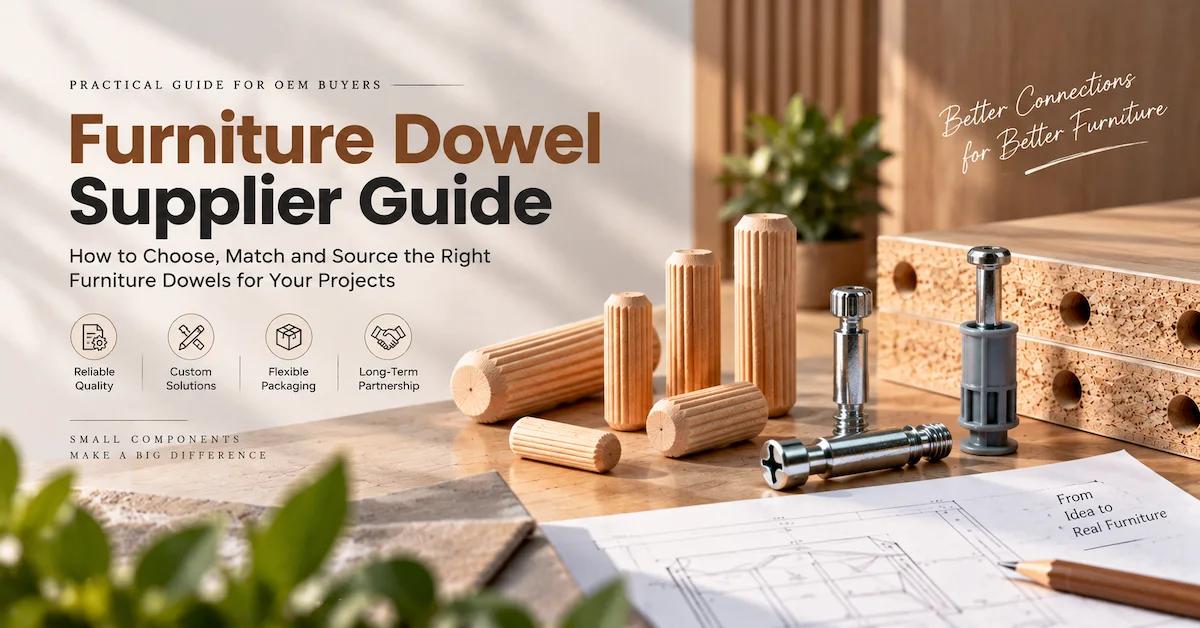
A furniture dowel looks like a small component. In production, it can decide whether two panels align correctly, whether a cam connector catches at the intended position, whether an RTA cabinet assembles smoothly, and whether thousands of hardware kits can be packed without creating the same problem thousands of times.
That is why professional buyers should not choose a furniture dowel supplier by comparing price and nominal size alone.
The first question should be more practical:
What is the dowel expected to do inside the furniture joint?
A wooden dowel used to align two drilled panels is not specified in the same way as a metal connector dowel that must engage a cam. A quick-connect dowel installed through a polymer sleeve introduces another set of interfaces involving the sleeve, pilot hole, projection, and mating connector.
For OEM furniture production, dowel selection therefore starts with the complete joint.
Buyers should define the panel material, panel thickness, drilled-hole geometry, dowel type, mating hardware, installation method, required joint behavior, production quantity, and packaging format before approving a component.
JHFIX groups these products within its Furniture Connecting Bolts & Dowels range, alongside other Furniture Hardware used for cabinet, wardrobe, shelving, RTA, and modular furniture assembly.
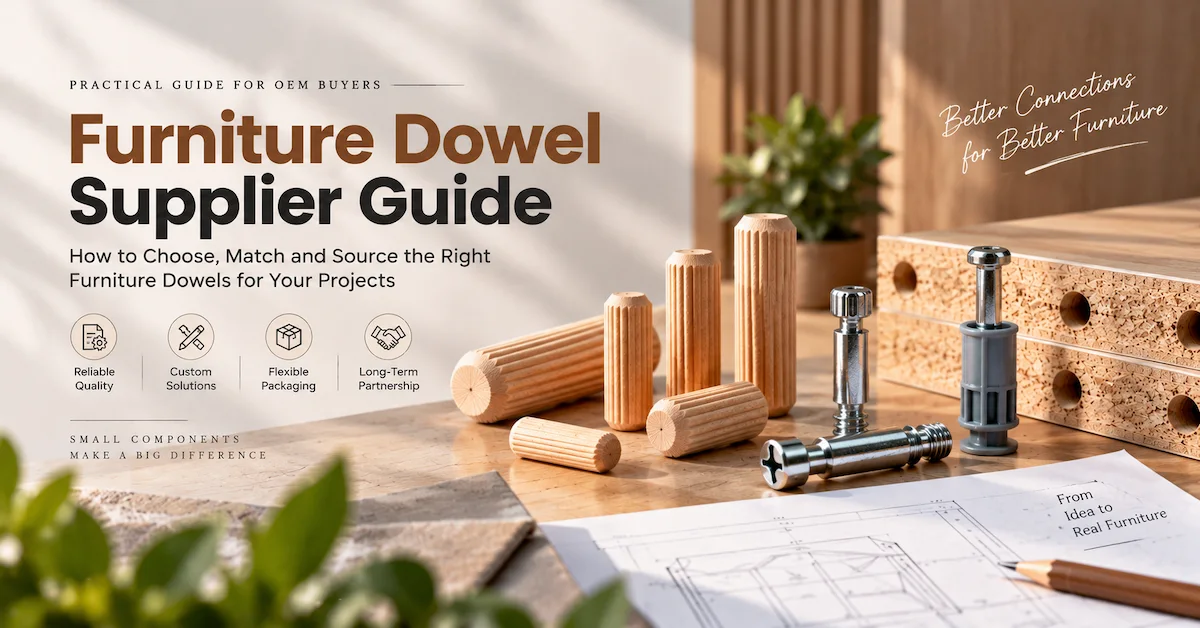
Quick Answer: What Should You Expect From a Furniture Dowel Supplier?
A qualified furniture dowel supplier should be able to do more than ship parts that match a catalog photo.
For an OEM or repeat-production project, the supplier should help the buyer define and control:
-
Dowel type and function
-
Diameter and length
-
End geometry
-
Flutes, slots, sleeves, threads, or capture heads
-
Panel material and thickness
-
Hole diameter and depth
-
Hole position and center distance
-
Mating cam, connector, bolt, or panel
-
Material or wood specification
-
Surface finish where applicable
-
Installation method
-
Adhesive requirements for wooden dowels where applicable
-
Dimensional tolerances
-
Sample approval
-
Functional assembly checks
-
Packaging quantities
-
Variant identification
-
Private-label requirements
-
Repeat-order specification control
The most useful supplier is usually the one that asks about the hole and the mating joint before confirming the dowel.
A dowel cannot be evaluated properly in isolation when its performance depends on the furniture around it.
Why “Furniture Dowel” Can Mean Different Products
One reason sourcing projects become confused is that “furniture dowel” is used for several different hardware concepts.
A buyer may use the term when referring to a traditional wooden alignment dowel. Another buyer may mean the metal connecting pin used with an eccentric cam. Another may be sourcing a plastic-sleeved quick-connect fitting.
Those products may all appear in furniture assembly, but they solve different problems.
| Dowel Type | Primary Role | Critical Buyer Checks | Typical Applications |
|---|---|---|---|
| Fluted wooden dowel | Alignment and joining of prepared wooden panels | Diameter, length, flutes, wood condition, hole fit, adhesive | Cabinets, wood furniture, flat-pack panels |
| Metal connector dowel | Creates an interface with a cam or other capture fitting | Head geometry, thread, insertion depth, center distance, matched cam | RTA cabinets, wardrobes, modular furniture |
| Plastic-sleeved quick-connect dowel | Provides a prepared panel interface with sleeve and mating connector | Sleeve geometry, resin, hole size, projection, retention, matched cam | Quick-assembly cabinets and KD furniture |
| Connector set with cam | Pulls prepared furniture panels together as a matched system | Cam geometry, dowel/bolt geometry, drilling pattern, installation sequence | Flat-pack cabinets, wardrobes, shelving |
This distinction matters because a search for a “furniture dowel supplier” can represent several different purchasing intents.
Before sending an RFQ, define whether your project requires:
-
a wooden alignment dowel,
-
a threaded or screw-in connector dowel,
-
a cam-compatible dowel,
-
a plastic-sleeved quick-connect dowel, or
-
a complete dowel-and-cam connection system.
That single clarification can prevent a surprising amount of quotation and sampling confusion.
Wooden Furniture Dowels: What OEM Buyers Need to Specify
A fluted wooden dowel is one of the simplest-looking furniture components, but repeatable production still depends on several variables.
JHFIX currently presents a Fluted Wooden Furniture Dowel Pin intended for use in matched drilled furniture joints. The product information emphasizes that the final geometry, wood specification, panel holes, joint configuration, quantity, and packaging should be confirmed for the actual order.
That approach is important.
A buyer should not approve a wooden dowel simply because it “looks approximately right.”
Dowel Diameter
Diameter has to be evaluated together with the production hole.
If the relationship is unsuitable, the assembly can become unnecessarily difficult or too loose for the intended process.
The RFQ should therefore describe both sides:
-
Required dowel diameter
-
Hole diameter
-
Hole-production method
-
Tolerance expectations
-
Panel material
-
Whether adhesive will be used
-
How the dowel will be inserted
Do not provide only the dowel dimension while leaving the mating hole undefined.
Dowel Length
Overall length affects the amount of dowel entering each component of the joint.
A longer dowel is not automatically stronger or better. Available drilling depth, panel geometry, joint position, and assembly sequence determine what can actually be used.
For a two-panel joint, identify how much insertion is required on each side and whether either hole is blind.
Flute Geometry
Flutes are part of the component geometry and should be controlled like any other functional feature.
Useful specification points can include:
-
Number of flutes
-
Flute depth
-
Flute shape
-
Consistency around the dowel
-
Surface quality
-
Accepted dimensional tolerance
If an existing furniture line already has an approved dowel, supplying the physical sample together with representative drilled panels can be more informative than sending a photograph.
End Profile
Rounded, chamfered, or otherwise prepared ends influence insertion and alignment.
The end form should therefore be included in the approved sample or drawing instead of being left to visual interpretation.
Wood Specification
A professional wooden furniture dowel order should not identify the material simply as “wood.”
Where relevant to the buyer’s product, the specification should address:
-
Wood species
-
Grade
-
Moisture requirement or approved moisture-control method
-
Visible defect acceptance
-
Grain and surface expectations
-
Accepted color range
-
Finish, if any
Color alone should not be used to identify the species.
If a project depends on a particular wood specification, put it into the purchasing document and approval record.
Why Moisture and Hole Fit Matter for Wooden Furniture Dowels
Wooden dowels are used inside drilled components, so dimensional consistency matters in the exact place where the dowel and the panel interact.
For a buyer, this means the receiving inspection should not stop at counting cartons.
A useful wooden-dowel quality plan can include:
-
Diameter inspection
-
Length inspection
-
Straightness
-
Flute condition
-
End condition
-
Surface defects
-
Approved wood specification
-
Agreed moisture-control criteria
-
Trial insertion into representative holes
-
Assembly evaluation with the real panel material
If glue is used, the assembly method should also be defined.
Questions such as “Is adhesive required?” cannot be answered correctly by the dowel supplier without understanding the furniture design.
The buyer should state:
-
Adhesive type or process, if specified
-
Where adhesive is applied
-
Whether the dowel is pre-inserted
-
Assembly timing
-
Production-line insertion method
-
Required joint evaluation
This makes the approval process much more useful than inspecting loose dowels on a table.
Metal Furniture Connector Dowels Are a Different Sourcing Problem
A metal furniture connector dowel often belongs to a larger mechanical connection system.
For example, JHFIX lists a Slotted Double-End Furniture Connector Dowel with a capture-head side, central slotted section, and panel-entry end.
The important purchasing point is not the product photograph.
It is the interface.
A connector dowel may need to:
-
install into a prepared furniture panel,
-
reach a controlled position,
-
present a head or neck geometry at the correct location,
-
enter a mating cam or quick-connect component,
-
pull or retain the joint during assembly.
A small change in one area can affect another.
That is why the buyer should approve the dowel with the mating hardware and panel geometry.
What Dimensions Matter on a Metal Connector Dowel?
Depending on the connector design, the relevant specification may include:
-
Overall length
-
Shank diameter
-
Head diameter
-
Capture-head profile
-
Neck diameter
-
Shoulder geometry
-
Thread diameter
-
Thread form
-
Thread length
-
Slot width
-
Slot length
-
Panel-entry geometry
-
Installation depth
-
Projection from the installed panel
-
Center distance to the mating cam
-
Surface finish
Not every connector requires every item on this list.
The correct principle is to identify the dimensions that control the real assembly.
A drawing full of dimensions that do not affect fit is less useful than a concise drawing that clearly controls the actual interfaces.
A Dowel and Cam Should Be Approved as One System
This is one of the most important purchasing lessons for RTA furniture.
A cam-compatible dowel should not be approved without considering the corresponding eccentric connector.
The JHFIX Cam Locks & Connector Sets range shows how cams, connecting rods, bolts, dowels, and related components appear together in furniture systems.
For a matched connection, the buyer may need to verify:
-
Dowel capture-head geometry
-
Cam internal geometry
-
Installed dowel projection
-
Panel thickness
-
Cam bore diameter
-
Cam bore depth
-
Edge bore or pilot hole
-
Distance between hole centers
-
Direction of assembly
-
Accessible tightening direction
-
Panel alignment after locking
-
Joint gap after assembly
The important question is not:
“Does this dowel have the same nominal size?”
It is:
“Does this dowel engage the approved cam at the correct position in our actual drilled panels?”
That is a much more useful qualification standard.
Plastic-Sleeved Quick-Connect Dowels: Control Both Materials
Quick-connect furniture dowels introduce another interface.
JHFIX currently lists a Plastic-Sleeved Quick-Connect Furniture Dowel consisting of a metal dowel and polymer sleeve configuration.
In this type of product, buyers should treat the metal and polymer components separately during specification review.
Metal Component
Check the:
-
Head
-
Neck
-
Shank
-
Straightness
-
Projection
-
Retention with the sleeve
-
Mating connector interface
-
Surface appearance
-
Agreed finish
Polymer Sleeve
Check the:
-
External geometry
-
Thread form where applicable
-
Flange geometry
-
Resin specification
-
Color
-
Surface condition
-
Retention of the metal component
-
Panel-hole engagement
A green, blue, black, or other visible sleeve color should not be treated as proof of a particular resin.
If resin identity matters to the project, it should be specified.
Color can also function as a production identifier, but the supplier and buyer should agree on what the color means before it becomes part of the BOM.
Wooden Dowel vs Metal Connector Dowel: Which Is Better?
Neither is universally better.
They solve different assembly requirements.
Choose a Wooden Dowel When:
-
The primary function is panel alignment or traditional dowel joining.
-
The furniture design uses accurately drilled matching holes.
-
The dowel will remain inside the assembled joint.
-
Adhesive or a combined fastening method is part of the design.
-
The required joint does not depend on a cam capture head or threaded connector interface.
Consider a Metal Connector Dowel When:
-
The furniture uses an eccentric cam connection.
-
The joint must be tightened through a mating fitting.
-
The product is RTA or knock-down furniture.
-
The connection needs controlled installed projection.
-
A defined mechanical connector system already exists.
Consider a Plastic-Sleeved Quick-Connect Dowel When:
-
The approved assembly uses a sleeve-based panel interface.
-
Quick assembly is part of the furniture design.
-
The sleeve helps define installation or retention.
-
Color-coded hardware variants are useful for production or kit management.
-
The mating connector has already been confirmed.
The furniture structure should decide the hardware—not the other way around.
Which Furniture Applications Commonly Use Dowels?
Furniture dowels can appear in many product categories, but the correct type depends on the joint.
Common applications include:
Cabinet Manufacturing
Dowels may align side panels, tops, bottoms, internal partitions, shelves, or structural members.
Where eccentric cams are used, metal connector dowels and cam fittings should be treated as a matched system.
Wardrobes
Wardrobes often involve large panels and repeated drilling patterns.
Variation in panel machining or connector position can become visible during assembly as gaps, misalignment, or difficult locking.
Flat-Pack and RTA Furniture
RTA products make hardware selection particularly important because assembly may occur far from the factory.
The person building the furniture expects:
-
Correct components
-
Correct quantities
-
Predictable fit
-
Clear differentiation between similar parts
-
Smooth assembly sequence
The dowel therefore becomes part of the user experience.
Shelving and Storage Furniture
Wooden dowels may support alignment and joining, while connector dowels can be used where panels need a mechanical locking system.
Tables and Modular Furniture
Depending on the design, dowels may work with connecting bolts, inserts, brackets, or other furniture fittings.
The surrounding hardware should be reviewed together.
Replacement Hardware
Replacement projects can be more difficult than new development.
The buyer may not have the original drawing.
In this situation, send:
-
Existing dowel
-
Mating cam or connector
-
Representative panel if possible
-
Accurate hole dimensions
-
Installed projection
-
Photographs of the assembly
-
Furniture model information
Avoid asking the supplier to reproduce an unknown connector from one distant photograph.
How Panel Drilling Changes the Furniture Dowel Specification
The drilled panel is effectively the second half of the dowel specification.
A dowel drawing without the relevant hole data can leave an important part of the connection undefined.
For wooden dowels, useful panel information includes:
-
Panel material
-
Panel thickness
-
Hole diameter
-
Hole depth
-
Hole centerline
-
Distance from edges
-
Drilling tolerance
-
Whether the hole is blind or through
-
Adhesive process
For connector dowels, add:
-
Pilot hole
-
Edge bore
-
Installed depth
-
Required projection
-
Cam-hole position
-
Center distance
-
Mating hardware geometry
For quick-connect sleeve systems, also define:
-
Sleeve pilot hole
-
Sleeve insertion condition
-
Flange position
-
Retention requirement
This information is especially important when moving a furniture program from one supplier to another.
Two dowels that look almost identical may not behave identically if the installed geometry changes.
Why Sample Approval Should Use Real Furniture Panels
A loose component sample is useful for appearance and basic dimensional review.
It is not enough for every furniture connector project.
For a functional approval, use a representative assembly.
That can include:
-
Production-equivalent panel material
-
Actual panel thickness
-
Actual drilling pattern
-
Proposed dowel
-
Mating cam or connector
-
Production tool or driver
-
Normal assembly sequence
Then evaluate the characteristics that matter to the product.
For example:
-
Is insertion controlled?
-
Do panels align?
-
Does the cam catch correctly?
-
Is the tightening direction practical?
-
Does the joint close as intended?
-
Is there unwanted panel damage?
-
Can operators assemble it consistently?
-
Can the approved configuration be reproduced?
The approved sample should then become part of the repeat-order reference.
For a custom project, JHFIX states that made-to-drawing and made-to-sample review can be used for furniture dowels and connector components.
Build a “Golden Sample” Before Bulk Production
For repeat purchasing, a controlled approval reference is extremely useful.
The buyer can create a golden-sample package containing:
-
Approved dowel
-
Matching connector
-
Representative finished panel or hole sample
-
Approved drawing revision
-
Material specification
-
Finish standard
-
Packaging sample
-
Label
-
BOM version
-
Test or inspection requirements
The purpose is simple:
When the next order is placed six months later, the team should not have to reconstruct the requirement from old email conversations.
A controlled sample and revision record gives purchasing, engineering, quality, and the supplier a common reference.
This is especially valuable when the furniture range contains several similar dowels.
How to Evaluate Furniture Dowel Quality
“Good quality” is too vague for an RFQ or inspection plan.
Define what quality means for the actual dowel.
For Wooden Furniture Dowels
Consider checking:
-
Diameter
-
Length
-
Flute geometry
-
End geometry
-
Straightness
-
Surface quality
-
Wood specification
-
Approved moisture-control requirement
-
Visible defects
-
Hole fit
-
Panel alignment
-
Adhesive process where relevant
-
Packaging condition
For Metal Connector Dowels
Consider:
-
Head geometry
-
Neck and shoulder
-
Shank diameter
-
Straightness
-
Thread diameter and form
-
Thread length
-
Slot geometry where applicable
-
Installed depth
-
Projection
-
Surface condition
-
Mating-cam engagement
-
Assembly alignment
For Plastic-Sleeved Dowels
Check both components:
-
Metal geometry
-
Sleeve dimensions
-
External sleeve thread
-
Flange
-
Resin requirement
-
Color
-
Surface molding condition
-
Metal-to-sleeve retention
-
Panel fit
-
Mating connector engagement
For Finished Hardware Kits
Add:
-
Correct part number
-
Correct variant
-
Quantity per kit
-
Mating-part ratio
-
Bag or compartment identity
-
Label
-
Barcode
-
Carton marking
-
Protection during transport
Quality should follow the product from the component level to the final packed kit.
What Does a Professional Furniture Dowel Supplier Check During QC?
For an OEM buyer, a useful supplier QC system normally has several stages.
1. Incoming or Material Review
The supplier confirms the materials or approved component inputs against the purchase specification.
For a wooden dowel, this can include the approved wood specification and condition requirements.
For a mixed metal/polymer product, both component materials should be controlled.
2. Dimensional Inspection
Inspection should focus on features that affect fit.
This may include:
-
Diameter
-
Length
-
Head dimensions
-
Threads
-
Flutes
-
Sleeve geometry
-
Straightness
-
Projection-related dimensions
3. In-Process Monitoring
The objective is to detect drift before an entire batch is completed.
For repeated furniture production, consistency matters as much as one perfect sample.
4. Functional Joint Trial
Representative parts should be checked with the defined mating system where required.
A metal dowel that passes a dimensional check can still cause a problem if the matched cam or panel geometry has changed.
5. Appearance and Finish Inspection
This applies where visible surface condition, plating, color, or polymer appearance forms part of the agreed requirement.
6. Packaging Audit
Confirm:
-
Part identity
-
Pack count
-
Variant separation
-
Label information
-
Protection
-
Carton identification
This final stage is critical for furniture kits because an accurately manufactured dowel is still a customer problem if it is packed in the wrong bag.
How Packaging Affects Furniture Dowel Sourcing
Packaging is often treated as a logistics detail.
For flat-pack furniture, it is part of production control.
A furniture manufacturer may need 4 dowels in one product, 8 in another, and a different dowel variant in a third model.
If all parts are delivered loose, the furniture factory must perform the integration work.
A supplier that can prepare counted packs may help simplify downstream assembly and kit preparation.
JHFIX provides Bag Packaging alongside furniture hardware manufacturing, allowing projects to be reviewed for bulk packing, counted bags, hardware kits, or private-label formats depending on the component and order requirement.
When requesting packaging, specify:
-
Furniture model
-
GOOD review
-
Dowel part number
-
Quantity per furniture unit
-
Other components in the same pack
-
Spare quantity, if any
-
Bag or compartment format
-
Label
-
Barcode
-
Instruction reference
-
Inner-carton quantity
-
Master-carton requirements
Do not simply request “custom packaging.”
Define the packing logic.
Why BOM Accuracy Matters More Than Packaging Appearance
A beautifully printed hardware bag is useless if the wrong component is inside it.
For OEM furniture programs, component identity should come before graphic design.
The supplier and buyer should establish:
Part number → specification → quantity → kit → furniture model → label.
This becomes especially important where several dowels have similar appearances.
A furniture line may contain:
-
Two wooden dowel lengths
-
Different cam-compatible connector dowels
-
Several sleeve colors
-
Similar bolts
-
Different shelf pins
Without controlled identification, visual similarity can create packing errors.
The packaging approval should therefore include both artwork and actual packed contents.
What Should Buyers Send in a Furniture Dowel RFQ?
A strong RFQ produces a stronger quotation.
Instead of sending:
Need furniture dowel. Please quote best price.
Send structured information.
| RFQ Item | Information to Provide | Why It Matters |
|---|---|---|
| Dowel type | Wooden, metal connector, quick-connect, cam-compatible | Defines the product family |
| Drawing/sample | Controlled drawing or physical approved part | Reduces interpretation |
| Diameter/length | Required dimensions and tolerances | Controls basic fit |
| Interface geometry | Flute, head, neck, shoulder, slot, sleeve, thread | Controls function |
| Panel material | MDF, particleboard, plywood, wood or specified panel | Provides application context |
| Panel thickness | Actual production thickness | Helps define joint geometry |
| Hole details | Diameter, depth, centerline, edge distance | Defines mating condition |
| Mating hardware | Cam, bolt, connector or other component | Confirms system compatibility |
| Installation | Tool, insertion method, sequence | Supports manufacturability review |
| Material | Wood specification, metal, polymer requirements | Defines component construction |
| Finish | Required finish or approved appearance | Controls surface requirement |
| Testing | Buyer-defined fit or joint evaluation | Creates acceptance criteria |
| Quantity | Forecast and order quantity | Supports quotation planning |
| Packaging | Bulk, bag, kit, private label | Defines finished supply format |
The more important the furniture program, the less the RFQ should depend on assumptions.
A Practical RFQ Example
A useful inquiry could read like this:
We are developing an RTA wardrobe and need a furniture connector dowel for production. The panels are 18 mm particleboard. We can provide the existing cam, dowel sample, panel drilling drawing, and complete joint section. Please review the dowel geometry, installed projection, mating cam compatibility, proposed material and finish, sample requirements, MOQ, packaging, and quotation. Each wardrobe hardware kit requires eight dowels, and we need the bags identified by our internal item code.
That message gives the supplier something meaningful to review.
It is much better than:
Please send catalog and price.
What Is the MOQ for Furniture Dowels?
MOQ should be confirmed for the exact product and specification rather than assumed across the entire category.
For example, the current JHFIX product pages for its fluted wooden furniture dowel, slotted connector dowel, and plastic-sleeved quick-connect dowel state an MOQ of 10,000 pcs per confirmed specification.
That figure should not automatically be applied to every furniture hardware product.
Changes in:
-
Geometry
-
Tooling
-
Material
-
Finish
-
Color
-
Packaging
-
Variant count
can affect commercial conditions.
For a new project, send the specification and requested annual or order quantity through the JHFIX Contact Us page for project-specific review.
How Should You Compare Furniture Dowel Supplier Quotations?
The cheapest unit price does not always represent the lowest sourcing risk.
Compare quotations on the same scope.
A useful comparison sheet should include:
| Supplier Comparison Item | Supplier A | Supplier B | Supplier C |
|---|---|---|---|
| Drawing revision confirmed | |||
| Dowel type clearly defined | |||
| Material specification | |||
| Critical dimensions | |||
| Panel-hole requirement reviewed | |||
| Mating cam/component reviewed | |||
| Sample available | |||
| Functional assembly approval | |||
| Packaging format | |||
| MOQ | |||
| Tooling requirement | |||
| Inspection criteria | |||
| Private label | |||
| Repeat-order reference |
If one quotation is dramatically cheaper, check whether the scope is actually identical.
Perhaps one supplier quoted a loose metal part while another included a polymer sleeve. Perhaps packaging was excluded. Perhaps the finish was not defined. Perhaps the mating connector was never reviewed.
A price comparison only works after the specification has been normalized.
Common Furniture Dowel Sourcing Mistakes
Mistake 1: Choosing From a Photograph
Photographs help identify a product family.
They do not reliably define:
-
Dimensions
-
Material
-
Thread
-
Wood species
-
Resin
-
Tolerance
-
Hole fit
-
Mating geometry
Use a drawing or approved sample.
Mistake 2: Specifying the Dowel but Not the Hole
A dowel has to fit something.
Send the panel-hole information.
Mistake 3: Approving a Cam Dowel Without the Cam
A connector dowel and cam form an interface.
Approve them together.
Mistake 4: Assuming Similar Appearance Means Interchangeability
Two connector dowels can look almost identical while differing in head geometry, installed projection, thread, or center-distance requirement.
Mistake 5: Ignoring the Assembly Sequence
A component can fit dimensionally but still be awkward to install in the real furniture.
Use an assembly trial.
Mistake 6: Treating Sleeve Color as Material Identification
Color is not a complete polymer specification.
Mistake 7: Ignoring Packaging Until Production Is Finished
Packaging affects part identification, count, BOM accuracy, and furniture-model control.
Discuss it during development.
Mistake 8: Changing One Part of a Matched Set Without Revalidation
Changing a cam, dowel, sleeve, panel drilling pattern, or material can affect the joint.
Recheck the interface.
Mistake 9: Ordering by an Old Email Description
Use a controlled revision, item number, and approved sample for repeat orders.
Mistake 10: Negotiating Price Before Defining the Product
A low quote based on an incomplete specification can become expensive after sampling, rework, sorting, or assembly problems.
What Should a Furniture Dowel Supplier Do During OEM Development?
A practical OEM development sequence looks like this:
Step 1 — Define the Joint
Start with the furniture.
Identify:
-
Which panels are being connected
-
Panel materials
-
Thicknesses
-
Hole positions
-
Assembly direction
-
Whether disassembly is required
Step 2 — Define the Dowel Function
Is it used for:
-
Alignment?
-
Adhesive joining?
-
Cam engagement?
-
Quick connection?
-
Replaceable furniture hardware?
Step 3 — Review Existing Parts
If replacing an existing supplier, provide the complete interface, not only the dowel.
Step 4 — Confirm Drawing and Open Items
Separate confirmed requirements from assumptions.
An engineering review should make unknown values visible.
Step 5 — Produce Representative Samples
Samples should reflect the proposed production specification.
Step 6 — Test in Representative Panels
Use actual holes, mating components, and assembly conditions.
Step 7 — Freeze the Approval Reference
Create an approved specification and sample.
Step 8 — Confirm Packaging and BOM
Do this before mass production, not after components are already finished.
Step 9 — Mass Production and Inspection
Inspect the characteristics agreed during approval.
Step 10 — Maintain Repeat-Order Control
Future orders should reference the same approved configuration unless a controlled change is introduced.
This workflow turns a small hardware purchase into a manageable manufacturing process.
Why Integrated Furniture Hardware Capability Matters
Many furniture programs contain more than dowels.
A cabinet hardware package may also require:
-
Cam locks
-
Connecting bolts
-
Insert nuts
-
Screws
-
Shelf supports
-
Brackets
-
Mounting plates
-
Plastic parts
-
Packaging
When several suppliers are involved, the buyer becomes the system integrator.
That may be perfectly reasonable for some programs. For others, consolidating compatible components can simplify communication and kit management.
JHFIX's Furniture Hardware product range includes dowels, connector components, cam locks, shelf supports, brackets, and related furniture fittings.
According to the company’s About Us page, its manufacturing operations include cold heading, tapping, punching, injection molding, assembly, packing, inspection, warehousing, and production-line operations.
For an OEM buyer, the relevant question is not simply whether a supplier owns multiple processes.
It is whether those capabilities help control your actual BOM.
If your project contains a metal dowel, polymer sleeve, cam fitting, screws, and a counted hardware bag, an integrated production and packing workflow can be useful because the interfaces can be reviewed together.
What a Furniture Dowel Supplier Is Not Suitable For
Not every supplier is suitable for every project, and not every dowel is suitable for every furniture joint.
A wooden alignment dowel should not automatically replace a designed mechanical connector when the furniture requires a specific locking or detachable system.
A connector dowel should not be selected from a product photo when its mating cam and panel drilling are unknown.
A quick-connect dowel should not be approved only by sleeve color.
A catalog component should not be described as structurally approved for a new application until the furniture manufacturer has evaluated it in the intended assembly.
And a hardware supplier should not make design decisions that belong to the furniture manufacturer without the necessary product information.
A professional sourcing process keeps these boundaries clear.
How Can Buyers Reduce Furniture Dowel Cost Without Creating More Risk?
Cost reduction should begin with specification control rather than simply demanding a lower piece price.
Useful opportunities can include:
Standardize Variants
If multiple furniture models can legitimately use one approved dowel, SKU consolidation may simplify purchasing and packaging.
Do this only after engineering confirmation.
Improve RFQ Accuracy
Fewer assumptions mean fewer quotation revisions and sample rounds.
Freeze the Design Before Scale-Up
Late dimensional or finish changes can create unnecessary disruption.
Review Packaging Quantities
The ideal pack size should reflect the furniture BOM and production process.
Control Similar-Looking Parts
Clear item codes and packaging separation reduce confusion.
Combine Compatible Hardware Where Practical
If a supplier can manage dowels, mating connectors, screws, and kit packaging together, purchasing may be able to simplify coordination.
The goal is not “buy the cheapest dowel.”
The goal is to reduce the total amount of uncertainty attached to each furniture joint.
How to Qualify a Furniture Dowel Supplier Before a Large Order
Use a short qualification checklist.
Engineering
-
Can the supplier work from drawings?
-
Can it compare an existing sample?
-
Does it ask for panel and hole information?
-
Does it understand mating connectors?
-
Can open technical questions be documented?
Sampling
-
Can representative samples be produced?
-
Can multiple variants be clearly identified?
-
Can the sample be evaluated in the actual furniture joint?
Quality
-
Are critical dimensions defined?
-
Is there a functional joint check where required?
-
Can material and finish requirements be controlled?
-
Can packaging counts and labels be audited?
Production
-
Is the proposed manufacturing route suitable for the component?
-
Can repeat orders reference an approved revision?
Packaging
-
Can parts be supplied bulk, counted, or in kits?
-
Can similar components be separated?
-
Can private-label requirements be reviewed?
Communication
-
Are quotation assumptions visible?
-
Are changes documented?
-
Does the supplier distinguish confirmed specifications from values still requiring buyer approval?
Good communication is a technical control, not just a customer-service feature.
Frequently Asked Questions About Furniture Dowel Suppliers
1. What is a furniture dowel?
A furniture dowel is a component used to align, join, or connect furniture parts. The term can refer to traditional wooden dowel pins as well as metal or plastic-sleeved connector dowels used with cams and other knock-down furniture fittings. Always define the specific type when requesting a quotation.
2. How do I choose a furniture dowel supplier?
Evaluate the supplier’s ability to work from drawings or samples, review panel-hole conditions, understand mating components, support sample approval, control critical dimensions, provide suitable packaging, and reproduce the approved specification for repeat orders. Price should be compared only after those requirements are aligned.
3. What information should I send for a wooden furniture dowel RFQ?
Send the dowel diameter, length, end profile, flute geometry, required tolerances, wood specification, panel material, hole diameter and depth, joint drawing, adhesive requirement, quantity, and packaging format. A representative dowel and drilled panel can also help.
4. Can furniture dowels be customized?
Yes, depending on the specific product and manufacturing review. JHFIX's current dowel product information states that dimensions, geometry, flutes, end profiles, connector features, sleeves, finishes, and packaging can be reviewed against the approved drawing, sample, panel, and furniture joint.
5. What is the difference between a wooden dowel and a connector dowel?
A wooden dowel commonly aligns or joins drilled wooden or engineered-board components. A connector dowel is generally part of a mechanical furniture connection and may engage a cam or another capture fitting. Their specifications and approval methods are different.
6. Do I need to provide the panel-hole dimensions?
Yes. Hole diameter, depth, position, panel material, and related geometry can directly affect fit. For cam-type joints, center distance and mating-cam position can also be important.
7. Should a cam dowel be tested with the matching cam?
Yes. A cam-compatible dowel should be evaluated as part of the complete joint. The cam, dowel, panel drilling, installed projection, and assembly sequence all interact.
8. Can I order furniture dowels in custom hardware kits?
JHFIX offers hardware and packaging categories that can be reviewed for counted bags, component sets, compartment packs, or private-label packaging. The buyer should provide the BOM, quantity per furniture unit, item identification, label requirements, and packaging artwork.
9. What is the MOQ for JHFIX furniture dowels?
The current JHFIX product pages referenced in this guide for a fluted wooden dowel, slotted connector dowel, and plastic-sleeved quick-connect dowel state 10,000 pcs per confirmed specification. Other products or customized configurations should be confirmed separately during quotation.
10. Can I send an existing dowel instead of a drawing?
A physical sample can be useful, particularly for replacement projects. For better review, also provide the mating connector, panel-hole information, installed condition, quantity, packaging, and acceptance requirements.
11. How do I prevent wrong dowels from being packed into furniture kits?
Use controlled item codes, BOM revisions, clearly separated variants, approved labels, pack-count requirements, and a final pack audit. Where dowels look similar, do not rely on visual identification alone.
12. What should I check before approving a bulk furniture dowel order?
Confirm the final drawing or sample, material, finish, critical dimensions, panel-hole interface, mating components, assembly test, quantity, packaging, label, and repeat-order reference. Approval should cover the finished supply condition, not only a loose component.
A Better Way to Source Furniture Dowels
The most reliable furniture dowel sourcing projects usually begin with a joint drawing, not a supplier catalog.
First define what the furniture must do.
Then define the panel.
Then define the hole.
Then define the dowel.
Then verify the mating hardware.
Only after those points are clear should the buyer freeze the sample, inspection criteria, packaging, and commercial order.
That sequence is especially useful for RTA furniture, cabinets, wardrobes, shelving, and modular products where a small component can affect the assembly experience of every finished unit.
Buyers evaluating a broader connection system can review JHFIX's Furniture Connecting Bolts & Dowels, Cam Locks & Connector Sets, and complete Furniture Hardware ranges before preparing the RFQ.
For a custom part, replacement component, or model-specific hardware kit, providing the complete joint information will usually produce a more useful technical discussion than sending a generic request for “furniture dowels.”
Conclusion
Choosing a furniture dowel supplier is ultimately a joint-engineering and supply-control decision, not just a search for a small wooden or metal component at the lowest price.
For wooden furniture dowels, buyers should control dowel geometry, wood specification, hole fit, panel conditions, and the intended assembly process. For metal connector dowels, the capture head, thread, installed depth, projection, mating cam, and drilling geometry should be reviewed together. For plastic-sleeved quick-connect dowels, both the metal component and polymer sleeve need their own defined interfaces and quality criteria.
The same discipline should continue through sample approval, mass production, inspection, BOM control, packaging, and repeat orders.
JHFIX supplies furniture dowels within a broader furniture hardware system that includes connecting bolts, cam locks, screws, shelf supports, brackets, stamped parts, and configurable hardware packaging. Buyers can begin by reviewing the JHFIX product range and relevant furniture connector categories.
If you are sourcing a new furniture dowel, replacing an existing connector, or developing a complete hardware kit, prepare the dowel sample or drawing, panel and hole information, mating components, quantity, packaging requirements, and acceptance criteria. Then contact JHFIX for a specification review and project quotation.