
 When a Small Parts Kit Becomes a Real Sourcing Decision
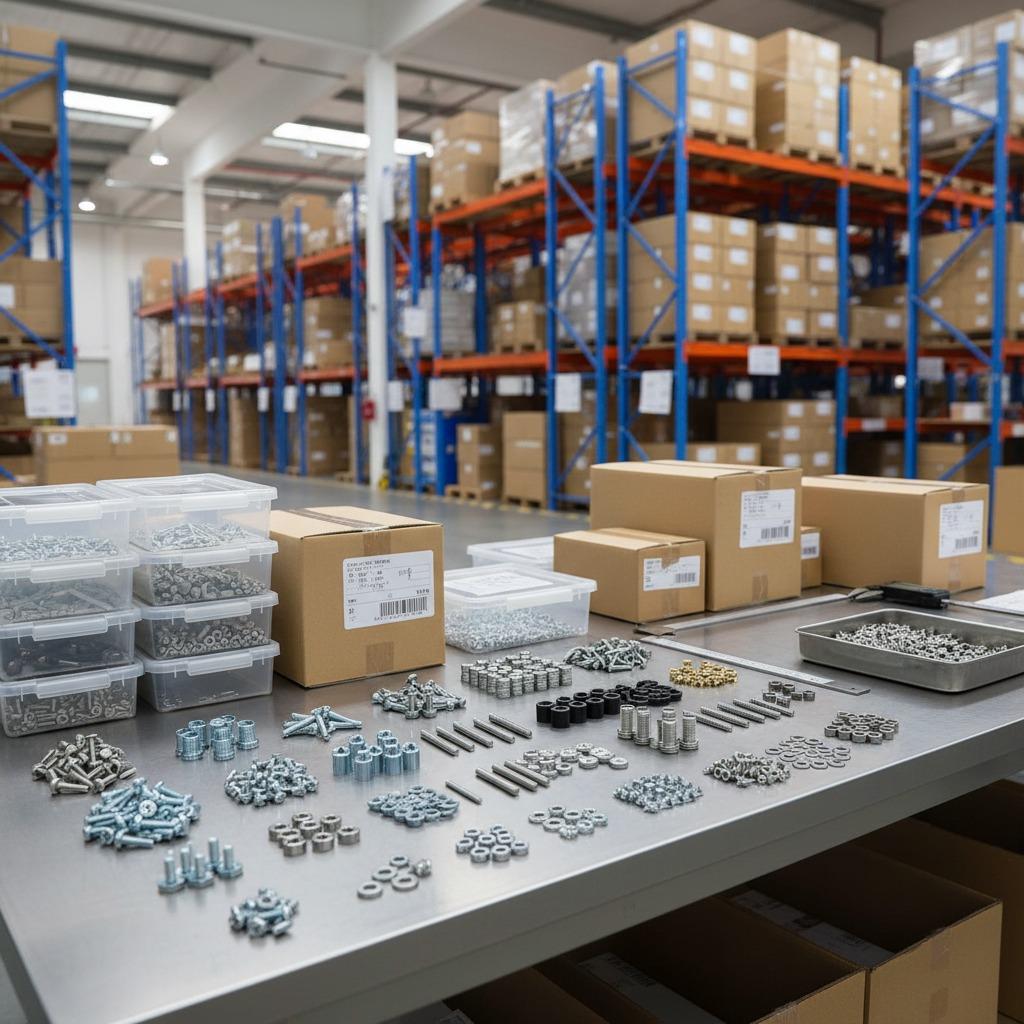
For buyers who handle fasteners, repair packs, furniture hardware, installation kits, or field-service assortments, a custom hardware kit supplier is not just another packaging vendor.
The right supplier affects how quickly a kit can be packed, how well small parts stay organized during shipping, and whether the final product feels professional when it reaches a contractor, wholesaler, installer, retailer, or end user.
That sounds simple until the buyer starts comparing kits for different channels.
A retail hardware kit needs clear presentation.
A maintenance kit needs easy access.
An e-commerce kit needs secure packaging.
A furniture installation kit needs correct part matching.
A factory assembly kit needs repeatable counts and labels.
In all of these cases, the packaging is not separate from the product. It is part of how the product works.
A hardware kit can fail quietly. Screws move into the wrong compartment. Similar sizes get mixed. A lid opens during transport. A customer receives the correct parts but cannot understand which one to use. A clear case looks neat in photos, but the internal layout wastes time every time the user opens it.
So the sourcing decision is not only about price or box appearance.
It is about whether the kit supports sorting, transport, installation, and repeat handling.
Product example: customized drywall and self-drilling screw set
The linked JHFix product page identifies the product direction as Drywall metal self-drilling screw stainless steel installation tools, drywall screws, fiber self-tapping screws set. The visible specification table lists the product name as Customized Screw Set, strength grade 6.8, standard ISO, finish shown as clear / blue zinc, application for bed installation / furniture installation / screw assembly, customized color, OEM/ODM support, customizable screw head types, customizable coarse or fine thread, customizable materials, and thread sizes from M2 / M3 / M4 / M5 / M6 / M8 / M10 / M12.
| Product / Kit Point | Information Buyers Should Review |
|---|---|
| Product Direction | Drywall metal self-drilling screw, stainless steel installation tool, drywall screws, fiber self-tapping screws set |
| Product Name | Customized Screw Set |
| Strength Grade | 6.8 |
| Standard | ISO |
| Finish | Clear / blue zinc wording appears in the translated page text |
| Application | Bed installation / furniture installation / screw assembly |
| Color | Customized |
| Custom Support | OEM/ODM support |
| Head Type | Phillips, multipurpose, slot, Torx, flat, customizable |
| Thread Type | Coarse thread / fine thread, customizable |
| Thread Size | M2, M3, M4, M5, M6, M8, M10, M12 |
This product is a useful example because it is not presented only as a loose screw. It is positioned as a customizable screw set for installation and assembly use. That makes it relevant for furniture hardware kits, drywall installation packs, repair boxes, contractor assortments, and OEM fastener packaging.
At the same time, buyers should read the product information carefully. The title mentions drywall metal self-drilling screws, stainless steel installation tools, drywall screws, and fiber self-tapping screws, while the product table uses the broader name Customized Screw Set. The material line in the translated table also appears imperfect, so final material, finish, screw type, head type, and package structure should be confirmed by drawing, sample, or quotation before bulk production.
Why buyers consider this format for custom hardware kits
Custom packaging for fasteners is usually a compromise between three goals: speed, presentation, and control.
A screw kit must be fast to pack.
It should be easy for the customer to understand.
It must keep the correct parts together.
It should reduce mistakes during installation or assembly.
For a customized screw set, this becomes especially important because the same product family may include different screw heads, different thread types, and different thread sizes. A Phillips screw and a Torx screw cannot be packed carelessly if the instruction sheet expects one specific tool. A coarse-thread screw and a fine-thread screw may look similar to a hurried worker. M5 and M6 parts may be easy to confuse if labels are weak.
The JHFix page lists customizable head types and coarse/fine thread options, which means buyers can adjust the kit according to the real application. But this flexibility only helps when the packaging is controlled.
A custom hardware kit should not become a box of “similar-looking parts.”
It should be a clear system.
What the organizer case teaches sourcing teams
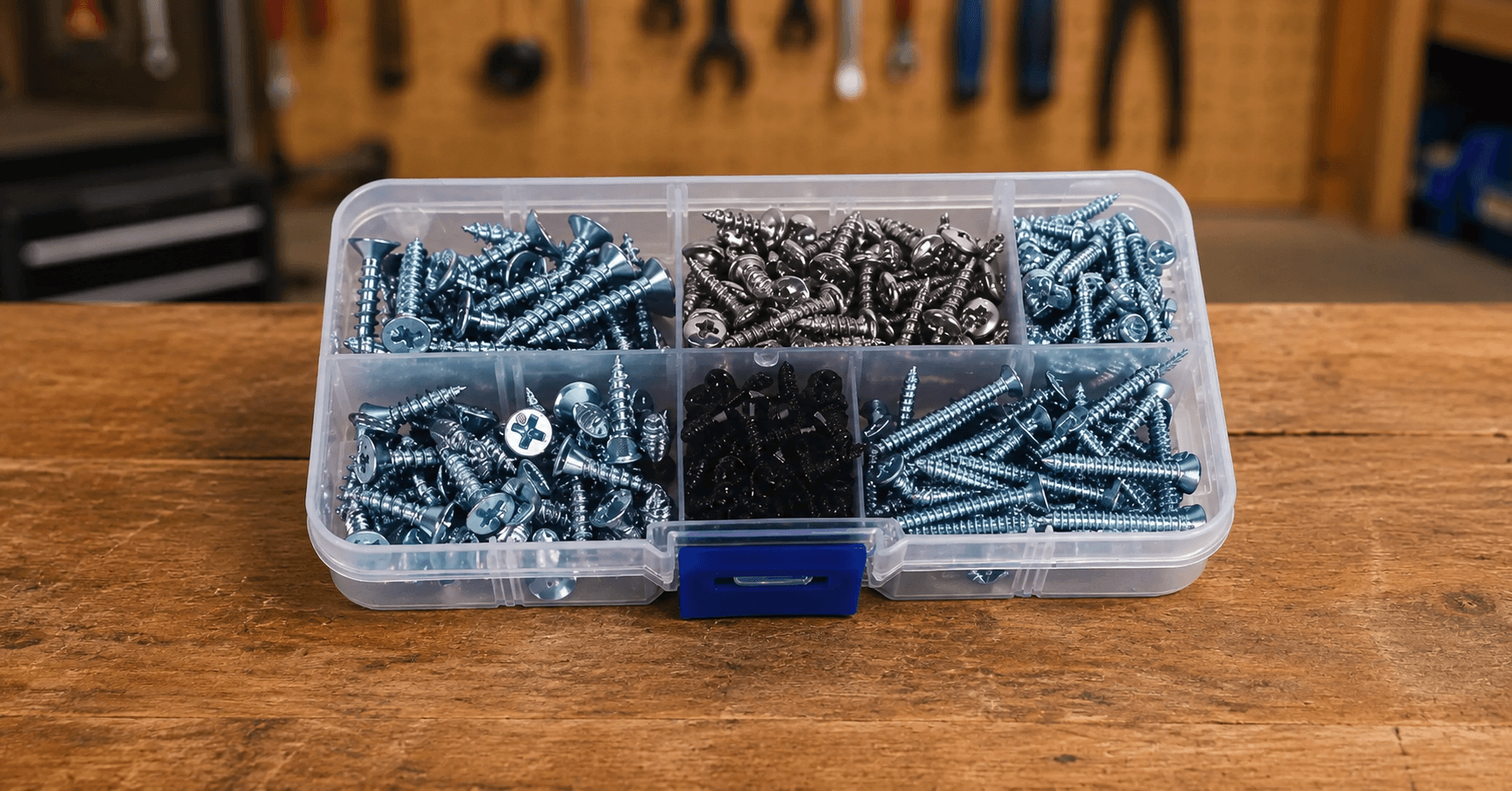
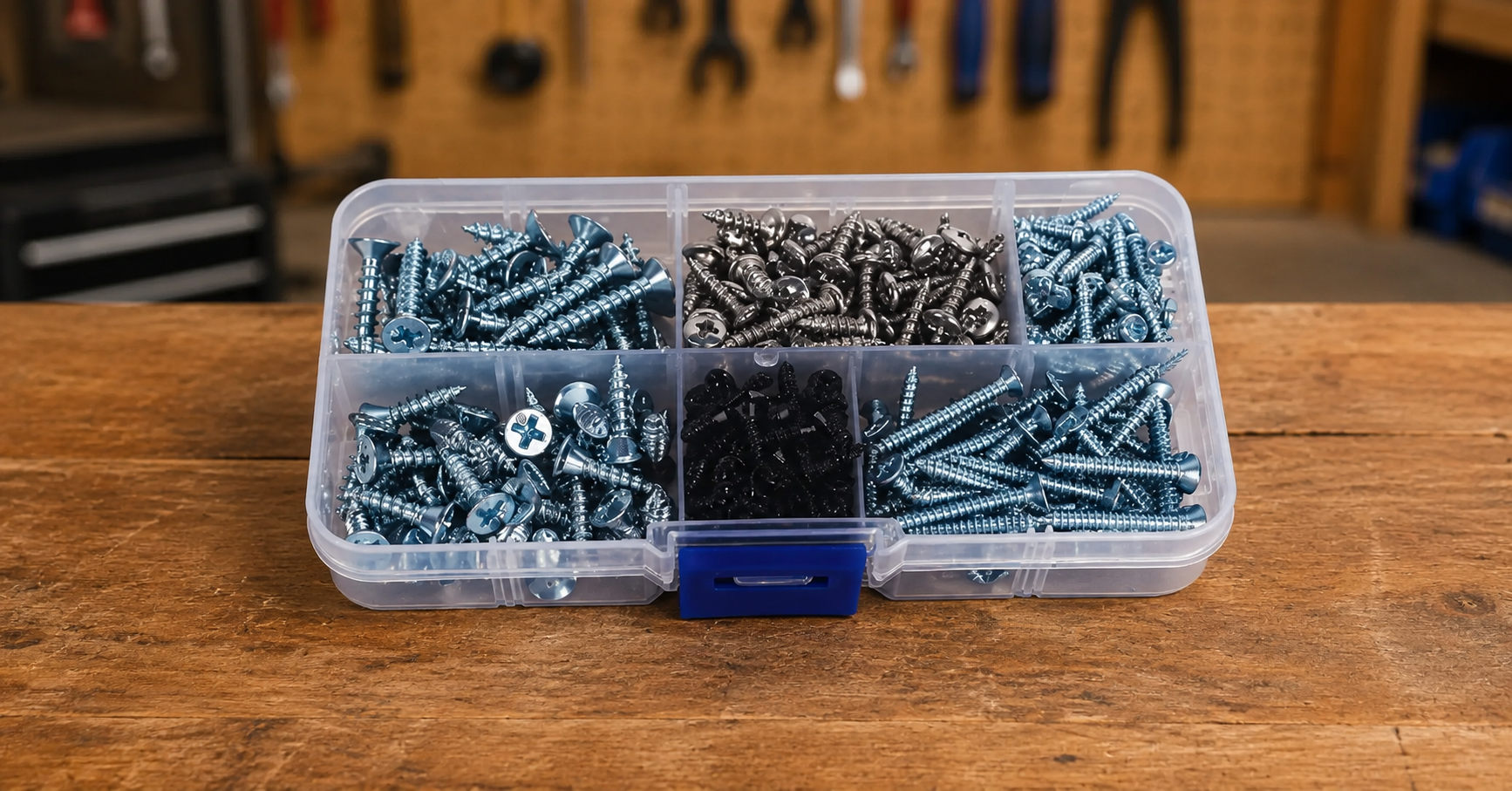
A transparent plastic organizer box is a practical format for many small hardware kits.
The clear lid helps workers check contents quickly. Compartments keep different sizes separated. A latch gives the user a basic way to keep the kit closed during normal handling. For small fasteners, installation screws, drywall screws, anchors, and repair parts, that kind of simple organization can save real time.
But buyers should not assume every clear box performs the same way.
A good organizer must match the part geometry. Long screws and tiny washers do not behave the same way. A compartment that works for short machine screws may be awkward for self-drilling screws. If screws are too long for the box, the lid may not close cleanly. If compartments are too shallow, parts can cross into another section during shipping.
This is why buyers should test the kit with real parts, not empty packaging.
Where this screw kit can be used
Based on the product page, the listed application direction includes bed installation, furniture installation, and screw assembly. The product title also points toward drywall screws, self-drilling screws, and self-tapping screws.
That makes the kit relevant for several B2B channels:
- furniture installation kits
- bed assembly hardware packs
- drywall fixing kits
- contractor screw assortments
- repair and maintenance boxes
- flat-pack furniture hardware bags
- installation tool packs
- OEM screw kits
- e-commerce hardware sets
- distributor fastener assortments
Each channel needs a slightly different packaging logic.
A furniture kit should match the assembly instruction.
A drywall screw set should match the wall or board material.
A contractor kit should be easy to carry and reopen.
A retail kit should be easy to understand at first glance.
An OEM kit should repeat the same BOM every shipment.
That is why the best custom hardware kit supplier starts with the use case, not just the box size.
Selection criteria buyers often miss
1. Part geometry
The first question is not how many compartments the box has. The first question is whether the compartments fit the actual parts.
Self-drilling screws, drywall screws, anchors, washers, and installation tools all have different shapes. If the kit includes several screw lengths, the box should keep them separated. If the kit includes tools, the tool should not crush or scratch the fasteners. If the kit includes sharp screw points, the packaging should protect the inner surface and prevent loose movement.
2. Head type and tool matching
The product page lists customizable screw head types, including Phillips, multipurpose, slot, Torx, and flat options.
This matters because the user must have the correct tool.
For consumer furniture kits, a common drive type may reduce confusion. For professional installation kits, a Torx or other drive type may be acceptable if the correct bit is expected. For a mixed screw assortment, head type should be clearly separated and labeled.
A screw kit fails when the user has the right screw but the wrong driver.
3. Thread type and application
The page lists customizable coarse or fine thread options.
This should be matched to the material and application. A screw used in drywall, metal, wood-based panels, or furniture hardware may need different thread behavior. Buyers should not choose coarse or fine thread only by habit.
The screw should be tested in the real material before mass production.
4. Visibility and labeling
A clear lid helps, but it does not replace labeling.
For retail assortments, buyers may need printed size charts. For factory use, a simple part number label may be enough. For furniture kits, the label should match the assembly step. For maintenance kits, size and type should be easy to identify after repeated use.
A tidy kit is useful.
A searchable kit is better.
5. Finish and material confirmation
The product table shows finish wording as clear / blue zinc, while the page title mentions stainless steel installation tools and drywall screw directions. Buyers should confirm what finish applies to each item in the final kit.
For B2B orders, the final specification should clarify:
- screw material
- screw finish
- tool material, if included
- thread type
- head type
- screw length
- screw size
- quantity per compartment
- packaging format
- carton packing
This protects both the buyer and the supplier.
Hardware-only sourcing versus kit-based supply
Buying screws in bulk is not the same as buying a finished hardware kit.
Bulk sourcing can be cheaper at first. But if the buyer must sort, count, label, and repack the screws after receiving them, the real cost rises. Kit-based supply may cost more per set, but it can reduce labor, mistakes, and customer complaints.
| Sourcing Method | Main Advantage | Main Risk |
| Bulk screw supply | Lower simple part cost | Buyer must sort, count, and repack |
| Bagged screw kit | Economical for furniture or installation packs | Similar parts may still mix if labels are weak |
| Plastic organizer box | Better visibility and reuse | Compartments must match part geometry |
| PVC packaging kit | Useful for organized installation hardware | Final structure must be confirmed before order |
| OEM custom hardware kit | Matches product model, brand, and assembly process | Requires clear BOM and sample approval |
A buyer should not ask only, “How much is each screw?”
The better question is, “How much work does this kit save after delivery?”
What a custom hardware kit supplier should support
A credible custom hardware kit supplier should handle more than packaging supply.
The supplier should be able to discuss:
- screw size selection
- head type options
- thread type options
- material and finish confirmation
- kit BOM review
- packaging layout
- box or bag format
- label content
- sample approval
- inspection before delivery
- repeat-order consistency
The linked JHFix page shows direct inquiry channels through sharon@hkhomeideas.com and +86 13322893939, and the footer identifies Jiangmen Jinhe Hardware Products Co., Ltd. This gives buyers a route to request samples, confirm product details, and discuss OEM/ODM packaging needs.
For sourcing teams, the important point is to turn broad product options into a controlled kit.
A supplier that simply fills a box may not be enough.
A supplier that helps define the kit structure can reduce future problems.
Common mistakes buyers make
One common mistake is treating all storage cases as interchangeable.
A box for short screws may not suit longer self-drilling screws. A case for washers may not hold tools securely. A compartment layout for furniture fasteners may not work for drywall anchors.
Another mistake is choosing by total piece count only. More pieces do not automatically make a better kit. The size mix must match real demand.
A third mistake is approving the screw and packaging separately. They should be tested together.
Buyers also sometimes ignore the final user. Warehouse staff may prefer one layout. Contractors may prefer another. Retail customers may need more visible labeling. Factory assembly workers may need step-based packaging.
The final mistake is not testing transit behavior. A box that looks organized on a desk may mix parts inside a carton.
Buyer takeaway
A reliable hardware kit is a system, not a pile of parts.
The screws must match the application.
The head type must match the tool.
The thread must suit the material.
The compartments must fit the parts.
The label must guide the user.
The supplier must repeat the approved kit.
The linked JHFix product is relevant because it combines a customized screw set direction with drywall, self-drilling, self-tapping, installation, furniture, and OEM/ODM packaging possibilities. That is exactly where many sourcing teams need support: not only buying fasteners, but turning them into a usable kit.
FAQ
Is a clear organizer case only for retail kits?
No. Clear organizer cases can also be useful for workshops, maintenance teams, contractor assortments, installation kits, and internal factory use.
What product information is supported by the linked JHFix page?
The page supports a drywall metal self-drilling screw / drywall screw / fiber self-tapping screw set direction. The table lists customized screw set, strength grade 6.8, ISO standard, clear / blue zinc finish wording, bed installation / furniture installation / screw assembly application, customized color, OEM/ODM support, customizable head types, customizable coarse or fine thread, and M2 to M12 thread sizes.
What should buyers confirm before placing a custom order?
Buyers should confirm screw type, screw size, length, head type, thread type, material, finish, quantity per kit, packaging layout, labels, carton packing, and sample approval.
Can one kit serve drywall and furniture applications?
Possibly, but not automatically. Drywall, metal, wood-based panels, and furniture hardware may need different screw point types, thread forms, and packaging logic. The final kit should be tested for the intended application.
Why does OEM/ODM support matter?
OEM/ODM support allows buyers to discuss custom size mixes, packaging formats, labels, color, kit layout, and project-specific fastener requirements.
Next step
If you are planning a branded hardware assortment, furniture screw kit, drywall screw set, installation hardware pack, or custom kitting project, request a real sample structure and compare it with your actual parts list.
Open the kit.
Count the parts.
Check the labels.
Shake the box lightly.
Test the screw in the real material.
Confirm whether the packaging still makes sense after repeated use.
For custom hardware kits, drywall screw sets, self-drilling screw kits, fiber self-tapping screw sets, furniture installation fasteners, PVC packaging hardware kits, and OEM screw assortments, Jiangmen Jinhe Hardware Products Co., Ltd. can discuss samples, kit structure, packaging format, labeling, and repeat supply.
Start with the screw list, application material, head type, thread type, finish, packaging style, and order quantity.
Once those details are clear, the right custom hardware kit supplier becomes much easier to choose.