
When Fastener Sourcing Becomes a Supply Chain Decision
If you are searching for a custom wholesale screws supplier, the real problem is often bigger than the screw itself.
It may be the delay between drawing confirmation and sample approval. It may be the gap between standard catalog parts and the assembly your factory actually runs. Or it may be something more ordinary, but just as costly: a worker standing beside a production bench at the end of the day, searching through mixed bins for the right fastener.
Fasteners look simple until production needs the right thread, the right head, the right finish, the right packaging, and the right quantity at the same time.
That is why buyers in machinery, electronics, furniture, home appliances, MRO, building materials, and hardware distribution often evaluate screw suppliers by more than product range. Organization matters. Response time matters. Packaging matters. Documentation matters. A good fastener partner does not merely ship cartons of screws. It helps control variation, reduce picking errors, and keep assemblies moving.
In fastener supply, boring is often a compliment. The best orders are the ones that arrive correctly, get received quickly, and cause no drama on the line.
What a wholesale screw partner should help you solve
For bulk orders, the basic question is not, “Does the supplier have screws?”
Many suppliers have screws.
The better question is whether the supplier can support repeatable assembly with the right mix of standard and custom parts. In real purchasing work, that may include machine screws, self-tapping screws, micro screws, precision screws, bolts, nuts, washers, studs, threaded rods, spacers, standoffs, and other small hardware.
Jiangmen Jinhe Hardware Co., Ltd. describes its business around fasteners, standard parts, and non-standard customization. The company produces machine screws, self-tapping screws, micro screws, and precision screws in materials such as stainless steel, iron, and aluminum. It also states that it works with GB, DIN, ANSI, BS, JIS, and ISO standards.
For buyers, that matters because standards give engineering and procurement a shared language. They help clarify whether the order is a standard fastener, a modified standard part, or a fully customized component.
Still, no buyer should treat a standard name as final confirmation. The exact part specification, material, finish, drawing, packaging, and inspection requirements should be confirmed before production.
Standard fasteners or custom parts?
Standard fasteners are often the right choice when the application is common, the design is stable, and the fastener does not need special geometry or finish control.
They are easier to source.
They are usually faster to replenish.
They may also reduce cost and approval time.
Custom fasteners become necessary when the part needs to match a specific product design or assembly condition. That may involve a special head style, non-standard length, particular drive type, different coating, tighter dimensional requirement, or special packaging format.
A custom fastener manufacturer becomes useful when “close enough” is not good enough.
For example, a self-tapping screw may need a specific thread form for the substrate. A precision screw may require tighter dimensional control for electronics or compact mechanisms. A furniture screw may need the right head finish and packaging for end-user assembly. A maintenance kit may need mixed parts sorted clearly by size and use.
These are not just product details. They affect labor, rework, and customer experience.
OEM support and bulk supply are not the same thing
An OEM screw supplier is usually expected to do more than fill a box.
Buyers often need stable specifications, packaging that fits production, and documentation that supports incoming inspection. For larger programs, warehouse kitting and mixed-inventory control can matter almost as much as the fastener itself.
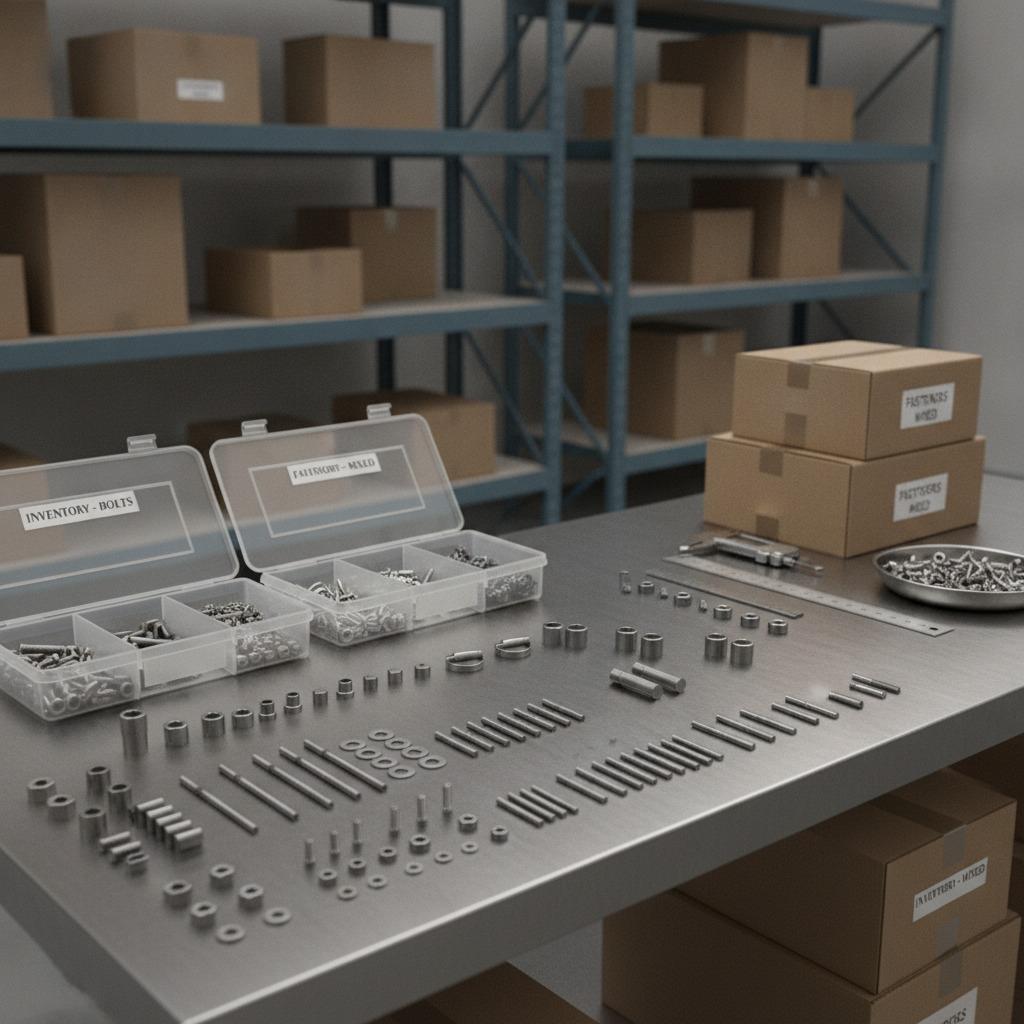
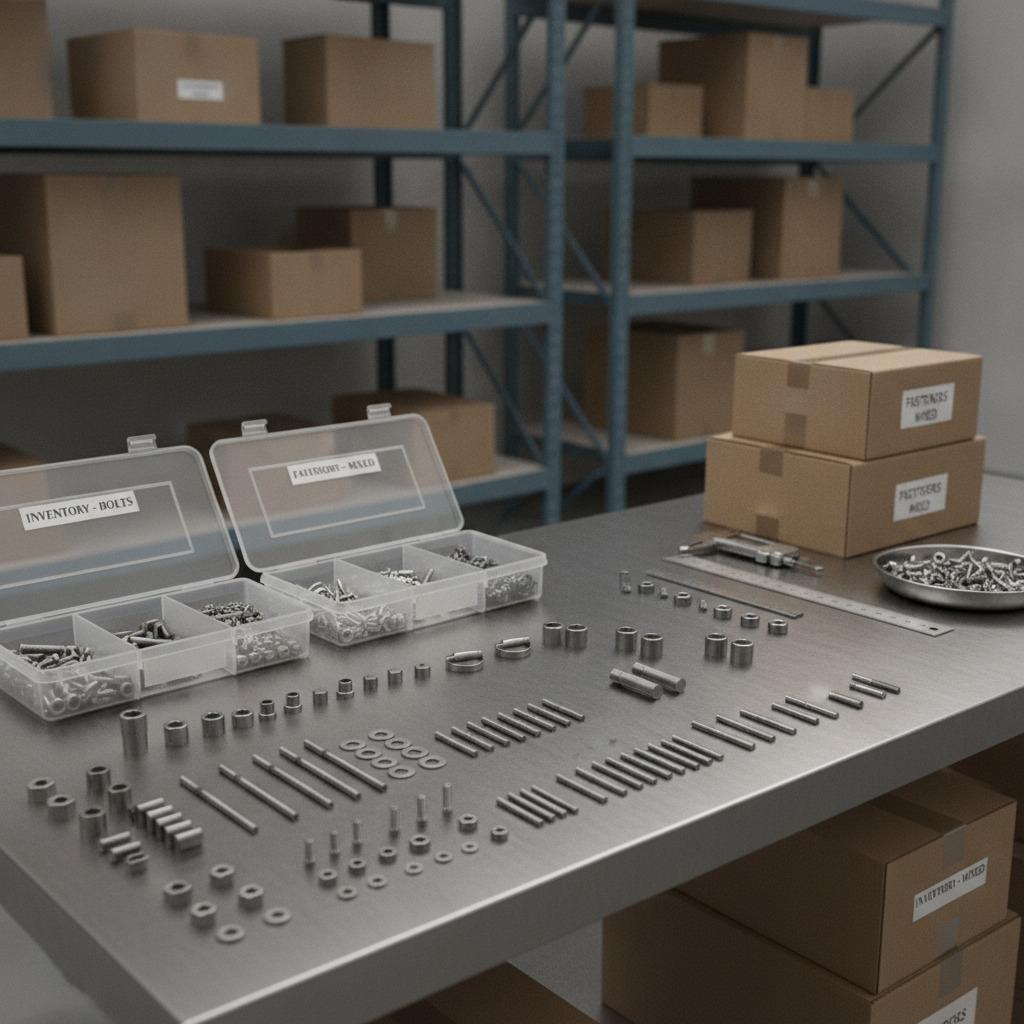
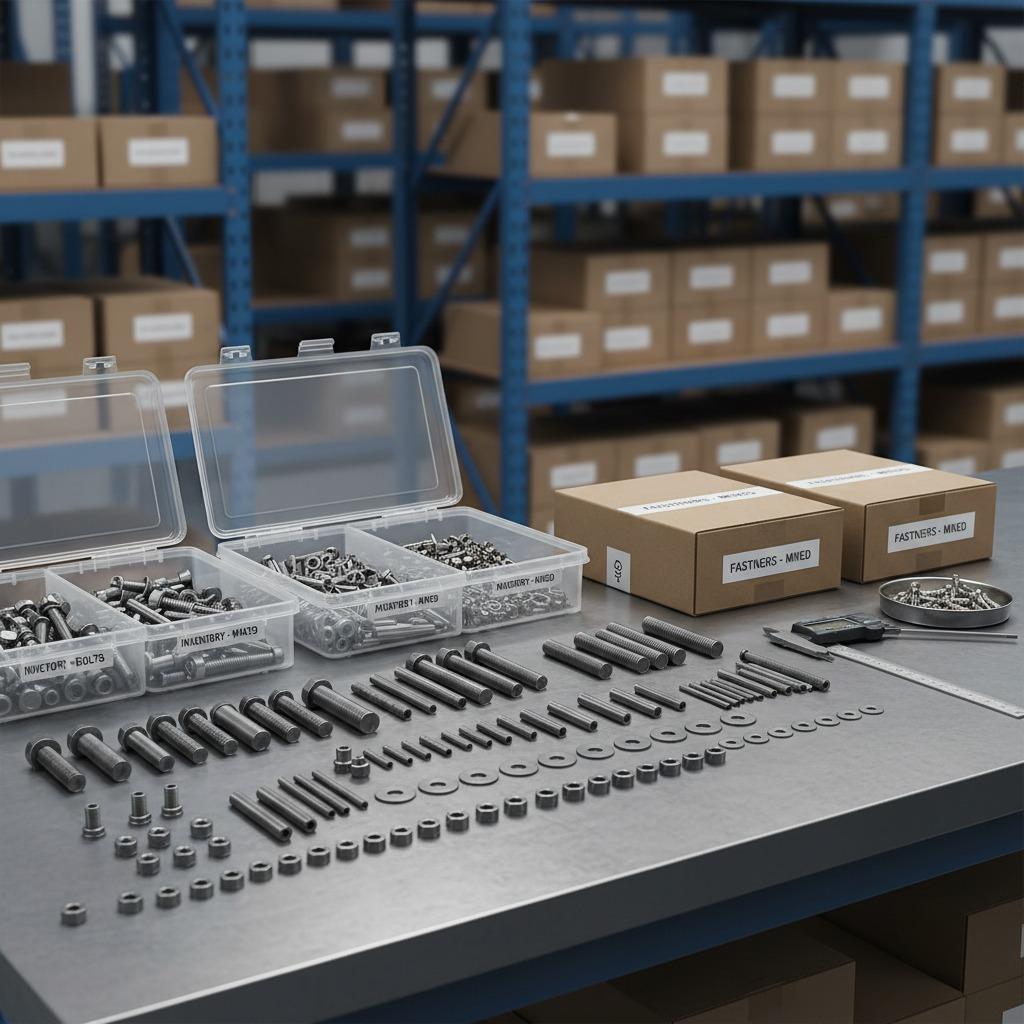
The product image shows compartmented storage boxes, labeled lids, and sorted trays. That type of setup is a useful reminder: fastener supply is often about order and traceability, not just part availability.
A supplier may have the right screw. But if the packaging is confusing, the warehouse still inherits the problem.
For mixed hardware kits, service packs, and distributor assortments, buyers should ask how the supplier controls:
- bin labels
- carton markings
- part separation
- mixed-size assortments
- quantity checking
- packing consistency
- reorder references
- documentation
These details are not exciting. They are exactly the details that prevent delays.
Why sorting and packaging deserve more attention
Fastener buyers sometimes focus so heavily on dimensions and coatings that packaging becomes an afterthought.
That is a mistake.
When a bulk self tapping screws supplier ships mixed hardware in loose cartons, the receiving team may have to sort the order again. When parts are organized by type, size, finish, or project kit, the warehouse and assembly teams move faster.
Transparent compartment boxes, marked cartons, labeled trays, and clean kit layouts can reduce errors before they reach the line.
This is especially important for maintenance and repair operations. One plant may need a small batch of screws today and a mixed assortment of fittings tomorrow. Without kitting support, stock management becomes messy very quickly.
Good packaging can reduce stockouts, protect spare-part inventory, and make replenishment easier to manage.
Selection criteria that save money later
When comparing suppliers, start with the practical details.
Can the supplier produce the fastener family you need?
Can they support non-standard customization?
Can they handle bulk orders without turning every reorder into a fresh negotiation?
Are materials and finishes documented clearly enough for engineering and purchasing to agree?
Can packaging be adapted to your line, warehouse, or resale channel?
Jiangmen Jinhe Hardware says it provides strict inspection before delivery and can supply necessary documentation. It also notes customer support response within 30–60 minutes and solutions within 2 hours.
These are service claims, so buyers should still verify them through their own supplier approval process. Even so, they point to the kind of support industrial buyers look for when a small part issue can affect a larger schedule.
In fastener work, “small” can be a dangerous word. Small parts can stop big orders.
Common mistakes buyers still make
The first mistake is assuming screws with similar dimensions are interchangeable.
They are not.
Head style, thread form, drive type, material, and coating can all change performance. A screw that looks similar may behave differently during assembly, under vibration, in corrosion exposure, or after repeated servicing.
The second mistake is buying only by unit price. Cheap fasteners become expensive if they fail inspection, arrive mixed, require manual sorting, or slow the line.
The third mistake is under-specifying packaging. If your team needs kitted packs, clearly labeled lots, compartment boxes, or mixed inventory control, say so early. A supplier cannot guess your factory layout from a purchase order.
The fourth mistake is waiting too long to discuss documents. If your internal process needs inspection reports, material confirmation, carton labels, or export paperwork, those requirements should be raised before production starts.
Practical advice for sourcing teams
Ask for the part details in writing.
Confirm what can be customized and what cannot. If the fasteners will be used in electronics, appliances, furniture, building materials, medical device-related products, or automation equipment, explain the application early.
Different goals may lead to different fastener choices.
Corrosion resistance may point one way.
Appearance may point another.
Assembly speed may require a different head or drive.
Cost control may favor a standard part instead of a custom one.
For cross-border buyers and hardware wholesalers, supply-chain support also matters. Jiangmen Jinhe lists warehousing, domestic logistics, international freight forwarding, and foreign trade services. That kind of support can simplify distribution when the program spans multiple markets or shipment stages.
It may not be glamorous, but it is useful. A delayed container is rarely made better by a cheap screw quote.
What to ask before placing a bulk order
Before placing a bulk screw order, ask clear questions:
Which standards can be supported?
What materials are available?
What finish options are suitable for the application?
Can the supplier handle non-standard customization?
What inspection documents can be provided?
How are mixed parts sorted and labeled?
Can packaging be adapted for the line or warehouse?
How are repeat orders matched to the approved sample?
Can logistics or warehousing support be arranged?
If you need machine screws, self-tapping screws, micro screws, or precision screws in bulk, make sure the supplier understands your application before you compare prices.
A vague RFQ often leads to a vague quote. A clear technical brief leads to a better sourcing conversation.
FAQ
What does a custom wholesale screws supplier do?
A custom wholesale screws supplier provides screws and related fasteners in bulk while supporting customization, inspection, packaging, documentation, and repeat supply.
When should buyers choose custom fasteners instead of standard screws?
Buyers should choose custom fasteners when standard parts do not meet the required head style, length, drive type, thread form, material, finish, packaging, or application requirement.
Why is packaging important in screw sourcing?
Packaging affects receiving, sorting, storage, assembly, resale, and maintenance work. Poor packaging can create extra labor even if the fasteners themselves are correct.
Can one supplier handle standard and non-standard screws?
Yes, if the supplier has production capability, customization experience, inspection control, and clear communication. Buyers should still verify capability for each product family.
What should buyers confirm before production?
Buyers should confirm drawings, samples, material, finish, head style, drive type, thread form, packaging, carton labels, inspection documents, and repeat-order rules.
Next step
If you are evaluating a custom wholesale screws supplier, use your next RFQ to test more than the product.
Test the communication.
Test the packaging discipline.
Test the ability to review drawings.
Test the willingness to support repeat orders without confusion.
The best fastener partner makes procurement feel uneventful. In this industry, that is a strong compliment.
For buyers who want to discuss standard parts, non-standard customization, or bulk fastener supply, Jiangmen Jinhe Hardware Co., Ltd. provides direct contact through:
Tel / WeChat: +86 13729150102
WhatsApp: +86 13322893939
Email: sharon@hkhomeideas.com