
How to Choose a Reliable Cabinet Hardware Supplier for Furniture Manufacturing
Cabinet hardware plays a critical role in furniture production. Although these components are often small, they directly influence cabinet assembly efficiency, structural stability, appearance quality, and long-term user experience.
For cabinet manufacturers, kitchen furniture factories, wardrobe producers, and furniture brands, choosing the right cabinet hardware supplier is not simply a purchasing decision. It is a supply chain decision that affects product consistency, production efficiency, and customer satisfaction.
A professional cabinet hardware supplier should provide more than standard fittings. The ideal supplier should understand cabinet structures, furniture assembly methods, hardware compatibility, manufacturing processes, quality control requirements, and OEM development needs.
The right supplier can help manufacturers achieve:
- Stable hardware quality across production batches
- Better compatibility between components
- Faster furniture assembly
- Reduced installation problems
- Customized solutions for different cabinet designs
- More efficient hardware sourcing management
JHFIX provides furniture hardware solutions including cabinet connectors, screws, nuts, and customized hardware components for furniture manufacturers and OEM customers.
Why Cabinet Hardware Supplier Selection Matters for Manufacturers
Cabinet production requires multiple hardware components working together.
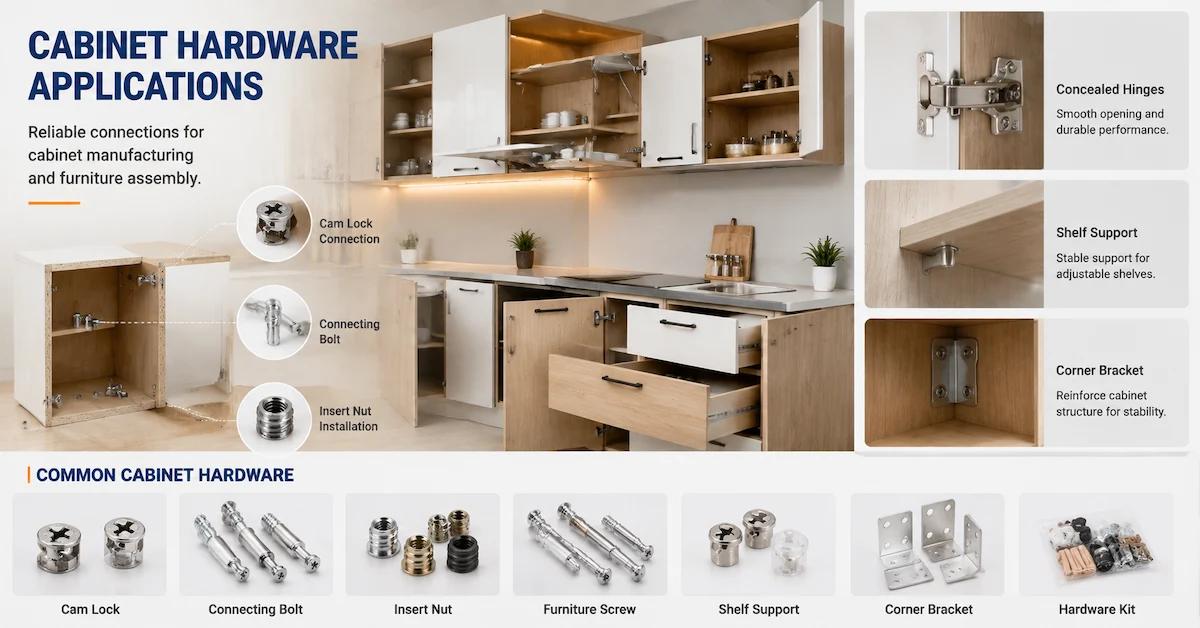
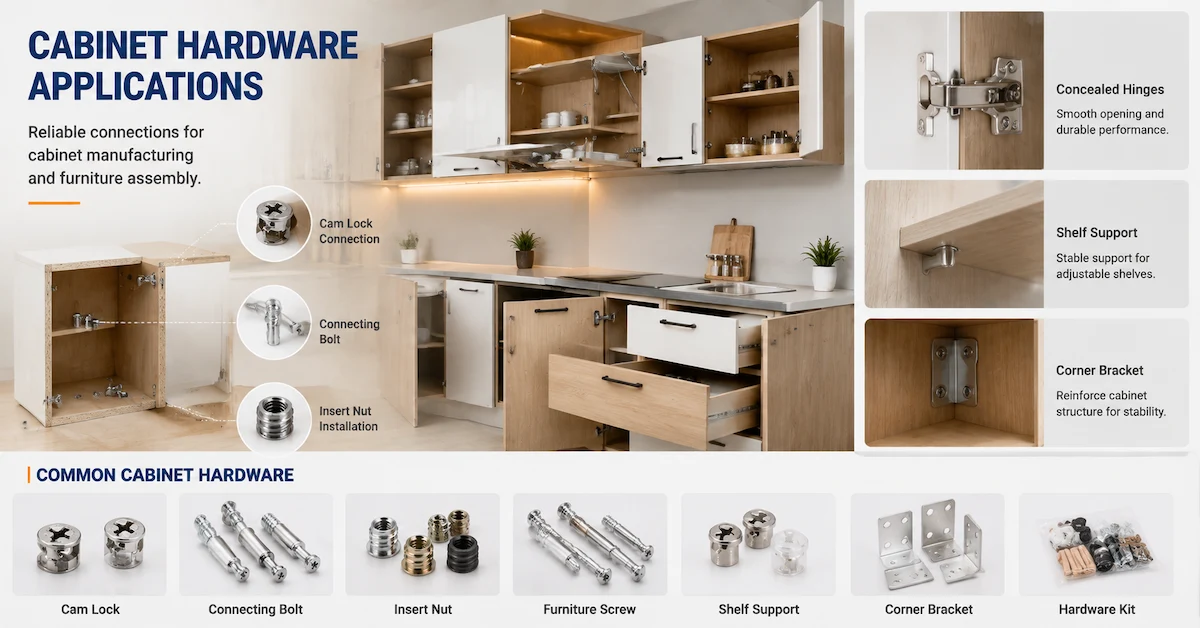
A typical cabinet assembly may include:
- Cabinet connectors
- Cam lock systems
- Connecting bolts
- Furniture screws
- Insert nuts
- Shelf supports
- Brackets
- Plastic accessories
- Installation hardware kits
If one component has inconsistent dimensions or poor compatibility, it may affect the entire assembly process.
Common problems caused by unsuitable cabinet hardware include:
- Loose cabinet joints
- Difficult installation
- Misaligned panels
- Increased production adjustments
- Higher assembly costs
- Customer complaints after installation
For this reason, cabinet manufacturers should evaluate suppliers based on technical capability, manufacturing experience, product consistency, and customization ability rather than focusing only on unit price.
What Products Should a Cabinet Hardware Supplier Provide?
A reliable cabinet hardware supplier should provide a complete range of components that support different cabinet manufacturing requirements.
Cabinet Connectors
Cabinet connectors are essential for joining furniture panels and creating stable structures.
Common connector solutions include:
- Cam locks
- Connecting bolts
- Concealed connectors
- Knock-down fittings
- Furniture joint connectors
These products are commonly used in:
- Kitchen cabinets
- Wardrobes
- Storage cabinets
- Office cabinets
- Modular furniture
The connector selection should consider:
- Panel thickness
- Drilling requirements
- Assembly method
- Joint design
- Required appearance
JHFIX offers a range of furniture hardware solutions designed for cabinet and furniture applications.
Cam Lock Systems
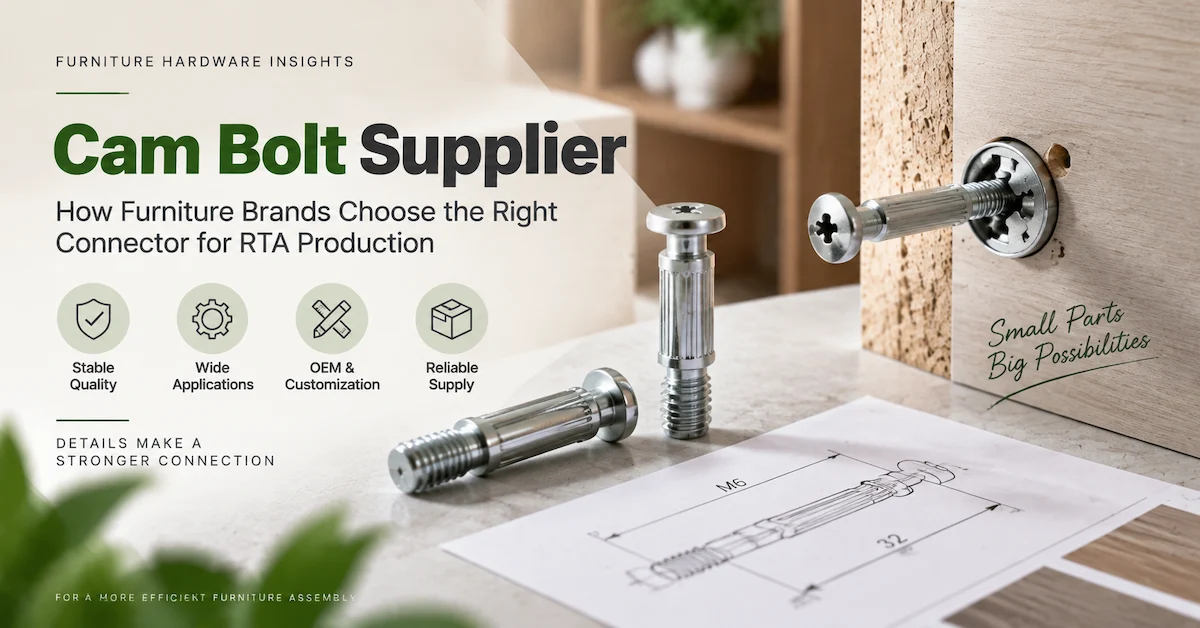
Cam lock systems are widely used in cabinet manufacturing because they provide concealed and detachable connections.
A typical cam lock system includes:
- Eccentric cam
- Connecting bolt
- Matching drilled holes
During assembly, the cam rotates and pulls the connecting bolt into position, creating a secure connection between panels.
Cam locks are especially suitable for:
- Flat-pack cabinets
- Modular furniture
- Kitchen cabinets
- Wardrobes
- Office furniture
When selecting cam lock hardware, manufacturers should consider:
| Selection Factor | Why It Matters |
|---|---|
| Cam size | Ensures component compatibility |
| Bolt length | Matches panel thickness |
| Material | Influences durability and cost |
| Finish | Affects appearance and protection |
| Manufacturing accuracy | Ensures assembly consistency |
A professional cabinet hardware supplier should provide matched connector systems instead of individual components without compatibility testing.
Cabinet Screws
Cabinet screws are commonly used for:
- Panel fixing
- Bracket installation
- Structural reinforcement
- Accessory mounting
Common types include:
- Wood screws
- Self-tapping screws
- Machine screws
- Assembly screws
When selecting cabinet screws, buyers should evaluate:
- Screw diameter
- Length
- Thread design
- Head type
- Drive type
- Material
- Surface finish
JHFIX supplies different screw solutions for furniture manufacturing and OEM applications.
Insert Nuts and Threaded Components
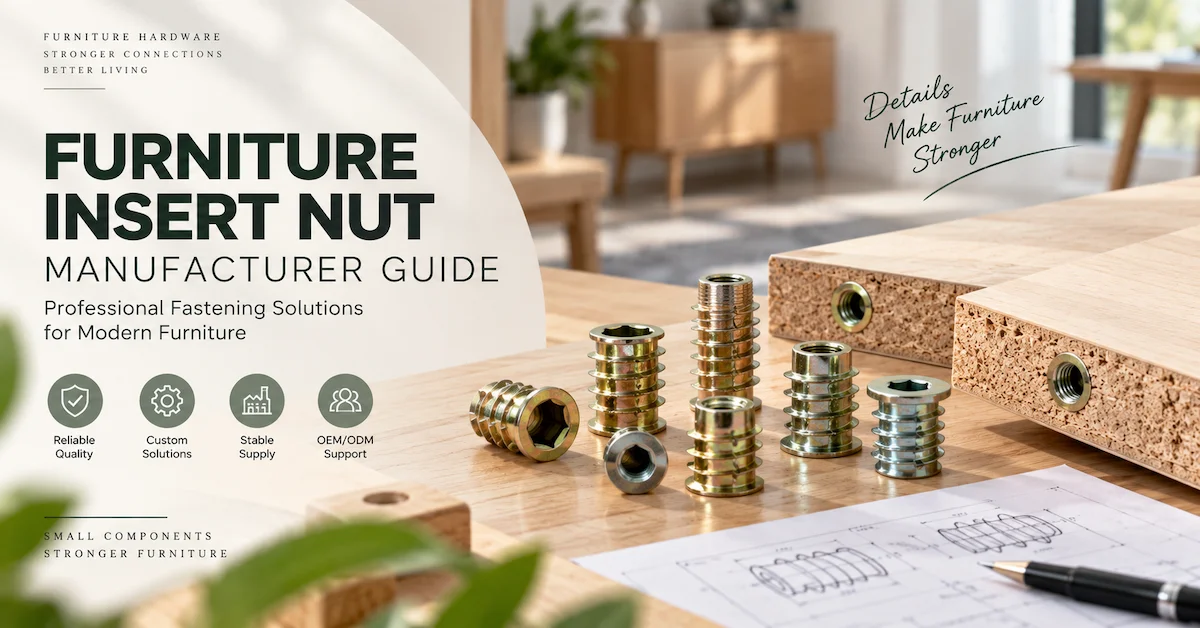
Insert nuts provide internal threads inside furniture panels, allowing stronger and reusable connections.
They are often used in:
- Cabinets
- Beds
- Tables
- Modular furniture
Advantages include:
- Repeatable assembly
- Improved connection consistency
- Easier maintenance
- Reduced damage from repeated installation
Important specifications include:
- Thread size
- Insert design
- Installation method
- Panel material
- Matching bolt specification
JHFIX provides nut and threaded hardware solutions for different furniture applications.
Shelf Supports and Brackets
Cabinet interiors often require additional supporting hardware.
Common products include:
- Shelf pins
- Shelf supports
- Mounting brackets
- Metal support components
These components influence:
- Shelf stability
- Cabinet functionality
- Installation convenience
For cabinet manufacturers, shelf hardware should be selected according to:
- Shelf material
- Load requirements
- Cabinet structure
- Installation method
Hardware Kits and Packaging Solutions
Modern cabinet production often requires complete hardware kits rather than individual components.
A cabinet hardware kit may include:
- Screws
- Connectors
- Bolts
- Nuts
- Accessories
- Installation components
Professional packaging helps reduce:
- Missing parts
- Wrong component selection
- Assembly delays
JHFIX supports different hardware packaging solutions including bag packaging, box packaging, blister packaging, and customized hardware kits.
Cabinet Hardware Trends from a Manufacturing Perspective
Cabinet hardware trends are not only about appearance. For manufacturers, the focus is increasingly on functionality, efficiency, and customization.
Functional Hardware Over Decorative Trends
For furniture manufacturers, hardware must support production requirements.
Important factors include:
- Reliable connection
- Easy assembly
- Consistent quality
- Compatibility with automated production
While decorative appearance matters for visible hardware, hidden structural components require precision and reliability.
Growth of Modular and Flat-Pack Furniture
The demand for modular and ready-to-assemble furniture continues to increase.
This creates higher requirements for:
- Concealed connectors
- Easy installation
- Compact packaging
- Repeatable assembly
Cabinet hardware suppliers need to provide solutions that support both factory production and end-user installation.
Concealed Connection Systems
Modern furniture designs increasingly prefer clean appearances.
Concealed hardware solutions help manufacturers achieve:
- Minimal visible hardware
- Better product appearance
- Flexible furniture designs
Examples include:
- Cam locks
- Hidden connectors
- Insert nut systems
Customized Hardware Solutions
Different cabinet designs may require different hardware specifications.
OEM customers may need:
- Customized dimensions
- Special finishes
- Unique connector structures
- Custom packaging
- Private label solutions
A capable supplier should support product development from drawings or samples.
How Cabinet Manufacturers Evaluate Hardware Materials
Material selection affects performance, appearance, and cost.
Carbon Steel Cabinet Hardware
Carbon steel is widely used in furniture hardware because it provides:
- Good processing performance
- Flexible manufacturing options
- Cost efficiency
Common applications include:
- Screws
- Connector bolts
- Metal fittings
Stainless Steel Cabinet Hardware
Stainless steel may be selected for applications requiring improved corrosion resistance.
Common applications include:
- Kitchen cabinets
- Bathroom furniture
- Humid environments
The correct stainless steel grade should be selected according to actual application requirements.
Zinc Alloy Cabinet Hardware
Zinc alloy is commonly used for furniture components requiring:
- Good appearance
- Dimensional consistency
- Decorative finishes
It is often used for visible furniture hardware.
Surface Finishes
Surface treatment affects both appearance and protection.
Common finishes include:
- Zinc plating
- Nickel plating
- Black finishes
- Custom decorative finishes
Cabinet manufacturers should evaluate finish requirements based on:
- Environment
- Appearance expectations
- Customer requirements
Key Factors When Choosing a Cabinet Hardware Supplier
Manufacturing Capability
A professional supplier should have control over important manufacturing processes.
Relevant capabilities include:
- Cold heading
- Tapping
- Stamping
- Injection molding
- Assembly
- Packing
- Inspection
These capabilities help maintain production consistency.
JHFIX describes its manufacturing capabilities including cold heading, tapping, stamping, injection molding, assembly, packing, and inspection processes on its About Us page.
Product Customization Ability
Cabinet manufacturers often need customized hardware.
A capable supplier should support:
- Drawing review
- Sample development
- Product modification
- Custom specifications
- Packaging customization
Quality Control
Cabinet hardware quality should be controlled throughout production.
Important inspection areas include:
Dimensional Inspection
Checking:
- Size accuracy
- Thread dimensions
- Connector dimensions
- Component matching
Functional Testing
Checking:
- Assembly performance
- Connection stability
- Compatibility
Surface Inspection
Checking:
- Finish consistency
- Surface defects
- Coating appearance
Packaging Inspection
Checking:
- Correct quantity
- Correct components
- Label accuracy
Supply Chain Stability
Long-term cabinet production requires stable supply.
Manufacturers should evaluate:
- Production capability
- Communication efficiency
- Repeat order consistency
- Packaging support
A reliable supplier reduces sourcing risks and improves production planning.
OEM Cabinet Hardware Solutions for Furniture Brands
Many furniture brands require customized hardware solutions.
OEM support may include:
Drawing-Based Development
Customers can provide:
- Product drawings
- Samples
- Existing specifications
The supplier evaluates:
- Manufacturing feasibility
- Material selection
- Production method
Sample Approval
Samples help verify:
- Dimensions
- Assembly
- Appearance
- Compatibility
Custom Dimensions and Finishes
OEM projects may require:
- Special sizes
- Different materials
- Custom finishes
- Unique designs
Private Label Packaging
Furniture brands may require:
- Custom labels
- Product packaging
- Hardware kits
- Retail-ready solutions
Common Cabinet Hardware Purchasing Mistakes
Choosing Only Based on Price
The cheapest supplier may create additional costs through:
- Quality problems
- Assembly delays
- Rework
- Replacement issues
Ignoring Component Compatibility
Cabinet hardware should be evaluated as a system.
For example:
- Cam lock + bolt
- Insert nut + screw
- Connector + panel drilling
All components must work together.
Skipping Sample Testing
Before mass production, manufacturers should verify:
- Assembly performance
- Product fit
- Appearance
- Installation process
Not Considering Long-Term Supply
Furniture production requires repeat consistency.
A supplier should support:
- Stable specifications
- Continuous production
- Consistent quality
Cabinet Hardware Quality Control Checklist
| Inspection Item | Importance |
|---|---|
| Dimensions | Assembly consistency |
| Thread accuracy | Connection performance |
| Surface finish | Appearance and protection |
| Component matching | Installation efficiency |
| Packaging accuracy | Reduced assembly errors |
How JHFIX Supports Cabinet Hardware Buyers
JHFIX provides cabinet and furniture hardware solutions for manufacturers, distributors, and OEM customers.
The product range includes:
- Furniture connectors
- Screws
- Nuts
- Stamping hardware
- Hardware kits
- Packaging solutions
With integrated manufacturing processes and customization support, JHFIX helps customers develop hardware solutions based on drawings, samples, and production requirements.
For companies looking for a reliable cabinet hardware supplier, JHFIX can support product evaluation, customization, and manufacturing cooperation.
FAQ
What should I look for in a cabinet hardware supplier?
A reliable cabinet hardware supplier should provide consistent products, manufacturing capability, quality control, customization support, and stable long-term supply.
What cabinet hardware components are commonly used by manufacturers?
Common components include cam locks, connecting bolts, screws, insert nuts, shelf supports, brackets, and complete hardware kits.
Can cabinet hardware suppliers provide OEM customization?
Yes. Many professional suppliers can customize dimensions, materials, finishes, packaging, and complete hardware solutions based on drawings or samples.
What materials are commonly used for cabinet hardware?
Common materials include carbon steel, stainless steel, zinc alloy, and other engineered materials selected according to application requirements.
How do I evaluate cabinet hardware quality?
Evaluate dimensions, material consistency, surface finish, component matching, functional performance, and packaging accuracy.
Can a cabinet hardware supplier provide complete hardware kits?
Yes. Many suppliers can combine connectors, screws, nuts, and accessories into customized cabinet assembly kits.
Why choose an OEM cabinet hardware supplier?
OEM suppliers can provide customized solutions, technical support, production consistency, and simplified supply chain management.
Conclusion
Choosing the right cabinet hardware supplier is essential for furniture manufacturers seeking reliable production, consistent quality, and efficient assembly.
The best supplier should provide more than standard cabinet fittings. A strong hardware partner should understand furniture structures, connection systems, manufacturing processes, quality control, OEM requirements, and packaging solutions.
For cabinet factories, furniture brands, and distributors, working with an experienced supplier can reduce sourcing complexity and improve long-term product consistency.
JHFIX provides cabinet hardware and furniture hardware solutions including connectors, screws, nuts, stamped components, and customized packaging options. Manufacturers looking for OEM cabinet hardware support can contact JHFIX to discuss product requirements, drawings, and cooperation opportunities.