
What Should an Eccentric Cam Connector Supplier Help You Confirm?
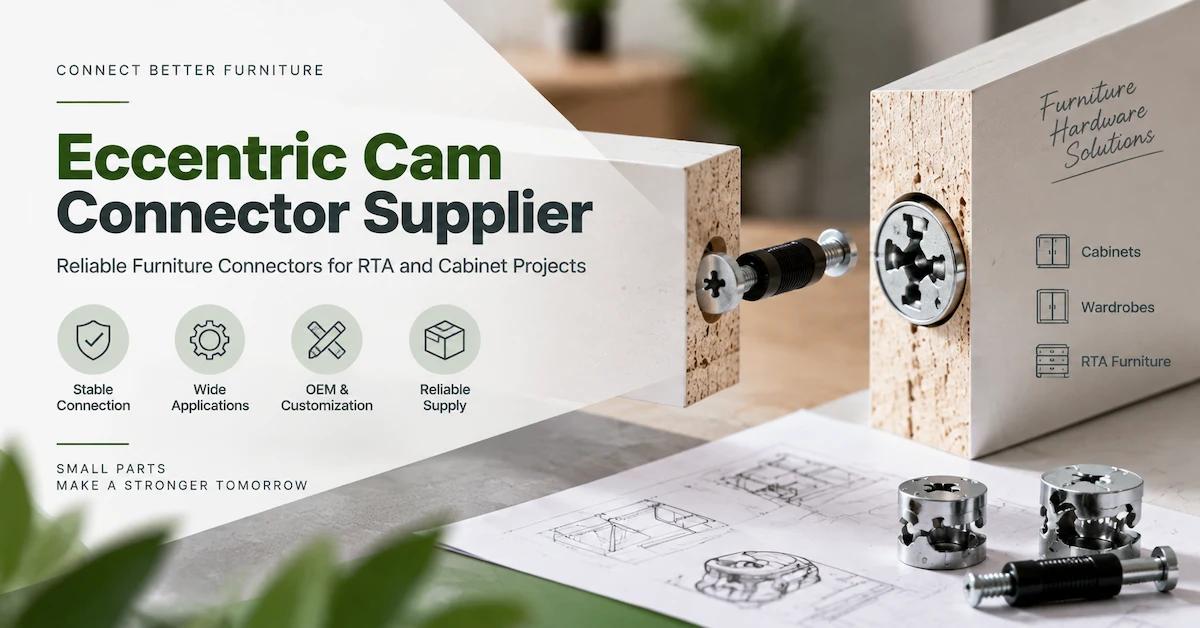
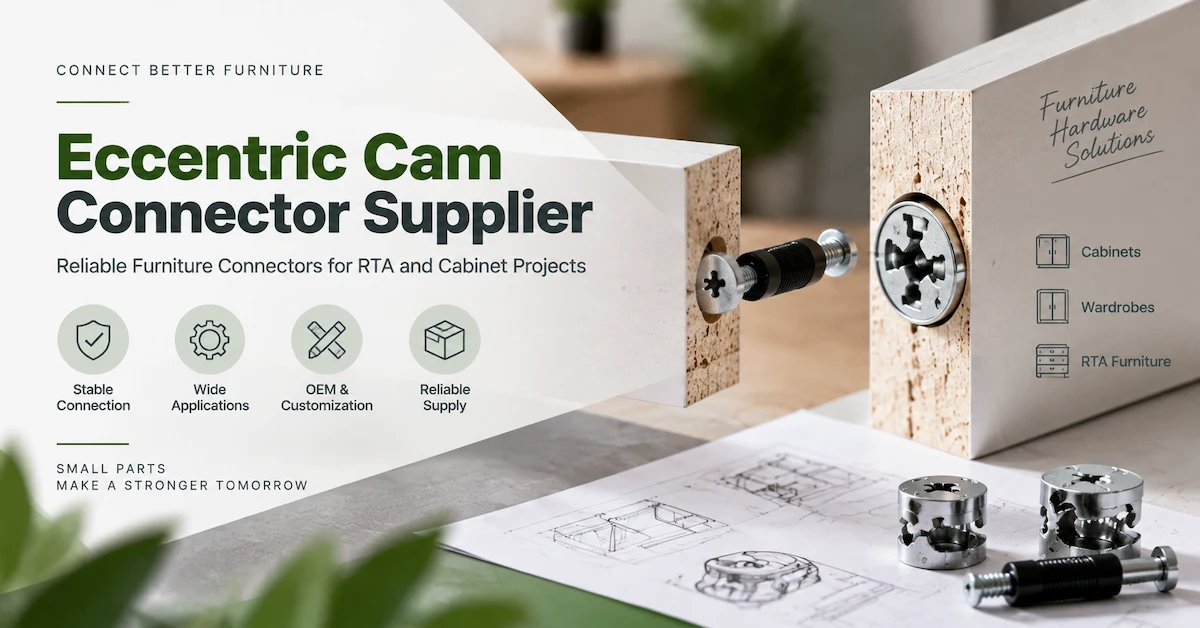
An eccentric cam connector supplier should help an OEM buyer define a complete furniture joint rather than simply identify a round metal cam that looks similar to an existing part. In an RTA cabinet connection, the eccentric cam normally works together with a connecting bolt and accurately machined furniture panels. The cam rotates around the mating bolt and pulls the two prepared panels into position, which means the cam geometry, bolt geometry, drilling position, panel thickness, and installation sequence all affect the final joint.
JHFIX currently includes eccentric connectors together with 2-in-1 and 3-in-1 cam locks, Minifix fittings, and connector sets in its Cam Locks & Connector Sets category. That product structure is relevant to cabinet, wardrobe, modular, and flat-pack furniture buyers because the supplier can be evaluated around the complete connector system rather than one isolated component.
For bulk purchasing, the approval sequence should be straightforward: define the furniture joint, identify the proposed cam and mating bolt, confirm the panel machining, test a representative assembly, approve the production specification, and then approve the packed hardware configuration. If one of those steps remains unclear, the product should still be treated as a candidate rather than a released production component.
Which Buyers Need a Dedicated Eccentric Cam Connector Supply Program?
This sourcing approach is most useful for kitchen cabinet factories, wardrobe manufacturers, shelving producers, office furniture companies, modular-storage brands, RTA furniture companies, importers, distributors, and private-label furniture brands that purchase connectors repeatedly.
These buyers usually need more than a replacement fitting. They need the same connection to work across a large number of machined panels and future production batches. A small difference in the connector interface can create a larger assembly problem when several fittings must align inside one cabinet body.
An eccentric cam connector supplier is therefore particularly relevant when the connector must be linked to a furniture SKU, drawing revision, approved panel machining, bill of materials, and repeat-order specification. A consumer trying to identify one unknown replacement from a photograph has a different problem; photographs can support identification, but they do not replace measurements, mating hardware, or an assembly reference.
JHFIX’s existing furniture joint connector guide follows the same purchasing principle: the connector, mating hardware, and prepared panels need to be considered together before bulk approval.
Where Are Eccentric Cam Connectors Commonly Used?
Eccentric cam connectors are commonly associated with furniture designed for efficient panel assembly and disassembly. JHFIX’s current furniture content identifies cam-lock systems for kitchen cabinets, wardrobes, shelving systems, modular furniture, office furniture, and ready-to-assemble products. A typical system combines an eccentric cam, a connecting bolt, and accurately drilled panels.
The application name alone does not define the connector specification. Two wardrobes may use different panel thicknesses or drilling arrangements, while two cabinets may require different bolt lengths or cam geometries. A supplier should therefore use the application to understand the joint, not to assume that every product in the same furniture category uses an identical connector.
Buyers sourcing components for a wider RTA program can also review JHFIX’s Ready to Assemble Furniture Hardware guide to place cam connectors within the broader hardware system of bolts, dowels, shelf supports, screws, mounting hardware, and packaged kits.
Which Specifications Should Be Included in the RFQ?
A professional RFQ should convert the furniture joint into measurable information. Avoid sending only “need eccentric cam” or “need Minifix connector.” Those terms identify a connector family but do not define the exact interface.
The following table is a purchasing framework, not a universal dimensional standard. The actual values must come from the buyer’s approved furniture design, sample, or drawing.
| Specification Area | What to Confirm | Why It Matters |
|---|---|---|
| Furniture reference | Model, SKU, drawing revision | Links the connector to the correct furniture version |
| Panel material | Particleboard, MDF or specified board | Defines the application condition |
| Panel thickness | Finished panel thickness | Affects connector positioning and drilling |
| Cam type | Eccentric cam configuration and mating concept | Identifies the connector family |
| Cam dimensions | Diameter, height and other critical geometry | Determines compatibility with the prepared bore |
| Cam bore | Diameter and drilling depth | Must correspond with the selected cam |
| Center position | Cam-bore location relative to panel references | Determines where cam and bolt meet |
| Connecting bolt | Diameter/thread where applicable, length and head geometry | Defines the mating component |
| Installed bolt position | Required projection after installation | Controls engagement with the cam |
| Related components | Dowel, nut, sleeve or plastic accessory | Prevents incomplete set definitions |
| Material | Material for every major component | Avoids vague mixed-material descriptions |
| Surface finish | Required finish and appearance | Separates finish from base material |
| Quantity unit | Piece, pair, set or kit | Prevents purchasing and packing errors |
| Packaging | Bulk, matched set or model-specific kit | Defines what the buyer will receive |
| Acceptance | Dimensions, fit, appearance and agreed functional checks | Establishes measurable QC requirements |
JHFIX’s cabinet and kitchen-furniture content similarly identifies factors such as cam diameter, cam height, connecting-bolt length, hole diameter, drilling depth, center distance, panel thickness, material, and finish as relevant OEM inputs.
Why Is Cam-Bolt Compatibility More Important Than Cam Diameter Alone?
Cam diameter is important, but it answers only one compatibility question. The complete connection depends on how the eccentric feature captures or pulls the connecting bolt after both components have been installed in their respective panels.
A bolt that is slightly different in overall length, installed projection, head or neck geometry, or anchoring section may change the working relationship with the cam. Likewise, the correct hardware can perform poorly if the panel machining places the cam bore or bolt in the wrong position.
JHFIX’s JH-18 furniture connecting bolt illustrates why buyers should review multiple fields rather than one dimension. Its published product information lists an M6 thread, lengths of 24, 28, 32, and 34 mm, an 8 mm thread length, and pan-head or countersunk options. Those values help identify candidate configurations, but they do not by themselves prove compatibility with a specific eccentric cam or panel design.
For that reason, an eccentric cam connector supplier should be able to discuss the matched interface instead of recommending a bolt solely because its diameter or overall length appears similar.
How Do 2-in-1, 3-in-1, and Eccentric Connector Sets Differ for Purchasing?
The terms 2-in-1, 3-in-1, eccentric cam, and Minifix are useful category labels, but OEM purchasing requires the exact contents of the set to be stated explicitly.
| Supply Format | Purchasing Focus | Main Points to Confirm |
|---|---|---|
| Eccentric cam only | Component replacement or controlled separate sourcing | Cam dimensions, mating bolt and panel bore |
| Cam + bolt set | Matched two-component connection | Cam-bolt interface and installation geometry |
| 3-in-1 connector | Multi-component furniture connection | Exact three pieces, materials and quantity definition |
| Minifix-style fitting | Concealed RTA connection concept | Geometry, drilling relationship and compatible bolt |
| Full furniture hardware kit | Connector combined with other assembly hardware | BOM, quantities, identification and packaging |
JHFIX’s HI-CB0012 three-in-one connector is a useful example. The published listing describes a bolt + cam + nut configuration and identifies carbon steel, zinc alloy, and plastic among the materials, with M6.1 and a 45 mm length listed as customizable information. That means a buyer should define which dimension and material belong to each relevant component rather than record the complete set simply as “one cam connector.”
How Should Materials and Surface Finishes Be Specified?
The material should be recorded component by component. An eccentric connector set can contain different materials because the cam, bolt, nut, sleeve, or plastic positioning element may perform different functions.
Do not use appearance as a substitute for material identification. Silver, black, or yellow describes appearance, but it does not by itself define the base material or demonstrate a specific performance level. Similarly, “zinc plated” or “nickel” should be treated as finish information rather than a universal statement that the product is suitable for every environment.
JHFIX’s product listings show both zinc-plated and nickel finish options on relevant connector products, while the HI-CB0012 listing combines carbon steel, zinc alloy, and plastic within one set.
For kitchen, bathroom, humid-storage, or other exposure-sensitive furniture, explain the expected environment during the RFQ. If the buyer has a specific surface-performance or test requirement, include the method and acceptance condition rather than assuming that a finish name alone establishes suitability.
What Manufacturing Capability Should an Eccentric Cam Connector Supplier Explain?
Factory capability should be connected to the product being purchased. JHFIX’s About Us page identifies manufacturing facilities or workshops associated with cold heading, tapping, punching, injection molding, assembly, packing, inspection, warehousing, and production operations. The company also specifically lists cam-lock systems, connectors, shelf supports, screws, assortment kits, and furniture fittings among its product scope.
That information gives buyers a useful starting point, but qualification should go further. Ask which processes apply to the specific eccentric cam, connecting bolt, and accessories being quoted; which dimensions are considered critical; how those dimensions are checked; how parts are kept associated with the correct mating components; and how the approved production version is identified.
Not every factory process necessarily applies to every connector. A long equipment list is therefore less useful than a clear explanation of how the proposed component moves from specification to production, inspection, and packing.
How Should Samples Be Approved Before a Bulk Order?
Sample validation should occur at three different levels because each level answers a different question.
Component Approval
First compare the cam, bolt, and other components with the approved drawing or specification. Relevant items may include critical dimensions, material identification, surface finish, thread or anchoring details, and visible defects.
Joint Approval
Next install the proposed parts in representative panels prepared according to the intended furniture drilling. Check whether the cam seats correctly, whether the connecting bolt enters the working position, whether the panels align, and whether the joint can be assembled using the intended tool and sequence.
JHFIX product guidance for connector products recommends trial assembly using the actual board and mating parts to verify fit, alignment, appearance, and assembly efficiency before volume production.
Pack Approval
If the supplier is also producing hardware bags or kits, approve the physical pack. Confirm cam quantities, matching bolts, accessories, labels, model identification, and spare quantities where required.
This produces a clear approval chain:
Component → Joint → Hardware Pack
Passing one stage should not automatically be treated as passing all three.
How Can Buyers Troubleshoot an Eccentric Cam Joint That Does Not Close Properly?
A connector problem should be investigated systematically rather than corrected by increasing tightening force.
Start by confirming that the cam and bolt are the intended versions. Compare them against the approved sample and drawings. Then verify panel thickness, cam-bore diameter, drilling depth, center position, and installed bolt projection. Check whether drilling debris or panel damage prevents the cam from seating correctly.
A useful comparison is to test the approved hardware and the candidate hardware in equivalent reference panels. If both hardware sets work in the reference panel but both fail in a newly machined panel batch, panel preparation becomes an important area to investigate. If the approved set works while the candidate set repeatedly fails under equivalent panel conditions, review the connector geometry and mating relationship.
These observations help narrow the investigation; they do not independently establish a root cause.JHFIX’s connector product guidance also recommends confirming drilling accuracy, maintaining a clean assembly area, following the intended insertion sequence, and avoiding excessive force that could damage the board or hardware.
How Should Different JHFIX Connector References Be Compared?
The examples below are useful for understanding different supply configurations. They are not a ranking and should not be treated as automatically interchangeable.
| JHFIX Reference | Published Information | Possible Sourcing Use | Still Needs Confirmation |
|---|---|---|---|
| JH-08 cam dowel connector | M10; 32/35/40/42 mm lengths; bolt + cam configuration | Review of a 2-in-1 connector system | Actual mating geometry, drilling and panel compatibility |
| JH-18 furniture connecting bolt | M6; 24/28/32/34 mm lengths; 8 mm thread length | Candidate connecting bolt for a cam system | Selected cam, installed position and drilling |
| HI-CB0012 3-in-1 connector | Bolt + cam + nut; M6.1 and 45 mm listed; mixed materials | Multi-component furniture-connector sourcing | Exact component specs, dimensions and joint validation |
| Cam Locks & Connector Sets | 2-in-1, 3-in-1, eccentric and Minifix product directions | Early-stage model selection | Final drawing, materials, mating parts and sample approval |
The JH-08 page specifically lists stainless steel, M10, several length options, and a bolt + cam 2-in-1 configuration; the HI-CB0012 and JH-18 pages provide separate dimensional and material references.
What Should Quality Control Cover?
“Strict quality control” is too general to function as an OEM acceptance requirement. The buyer and eccentric cam connector supplier should agree on the specific characteristics that affect the approved connection.
For individual components, that may include dimensions, surface condition, relevant thread or anchoring features, and appearance. For the joint, it may include cam seating, engagement, locking action, alignment, and agreed functional requirements. For a hardware pack, it can include part identity, quantity, labeling, and pack completeness.
Treat company qualifications and product acceptance as separate issues. A general factory credential does not replace inspection of the ordered connector. Likewise, if a buyer requires a specific material report, performance test, or market-related document, request evidence that clearly applies to the relevant product or production scope rather than assuming that any certificate displayed elsewhere covers every connector.
How Should MOQ, Capacity, and Lead Time Be Evaluated?
MOQ and lead time should be confirmed for the actual connector specification. Standard connecting bolts, customized cams, multi-component sets, special finishes, and model-specific furniture kits can represent different production and packaging scopes.
Ask the supplier to separate sample timing from production timing. A useful schedule identifies specification review, sample preparation, trial assembly, sample approval, bulk manufacturing, finishing where applicable, inspection, kitting, and shipment preparation.
Also establish when the stated production lead time begins. If production cannot start until drawings, samples, and packaging have been approved, the quotation should make that dependency clear.
The same applies to factory capacity. JHFIX describes more than 20 years of industry experience and exports to more than 40 countries on its current About Us page, but order-specific production availability should still be confirmed for the particular project rather than inferred from company-level information.
Why Should Buyers Compare Total Joint Cost Instead of Cam Price Alone?
The lowest cam price is not necessarily the lowest supply cost.
One supplier may quote the eccentric cam only. Another may quote the cam, connecting bolt, accessories, inspection, counting, and model-specific packaging. Those quotations cover different scopes and should not be compared as if they were identical.
For internal evaluation, calculate the cost per approved furniture connection or per complete hardware kit. Include the specified components and the work that remains after receiving the goods. If loose components must still be sorted, matched, counted, and repacked internally, that work belongs in the sourcing comparison.
Also separate one-time costs such as special development or tooling from recurring product costs. If an apparently inexpensive replacement connector requires changes to panel machining or repeated line adjustments, those consequences should be evaluated using the buyer’s own production data rather than generic savings claims.
Should You Buy Loose Eccentric Connectors or Pre-Packed Furniture Kits?
The answer depends on the buyer’s operation.
Furniture factories with controlled internal kitting may prefer bulk cams and connecting bolts. RTA furniture brands that want one complete hardware bag inside every carton may prefer supplier-packed sets. JHFIX currently provides bag packaging as one of its packaging categories, while the wider website also includes blister, box, and bucket packaging for different hardware supply requirements.
If supplier kitting is required, define the BOM rather than simply requesting “one furniture hardware bag.” Identify the number of eccentric cams, the matching bolt code and quantity, related dowels or accessories, spare quantity, furniture model, label, barcode, and instructions where applicable.
The packaged sample should be approved in its finished form. Correct components placed in the wrong kit, or correct cams paired with the wrong bolt length, can still stop furniture assembly.
How Should OEM Eccentric Cam Connector Development Be Managed?
Custom development should begin with an application problem. The buyer may need a different connector interface because of panel geometry, drilling restrictions, installation access, target appearance, existing furniture inventory, or packaging requirements.
JHFIX’s connector product information states that dimensions, material, surface finish, compatible parts, packaging format, carton labeling, and inspection requirements can be discussed for relevant OEM connector projects, with samples available for evaluation before mass production.
A practical OEM process is:
Furniture requirement → drawing/sample review → proposed connector configuration → sample → representative panel assembly → specification approval → packed-set approval → bulk production.
The important step is revision control. If the cam geometry, connecting bolt, panel machining, material, or packaging changes later, identify the new version and determine whether the joint needs to be validated again.
What Should You Send an Eccentric Cam Connector Supplier for a Quote?
A useful RFQ should contain the furniture application, panel material, panel thickness, drilling drawing, existing cam and bolt samples where available, target dimensions, material and finish requirements, expected first-order quantity, repeat-volume estimate, supply format, packaging requirements, and any defined inspection or testing conditions.
If the project replaces existing hardware, send both the cam and mating bolt rather than only the visibly damaged component. If the furniture joint is still under development, clearly mark which dimensions are fixed and which can be discussed with the supplier.
Buyers can review the JHFIX Cam Locks & Connector Sets, compare related furniture connecting hardware, and then submit drawings, samples, quantities, and packaging requirements through Contact Us for a project-specific review.
FAQ
1. What is an eccentric cam connector?
An eccentric cam connector is a furniture fitting in which a rotating cam engages a mating connecting bolt to draw prepared furniture panels together. It is commonly associated with cabinets, wardrobes, modular furniture, and RTA products. JHFIX includes eccentric connectors within its cam-lock and connector-set category.
2. What should I look for in an eccentric cam connector supplier?
Look for a supplier that can discuss the cam and connecting bolt as a matched system, review panel drilling conditions, provide samples for representative assembly, define component materials and finishes, and preserve the accepted specification for repeat orders.
3. Are eccentric cam connectors and Minifix connectors the same?
The terms can overlap in furniture sourcing conversations, but buyers should not assume that every product carrying either name uses identical dimensions or interfaces. Use the actual cam, bolt, drilling, and panel specifications to establish compatibility.
4. Can I replace an existing eccentric cam using only its diameter?
Diameter alone is not enough. Confirm cam height or other relevant geometry, mating bolt design, installed bolt position, cam-bore depth, center position, and panel conditions before approving a replacement.
5. Should the eccentric cam and connecting bolt come from the same supplier?
They can be purchased together or separately, but the mating relationship needs to be controlled. Sourcing them together can simplify coordination, while separate sourcing requires both suppliers to work from the same interface specification. In either case, validate the final combination.
6. What panel information should I provide to the supplier?
Provide panel material, finished thickness, cam-bore diameter and depth, hole center location, relevant edge or reference dimensions, and the drawing revision. A representative panel sample can also help during validation.
7. Can JHFIX customize eccentric connector components?
JHFIX states that it can discuss dimensions, materials, surface finishes, compatible parts, packaging, carton labeling, and inspection requirements for relevant furniture connector products. Exact feasibility, samples, MOQ, and commercial terms should be confirmed for the specific project.
8. How should an eccentric cam connector be inspected?
Inspection can cover the approved critical dimensions, material or finish requirements, visible condition, mating fit, locking function, and pack quantity. Representative assembly provides additional information that an individual-component measurement cannot show.
9. Is there a standard MOQ for eccentric cam connectors?
A universal MOQ should not be assumed. Commercial requirements can vary by component, dimensions, material, finish, customization level, and packaging format, so the applicable MOQ should be confirmed against the final specification and quotation.
10. How can I control consistency on repeat orders?
Link every repeat order to controlled component codes, drawings, panel requirements, mating hardware, approved samples, materials, finishes, BOM quantities, and packaging revisions. Proposed substitutions should be reviewed before they are introduced into production.
Conclusion
Choosing an eccentric cam connector supplier requires buyers to control the full furniture joint, not just the visible cam. The eccentric cam, connecting bolt, panel drilling, materials, installation method, inspection criteria, and packaging should all point to the same approved configuration. For RTA furniture and cabinet programs, representative assembly and revision control provide a stronger basis for repeat purchasing than catalog names or appearance alone. JHFIX currently offers eccentric connectors, cam locks, Minifix fittings, connecting bolts, and related furniture-hardware solutions through its Cam Locks & Connector Sets range. To review a new or replacement project, contact JHFIX with your drawings, mating samples, panel information, quantities, and packaging requirements.