
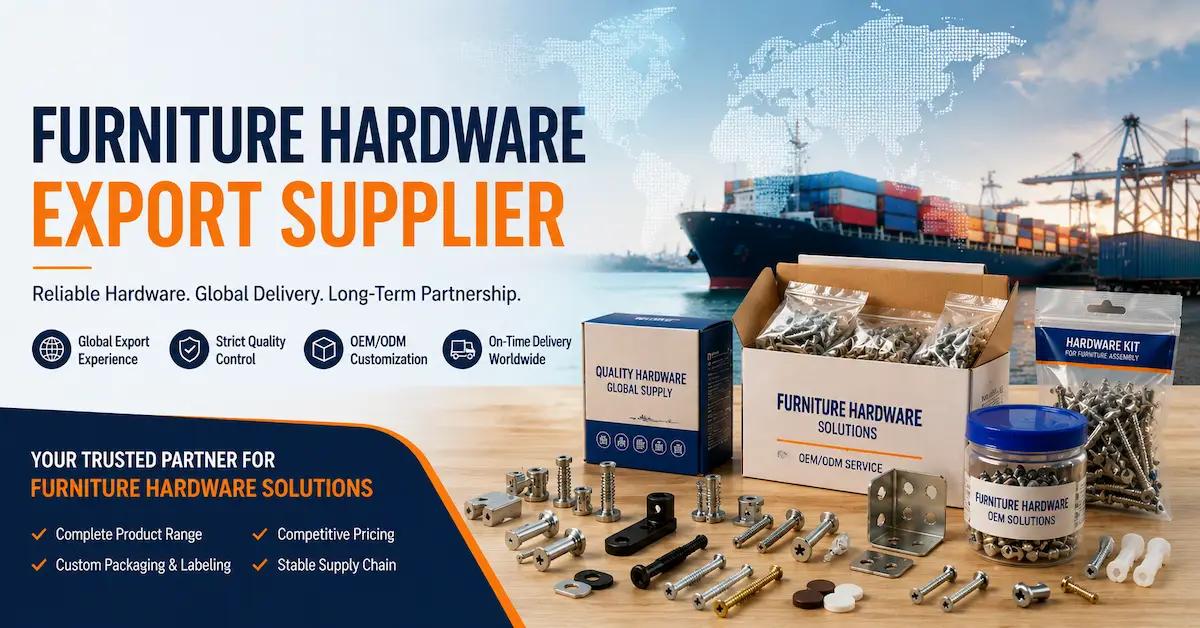
A furniture hardware export supplier plays a critical role in helping furniture manufacturers, cabinet factories, importers, wholesalers, retailers, and e-commerce brands source stable hardware products from overseas.
Furniture hardware may include screws, cam locks, cabinet bolts, insert nuts, brackets, stamped plates, washers, anchors, plastic accessories, and complete assembly kits. Although these components are relatively small, they directly affect furniture strength, assembly efficiency, packaging accuracy, and customer satisfaction.
For international buyers, product quality is only one part of the sourcing decision. A suitable supplier must also understand export documentation, packaging standards, labeling, shipping schedules, order consolidation, inspection requirements, and repeat-order consistency.
A low quotation may become expensive if the shipment contains mixed specifications, missing components, weak cartons, incorrect labels, unstable finishes, or delayed production.
That is why choosing a furniture hardware export supplier should be treated as a long-term supply-chain decision rather than a one-time price comparison.
JHFIX provides screws, nuts, furniture hardware, stamping hardware, and customized packaging solutions for international buyers. Explore the complete JHFIX product range for furniture manufacturing, wholesale, retail, and OEM projects.
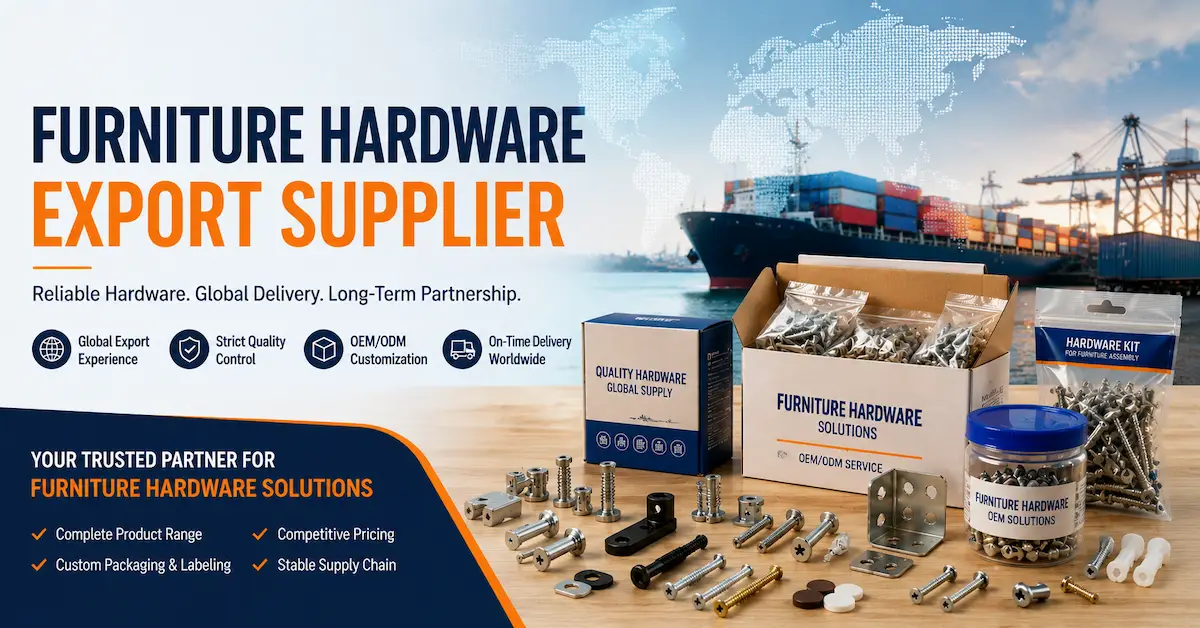
Quick Answer: What Does a Furniture Hardware Export Supplier Provide?
A furniture hardware export supplier provides hardware products and related services for buyers in overseas markets.
Common products include:
- Furniture screws
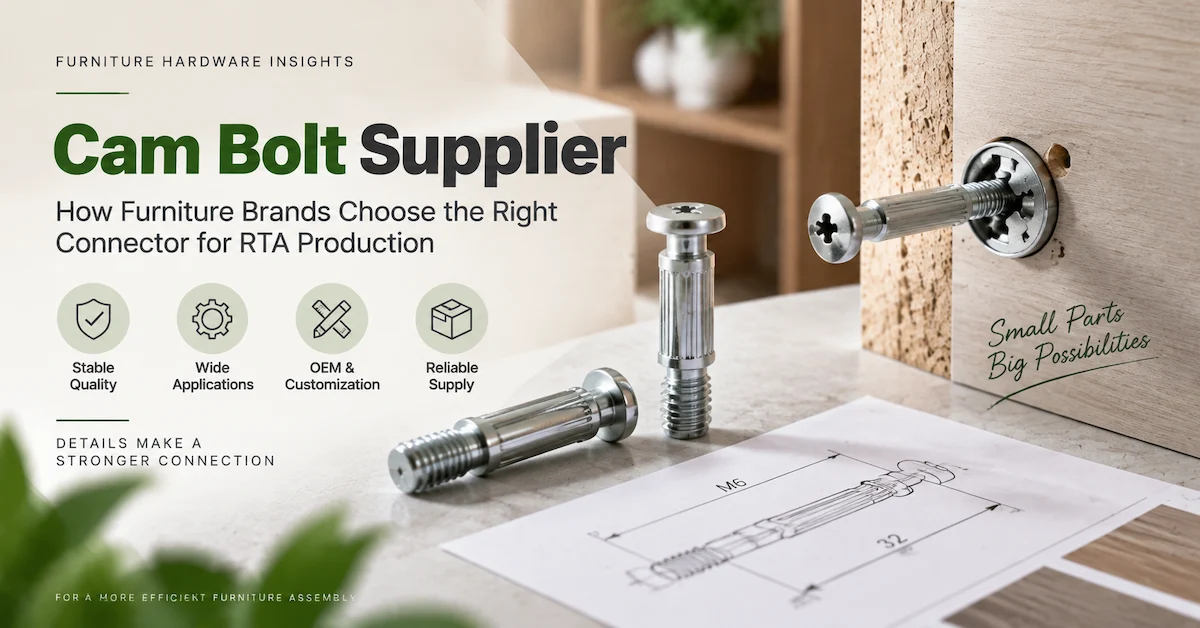
- Cam locks and cam bolts
- Cabinet connectors
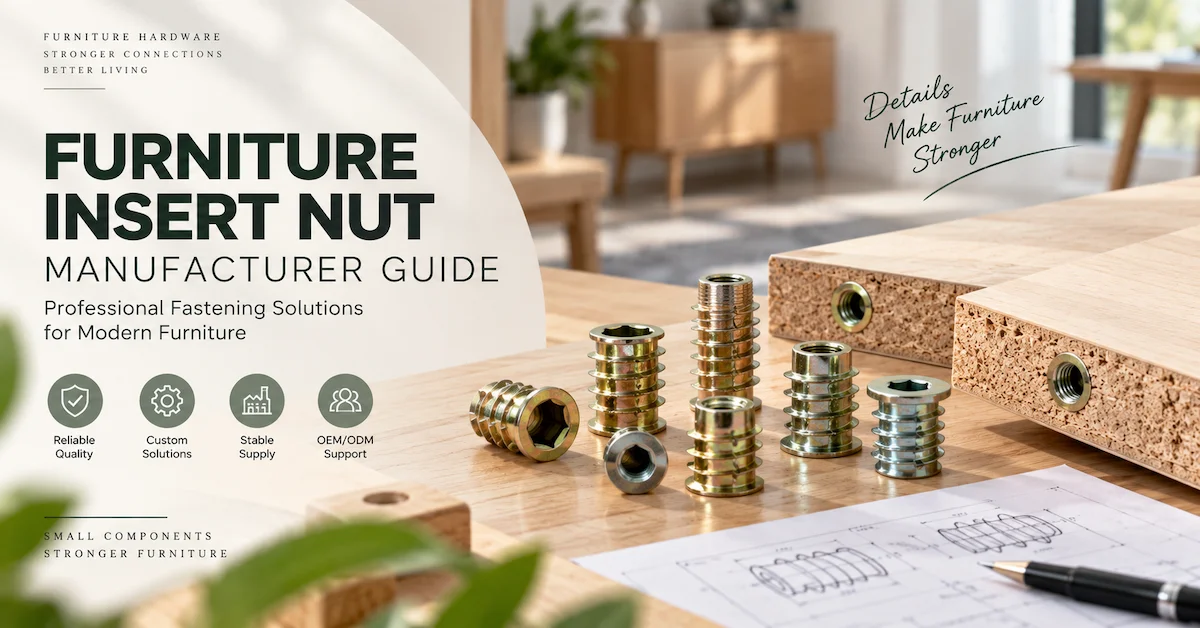
- Insert nuts
- Brackets and fixing plates
- Washers and wall anchors
- Stamped furniture hardware
- Plastic accessories
- Pre-packed hardware kits
- Retail screw assortments
A professional export supplier should also support OEM customization, product matching, sample development, quality inspection, export packaging, labels, barcodes, shipping documents, and repeat-order management.
Who Needs a Furniture Hardware Export Supplier?
Different international buyers require different hardware and service models.
Furniture Manufacturers
Furniture factories need stable specifications, repeatable quality, production-line packaging, and predictable delivery schedules.
They commonly purchase:
- Wood screws
- Confirmat screws
- Cam locks
- Insert nuts
- Cabinet bolts
- Brackets
- One-kit-per-furniture-unit hardware bags
Furniture Importers
Importers need a supplier that understands export cartons, product labels, customs documents, shipping terms, and mixed-product orders.
They often prioritize:
- Competitive landed cost
- Stable production
- Accurate paperwork
- Container utilization
- Packaging compliance
- Long-term price and specification control
Hardware Wholesalers
Wholesalers need a wide product range, bulk packaging, repeat availability, and clear SKU management.
Retail and DIY Brands
Retail brands need blister packs, boxes, printed labels, barcodes, logos, and market-ready hardware assortments.
Flat-Pack Furniture Brands
Flat-pack furniture companies require model-specific kits with correct quantities and clear component identification.
E-Commerce Sellers
Online sellers need compact, durable, visually organized packaging that can reduce returns and negative reviews.
Main Products Exported by Furniture Hardware Suppliers
A furniture hardware export supplier may provide several product categories within one order.
| Product Category | Common Products | Main Application |
|---|---|---|
| Screws | Wood screws, self-tapping screws, machine screws, confirmat screws | Panel fixing and furniture assembly |
| Furniture connectors | Cam locks, cabinet bolts, joint connectors | Flat-pack and modular furniture |
| Nuts | Insert nuts, hex nuts, flange nuts, rivet nuts | Threaded furniture connections |
| Stamped hardware | L-brackets, fixing plates, support plates | Reinforcement and structural support |
| Anchors and washers | Wall plugs, expansion anchors, flat washers | Furniture installation and load distribution |
| Plastic accessories | Caps, sleeves, spacers, plugs | Protection, alignment, and appearance |
| Hardware kits | Pre-packed bags, blister packs, boxes | Furniture assembly, retail, and e-commerce |
| Bulk packaging | Cartons, boxes, buckets | Factory and distributor supply |
A supplier with multiple categories can help buyers reduce sourcing complexity and improve compatibility between components.
Why Export Experience Matters
Domestic supply and international supply require different operating capabilities.
An experienced furniture hardware export supplier should understand:
- Commercial invoices
- Packing lists
- Product descriptions
- HS code coordination
- Country-of-origin information
- Carton markings
- Pallet requirements
- Shipping marks
- Export packaging
- Destination-market labels
- Incoterms
- Freight coordination
Incorrect documentation can delay customs clearance, while weak packaging can cause product damage or carton failure during transportation.
Export experience also improves communication. A supplier familiar with international orders is more likely to confirm technical specifications, packaging details, delivery dates, and shipping requirements clearly before production.
How to Evaluate a Furniture Hardware Export Supplier
1. Review the Product Range
A furniture project may require screws, cam locks, nuts, brackets, anchors, and packaging in the same shipment.
A wider product range helps buyers reduce:
- Supplier coordination
- Product mismatch
- Multiple payment arrangements
- Separate inspection costs
- Complicated shipping consolidation
JHFIX supplies several related categories, allowing buyers to build more complete furniture hardware orders through one supplier.
2. Confirm Manufacturing and Customization Capability
International buyers may require:
- Custom screw lengths
- Special head and drive types
- Custom connector dimensions
- Stamped brackets based on drawings
- Specific materials
- Special finishes
- Model-specific hardware kits
- Private-label packaging
The supplier should be able to evaluate drawings, samples, photographs, BOMs, and functional requirements.
3. Check Export Packaging Experience
Furniture hardware is heavy relative to its size. Poor carton design can cause damage during international shipping.
The supplier should consider:
- Carton strength
- Maximum carton weight
- Inner bag thickness
- Moisture protection
- Product separation
- Pallet loading
- Shipping marks
- Barcode placement
- Container stacking
Sharp stamped brackets may require reinforced bags or internal protection. Plated parts may need separation to avoid scratching.
4. Evaluate Quality-Control Procedures
A reliable export supplier should inspect both the hardware and the final packaging.
Important checks include:
- Material
- Dimensions
- Thread accuracy
- Head and drive shape
- Connector compatibility
- Hole positions
- Bracket thickness
- Surface finish
- Quantity per package
- Label accuracy
- Carton condition
5. Confirm Communication Speed
Good export communication should be clear, complete, and documented.
The supplier should confirm:
- Product specifications
- Sample requirements
- MOQ
- Tooling charges
- Unit prices
- Packaging costs
- Lead time
- Payment terms
- Shipping terms
- Inspection standards
Unclear communication before production often creates costly problems after shipment.
Furniture Hardware Export Supplier vs. Domestic Supplier
| Comparison Point | Export Supplier | Domestic-Only Supplier |
| Export documentation | Familiar with international paperwork | May require outside support |
| Packaging | Designed for long-distance shipping | Often suitable for local delivery |
| Label requirements | Supports barcodes and export marks | May provide only standard labels |
| Incoterms | Familiar with common trade terms | Limited experience |
| Communication | Usually supports international buyers | May focus on local customers |
| Customs awareness | Better preparation for export | May lack export knowledge |
| Best suited for | Importers, brands, distributors | Domestic purchasing |
A supplier may manufacture good products but still be unsuitable for export if it cannot manage packaging, documentation, and shipping requirements.
OEM Furniture Hardware for Export Markets
OEM customization allows buyers to develop products that match their furniture design, market positioning, and brand requirements.
Common OEM services include:
- Custom screws
- Custom finishes
- Drawing-based stamped parts
- Cam lock and bolt matching
- Insert nut customization
- Hardware set combinations
- Private-label bags
- Retail blister packaging
- Printed boxes
- Barcode labels
- Multi-language labels
- Custom carton marks
Buyers should provide complete technical and commercial information before requesting an OEM quotation.
Typical OEM Development Process
| Step | Supplier Activity | Buyer Confirmation |
| 1 | Review inquiry | Application and product requirements |
| 2 | Check drawings or samples | Dimensions, material, finish |
| 3 | Prepare quotation | Price, MOQ, tooling, lead time |
| 4 | Develop sample | Fit, appearance, and function |
| 5 | Confirm packaging | Label, quantity, barcode, carton |
| 6 | Start mass production | Approved sample and BOM |
| 7 | Conduct inspection | Product and packaging quality |
| 8 | Arrange export shipment | Documents and delivery terms |
A complete sample should be approved before mass production, particularly for customized fasteners, connectors, brackets, and hardware kits.
Export Packaging Options
Bulk Carton Packaging
Bulk cartons are suitable for furniture factories and hardware distributors purchasing large quantities of one product.
Advantages include:
- Lower packaging cost
- Efficient container loading
- Suitable for factory storage
- Easy bulk handling
Bag Packaging
Bag packaging is suitable for model-specific furniture kits.
A bag may contain:
- Screws
- Cam locks
- Bolts
- Insert nuts
- Brackets
- Washers
- Plastic accessories
Plastic Blister Packaging
Blister packaging is suitable for retail display and DIY hardware products.
Box Packaging
Boxes are useful for organized assortments, repair kits, and e-commerce products.
Plastic Bucket Packaging
Buckets are suitable for bulk screws, contractors, and large-volume installation projects.
JHFIX supports multiple packaging methods, helping buyers select the right format for manufacturing, distribution, retail, or online sales.
How to Control Missing Parts in Export Hardware Kits
Missing parts can create expensive international after-sales problems. Sending replacement pieces overseas may cost much more than the hardware itself.
A controlled kitting process may include:
- Confirming the BOM
- Assigning unique part numbers
- Approving component samples
- Preparing a reference kit
- Counting or weighing components
- Sealing the package
- Applying labels and barcodes
- Inspecting finished kits
- Checking carton quantities
- Retaining production records
Complex kits can be separated into labeled sub-bags according to assembly stage.
This helps installers identify components and reduces packing errors.
Materials and Surface Finishes
| Option | Main Benefit | Typical Application |
| Carbon steel | Strong and cost-effective | General furniture screws and brackets |
| Stainless steel | Corrosion resistance | Premium or humid environments |
| Zinc alloy | Suitable for connector components | Cam locks and fittings |
| Zinc plating | Balanced cost and rust protection | Indoor furniture hardware |
| Nickel plating | Cleaner decorative finish | Visible components |
| Black coating | Modern visual appearance | Dark furniture |
| Coloured finish | Matches furniture or brand design | Decorative and retail screws |
The supplier should recommend materials and finishes based on the environment, load, appearance, and target cost.
Quality Inspection for Export Orders
International buyers may use supplier inspection, third-party inspection, or both.
A typical inspection checklist may include:
Product Inspection
- Dimensions
- Thread
- Material
- Finish
- Appearance
- Connector fit
- Bracket shape
- Quantity
Packaging Inspection
- Bag sealing
- Product count
- Label content
- Barcode readability
- Carton strength
- Carton marks
- Gross and net weight
- Pallet condition
Documentation Inspection
- Commercial invoice
- Packing list
- Product description
- Quantity
- Carton count
- Shipping marks
Inspection requirements should be confirmed before production.
Lead Time and Production Planning
Furniture hardware lead time depends on:
- Product complexity
- Stock availability
- Tooling
- Surface treatment
- Order quantity
- Packaging customization
- Label printing
- Inspection requirements
- Production schedule
Standard screws may have a shorter lead time than custom stamped parts or branded hardware kits.
Buyers should provide an annual forecast when possible. This allows the supplier to prepare materials, packaging, and production capacity more effectively.
Incoterms and Shipping Options
Common trade terms include:
- EXW
- FOB
- CIF
- DDP
The correct term depends on the buyer’s logistics capability, destination, order volume, and import arrangement.
Buyers should confirm whether the quotation includes:
- Inland transport
- Export customs handling
- Ocean freight
- Insurance
- Destination clearance
- Duties and taxes
- Final delivery
The lowest product price does not always create the lowest landed cost.
Cost Factors for Export Furniture Hardware
The final cost may include:
- Product material
- Manufacturing
- Tooling
- Surface treatment
- Packaging
- Labels
- Inspection
- Export cartons
- Pallets
- Inland freight
- International shipping
- Duties and taxes
Buyers should compare total landed cost rather than unit price alone.
A slightly higher product price may be worthwhile if it provides better packaging, fewer defects, lower missing-part risk, and more reliable delivery.
RFQ Checklist for Global Buyers
| Information | Details to Provide |
| Product type | Screw, connector, nut, bracket, hardware kit |
| Application | Cabinet, wardrobe, shelf, flat-pack furniture |
| Specification | Size, material, finish, tolerance |
| Drawing or sample | Technical file or physical reference |
| Quantity | Trial order and annual forecast |
| Packaging | Bulk, bag, blister, box, bucket |
| Branding | Logo, barcode, label, carton marks |
| Target country | Destination market |
| Incoterm | EXW, FOB, CIF, DDP |
| Inspection | Supplier or third-party inspection |
| Required date | Production and delivery deadline |
Providing complete RFQ information helps the supplier quote more accurately and respond faster.
Why Choose JHFIX as Your Furniture Hardware Export Supplier?
JHFIX supports international buyers with a combination of furniture hardware manufacturing, product matching, kitting, and packaging.
JHFIX can supply:
- Furniture screws
- Custom screws
- Cam locks
- Cabinet connectors
- Insert nuts
- Stamped brackets
- Fixing plates
- Washers and anchors
- Plastic accessories
- Complete furniture hardware kits
- Bag packaging
- Plastic blister packaging
- Box packaging
- Plastic bucket packaging
- Private-label products
JHFIX is particularly suitable for buyers who want to source several related hardware categories through one export supplier.
This integrated approach can help reduce:
- Supplier communication
- Component mismatch
- Separate inspections
- Shipping consolidation
- Packaging errors
- Repeat-order inconsistency
Buyers can learn more through the About Us page, browse available categories on the Products page, or contact JHFIX with a BOM, drawings, quantity, destination, and packaging requirements.
FAQ
1. What does a furniture hardware export supplier provide?
A furniture hardware export supplier provides screws, connectors, nuts, brackets, anchors, accessories, kits, export packaging, documentation, and shipping support for international buyers.
2. Can furniture hardware be customized for export markets?
Yes. Products can be customized by size, material, finish, design, quantity, label, barcode, packaging, and target-market requirements.
3. What export packaging options are available?
Common options include bulk cartons, bags, blister packs, boxes, plastic buckets, pallets, and private-label packaging.
4. Can multiple furniture hardware products be shipped together?
Yes. Screws, connectors, nuts, brackets, stamped parts, and accessories can be consolidated into one shipment or packed as complete kits.
5. What documents are normally required for export?
Common documents include a commercial invoice, packing list, bill of lading or airway bill, and other destination-specific documents.
6. How can buyers reduce missing parts in furniture hardware kits?
Use a confirmed BOM, unique part codes, sample kits, quantity verification, labels, finished-kit inspection, and carton checks.
7. What information is needed for an export quotation?
Provide product specifications, drawings or samples, quantity, packaging, destination country, trade term, inspection requirements, and delivery schedule.
8. Can JHFIX provide private-label furniture hardware?
Yes. JHFIX can support logos, labels, barcodes, model numbers, customized packages, and private-label hardware kits.
9. Which shipping term is best for furniture hardware?
The best Incoterm depends on the buyer’s import capability and logistics arrangements. FOB, CIF, and DDP may suit different purchasing situations.
10. How should buyers evaluate a furniture hardware export supplier?
Evaluate product range, customization, quality control, export packaging, documentation, communication, lead time, shipping support, and repeat-order stability.
Conclusion
Choosing the right furniture hardware export supplier helps global buyers reduce sourcing risk, improve component compatibility, protect products during shipping, and maintain stable repeat orders.
A reliable supplier should provide more than screws and connectors. It should understand OEM customization, BOM management, quality inspection, export packaging, documentation, logistics, and destination-market requirements.
For furniture manufacturers, importers, distributors, wholesalers, retailers, and flat-pack furniture brands, JHFIX provides an integrated export solution covering screws, furniture connectors, nuts, stamped hardware, accessories, customized kits, and multiple packaging formats.
Browse the JHFIX product range, learn more about JHFIX, review common purchasing questions on the FAQ page, or contact JHFIX with your product list, drawings, annual demand, destination country, and packaging requirements for a customized export quotation.