
What Hardware Does a Wardrobe Manufacturer Actually Need?
A wardrobe may look simple from the outside, but manufacturing one consistently requires multiple hardware components working as a coordinated system.
For a furniture factory, choosing a wardrobe hardware supplier is therefore not just about finding screws or fittings at a competitive price. The supplier must be able to match connectors, bolts, nuts, shelf supports, brackets, and packaging with the actual wardrobe structure.
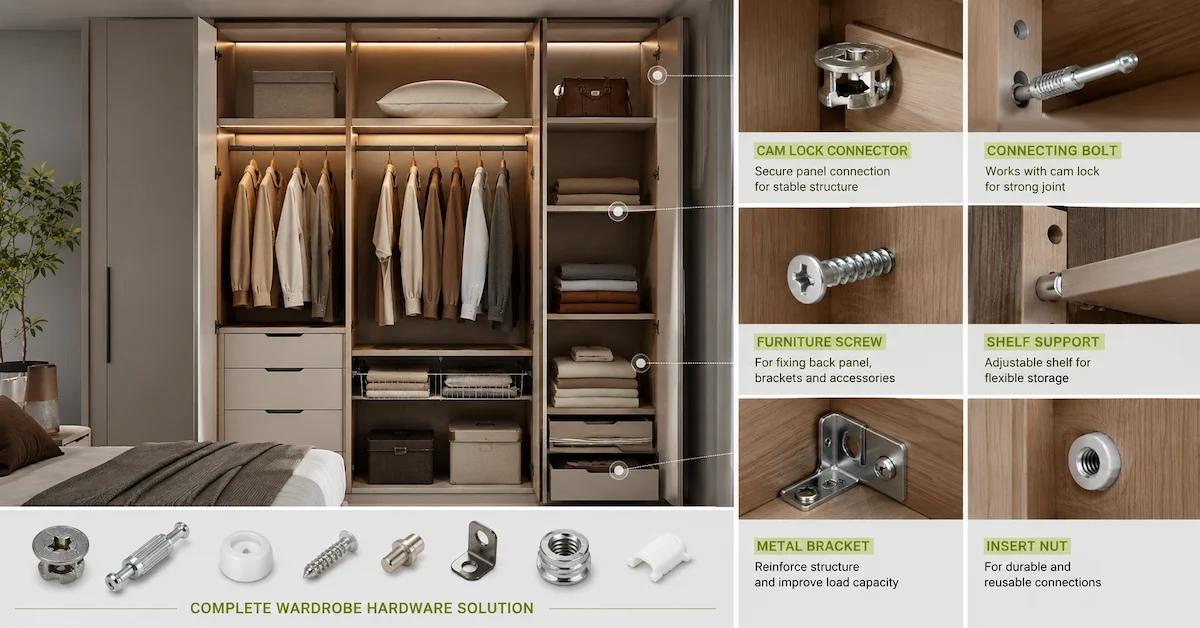
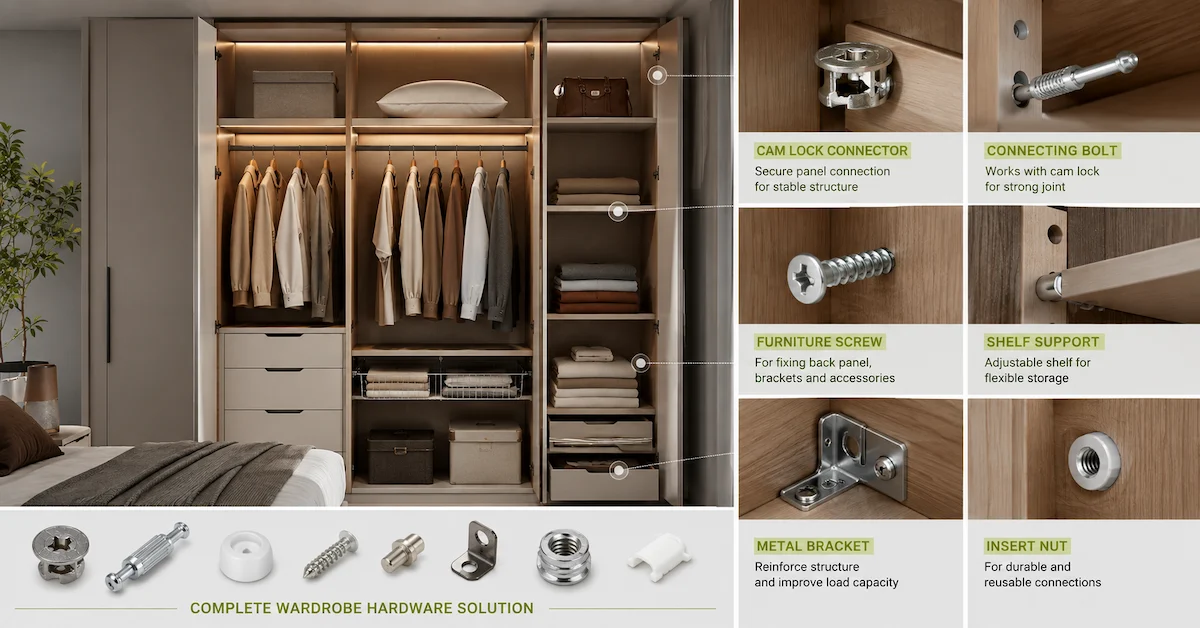
A typical wardrobe hardware system may include:
- Cam lock connectors
- Furniture connecting bolts
- Insert nuts
- Furniture screws
- Shelf supports
- Stamped brackets
- Plastic accessories
- Pre-packed assembly hardware kits
The exact combination depends on the wardrobe design, panel material, thickness, assembly method, target market, and whether the finished product is shipped assembled or flat packed.
JHFIX supplies furniture hardware components for cabinets, wardrobes, modular furniture, and other furniture manufacturing applications.
For B2B buyers, the key question is not:
Which individual fastener is cheapest?
It is:
Which hardware system can be assembled accurately, supplied consistently, and repeated across thousands of wardrobes?
Why Wardrobe Hardware Selection Matters in Production
Small hardware components can create large production problems when specifications are incorrect.
Common issues include:
- Cam locks that do not engage correctly
- Connector bolts that do not match the panel thickness
- Screws that damage MDF or particleboard
- Shelf supports that do not fit drilled holes
- Brackets with inconsistent hole positions
- Wrong quantities inside assembly bags
- Missing components in flat-pack furniture cartons
These issues may cause rework in the factory or become customer complaints after shipment.
A professional wardrobe hardware supplier should therefore understand both hardware manufacturing and furniture assembly.
The supplier should help buyers evaluate:
- Application
- Panel material
- Panel thickness
- Connection method
- Hardware dimensions
- Surface finish
- Matching components
- Packaging requirements
This application-based approach is more reliable than selecting products only by catalogue appearance.
Cam Locks and Furniture Connectors for Wardrobe Assembly
Cam lock connectors are widely used in wardrobes, cabinets, and ready-to-assemble furniture because they create relatively concealed and detachable panel connections.
A typical system includes:
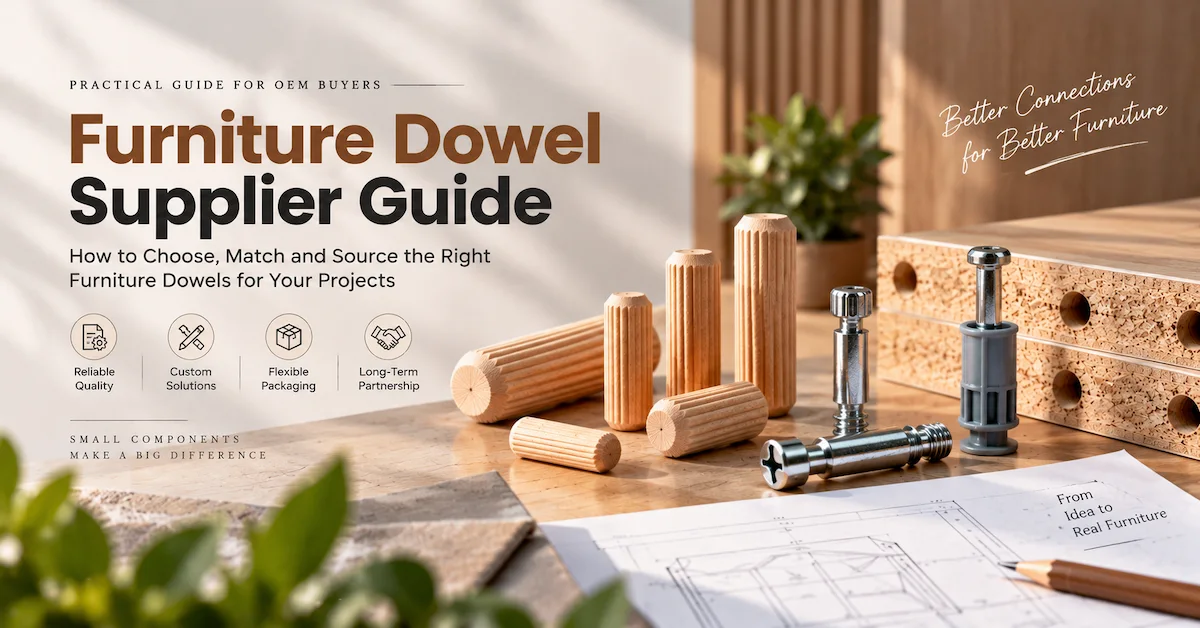
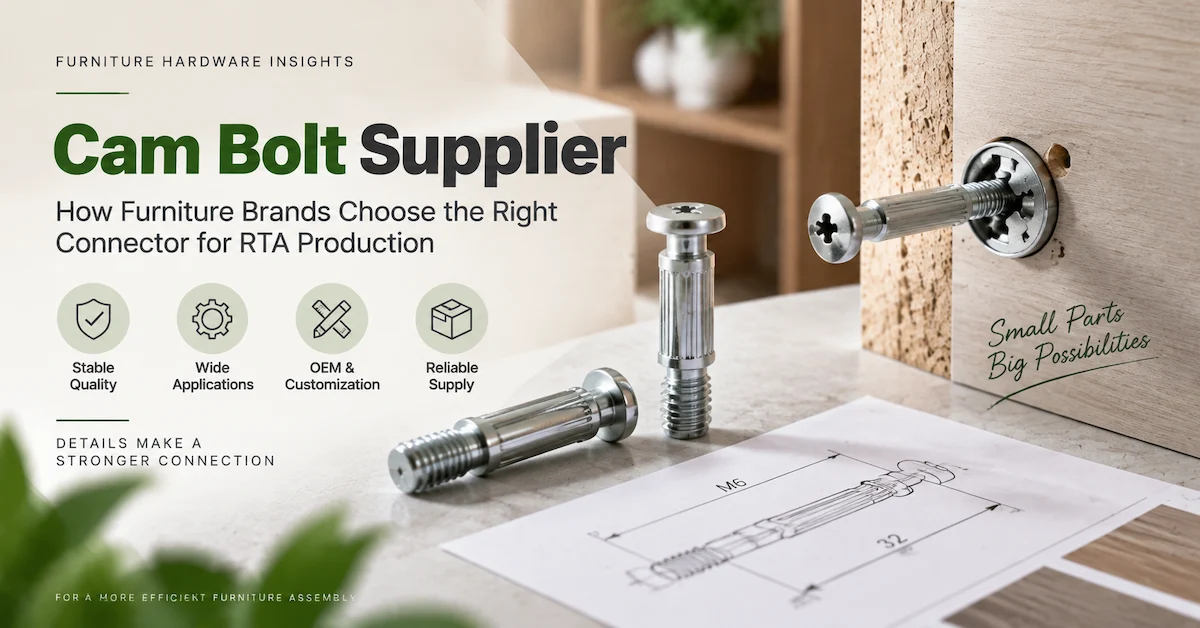
- An eccentric cam
- A connecting bolt
- Accurately drilled furniture panels
When the cam rotates, it engages the connecting bolt and pulls the two panels together.
For wardrobe production, this system can support:
- Side-panel connection
- Top and bottom panel assembly
- Interior partition installation
- Flat-pack furniture assembly
- Detachable furniture structures
JHFIX offers cam locks and furniture connectors for furniture manufacturing applications.
What Should Buyers Specify?
A wardrobe manufacturer should provide more than the words “cam lock.”
Useful information includes:
- Cam diameter
- Connecting bolt length
- Panel thickness
- Drilling diameter
- Drilling depth
- Hole center position
- Material
- Surface finish
- Quantity
The cam and connecting bolt should be evaluated together.
Ordering these components separately without confirming compatibility can increase assembly risk.
Connecting Bolts and Insert Nuts
Connecting bolts are another important part of wardrobe assembly systems.
They may work together with:
- Cam locks
- Insert nuts
- Threaded components
- Concealed furniture connectors
Important parameters include:
- Diameter
- Thread
- Overall length
- Thread length
- Head type
- Drive type
- Surface finish
- Matching component
A furniture factory should also consider how deeply the bolt enters the panel and whether the design leaves enough material around drilled holes.
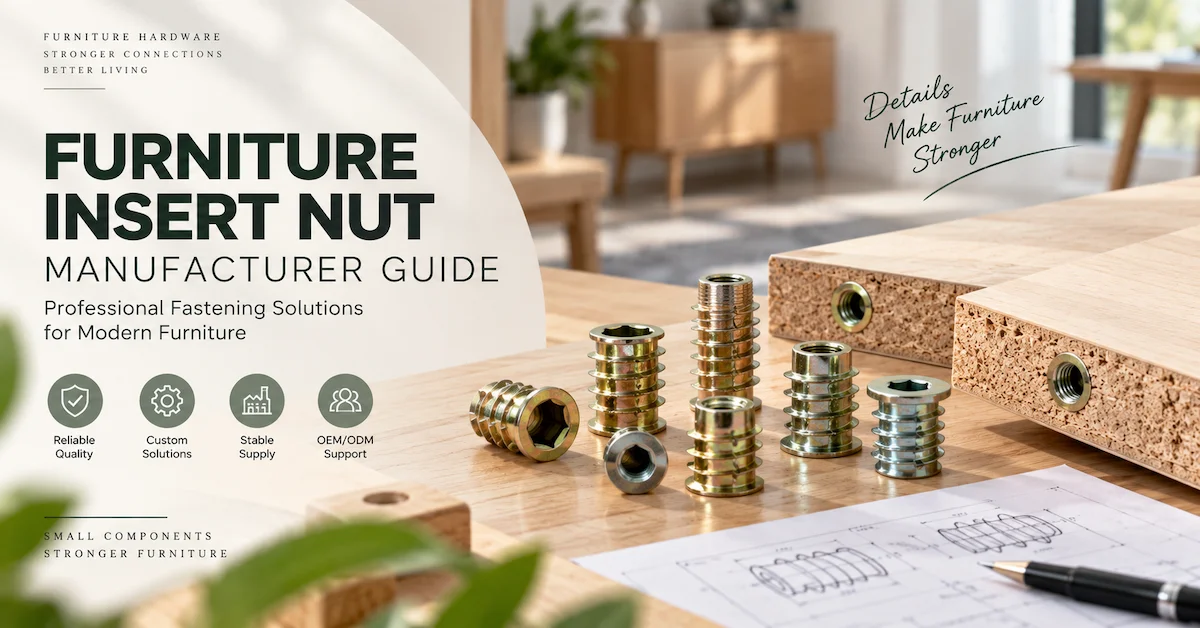
Insert Nuts for Reusable Connections
Insert nuts are useful where a wardrobe requires a reusable machine-thread connection.
Typical applications may include:
- Removable wardrobe frames
- Bed-and-wardrobe combinations
- Modular furniture
- Replaceable furniture components
JHFIX provides nuts and threaded furniture hardware for different assembly requirements.
The key selection factors include:
- Internal thread
- External geometry
- Insert length
- Installation method
- Panel material
- Matching bolt
An insert nut suitable for one board construction should not automatically be assumed to perform the same way in another.
Furniture Screws for Wardrobe Production
Screws remain one of the most frequently used components in wardrobe manufacturing.
They may be used for:
- Back-panel fixing
- Bracket installation
- Reinforcement
- Accessory mounting
- Internal panel connection
Common types include:
- Wood screws
- Self-tapping screws
- Machine screws
- Countersunk screws
- Custom furniture screws
Buyers can review the JHFIX screw product range when developing a wardrobe hardware specification.
Screw Selection Should Match the Board
A useful wardrobe screw specification should include:
| Parameter | Buyer Should Confirm |
|---|---|
| Panel material | MDF, particleboard, plywood, solid wood |
| Panel thickness | Actual production thickness |
| Screw diameter | Based on joint design |
| Length | Required engagement without breakthrough |
| Thread | Suitable for mating material |
| Head type | Flush, visible or bracket fixing |
| Drive | Phillips, Torx, hex socket, etc. |
| Material | Based on application |
| Finish | Appearance and environment |
A screw selected only by length can still fail to match the production requirement.
Shelf Supports and Structural Brackets
Wardrobes increasingly use adjustable interior storage layouts.
From a manufacturing perspective, adjustable shelving depends on correctly specified shelf supports rather than only the shelf design itself.
A wardrobe factory should evaluate:
- Shelf material
- Shelf thickness
- Support-pin diameter
- Drilling size
- Hole spacing
- Installation position
- Required appearance
JHFIX's furniture hardware range includes shelf-support components suitable for cabinet and wardrobe applications.
Brackets and Stamped Hardware
Metal brackets may be used for:
- Reinforcement
- Corner connections
- Internal support
- Mounting
- Furniture-frame assembly
For custom stamped components, buyers should define:
- Material
- Sheet thickness
- Hole diameter
- Hole position
- Bend geometry
- Surface finish
- Drawing tolerance where required
JHFIX also provides stamping hardware solutions for furniture and OEM assembly.
How Board Material Changes Wardrobe Hardware Selection
The wardrobe panel should be considered before the hardware is finalized.
MDF
MDF has a relatively uniform structure, but installation near edges can require careful control.
Important variables include:
- Pilot-hole size
- Screw geometry
- Edge distance
- Installation torque
- Connector drilling position
Testing should use the same board specification planned for production.
Particleboard and Chipboard
Particleboard is common in panel furniture and RTA wardrobes.
Because the material consists of compressed particles, buyers should pay attention to:
- Thread engagement
- Screw diameter
- Penetration depth
- Hole location
- Installation torque
A fastener that is unnecessarily aggressive or incorrectly positioned can damage the surrounding panel.
Plywood
Plywood has a layered structure and can behave differently from MDF or particleboard.
Hardware should be tested with the actual:
- Board thickness
- Layer construction
- Joint location
- Installation method
Solid Wood
Wood species, density, grain direction, moisture condition, and distance from the edge can affect screw installation.
For all four materials, a practical rule is:
qualify the hardware in the actual wardrobe panel instead of approving it only from a drawing.
Materials and Surface Finishes for Wardrobe Hardware
The original appearance of wardrobe hardware matters, but manufacturers also need to consider production method, environment, and cost.
| Material / Finish | Main Buyer Consideration | Typical Application |
| Carbon steel | Manufacturing flexibility and cost | Screws, bolts, brackets |
| Stainless steel | Corrosion resistance | Selected humid environments |
| Zinc alloy | Formability and appearance | Furniture connectors |
| Zinc plating | Protection and appearance | General furniture hardware |
| Nickel plating | Decorative appearance | Visible fittings |
| Black finish | Dark furniture aesthetics | Exposed components |
Surface Finish Should Match the Application
A wardrobe installed in a dry bedroom may have different requirements from furniture intended for a humid environment.
The buyer should therefore define whether the priority is:
- Appearance
- Surface protection
- Color matching
- Corrosion requirement
- Cost control
Avoid treating a finish name as a complete performance specification.
If a project requires a particular corrosion-testing result, specify the test method and acceptance requirement during RFQ and sample approval.
Why Wardrobe Manufacturers Should Consider Pre-Packed Hardware Kits
One of the biggest sourcing opportunities for wardrobe factories is moving from loose components to model-specific hardware kits.
A wardrobe hardware kit might contain:
- 20 cam locks
- 20 connecting bolts
- Furniture screws
- Shelf supports
- Brackets
- Plastic caps
- Installation accessories
The exact BOM depends on the wardrobe design.
The benefit is not simply convenient packaging.
Hardware kitting can help reduce:
- Missing parts
- Mixed screw sizes
- Wrong connector quantities
- Assembly-line sorting
- Packaging errors
- End-user installation complaints
For flat-pack wardrobes, the hardware kit becomes part of the product itself.
JHFIX supports different packaging formats across its hardware and packaging product range, including bag, box, blister, and other packaging solutions.
Wardrobe Hardware Selection Checklist
The following checklist can help procurement teams connect each wardrobe function with its hardware requirement.
| Wardrobe Requirement | Hardware to Review | Key Specification |
| Main panel joint | Cam + connector bolt | Panel thickness and drilling |
| Reusable connection | Insert nut + bolt | Thread and installation |
| Panel fastening | Furniture screw | Diameter, length and thread |
| Adjustable shelf | Shelf support | Pin size and shelf material |
| Structural reinforcement | Bracket | Material, thickness and holes |
| Flat-pack installation | Hardware kit | BOM and quantity accuracy |
This approach is especially useful when comparing suppliers because it evaluates the complete hardware system rather than only individual SKUs.
How to Evaluate a Wardrobe Hardware Supplier
A professional buyer should assess several dimensions before approving a long-term supplier.
Product Compatibility
Ask whether the supplier can match the hardware to:
- Board thickness
- Drilling layout
- Assembly process
- Other mating components
A catalogue match is not enough when several parts operate together.
Manufacturing Capability
Useful capabilities may include:
- Cold heading
- Tapping
- Stamping
- Injection molding
- Assembly
- Packaging
- Inspection
JHFIX states that these processes are part of its manufacturing system. Buyers can review more details on the JHFIX About Us page.
Having multiple processes within one supply system can be useful when a wardrobe BOM combines metal fasteners, plastic components, stamped brackets, and packaged kits.
Engineering Support
For OEM projects, suppliers should be able to review:
- Drawings
- Physical samples
- Existing specifications
- BOMs
- Matching parts
- Furniture application
This helps identify compatibility issues before production.
Quality Control
Wardrobe hardware QC should cover characteristics that influence real assembly.
Key checks may include:
- Dimensions
- Thread quality
- Connector fit
- Surface condition
- Component matching
- Packaging quantities
Packaging Capability
If wardrobes are shipped flat packed, evaluate whether the supplier can package hardware by furniture model rather than only provide bulk cartons.
This reduces additional sorting and repacking at the furniture factory.
OEM Wardrobe Hardware Development Process
When standard components do not meet the furniture design, OEM development may be required.
1. Submit Drawings, Samples or BOM
Provide as much information as possible, including:
- Component drawing
- Sample
- Wardrobe BOM
- Panel material
- Panel thickness
2. Confirm the Application
Explain where the component will be installed and how the wardrobe will be assembled.
3. Engineering and Manufacturing Review
The supplier evaluates:
- Geometry
- Material
- Manufacturing process
- Matching hardware
- Customization feasibility
4. Quotation and Sample Development
After the specification is clarified, samples can be developed for evaluation.
5. Assembly Testing and Approval
Samples should be tested in representative wardrobe panels.
Check:
- Fit
- Assembly
- Alignment
- Tool engagement
- Appearance
6. Mass Production and Inspection
The approved drawing or sample should become the production reference.
7. Hardware Kitting and Shipping
For flat-pack projects, approved components can be organized into model-specific hardware kits before shipment.
This workflow is more reliable than developing each component without reference to the finished wardrobe.
Common Wardrobe Hardware Sourcing Mistakes
Choosing Hardware Only by Unit Price
A lower price can become expensive if it creates rework, mismatched parts, or field complaints.
Compare total purchasing impact, not only component price.
Ordering Cam and Bolt Components Separately
Connection systems should be approved together.
Small dimensional differences can affect engagement and assembly.
Ignoring Panel Thickness
Panel thickness influences:
- Bolt length
- Drilling depth
- Screw penetration
- Connector position
It should always be included in the inquiry.
Skipping Assembly Testing
Dimensions alone do not demonstrate that the complete wardrobe will assemble correctly.
Test samples in the actual material whenever possible.
Treating Packaging as an Afterthought
For flat-pack wardrobes, missing hardware can affect the end user even when every individual component meets specification.
Include packaging accuracy within final quality control.
Using Too Many Uncoordinated Suppliers
Buying screws, cams, bolts, brackets, and packaging separately can increase:
- Communication workload
- Incoming inspection
- Inventory complexity
- Compatibility risk
A consolidated supply strategy may be more efficient when the supplier can meet the technical requirements.
Questions to Ask Before Placing a Wardrobe Hardware Order
Before approving a wardrobe hardware supplier, consider asking:
- Can you manufacture from drawings or samples?
- Can you match cam locks with connecting bolts?
- Can you recommend hardware according to panel thickness?
- Can you provide screws, nuts, connectors, and brackets together?
- How are critical dimensions inspected?
- Can components be packaged according to our BOM?
- Can the package carry our model number or private-label information?
- How are repeat-order specifications controlled?
The supplier's ability to answer these questions clearly can reveal more than a generic company presentation.
FAQ
What products does a wardrobe hardware supplier provide?
A wardrobe hardware supplier may provide cam locks, connector bolts, furniture screws, insert nuts, shelf supports, brackets, plastic accessories, and complete furniture hardware kits.
What hardware is commonly used in wardrobe manufacturing?
Common wardrobe hardware includes cam-lock systems, connecting bolts, screws, insert nuts, shelf supports, brackets, and assembly accessories. The exact combination depends on the wardrobe structure.
Which connectors are suitable for flat-pack wardrobes?
Cam locks, connector bolts, insert-nut systems, and other knock-down furniture connectors are commonly considered. Selection should be based on panel thickness, drilling design, and assembly requirements.
How do I choose screws for MDF wardrobes?
Consider MDF thickness, screw diameter, thread geometry, engagement depth, edge distance, pilot-hole requirements, and installation torque. Test the screw in the actual MDF specification before production.
Can wardrobe hardware be customized from drawings?
Yes. Hardware dimensions, connector geometry, materials, finishes, and packaging can often be customized when manufacturing feasibility has been reviewed.
Can a supplier provide complete wardrobe hardware kits?
Yes. A model-specific kit can combine connectors, screws, nuts, shelf supports, brackets, and accessories according to the wardrobe BOM.
What should I send when requesting an OEM quotation?
Provide drawings or samples, furniture application, board material, panel thickness, required dimensions, material, finish, quantity, mating components, and packaging requirements.
How should wardrobe hardware quality be inspected?
Inspection should focus on dimensions, thread quality, surface condition, functional fit, mating-component compatibility, and packaging quantity according to the approved specification.
Conclusion
Choosing the right wardrobe hardware supplier starts with the wardrobe itself—not with a hardware catalogue.
Furniture manufacturers should define panel material, thickness, connection method, assembly process, BOM, and packaging requirements before selecting connectors, screws, nuts, shelf supports, and brackets.
A capable supplier should then demonstrate component compatibility, manufacturing control, OEM support, quality inspection, and the ability to supply repeatable hardware kits when required.
JHFIX provides furniture connectors, screws, nuts, stamped hardware, and packaging solutions for wardrobe, cabinet, and other furniture manufacturing applications.
For an OEM wardrobe project, buyers can review JHFIX manufacturing capabilities or contact JHFIX with drawings, samples, BOMs, and application requirements for further evaluation.