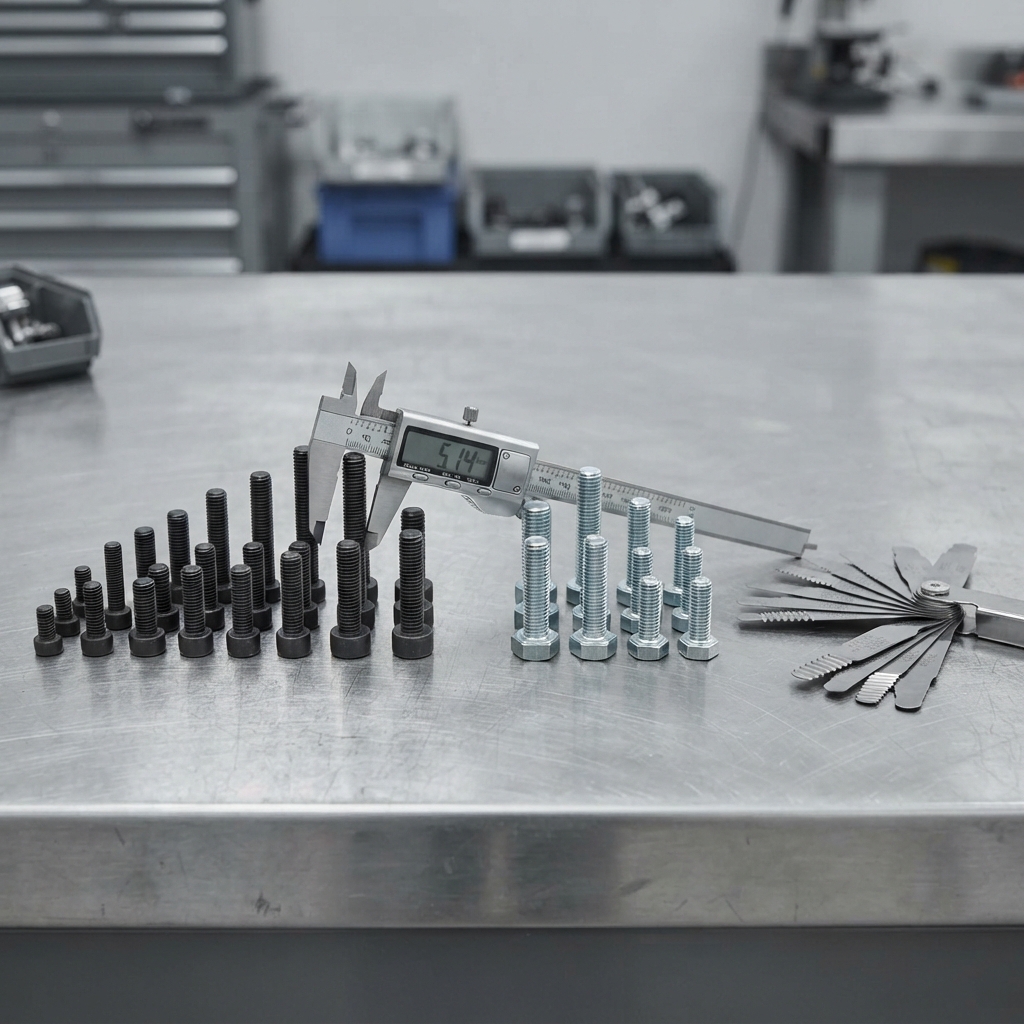
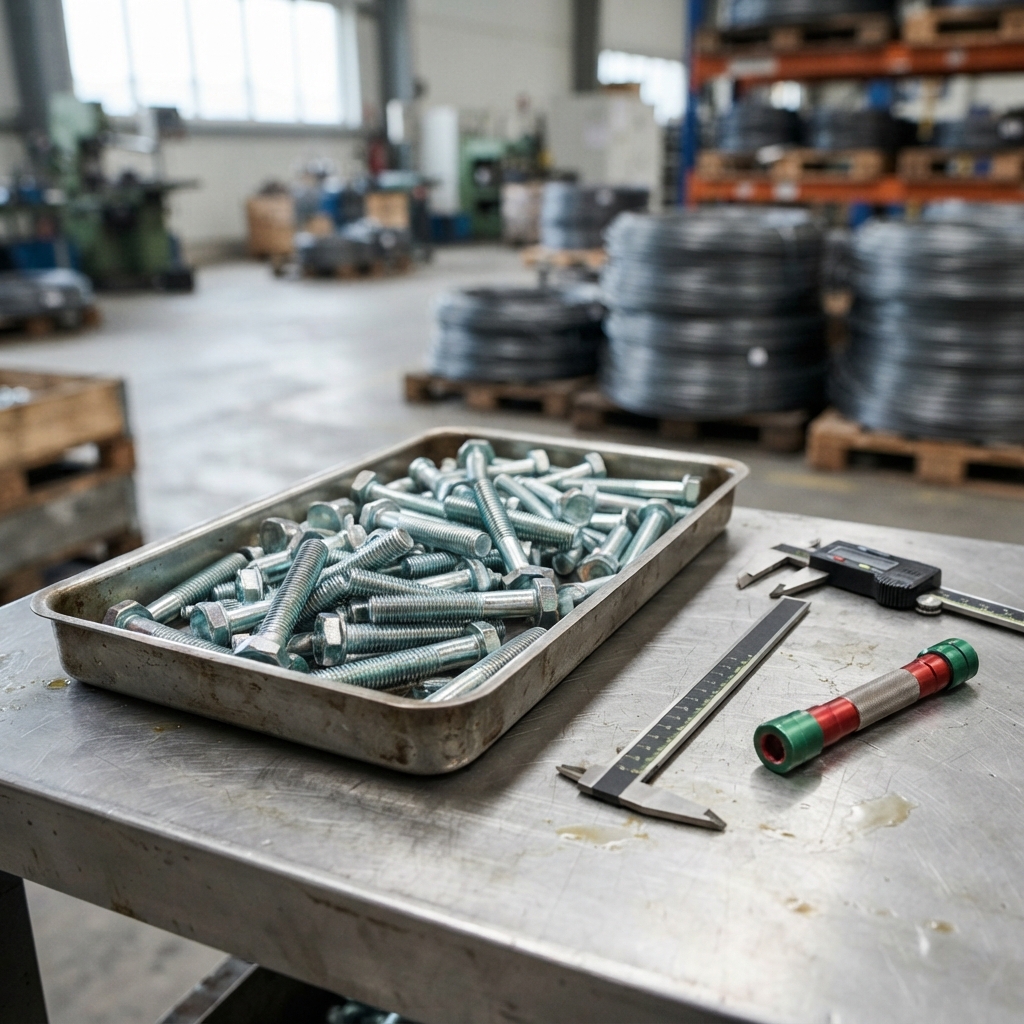

Short answer: A fastener cost breakdown explains a quoted price as eight cost lines — wire, heading, thread rolling, heat treatment, plating, sorting, packing, and overhead with margin. When one quote is 20–35% below the others for the same drawing and the same quantity, the gap is almost never efficiency. It is one of those lines being reduced. Ask for the eight lines, ask what evidence supports each, and a suspiciously cheap quote becomes comparable with an honest one.
By Lin Wei, Technical Sales Engineer, JHFIX
Why a price per thousand hides the answer
A price per 1,000 pieces is an output, not an explanation. Two suppliers can quote the same number for the same drawing while running completely different processes: one rolls the thread from certified wire and bakes after plating, the other machines a thread from whatever rod was in the yard and ships the same day. The buyer sees one number. The assembly line eventually sees the difference.
This is not a story about dishonest suppliers. It is about information asymmetry. The cost structure of a screw is invisible in a one-line quotation, and the supplier knows exactly which lines the buyer cannot see. That is why price comparison alone tends to reward whoever removed the most work, not whoever runs the best process.
The fix is procedural, not forensic. If every supplier quotes against the same eight-line template — one shared fastener cost breakdown — the cheap offer stops being a mystery and becomes a set of specific, checkable claims.
What a fastener cost breakdown should contain
The table below is the minimum structure worth requesting for any custom screw, bolt or hardware item above a few thousand pieces. It works for standard parts too; the supplier simply fills the lines from its routing rather than from a new quotation.
| Cost line | What it covers | Evidence to ask for | What a cut looks like |
|---|---|---|---|
| 1. Wire rod | Steel grade, wire diameter, coating on the wire, scrap allowance | Wire grade and mill certificate, EN 10204 3.1 where specified | Lower grade, smaller wire, higher scrap allowance |
| 2. Heading | Cold forming time, die set, tooling amortisation | Machine rate, strokes per minute, tooling cost and ownership | "Free" tooling recovered in the piece price |
| 3. Thread rolling and secondary | Thread rolling, pointing, slotting, shank reduction, deburring | Route sheet showing each operation and where it is done | Machined thread, skipped deburring, loose point geometry |
| 4. Heat treatment | Hardening and tempering to the required property class | Named furnace, hardness results per lot, class stated on the drawing | No treatment, short cycle, class claimed but not tested |
| 5. Plating or coating | Zinc, zinc-nickel, zinc flake, passivation, baking after plating | Coating thickness in µm, standard referenced, hydrogen embrittlement relief | Thinner deposit, poor coverage in recesses, no baking |
| 6. Sorting and inspection | Magnetic sorting, gauge checks, AQL sampling, first article | Inspection plan, gauge list, AQL level and acceptance numbers | Sample-only checks, no sorting, no record |
| 7. Packing and kitting | Counted packs, cartons, liners, labels, kit assembly | Packing specification, count method, carton grade | Weight-counted packs, thin cartons, no moisture barrier |
| 8. Freight, duty, overhead and margin | Inland haulage, export clearance, sea freight, finance cost, margin | Incoterm, freight basis, price validity and index clause | Freight excluded, price valid for a year with no wire clause |
Two things are worth noticing. First, only line 8 is commercial; the other seven are engineering decisions that a buyer can verify with documents. Second, lines 4 and 5 are frequently subcontracted even by real factories, which is fine as long as the subcontractor is named and the results come back with the lot.
A worked example: 1,000,000 pieces of M6 × 50, zinc plated
Numbers make the structure concrete. What follows is a should-cost model of screw manufacturing cost for one part, not a quotation: wire price, energy, labour rates and volume all move by region and by month. Rebuild it with your own inputs before you use it to challenge a price.
- Finished piece weight about 12 g; wire input about 13 g per piece including scrap.
- Wire rod at USD 700 per tonne; heading and thread rolling at USD 25 per machine hour, 150 pieces per minute.
- Heat treatment at USD 150 per tonne; zinc plating at USD 250 per tonne.
- Sorting and inspection at USD 1.00 per 1,000 pieces; packing at USD 1.20 per 1,000 pieces.
- Overhead and margin at 18% on the converted cost.
| Cost line | Basis | USD per 1,000 pieces |
|---|---|---|
| Wire rod | 13 kg input at USD 0.70/kg | 9.10 |
| Heading and thread rolling | 0.111 machine hours at USD 25/hour | 2.78 |
| Heat treatment | 13 kg at USD 0.15/kg | 1.95 |
| Zinc plating | 13 kg at USD 0.25/kg | 3.25 |
| Sorting and inspection | 1.00 per 1,000 | 1.00 |
| Packing | 1.20 per 1,000 | 1.20 |
| Subtotal | Direct and converted cost | 19.28 |
| Overhead and margin | 18% of subtotal | 3.47 |
| Model price | 22.75 |
That is a model price of roughly USD 22.75 per 1,000 pieces, or USD 0.0228 each. Now suppose a competing quote arrives at USD 14.50 per 1,000 — about 36% lower. The supplier has to remove USD 8.25 of cost from the same part. There are only a few places that money can come from.
| Where the difference comes from | Typical saving per 1,000 | What the buyer actually receives |
|---|---|---|
| Lower-grade or recycled wire | up to 1.95 | Same drawing, different steel; hardness and ductility scatter |
| Heat treatment skipped or shortened | 1.95 | A part sold as class 8.8 that does not test as class 8.8 |
| Plating at half the specified thickness | 1.60 | Cosmetically identical, corrosion life cut by years |
| No magnetic sorting or lot records | 1.00 | Mixed lots, cracked heads, no traceability |
| 2% short count in counted packs | 0.45 | You pay for 1,000, the carton holds 980 |
| Thin cartons, no moisture barrier | 0.30 | Transit damage and rust bloom before arrival |
| "Free" tooling | 1.00 deferred | Die not owned by you, price rises on the second order |
| Total | ≈ 8.25 |
Not every cheap quote is assembled this way, and a genuinely efficient factory can beat a model built on average inputs. But the arithmetic sets the burden of proof: a supplier quoting 36% below the field should be able to name the line where the saving comes from, and that answer should be a process, a volume effect or a location — not silence.
Seven places a cheap fastener quote takes the money out
1. Wire grade and wire diameter
Wire rod is the largest single line in most screws, so it is the first place a price is reduced. A change from killed steel to a cheaper grade, a lower carbon range, or a wire drawn slightly under nominal diameter all lower the cost and all change the part. This is fastener material substitution in its most common form, and it is hard to see. The under-diameter case is the most damaging because it hides: the thread still gauges at the minor diameter, the head still forms, and the fastener simply carries less load. Ask for the wire grade on the quote, and ask for the mill certificate with the lot.
2. Heat treatment that is skipped, shortened or relabelled
Property classes are not stamps applied at packing. ISO 898-1 ties a class to measured tensile strength, proof load and hardness, and those properties come from the steel plus the heat treatment cycle. A supplier that quotes class 8.8 and never treats the part is selling a label. Shortened tempering is worse than no treatment for some applications, because it leaves the part hard and brittle. Hardness results per lot, from a named furnace, are the only cheap way to check this before the parts reach your line.
3. Plating thickness and coverage
Zinc thickness is quoted in micrometres and inspected at specific points, typically on the shank and in the recess. A deposit that measures correctly on the shank can be almost absent inside a cross recess or under a washer face, which is exactly where corrosion starts. ISO 4042 sets out electroplated zinc coating classes and the thickness ranges behind them. Fastener plating cost is driven by both the deposit weight and the handling volume, which is why a thinner class is the easiest line to shave. For high-strength parts, the baking step after plating is not optional: hydrogen picked up in the plating bath can cause delayed brittle failure days or weeks after installation.
4. Thread and dimensional sorting
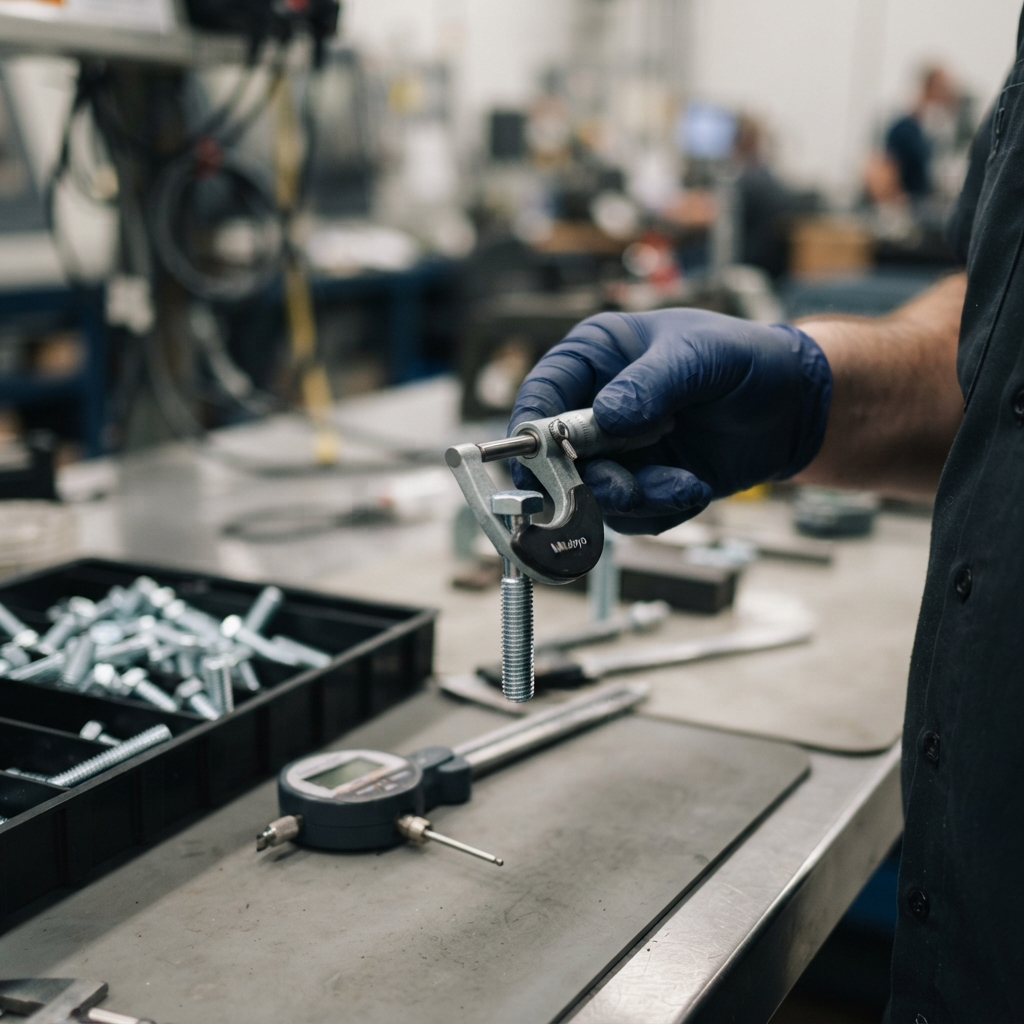
Go/no-go gauges prove that a thread falls inside its class; they do not prove that every piece in the lot does. Volume production drifts as dies wear, so a working process includes periodic gauge checks and, for critical parts, magnetic sorting to remove cracked or malformed pieces. A quote with no sorting line is a quote that relies on the operator noticing. Ask what happens to the pieces between the last check and the carton.
5. Count, weight and packing
A carton filled by weight rather than by count can be short by one or two percent and still pass a visual check, because nobody opens and counts a sealed carton. On a 500,000-piece order, 2% is 10,000 pieces. Packing also decides whether the finish survives the journey: an unlined carton in a humid container can produce rust bloom on a coating that was perfectly adequate when it left the factory. A written packing specification, with count method, carton grade and moisture protection, closes both gaps.
6. Tooling that is "free" but not yours
Tooling has to be paid for somewhere. When it is waived, it is either amortised into the piece price or retained as leverage. The second case is the expensive one: the die is not yours, the drawing is effectively locked to that supplier, and the price on the second order reflects it. If you pay for tooling, own it in writing, with the die tagged to your part number and transferable. Our guide to fastener tooling cost and ownership sets out the three common quoting models.
7. Documentation and traceability
Inspection reports, material certificates and plating results cost money to produce because somebody has to run the tests and keep the records. A supplier that cannot trace a carton back to a wire heat number has saved that cost. The saving is real until the first claim, when the absence of records turns a replaceable batch into an unresolvable argument.
The landed-cost formula, and why it rarely settles the argument
Buyers are often told to compare landed cost rather than the fastener price per piece. The formula is straightforward:
Landed cost per 1,000 usable pieces = (unit price × 1,000 + freight + incoming inspection + rework) ÷ (1 − reject rate)
Run it on the example above. The USD 14.50 quote with a 3% reject rate, USD 1.80 freight and USD 2.50 inspection per 1,000 works out at about USD 19.38 per 1,000 usable pieces. The USD 22.75 quote with a 0.3% reject rate works out at about USD 25.83. The cheap part still wins by more than USD 6 per 1,000.
That result surprises people, and it is the heart of the problem. If a rejected piece costs about USD 0.03 to replace and rework, the cheap quote only loses on piece economics at a reject rate above roughly 20%. Very few fasteners are that bad. So a spreadsheet will keep choosing the cheap quote right up to the point where something else happens:
- A batch passes incoming inspection and fails at the assembly station, stopping a line that costs far more per hour than the screws cost per year.
- A container arrives with rust bloom after six weeks at sea, and the finish has to be stripped and replaced.
- A customer finds a cracked head in a furniture kit and charges the defect back through the retail channel.
- A structural or safety-related part fails after installation, where the cost is a recall rather than a credit note.
None of those events fit in a reject-rate column. That is why the honest case for a higher price is not "it is cheaper per piece" — usually it is not. The case is that the price includes the process evidence that keeps the tail risk small. A buyer who understands this stops trying to win the unit-price argument and starts specifying the evidence at the quotation stage, where it costs nothing. Distributors describe the same effect from the service side: line stoppages, expedited freight and idle labour typically outweigh the part price itself (Specialty Bolt & Screw, 2025).
A 30-minute test you can run on any screw quote
Every custom screw quote should survive the same eight questions. None of them requires a factory visit, and none of them is adversarial if the supplier has a real process behind the price.
- Ask for the eight lines. If the supplier can only give a single number, that is the first finding, not a negotiating position.
- Put the drawing beside the quote. Check that material, property class, thread class, coating thickness and tolerance standard appear on both. A quote that does not restate them is quoting a different part.
- Ask which operations are in-house. Heading, thread rolling, heat treatment, plating and sorting should each be marked in-house or named subcontractor.
- Ask for one hardness result and one coating thickness result from a previous lot of a similar part. Redact the customer name; the numbers are what matter.
- Ask how the carton count is verified and what the packing specification says about liners and carton grade.
- Ask what happens to a rejected lot. A supplier with a defined corrective action process answers in steps; one without answers in adjectives.
- Ask for the price validity and the wire-index clause. A price fixed for twelve months on a steel-based part is either hedged or optimistic, and both have a cost.
- Ask for the tooling ownership terms if the part needs a new die. Get the answer in writing before the first order, not after the third.
If you are comparing several offers at once, run the same eight questions against each and score the answers. A structured line-by-line fastener quote comparison keeps the exercise honest, because it forces every offer into the same format before anyone talks about price.
Red flags worth acting on
Once the quote is laid out as a fastener cost breakdown, most problems become visible in the proportions rather than in the total. These are the patterns worth a follow-up question.
| What the quote says | What it usually means | What to request |
|---|---|---|
| One total price, no cost lines | The structure is either unknown or not to be shared | The eight-line breakdown, even at summary level |
| "Free" tooling on a custom part | Recovered in piece price or retained as leverage | Written ownership and transfer terms |
| No coating thickness stated | Plating quoted to a price, not to a standard | Micrometres and the referenced coating class |
| Tolerance given as "standard" | No drawing review has taken place | The tolerance standard and the critical dimensions |
| Class 8.8 with no heat treatment line | The class is a label, not a process | Furnace name and per-lot hardness results |
| Same price for 304 and 316 stainless | Material is not being priced from the alloy | Grade-specific pricing and mill certificates |
| Sample in three days, production in 45 | The sample was made outside the production route | First article from the production run |
How we quote at JHFIX
Our plant in Jiangmen, Guangdong runs cold heading, tapping, punching, injection moulding, assembly, packing and an inspection room under one roof, and has supplied fasteners and furniture hardware to buyers in more than 40 countries over two decades. Manufacturing is carried out by Jiangmen Jinhe Hardware Products Co., Ltd.; international sales, contracts and export coordination are handled by its authorised export partner, Jiangmen Shenxin Trading Co., Ltd. We publish both names because buyers should be able to check the plant and the contracting entity separately.
Two examples from the range show the level of detail a fastener cost breakdown has to be built on. The cross-drive countersunk self-tapping screw is listed as M3.5 × 25 mm with a coarse thread, sharp point and countersunk head; substrate, pilot hole and finish are confirmed against the drawing or approved sample. The yellow-coated deck screw assortment is offered in #8 and #10 with lengths from 1.5 in to 4 in, coarse thread, countersunk head, and bulk or counted contractor packs. In both cases the approved specification governs, not the photograph.
If a drawing is not final, say so at the quotation stage. It is cheaper to settle material, thread class, coating and packing before tooling than after the first batch.
FAQ
What is a fastener cost breakdown?
It is a quotation that separates the price into its cost lines — wire, heading, thread rolling, heat treatment, plating, sorting, packing and margin — instead of giving one number. It lets a buyer see which process was priced and which evidence should follow the shipment.
Why is one screw quote so much cheaper than the others?
Usually because one cost line has been reduced: a lower wire grade, skipped heat treatment, thinner plating, no sorting, short counts or "free" tooling recovered later. Genuine efficiency, volume or location advantages exist too, but the supplier should be able to name which one applies.
Is the cheapest quote always the worst choice?
No. A large-volume producer with efficient heading lines can legitimately be cheaper. The test is whether the saving can be explained and whether the process evidence is still there. Unexplained savings are the risk, not low prices in themselves.
How much does plating thickness actually matter?
Corrosion life scales roughly with zinc thickness, and thickness varies by position on the part. A deposit that measures well on the shank may be thin inside a recess. Specify micrometres and the coating class rather than "zinc plated", and ask where the measurement is taken.
Should I always require heat treatment?
Only if the drawing specifies a property class that needs it. Many furniture and drywall screws are used as formed. The problem is quoting a class and not treating the part, or treating it so briefly that hardness scatters across the lot.
How do I check a supplier's count without opening every carton?
Agree a count method in the packing specification, weigh-check cartons against a declared piece weight at incoming inspection, and open a sample of cartons per lot. Our guide to AQL sampling for fasteners explains how to set the sample size and acceptance numbers.
Does a lower price ever make sense for a non-critical part?
Yes, when the failure is visible, cheap to fix and does not reach a customer. That is a decision about the consequence of failure, not about the supplier. Make it explicitly, part by part, rather than applying one sourcing rule to the whole bill of materials.
What single document should I ask for first?
The process route, one page, with each step marked in-house or subcontracted. It tells you what the price is buying and which questions to ask next.
Conclusion
A fastener cost breakdown is the cheapest piece of due diligence in fastener sourcing, because it costs one email and it changes the conversation from price to process. Cheap fasteners are rarely cheap by accident: the saving usually sits on a named line, and the supplier either knows which one or does not want to say. Build the eight lines, put a number against each, and ask any supplier who lands far below the field to name the line where the saving comes from. If the answer is a process, a volume effect or a location, you have found a good supplier. If the answer is that their factory is simply better, you have found the risk you were about to buy.
If you want a quotation built line by line against your drawing — material, thread, coating, packing and tooling shown separately — send the specification and annual volume through our contact page and we will quote what we can make in-house and name the partners for anything we cannot.