
What Should a Furniture Assembly Components Supplier Actually Provide?
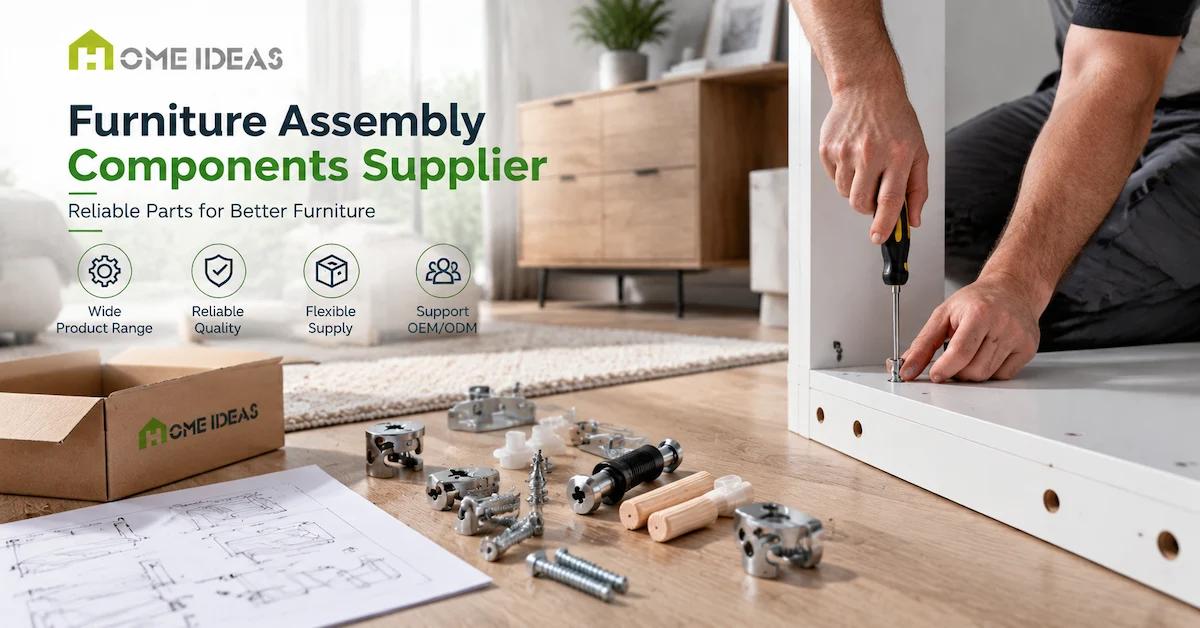
A furniture assembly components supplier should provide more than individual screws, connectors, dowels, shelf supports, or mounting plates. For an OEM furniture program, the supplier should help turn those individual parts into a controlled assembly specification that purchasing, engineering, quality, production, and packing teams can all follow.
The key question is not simply, “Can you supply this part?” It is, “Can this part work with the furniture design, its mating components, the drilling pattern, and the approved packing configuration?”
For cabinet, wardrobe, desk, table, storage, sofa, and flat-pack furniture projects, buyers should evaluate three levels separately: the individual component, the assembled connection, and the finished hardware kit. A component may meet its own dimensions but still create problems if it does not match the mating part or panel preparation. Likewise, a complete set of correct parts can still fail commercially if quantities, labeling, or packing versions are incorrect.
JHFIX provides multiple product groups through its furniture and fastening product range, allowing buyers to review connectors, screws, supports, mounting hardware, and packaging options as part of one sourcing program.
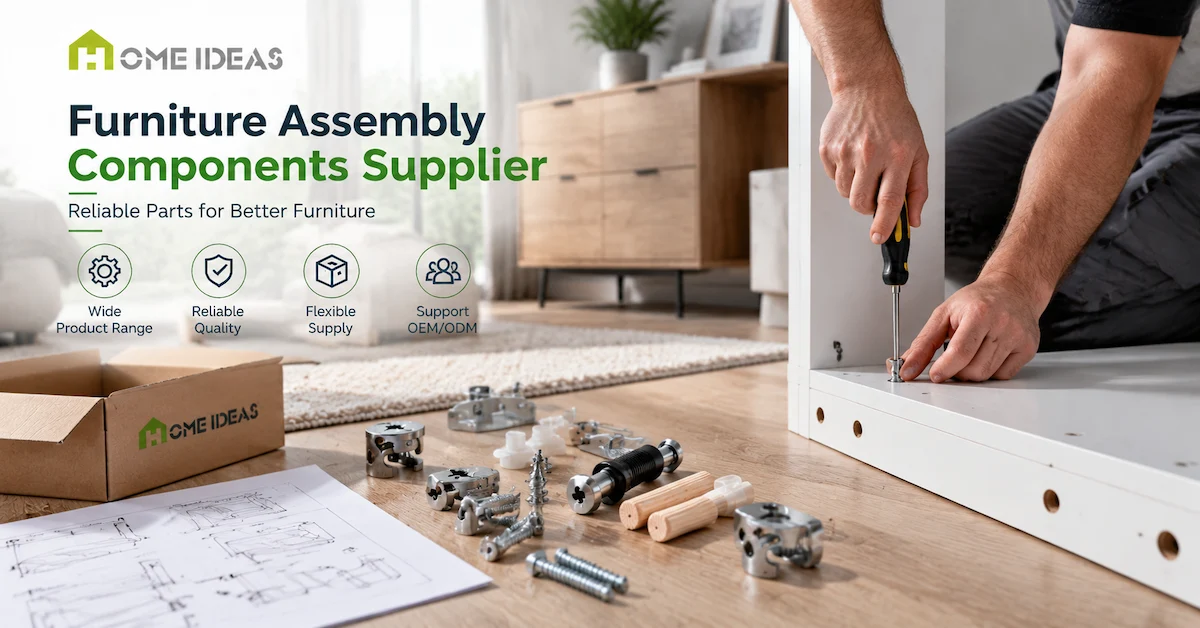
Which Buyers Need a Coordinated Furniture Component Supply Program?
A structured sourcing program is particularly relevant to furniture factories producing repeat models, RTA and flat-pack furniture manufacturers, cabinet and wardrobe producers, office furniture companies, private-label brands, furniture importers, and distributors managing multiple SKUs.
These buyers have a different requirement from someone purchasing an occasional replacement screw. A production buyer may need tens of thousands of individual components, but the real purchasing unit could be one complete hardware kit for each finished furniture carton. That means quantities must be translated from finished furniture units into individual component requirements.
For example, if one cabinet uses eight connector assemblies, four shelf supports, twelve screws, and two mounting brackets, the purchase order needs to define every component and its quantity.Writing only “one set of cabinet hardware” creates unnecessary ambiguity.
A coordinated furniture assembly components supplier is therefore most valuable when repeatability matters. Buyers should be able to identify which hardware version belongs to which furniture model and reproduce the same approved configuration on later orders.
Start With the Furniture Joint, Not the Component Catalog
A common purchasing mistake is selecting components from photographs or catalog names before defining how the joint is supposed to work. Two products may both be called furniture connecting bolts while differing in length, thread, head geometry, mating connector, or installation method.
Instead, start with the connection.
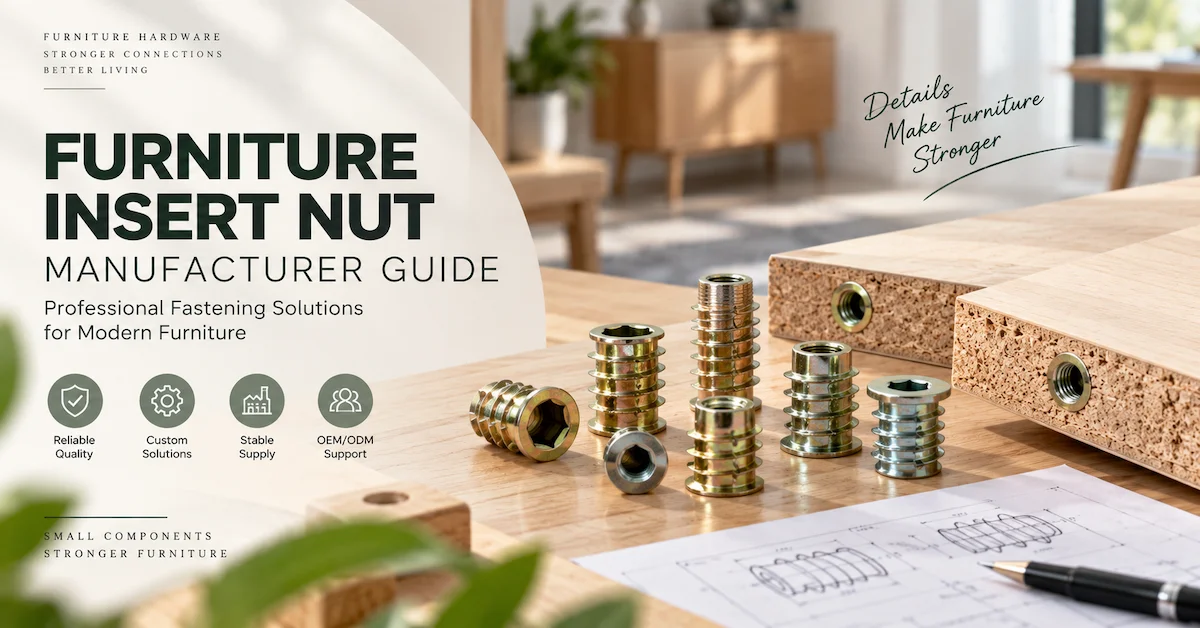
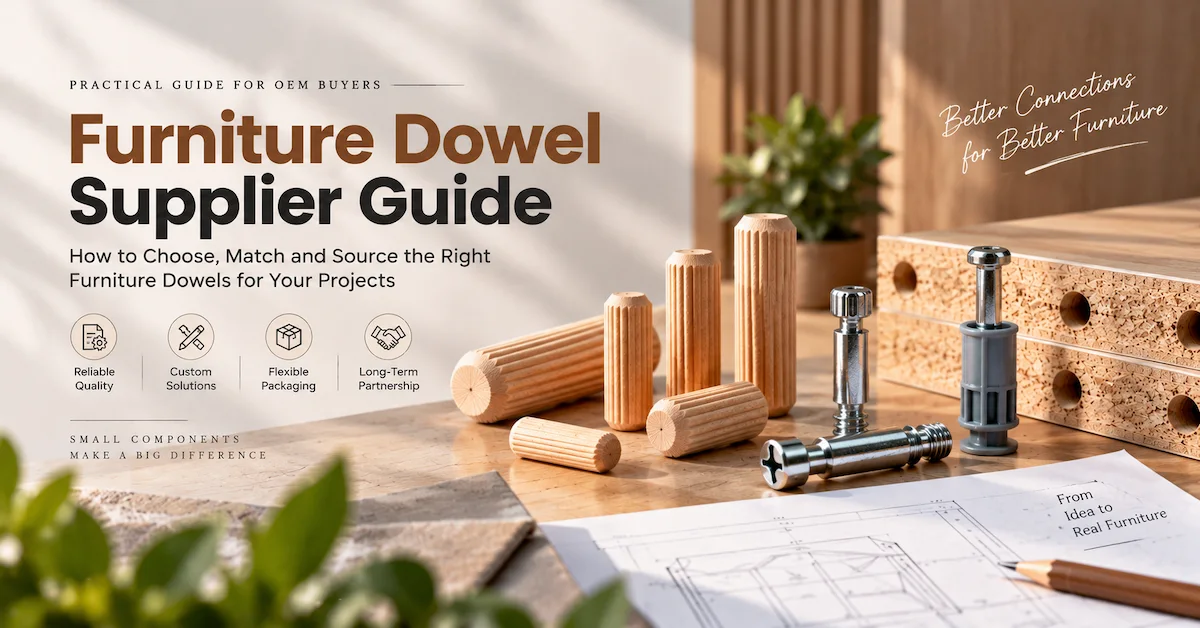
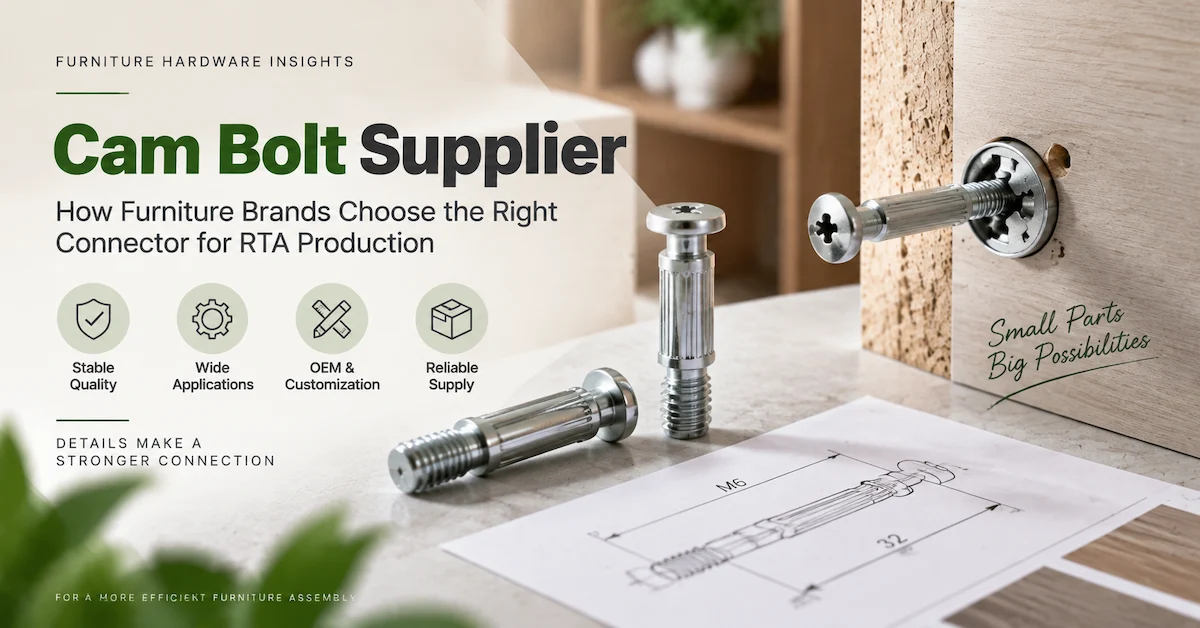
For cabinet panels and wardrobes, buyers may first review JHFIX cam locks and connector sets together with furniture connecting bolts and dowels. If the design includes adjustable or removable shelving, shelf supports and pins become another separate specification.
For tables, sofas, desks, or furniture with detachable legs, the assembly may depend more heavily on furniture brackets and mounting plates.
The product category should therefore follow the furniture structure. Do not select a cam fitting simply because another furniture model uses one, and do not replace a connecting bolt with a similar-looking fastener without checking the mating component and assembly geometry.
What Information Should Be Included in a Furniture Component Specification?
A professional RFQ should make the purchasing requirement measurable. Instead of sending “need furniture screws and connectors,” create a specification that identifies the furniture model, component function, drawing or sample, quantity, packaging, and inspection requirements.
| Specification area | Information to confirm | Purchasing purpose |
|---|---|---|
| Furniture model | Product name, SKU and drawing revision | Prevents mixing hardware between furniture versions |
| Component code | Unique part number or controlled description | Supports BOM and repeat ordering |
| Component function | Connecting, fastening,supporting or mounting | Clarifies why the part is used |
| Dimensions | Diameter, length, hole positions and other relevant dimensions | Confirms physical compatibility |
| Thread details | Thread diameter, pitch and mating component where applicable | Prevents mismatched threaded parts |
| Material | Material assigned to each component | Avoids vague “metal hardware” descriptions |
| Surface finish | Required finish and appearance | Separates appearance from base material |
| Panel information | Panel material,thickness and drilling conditions | Supports assembly validation |
| Quantity | Pieces or sets required per furniture unit | Controls hardware-kit completeness |
| Packaging | Bag, box, mixed kit, label and instructions | Defines the actual delivered format |
| Inspection | Dimensions, appearance, fit and agreed functional checks | Establishes acceptance criteria |
| Approval reference | Drawing revision, approved sample and packing version | Supports repeat production |
The values inside this table should come from the actual furniture design. It is a specification framework, not a universal set of dimensions for all furniture hardware.
Why Must Mating Components Be Evaluated Together?
Furniture assembly hardware frequently works as a system. A cam fitting depends on its connecting bolt. A threaded insert depends on its mating screw or bolt. A mounting plate depends on hole positions, plate geometry, furniture structure, and the threaded interface used to attach the leg or support.
This means individual inspection cannot answer every question.
Suppose a connecting bolt meets its specified overall length. That confirms one dimension, but it does not prove that the complete furniture joint will assemble correctly. Buyers may still need to confirm the thread engagement, connector position, drilling depth, insertion direction, tightening method, and final panel alignment.
The same principle applies to shelf supports. A supplier can manufacture a shelf-support component consistently, but the buyer still needs to confirm the panel hole, installation depth, shelf contact, and intended loading direction.
The most useful supplier discussion therefore moves from “Is the component dimension correct?” to “Does the complete approved connection work under the intended assembly conditions?”
How Should Materials and Surface Finishes Be Controlled?
Furniture assembly components can include carbon steel, stainless steel, zinc alloy, plastic parts, wooden dowels, and other materials depending on the product design. A multi-component furniture kit should not be described with one general material label when individual parts are different.
Each important component should have its own material record.
Surface treatment should also be recorded separately from material. Terms such as black, silver, white, or yellow may help identify appearance, but color alone does not define the material or demonstrate a particular corrosion-performance level.
For furniture intended for kitchens, bathrooms, humid storage areas, or other environments with additional exposure, buyers should communicate those conditions during technical review. If specific surface-performance testing is required, the required method and acceptance conditions should be agreed rather than inferred from appearance.
This approach helps prevent a visually acceptable substitution from becoming an unreviewed technical change.
How Does Manufacturing Capability Affect Component Consistency?
When comparing a furniture assembly components supplier, factory capability should be connected to the actual components being purchased. A general machinery list has limited value unless the buyer understands which processes are used for the ordered parts and which characteristics those processes need to control.
JHFIX introduces its manufacturing and hardware activities on the About Us page. Its product portfolio covers threaded fasteners, furniture connecting hardware, supports, mounting components, and packaged hardware solutions.
Different component groups require different control points. Screws and connecting bolts may require attention to thread geometry, overall dimensions, head form, and drive features. Mounting plates require review of dimensions, hole positions, formed features, and mating interfaces. Plastic or combined components introduce additional requirements related to fit and component interaction.
For buyers, the useful supplier question is therefore not only “What equipment do you have?” but also “Which characteristics of my part are controlled during production, and what is checked before shipment?”
Why Should Sample Approval Include a Real Assembly Check?
Sample approval should occur at more than one level.
First, inspect the individual components against the agreed specification. Then use those components in a representative assembly. Finally, evaluate the packed hardware set that will actually be delivered with the furniture.
An individual component check can cover dimensions, threads, appearance, and other specified characteristics. A representative assembly can reveal a different class of issues: connector seating, panel alignment, tool access, tightening sequence, interference, or drilling compatibility.
The complete hardware pack should then be checked separately for part identities and quantities.
This three-level method can be summarized as:
Component approval → Assembly approval → Kit approval.
The approved sample should also be linked to the correct drawing or specification revision.If a component is modified later, the supplier and buyer should decide whether the change requires a new sample or assembly verification rather than silently treating the new version as equivalent.
How Should Buyers Compare Different Furniture Assembly Components?
Different furniture components should be compared according to their function. They are often complementary parts rather than substitutes.
| Component group | Main role | Common furniture applications | Main points to confirm |
|---|---|---|---|
| Cam locks and connector sets | Panel-to-panel connection | Cabinets, wardrobes, storage furniture | Cam geometry, mating bolt, drilling and orientation |
| Connecting bolts and dowels | Joining and positioning components | Cabinets, desks and flat-pack furniture | Dimensions, thread, mating part and installation depth |
| Shelf supports and pins | Shelf positioning and support | Wardrobes, cabinets and shelving | Hole fit, shelf contact and installation direction |
| Furniture screws | Fastening components and accessories | General furniture assembly | Thread, length, head, drive and substrate |
| Mounting plates and brackets | Structural mounting interface | Tables, sofas and furniture legs | Plate dimensions, holes, thickness and mating connection |
| Hardware kits | Combining multiple approved components | RTA, flat-pack and private-label furniture | BOM, quantity, identification and packaging |
A good component comparison therefore begins with function. Comparing the unit price of a mounting plate with a cam fitting has little meaning because they solve different assembly problems.
Why Is the Hardware BOM Critical for Furniture Production?
A furniture hardware bill of materials, or BOM, converts a design into a repeatable purchasing and packing document. Each component should have an identifier, description, approved specification, quantity per furniture unit, and revision information where necessary.
Multi-piece connectors require particular attention.
If one furniture connector consists of a cam, a mating bolt, and another supporting component, the BOM should make clear whether purchasing quantities are recorded as individual pieces or complete sets. Otherwise, a phrase such as “10,000 connectors” can be interpreted differently by different teams.
This becomes even more important when one supplier produces the components and also creates finished hardware packs. The packing BOM must agree with the furniture assembly BOM.
A controlled BOM can also simplify replacement-part management. Instead of asking for “the screw used on our old cabinet,” the buyer can identify the furniture model, hardware-kit revision, and component code.
Should Buyers Purchase Loose Components or Complete Hardware Kits?
There is no single answer for every furniture factory.
Buying loose components may suit manufacturers with established automatic or manual kitting operations. The factory receives bulk screws, connectors, supports, and brackets and then performs counting, sorting, labeling, and packing internally.
Complete hardware kits may be more suitable when a furniture manufacturer or brand wants one controlled pack placed inside each furniture carton. In that case, the supplier performs additional work beyond component manufacturing.
JHFIX provides packaging categories such as bag packaging and box packaging, which can be evaluated when buyers require hardware sets rather than only loose components.
When comparing these two supply models, include the internal work required after delivery. A cheaper bulk component quotation may still require additional receiving inspection, counting, sorting, packing, and label management at the buyer's facility.
What Should Be Checked in a Finished Furniture Hardware Kit?
Hardware-kit inspection should not be limited to checking whether a bag is sealed correctly. The pack itself becomes part of the furniture assembly system.
Confirm the furniture model, kit code, BOM revision, part identities, quantity of each item, packaging arrangement, label, barcode where required, and assembly instructions where applicable.
Similar-looking components deserve particular attention. Two screws may appear nearly identical while having different lengths or threads. If both are used in the same furniture model, the packaging design should help prevent confusion during assembly.
The packed sample should therefore be approved as a finished deliverable.
If the packaging artwork or contents change after approval, record the new revision. Otherwise, later repeat orders can contain correct hardware inside the wrong packaging version.
How Should Quality Control Be Defined With a Supplier?
“Strict quality control” is not a usable purchasing requirement unless both parties know what is being controlled.
The inspection plan should identify the characteristics important to the order. Depending on the component, this can include dimensions, threads, hole locations, appearance, material identification, mating fit, assembly behavior, and packing quantity.
The buyer should also separate company-level qualifications from product-level acceptance. A certificate or general factory credential does not replace the inspection required for the specific component being ordered.
If your market or customer requires particular documentation or testing, communicate that requirement during the RFQ stage. Do not wait until production is complete to determine whether a document is applicable to the exact product.
JHFIX's FAQ page can help buyers review common commercial questions, while technical acceptance requirements should be documented for each project.
How Should MOQ, Capacity, and Lead Time Be Evaluated?
MOQ and production timing can depend on component type, customization depth, order quantity, finish, tooling requirements, and packaging configuration. Buyers should therefore avoid assuming that a minimum quantity or delivery time shown for one item automatically applies to every furniture component.
A more useful quotation separates the stages.
For a custom project, this may include technical review, sample preparation, sample approval, production, surface finishing where applicable, kitting, packing, inspection, and shipment preparation.
Ask when the stated production lead time starts.Does it start when the purchase order is issued, when drawings are confirmed, or after the final sample and packaging artwork have been approved?
This distinction matters when comparing suppliers. Two factories may both quote four weeks while using completely different starting points.
The same principle applies to capacity. Company-wide manufacturing capacity does not automatically equal capacity reserved for one furniture program. Order-specific availability should be confirmed during quotation and production planning.
What Are the Main Cost and Sourcing Risks?
A furniture hardware sourcing decision should not be based only on price per component.
Compare quotations on the same specification, material, finish, BOM, inspection requirement, packaging format, and delivery scope. If Supplier A quotes loose components while Supplier B quotes sorted and packaged hardware kits, their unit prices do not represent the same service.
Important commercial risks include specification ambiguity, uncontrolled substitutions, incomplete hardware kits, incompatible mating components, outdated drawings, mixed revisions, and incorrect packaging.
These risks often create costs outside the purchasing price: production stoppages, sorting, repacking, assembly rework, replacement shipments, or additional inspection.
A stronger sourcing comparison therefore asks:
What exactly is included in the quoted price, and what work remains with the buyer?
That question often provides more purchasing value than choosing the lowest number on a quotation sheet.
How Should OEM and Custom Furniture Hardware Projects Be Managed?
Custom furniture hardware should start with application information. Buyers can send drawings, existing samples, furniture assembly diagrams, panel details, required materials, quantity forecasts, and packaging requirements.
The supplier can then identify which existing components may be suitable and which items require modification or custom production.
Sample approval should occur before mass production. Once the component and assembled connection are accepted, the buyer and supplier should freeze the relevant drawing, sample, BOM, finish, and packaging version.
Repeat orders should reference those approved records.
This is particularly important for private-label furniture programs that may remain in production for several years. If the furniture model changes, the hardware revision should change in a controlled way as well.
Buyers can review JHFIX's broader company and manufacturing information through About Us and submit drawings or hardware requirements through Contact Us.
What Should You Send a Furniture Assembly Components Supplier for a Quote?
A useful inquiry should include enough information to distinguish confirmed requirements from unresolved design points.
Provide the furniture type and model, drawings or samples where available, required components, panel information, mating parts, materials, finishes, quantities, first-order volume, expected repeat demand, destination market, packaging method, label requirements, inspection requirements, and required delivery schedule.
For complete furniture kits, also send the hardware BOM and clearly state the quantity required per furniture unit.
If some specifications are still under development, identify them as open items. This allows the furniture assembly components supplier to quote the confirmed scope while identifying points that need additional technical discussion.
You can submit a project through the JHFIX Contact Us page and use the product catalog to identify relevant furniture hardware categories before requesting a detailed review.
FAQ
1. What are furniture assembly components?
Furniture assembly components are the connectors, fasteners, supports, brackets, mounting parts, and related hardware used to join or support furniture structures. They can include cam fittings, connecting bolts, dowels, screws, shelf supports, threaded parts, and mounting plates.
2. What should I look for in a furniture assembly components supplier?
Look beyond product range. Evaluate whether the supplier can work from controlled specifications, understand mating components, support sample approval, manage consistent production, and deliver the required loose parts or finished hardware kits.
3.Can I source all furniture hardware components as one kit?
Potentially, depending on the required components and project feasibility. Define the complete BOM first, including component codes and quantities, and then confirm which items can be combined into one approved packing configuration.
4. How do I know whether a furniture connector will fit my panels?
Confirm the panel material, thickness, drilling pattern, hole diameter and depth, connector dimensions, mating component, and installation direction. A representative assembly sample provides stronger evidence than appearance alone.
5. Why should mating components be approved together?
Because an individual component can meet its own dimensions while failing to work correctly with another component. Cam fittings, bolts, threaded inserts, and mounting systems should therefore be checked in their actual connection.
6. Should furniture factories buy loose components or finished hardware kits?
Factories with their own reliable sorting and packing operation may prefer loose components.Furniture brands or manufacturers requiring one complete assembly pack per carton may prefer pre-counted hardware kits. Compare the total handling work, not only the component price.
7. What should be included in a furniture hardware BOM?
Include the component code, description, approved specification or drawing, quantity, unit of measure, material or finish where relevant, and revision. Multi-part sets should be clearly defined so that “one set” cannot be misunderstood.
8. Can furniture assembly components be customized?
Custom dimensions, structures, materials, finishes, or packaging can be discussed depending on the component and manufacturing feasibility. Drawings or representative samples provide a stronger starting point than a general request for “custom furniture hardware.”
9. Is there one standard MOQ for all furniture assembly components?
No universal MOQ should be assumed across all components. Commercial requirements can vary with the component, customization, finish, packaging, and quantity, so the applicable MOQ should be confirmed for the actual quotation.
10. How can I reduce repeat-order problems?
Use controlled part numbers, approved drawings, reference samples, BOM revisions, packaging versions, and documented changes. Repeat orders should identify the approved configuration rather than relying only on a previous product description.
Conclusion
Choosing a furniture assembly components supplier is ultimately about controlling the complete furniture connection and supply package, not simply sourcing inexpensive screws or fittings. Furniture manufacturers and private-label buyers should define component functions, verify mating parts and panel conditions, approve representative assemblies, control the hardware BOM, confirm packaging, and link repeat orders to approved specifications. JHFIX offers furniture connectors, fasteners, supports, mounting hardware, and packaging options through its product range. For an OEM or bulk furniture project, send your drawings, samples, quantities, BOM, and packaging requirements through JHFIX Contact Us for project-specific review.