
How Should Furniture Manufacturers Choose Fasteners?
Fasteners for furniture manufacturing should be selected as part of the complete furniture joint and assembly system, not as isolated components. The correct choice depends on panel material, thickness, joint design, assembly method, expected use, installation tools, appearance requirements, production volume, and packaging method.
A screw that works well in solid timber may not provide the same holding behavior in MDF or particleboard. A cam connector may be ideal for concealed flat-pack furniture, but unnecessary for a permanently assembled wooden structure. An insert nut can support repeatable threaded assembly, while a self-tapping screw may offer a simpler solution when repeated disassembly is not required.
For furniture manufacturers, the practical question is therefore not simply “Which fastener is strongest?”
A better question is:
“Which fastening system provides the required joint performance, assembly efficiency, appearance, repeatability, and purchasing consistency for this furniture design?”
Buyers sourcing furniture hardware components should evaluate the complete connection system before approving an individual screw, nut, bolt, or fitting.
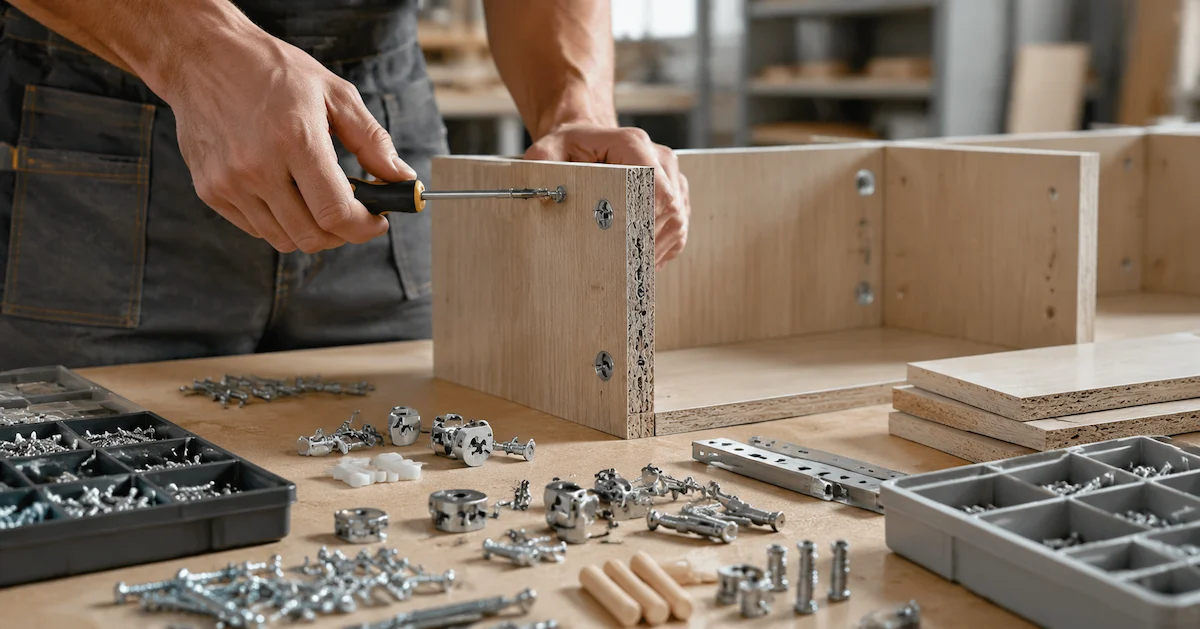
Why Fastener Selection Matters in Furniture Manufacturing
Fasteners are relatively small components, but they influence several stages of furniture production.
An unsuitable fastener can create problems during drilling, automated or manual assembly, packaging, transportation, final installation, and long-term use.
For a furniture factory, the main consequences may include:
- Loose or inconsistent joints
- Panel splitting or edge damage
- Stripped threads
- Visible fastener heads where concealed hardware is expected
- Difficulty during assembly
- Incorrect cam-and-bolt engagement
- Rework on the production line
- Mixed or missing hardware in flat-pack kits
- Increased installation complaints
- Difficulty maintaining the same specification across repeat orders
The objective is therefore not to purchase the cheapest furniture fastener. It is to establish a repeatable fastening specification that works with the furniture structure and manufacturing process.
This is especially important for cabinets, wardrobes, shelving systems, beds, tables, office furniture, kitchen furniture, RTA furniture, and other products produced in volume.
Who Needs Fasteners for Furniture Manufacturing?
The search intent behind fasteners for furniture manufacturing is primarily B2B.
Typical buyers include:
| Buyer Type | Typical Requirement | Main Purchasing Concern |
|---|---|---|
| Furniture manufacturers | Screws, connectors, nuts | Assembly consistency |
| Cabinet factories | Cam locks, screws, shelf supports | Panel compatibility |
| Wardrobe manufacturers | Connectors, bolts, brackets | Large-panel assembly |
| Flat-pack/RTA factories | Complete hardware kits | Correct parts and quantities |
| Kitchen furniture manufacturers | Screws, connectors, nuts | Finish and environment |
| Office furniture factories | Repeatable fastening systems | Durability and assembly |
| Furniture brands | OEM hardware | Specification consistency |
| Hardware distributors | Multiple fastener SKUs | Supply stability |
| Private-label brands | Hardware plus packaging | Branding and kit control |
| Industrial OEM buyers | Custom screws and stamped parts | Drawings and tolerance |
This guide is primarily intended for manufacturing and procurement applications. For a one-off household repair, a standard retail fastener may be sufficient and many of the OEM, QC, packaging, and repeat-order considerations discussed below will not apply.
Main Types of Fasteners Used in Furniture Manufacturing
Furniture manufacturing rarely depends on one fastener type.
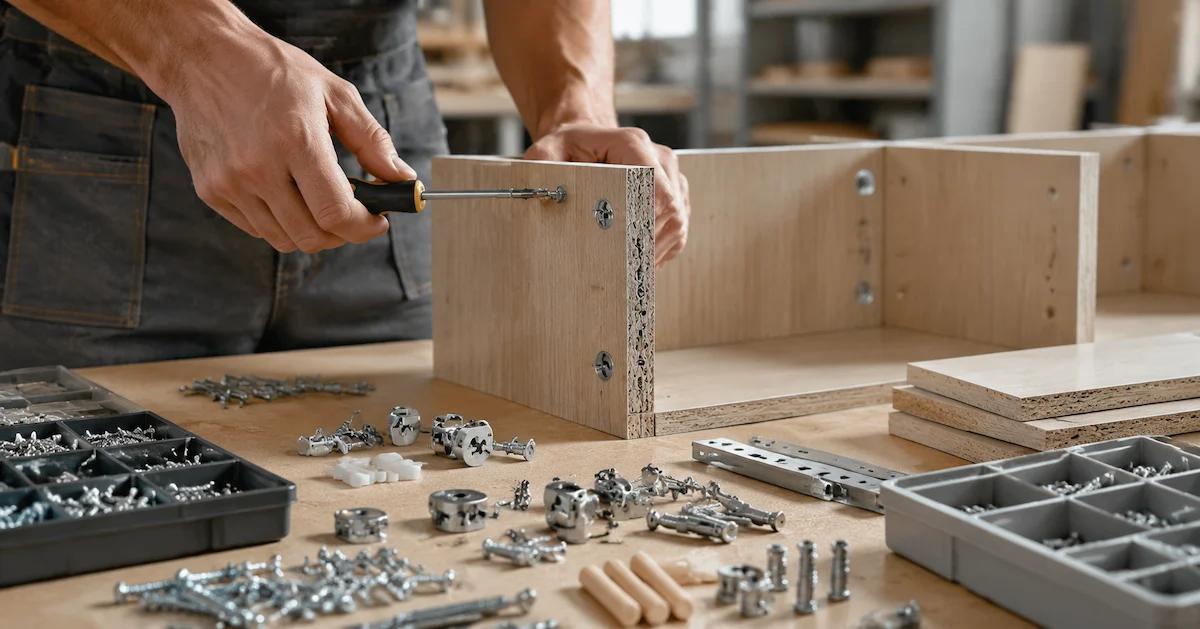
A complete assembly may combine screws, connector bolts, cam locks, nuts, brackets, washers, shelf supports, anchors, and plastic accessories.
Furniture Screws
Furniture screws are used for panel connection, bracket installation, accessory mounting, structural fixing, and general assembly.
Common categories include:
- Wood screws
- Self-tapping screws
- Machine screws
- Assembly screws
- Connector screws
- Countersunk screws
- Pan-head screws
- Socket-drive screws
- Custom screws
JHFIX currently lists a dedicated range of screws for furniture and OEM assembly, alongside furniture connectors and nuts.
The correct screw should be selected according to substrate, diameter, length, head geometry, drive system, thread form, material, and finish rather than product name alone.
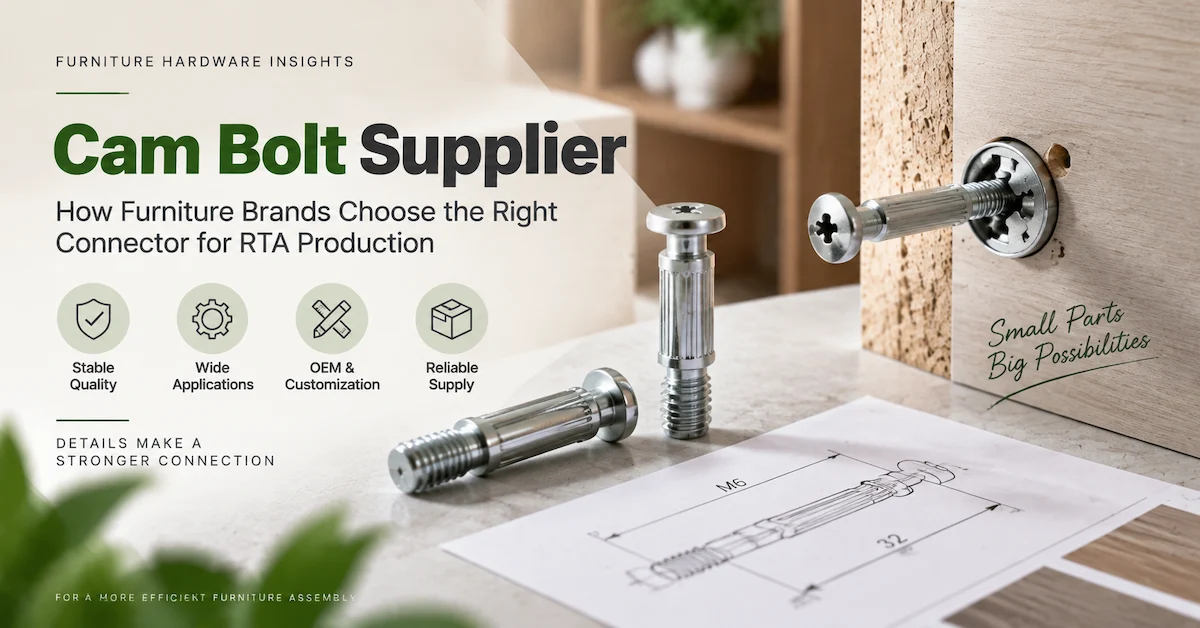
Cam Lock Connectors
Cam locks are widely associated with concealed and knock-down furniture joints.
A typical system contains:
- An eccentric cam
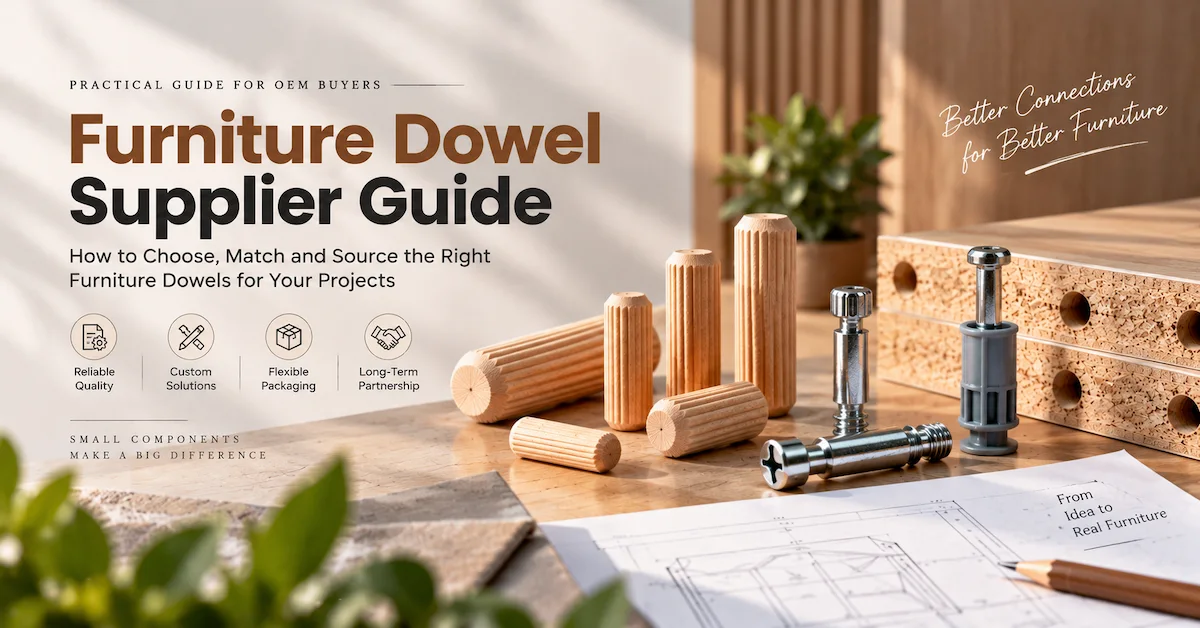
- A connecting bolt or dowel
- Matching drilled holes in the furniture panels
When the cam rotates, it engages the connector bolt and pulls the two panels together.
Cam systems are especially useful in:
- Flat-pack furniture
- Cabinets
- Wardrobes
- Shelving
- Bedroom furniture
- Office furniture
- Kitchen furniture
The cam and connecting bolt must be treated as a matched system. Cam diameter, bolt geometry, drilling position, panel thickness, and insertion depth all influence assembly.
JHFIX's current furniture hardware range includes concealed connecting bolts, 2-in-1 and 3-in-1 furniture connectors, cam-lock screws, and other cabinet fittings.
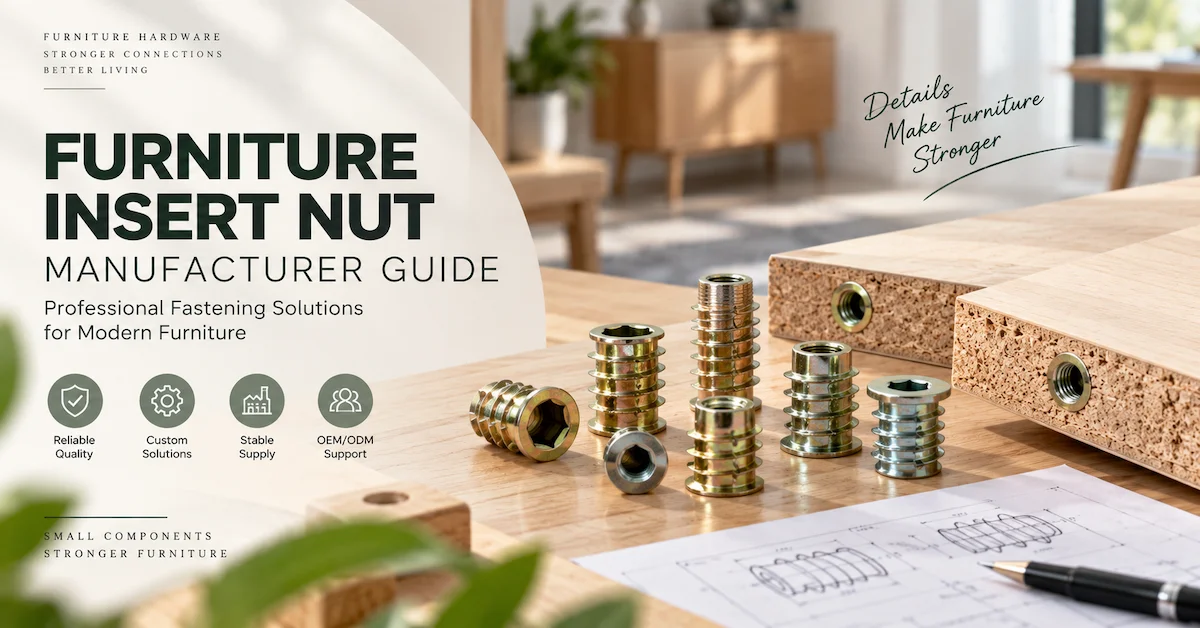
Insert Nuts
Insert nuts provide an internal machine thread inside wood-based panels or other suitable substrates.
They are useful when a furniture design requires:
- Bolt-based assembly
- Repeatable assembly
- Removable components
- More controlled threaded engagement
- A metal thread within a wooden component
Important selection factors include:
- Internal thread size
- External geometry
- Insert length
- Installation method
- Panel material
- Panel thickness
- Matching bolt specification
The current JHFIX nut product category includes furniture-oriented threaded and insert nut options.
Connector Bolts and Joint Fasteners
Connector bolts are frequently used with cam locks, cross dowels, barrel nuts, insert nuts, or other furniture connection systems.
Selection should consider the entire mating system.
For example, specifying only “M6 furniture bolt” may not be enough. A supplier may also need:
- Overall length
- Thread length
- Head type
- Drive type
- Shoulder dimensions
- Mating nut or cam
- Surface finish
- Panel thickness
- Assembly drawing
Stamped Brackets and Fixing Plates
Not every furniture fastener is threaded.
Metal brackets, support plates, clips, mounting plates, and other stamped components may reinforce or position furniture structures.
They are commonly used for:
- Cabinet reinforcement
- Shelf structures
- Bed frames
- Furniture bases
- Mounting systems
- Corner joints
- Hidden support structures
JHFIX also maintains a stamping hardware category for OEM assembly applications.
For these components, buyers should focus on sheet material, thickness, hole position, bending geometry, burr control, surface treatment, and dimensional consistency.
Furniture Fastener Comparison by Application
There is no universal “best furniture fastener.” Different designs require different connection principles.
| Fastener Type | Main Function | Typical Application | Key Selection Factor |
| Wood screw | Direct fastening | Timber, plywood, furniture panels | Thread and length |
| Self-tapping screw | Forms mating thread during assembly | Metal accessories, selected panels | Thread geometry |
| Machine screw | Threaded joint | Inserts, nuts, metal components | Thread specification |
| Cam lock + bolt | Concealed detachable joint | Flat-pack furniture | Drilling and component matching |
| Insert nut + bolt | Reusable threaded joint | Beds, tables, cabinets | Substrate and installation |
| Connector bolt | Furniture joint connection | Cabinets and RTA furniture | Mating hardware |
| Stamped bracket | Reinforcement/support | Cabinets, shelves, frames | Geometry and load path |
| Hardware kit | Complete assembly package | RTA and retail furniture | BOM and quantity control |
The best solution may also combine several of these.
A cabinet, for example, could use cam locks for panel joints, screws for back panels, shelf supports for internal shelving, brackets for reinforcement, and a pre-packed hardware bag for final assembly.
How Panel Material Changes Fastener Selection
One of the most important variables in furniture fastening is the material being joined.
Particleboard and Chipboard
Particleboard is widely used in economical and flat-pack furniture.
Because the substrate consists of compressed particles rather than continuous wood fibers, fastener geometry and installation control matter.
Buyers should evaluate:
- Screw diameter
- Thread depth
- Thread spacing
- Engagement length
- Edge distance
- Pilot-hole requirement
- Installation torque
Overdriving a screw can damage the surrounding material, while insufficient engagement can reduce joint stability.
MDF
MDF provides a relatively uniform material structure but requires care around edges and high installation forces.
For MDF applications, fastener testing should reflect the actual:
- Board density
- Thickness
- Edge distance
- Pilot-hole size
- Screw geometry
- Assembly torque
A specification proven in one board construction should not automatically be assumed to behave identically in another.
Plywood
Plywood contains multiple bonded wood layers and normally behaves differently from particleboard or MDF.
Thread engagement, screw orientation, panel thickness, and edge position still matter, but the optimum fastener may differ from a particleboard-focused design.
Solid Wood
Wood species, density, grain direction, moisture condition, and screw location can influence installation.
Furniture manufacturers should therefore qualify screws in the actual production material rather than relying only on nominal screw dimensions.
Metal Furniture Components
Furniture systems containing metal frames or stamped brackets may require:
- Machine screws
- Bolts
- Nuts
- Rivet nuts
- Self-tapping screws
- Thread-forming solutions
These connections should be specified separately from direct wood fastening.
Which Screw Parameters Should Furniture Buyers Specify?
A vague RFQ such as “We need furniture screws” increases the risk of quotation errors.
A better furniture fastener specification contains the following information.
| Parameter | Example Information to Provide | Why It Matters |
| Application | Cabinet, bed, wardrobe, shelf | Defines joint requirements |
| Panel material | MDF, plywood, particleboard | Affects thread selection |
| Panel thickness | Actual production thickness | Controls usable length |
| Diameter | Metric or inch requirement | Controls fit |
| Length | Overall/functional length | Controls engagement |
| Head type | Countersunk, pan, socket | Affects appearance and seating |
| Drive | Phillips, Torx, hex socket | Affects tooling |
| Thread | Coarse, fine, machine, tapping | Affects engagement |
| Material | Carbon steel, stainless, etc. | Affects properties and cost |
| Finish | Zinc, nickel, black, specified coating | Appearance/environment |
| Matching hardware | Nut, insert, cam, bracket | Prevents compatibility errors |
| Quantity | Trial or production volume | Influences process planning |
| Packaging | Bulk, bag, box, kit | Affects assembly logistics |
This specification-driven approach is much more reliable than approving a fastener from appearance alone.
Thread Type: Why It Matters in Furniture Production
Thread geometry influences how a fastener interacts with its mating material.
Coarse Thread
Coarser threads are often considered where greater thread spacing and material engagement are useful in wood-based substrates.
However, “coarse thread” alone does not define performance. Diameter, root geometry, penetration depth, panel density, pilot hole, and installation torque also matter.
Fine Thread
Fine threads are generally more relevant when a fastener engages an existing machine thread or a suitable denser mating material.
They should not automatically be substituted for a wood-oriented thread simply because the nominal diameter is identical.
Machine Thread
Machine-threaded screws and bolts require a matching internal thread, such as:
- Nut
- Insert nut
- Tapped metal component
- Threaded connector
The pitch and thread standard must match.
For metric carbon-steel and alloy-steel bolts, screws, and studs within its defined scope, ISO 898-1:2013 is one relevant international reference for mechanical and physical properties. Importantly, the ISO document does not establish corrosion resistance requirements and does not apply universally to every furniture screw geometry or application.
That distinction matters: buyers should specify the correct standard for the actual fastener rather than simply requesting an “ISO screw.”
Head and Drive Selection for Furniture Assembly
Head geometry influences appearance, seating, tool access, and load distribution.
Countersunk Head
A countersunk head can sit flush with or below a prepared surface.
This may be useful where:
- A flat finished surface is required
- A bracket must sit over the connection
- The screw head should be less visible
However, the countersink geometry and substrate must be compatible.
Pan or Raised Head
Pan-head designs provide a larger visible bearing surface and may be suitable for fixing brackets, accessories, or thin components.
Socket and Hex Drives
Internal hex or socket drives can provide controlled tool engagement where adequate access is available.
Phillips and Torx
Drive choice influences:
- Bit engagement
- Assembly speed
- Cam-out tendency
- Tool availability
- Automation compatibility
- End-user assembly experience
For mass-produced or flat-pack furniture, the drive system should also be considered from the customer's installation perspective. A technically suitable screw is less useful if the required tool is inconvenient for the intended assembly process.
Material and Surface Finish Selection
Material and finish should be selected according to the application environment rather than appearance alone.
Carbon Steel
Carbon steel is commonly considered for many furniture fasteners because it supports a broad range of manufacturing methods and finishes.
The exact material and mechanical requirement should be defined by the application.
Stainless Steel
Stainless steel may be considered when corrosion resistance is more important, but buyers should specify the required stainless grade instead of simply writing “stainless steel.”
Different grades can differ in corrosion behavior, mechanical properties, forming behavior, and cost.
Zinc and Nickel Finishes
Plated finishes may be chosen for:
- Appearance
- Basic surface protection
- Matching other furniture hardware
- Customer-specific color requirements
However, finish names alone do not define corrosion performance.
If a project has a formal corrosion requirement, buyers should state the applicable test method and acceptance criteria rather than assuming that every zinc-plated fastener provides the same result.
Black and Decorative Finishes
Black or other decorative finishes can be useful for visible furniture hardware, but color consistency and coating adhesion may become important when the fastener is part of the furniture design language.
Indoor, Kitchen, Bathroom, and Outdoor Furniture Need Different Specifications
The operating environment should be included in the RFQ.
Indoor Dry Furniture
Examples include:
- Bedroom furniture
- Office desks
- Wardrobes
- Indoor shelving
Key priorities often include assembly consistency, appearance, cost control, and compatibility.
Kitchen and Bathroom Furniture
Higher humidity and cleaning exposure may increase the importance of:
- Material selection
- Surface treatment
- Coating quality
- Corrosion testing requirements
The exact requirement depends on the finished product and target market.
Outdoor Furniture
Outdoor furniture requires a separate evaluation because moisture, temperature cycles, and environmental exposure may be substantially more demanding.
A buyer should not assume that an indoor furniture fastener is suitable outdoors without confirming material and finish performance.
Fasteners for Flat-Pack and RTA Furniture
Flat-pack furniture creates additional requirements because hardware is part of both manufacturing and the end-user installation experience.
The fastening system should support:
- Accurate factory drilling
- Repeatable component fit
- Compact packaging
- Clear identification
- Simple assembly
- Controlled part quantities
- Replacement-part management
Cam locks, connector bolts, insert nuts, wood screws, brackets, and plastic accessories may all be combined into one furniture hardware kit.
This is why a flat-pack furniture factory should evaluate the kit as a complete bill of materials, not purchase each component independently without compatibility testing.
For a broader overview of these systems, see the JHFIX guide to furniture hardware components manufacturing.
Why Hardware Kitting Matters as Much as the Fastener
A technically correct fastener can still create customer complaints if the wrong quantity is placed in the box.
Furniture hardware kitting should therefore include controls for:
- Component identification
- SKU separation
- Quantity
- Fastener size
- Matching connectors
- Accessories
- Labels
- Installation instructions
- Final packaging verification
For one furniture model, a kit might contain:
- 16 wood screws
- 8 cam locks
- 8 connecting bolts
- 4 shelf supports
- 2 brackets
- Matching caps or accessories
The exact composition depends on the furniture BOM.
The important point is that hardware manufacturing and hardware packaging are connected quality-control activities.
JHFIX's current product structure includes screws, furniture hardware, nuts, stamping parts, bag packaging, blister packaging, box packaging, and plastic bucket packaging, allowing buyers to review hardware and packaging within the same product portfolio.
Quality Control for Furniture Fasteners
Furniture fastener QC should focus on characteristics that affect real assembly rather than visual inspection alone.
Raw Material and Incoming Components
Depending on the product, incoming inspection may review:
- Material specification
- Wire or sheet dimensions
- Purchased components
- Surface condition
Dimensional Inspection
Important dimensions can include:
- Diameter
- Length
- Thread dimensions
- Head dimensions
- Cam diameter
- Bolt length
- Hole position
- Bracket thickness
- Bending dimensions
The critical dimensions should come from the approved drawing or specification.
Thread and Functional Fit
For mating components, checking dimensions independently may not be enough.
A connector bolt should also fit the corresponding cam or nut.
An insert nut should accept the specified mating bolt.
A furniture kit should be tested as a system whenever component compatibility affects assembly.
Surface Inspection
Inspection may consider:
- Coating coverage
- Color consistency
- Surface damage
- Burrs
- Contamination
- Visible defects
Packaging Verification
For RTA and private-label furniture projects, final QC should also verify:
- Correct SKU
- Correct quantity
- Correct bag or box
- Correct label
- Correct combination of parts
JHFIX states that its current manufacturing setup includes cold heading, tapping, punching, injection molding, assembly, packing, inspection, warehousing, and production-line operations, with quality control extending from raw material selection through final inspection.
Common Furniture Fastener Purchasing Risks
Good sourcing decisions are often about eliminating risks before mass production.
Risk 1: Choosing by Price Before Testing
Two fasteners with similar dimensions can behave differently because of thread geometry, material, heat treatment, finish, or manufacturing variation.
Better approach: approve the complete specification and test samples in the actual furniture structure.
Risk 2: Specifying Only the Fastener Name
“Furniture screw,” “cam lock,” or “M6 nut” may describe an entire family of products.
Better approach: provide drawings, dimensions, mating components, application, material, finish, and quantity.
Risk 3: Ignoring Panel Thickness
A fastener suitable for one panel thickness may interfere with another design.
Better approach: include actual panel thickness and hole layout in the technical review.
Risk 4: Buying Mating Components from Uncoordinated Sources
A cam lock and connecting bolt from different specifications may not engage correctly.
Better approach: evaluate matching parts as a connection system.
Risk 5: Treating Packaging as a Final Administrative Step
Incorrect kit quantities can create field complaints even when every component is individually correct.
Better approach: include hardware-kit verification in final QC.
Risk 6: Requesting Unnecessary Technical Claims
A fastener does not become better merely because a quotation contains a higher strength grade or longer salt-spray claim.
Better approach: specify only the properties actually required by the application and request supporting test documentation where necessary.
What Affects the Cost of Furniture Fasteners?
The cost of fasteners for furniture manufacturing is influenced by more than raw material.
Main cost drivers include:
- Material
- Fastener size
- Geometry
- Thread design
- Head design
- Tooling requirement
- Surface finish
- Heat treatment where applicable
- Tolerance
- Testing requirement
- Order quantity
- Number of SKUs
- Custom packaging
- Labeling
- Hardware-kit assembly
A standard high-volume screw can have a different cost structure from a custom connector requiring tooling, special finishing, multi-component assembly, and private-label packaging.
For that reason, buyers should compare quotations against the same technical specification and supply scope.
A lower component price is not necessarily lower total purchasing cost if it creates additional sorting, supplier coordination, repacking, inspection, or assembly work.
What Affects MOQ and Lead Time?
MOQ and production lead time should not be treated as universal figures.
They can change according to:
- Whether the part is standard or custom
- Material availability
- Tooling requirements
- Surface treatment
- Number of specifications
- Sample development
- Testing requirements
- Order volume
- Packaging complexity
- Private-label requirements
For a custom furniture fastener project, a supplier should therefore review the drawing and commercial requirements before confirming the production plan.
This is more reliable than applying one MOQ or lead-time number to every screw, connector, nut, stamped part, and hardware kit.
OEM and Custom Fasteners for Furniture Manufacturing
Standard fasteners work for many furniture products, but OEM development becomes useful when the furniture design requires a unique connection or supply format.
Customization may involve:
Dimensions
- Diameter
- Length
- Thread length
- Head dimensions
- Connector geometry
Materials and Finishes
- Steel selection
- Stainless steel selection
- Surface finish
- Color
- Application-specific coating
Furniture Connection Systems
- Cam and bolt combinations
- Insert nut and bolt combinations
- Concealed connectors
- Custom stamped brackets
- Plastic and metal component combinations
Packaging
- Model-specific hardware kits
- Small bags
- Boxes
- Blister packaging
- Bulk packaging
- Labels
- Private-label packaging
A sound OEM process should start with the customer's drawing, sample, BOM, furniture application, and assembly requirements rather than attempting to customize a component without understanding the final joint.
Recommended OEM Development Process
A practical development sequence is:
1. Submit the Drawing or Sample
Provide available 2D/3D drawings, physical samples, or existing specifications.
2. Define the Furniture Application
State:
- Furniture type
- Panel material
- Panel thickness
- Joint location
- Assembly method
- Expected environment
3. Review Manufacturing Feasibility
The supplier evaluates geometry, material, process, tooling, dimensions, and matching components.
4. Confirm Commercial Scope
Clarify:
- Quantity
- Packaging
- Labeling
- Target market
- Testing
- Delivery requirements
5. Develop Samples
Samples should be checked in the actual furniture or a representative joint.
6. Approve the Complete System
Do not approve only appearance.
Check:
- Fit
- Installation
- Alignment
- Tool engagement
- Surface
- Matching components
- Packaging
7. Move to Mass Production
The approved sample and drawing should become the production reference.
This process reduces the risk of solving a problem only after thousands of components have already been manufactured.
RFQ Checklist for Furniture Manufacturers
Before requesting a quotation for fasteners for furniture manufacturing, prepare as much of the following information as possible:
- Product or fastener name
- Furniture application
- Drawing or sample
- Panel/material type
- Panel thickness
- Fastener dimensions
- Thread specification
- Head and drive type
- Material
- Surface finish
- Matching components
- Required quantity
- Annual or repeat-order estimate if available
- Test or compliance requirements
- Packaging method
- Hardware-kit BOM
- Private-label requirement
- Target market
If several components belong to one furniture model, sending the complete BOM can be more useful than requesting each component separately.
Buyers can review the broader JHFIX product range before defining the sourcing scope.
How to Evaluate a Furniture Fastener Supplier
A furniture manufacturer should assess the supplier from both technical and supply-chain perspectives.
Manufacturing Capability
Ask whether the supplier controls the key processes required by the project.
For example:
- Heading
- Threading/tapping
- Stamping
- Injection molding
- Assembly
- Inspection
- Packaging
The current JHFIX About Us page lists these manufacturing and support processes within its facility.
Engineering Communication
A capable supplier should be able to discuss:
- Drawings
- Materials
- Thread
- Mating parts
- Panel thickness
- Hole location
- Finish
- Packaging
A quotation without technical clarification can be a warning sign when the product is custom.
Sample Approval
For furniture manufacturing, sample evaluation should include actual assembly whenever possible.
Quality Control
Ask which dimensions and functional characteristics will be inspected and how matching hardware is verified.
Packaging Capability
If you manufacture flat-pack furniture, determine whether the supplier can produce complete hardware kits rather than only bulk fasteners.
Repeat-Order Control
For long-running furniture models, consistency between production batches can be more important than the first sample alone.
When a Complete Hardware Supplier Can Reduce Sourcing Complexity
Furniture factories often manage dozens of small hardware components.
Using separate suppliers for every screw, nut, cam, bracket, plastic part, and package can increase:
- Supplier communication
- Purchase orders
- Incoming inspections
- Component matching work
- Inventory complexity
- Repacking work
A multi-process furniture hardware supplier can be useful when the products are technically compatible and commercially suitable.
JHFIX currently positions its product portfolio around screws, cam-lock systems, connectors, shelf supports, custom screws, assortment kits, nuts, stamped hardware, and multiple packaging formats. The company states that it began manufacturing in 2004 and exports hardware products to more than 40 countries.
For buyers developing a furniture program rather than purchasing one isolated screw, this makes it possible to discuss the project as a complete furniture hardware system.
FAQ
1. What are the most common fasteners for furniture manufacturing?
Common furniture fasteners include wood screws, self-tapping screws, machine screws, cam locks, connector bolts, insert nuts, barrel nuts, brackets, fixing plates, and other furniture connectors. The correct combination depends on the furniture structure and assembly method.
2. What fasteners are best for flat-pack furniture?
Flat-pack furniture commonly uses cam locks, connector bolts, screws, insert nuts, dowels, brackets, and pre-packed hardware kits. The best combination depends on panel material, thickness, drilling layout, assembly sequence, and whether the furniture must be disassembled later.
3. How do I choose screws for MDF or particleboard furniture?
Start with the actual board type and thickness, then evaluate screw diameter, thread geometry, engagement length, pilot hole, edge distance, and installation torque. Samples should be tested in the same board used in production.
4. Are cam locks better than screws for furniture assembly?
Neither is universally better. Cam locks are useful for concealed, detachable flat-pack connections, while screws can provide simpler direct fastening. Many furniture designs use both.
5. What information should I send to a furniture fastener manufacturer?
Send the drawing or sample, furniture application, panel material and thickness, dimensions, thread, head/drive type, material, finish, quantity, mating hardware, testing requirements, and packaging needs.
6. Can furniture fasteners be customized from drawings?
Yes, many furniture fasteners and connection components can be developed from drawings or physical samples, subject to manufacturing feasibility. Customization may include size, geometry, thread, material, finish, mating components, and packaging.
7. How should furniture fastener quality be checked?
Inspection should focus on raw material where relevant, dimensions, thread, surface condition, functional fit, matching components, and final packaging. Critical dimensions should follow the approved drawing and application requirements.
8. What affects the price of custom furniture fasteners?
Material, geometry, size, tooling, surface finish, tolerance, testing, production quantity, number of SKUs, assembly, and custom packaging can all affect cost.
9. Can screws and furniture connectors be packed into one assembly kit?
Yes. For flat-pack and RTA furniture, screws, cam locks, connector bolts, nuts, brackets, and accessories can be organized into model-specific hardware kits when the supplier supports component sorting and packaging.
10. How can I request a quotation for OEM furniture fasteners?
Prepare your drawing, sample, BOM, application, material, dimensions, quantity, finish, matching parts, and packaging requirements. You can then contact JHFIX to discuss a standard or customized furniture hardware project. Additional purchasing questions can also be reviewed on the JHFIX FAQ page.
Conclusion
Selecting reliable fasteners for furniture manufacturing requires a system-level approach.
Furniture manufacturers should evaluate the fastener together with the panel material, thickness, joint geometry, mating components, assembly tools, finish, production process, quality requirements, and final packaging.
For standard furniture production, this may mean selecting the correct screw, connector, or insert nut. For flat-pack or OEM projects, it may mean developing a complete system consisting of screws, cam locks, connector bolts, stamped parts, accessories, and pre-packed hardware kits.
The strongest purchasing strategy is therefore not to ask only “What is the lowest fastener price?” but to determine:
Which fastening specification can be produced, assembled, inspected, packaged, and repeated consistently across the entire furniture program?
JHFIX supplies screws, furniture hardware, nuts, stamped components, and customized packaging solutions for furniture and OEM applications. Buyers developing new furniture products can review JHFIX manufacturing capabilities or submit drawings, samples, and project requirements for technical evaluation.