
What Should You Expect From a Kitchen Cabinet Hardware Supplier?
A kitchen cabinet hardware supplier should help manufacturers solve three problems at the same time: component compatibility, repeatable production quality, and efficient hardware sourcing.
For an OEM cabinet project, purchasing a cam lock, screw, bolt, shelf support, or bracket independently is rarely enough. These parts must work with the actual panel thickness, drilling pattern, assembly sequence, surface requirements, and packaging plan.
For that reason, professional kitchen cabinet buyers should evaluate a supplier as a hardware system partner, not simply as a source of individual fasteners.
A capable supplier should be able to support:
- Cam locks and concealed connectors
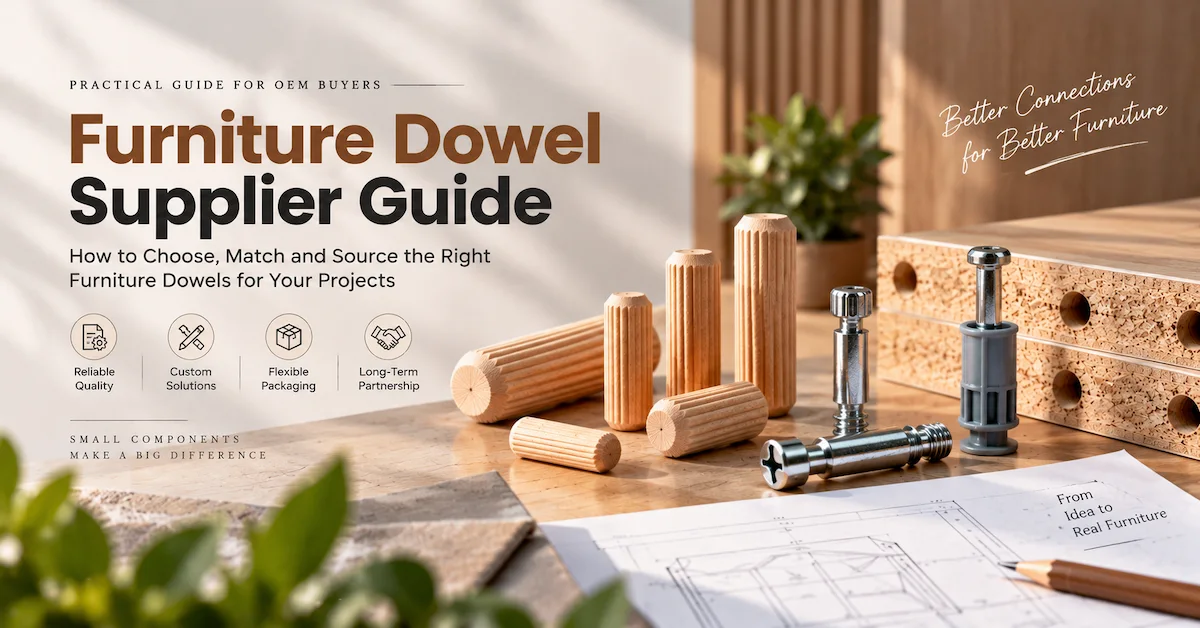
- Furniture connecting bolts and dowels
- Furniture screws
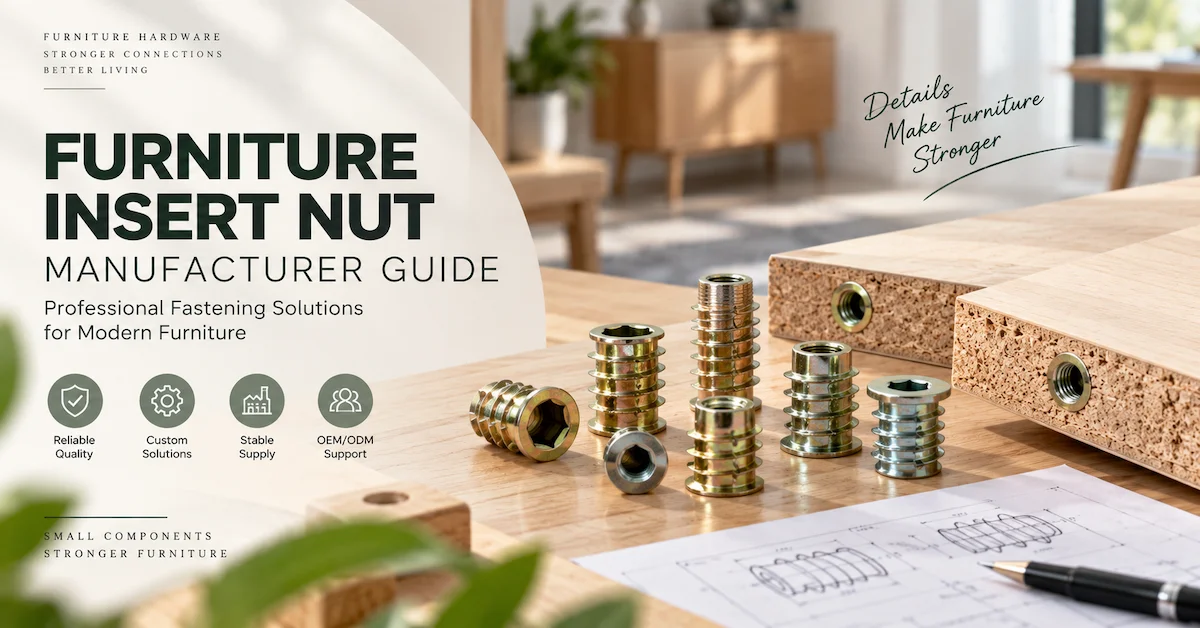
- Insert nuts and threaded components
- Shelf supports and pins
- Brackets and stamped mounting parts
- Plastic accessories
- Model-specific hardware kits
- OEM dimensions and finishes
- Packaging and final inspection
JHFIX currently supplies screws, furniture hardware, nuts, stamped hardware, and multiple packaging formats for furniture and OEM applications.
Explore JHFIX Furniture Hardware
Who Is This Guide For?
This guide is primarily written for B2B buyers such as:
- Kitchen cabinet manufacturers
- Modular kitchen factories
- Flat-pack cabinet manufacturers
- RTA furniture brands
- Furniture importers
- Hardware wholesalers
- Cabinet hardware distributors
- Private-label furniture brands
- OEM purchasing teams
- Furniture product engineers
It is not primarily a homeowner guide about choosing decorative handles or fashionable knobs.
The buying questions at manufacturing level are different:
- Will this connector fit our panel and drilling map?
- Can the same specification be repeated in the next production batch?
- Can screws, cams, bolts, shelf supports, and brackets be supplied together?
- Can our hardware be packed according to cabinet model?
- Which dimensions will be inspected?
- Can the supplier work from our drawing or sample?
- How should surface treatment be specified for kitchen use?
- What causes MOQ, tooling, and lead-time differences?
- How do we prevent wrong parts from reaching the assembly line?
- Can the supplier support OEM and long-term repeat orders?
These are the questions that determine whether a supplier can support real production.
What Hardware Is Commonly Used in Kitchen Cabinets?
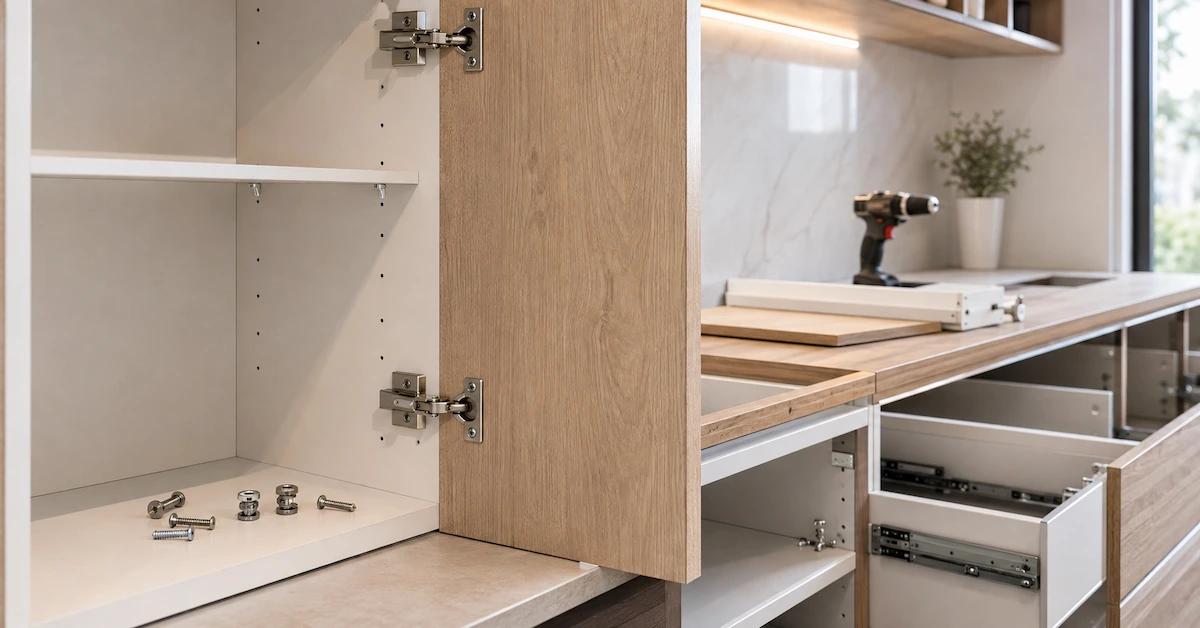
Kitchen cabinets normally require several connection and support systems rather than one type of hardware.
| Hardware Type | Main Function | Typical Kitchen Cabinet Use | Buyer Should Confirm |
|---|---|---|---|
| Cam lock connector | Concealed panel joint | Cabinet carcass, flat-pack units | Cam size, drilling, panel thickness |
| Connecting bolt | Works with cams/connectors | Side, top and bottom panels | Length, thread,mating part |
| Furniture screw | Direct fastening | Panels, brackets, accessories | Diameter, length, thread, drive |
| Insert nut | Reusable threaded joint | Modular components | Thread, panel material, installation |
| Shelf support | Supports adjustable shelf | Internal cabinet storage | Pin size, shelf material, hole size |
| Metal bracket | Reinforcement and mounting | Corners, shelves, frames | Thickness, holes,geometry |
| Hardware kit | Complete assembly set | RTA or export cabinets | BOM, quantities, labels |
The right specification depends on the cabinet construction.
Cam Locks and Connector Sets for Kitchen Cabinet Production
Cam lock systems are especially relevant to kitchen cabinets that are shipped flat packed or designed for repeatable panel assembly.
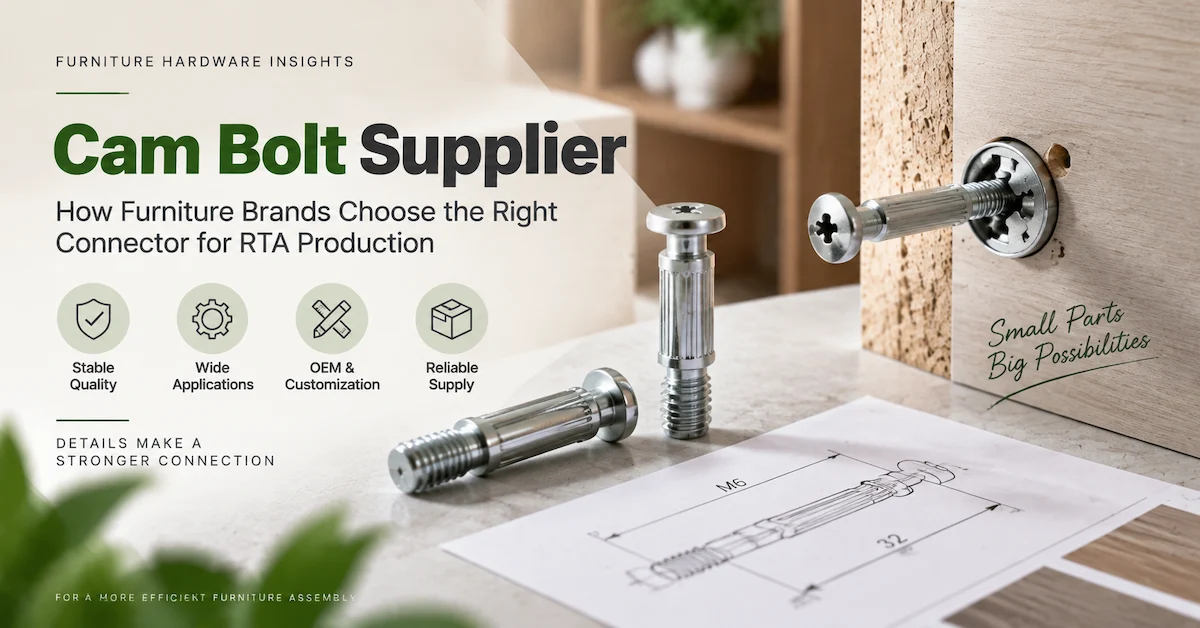
A typical system combines:
- An eccentric cam
- A matching connecting bolt
- Precisely drilled cabinet panels
The cam rotates around the connector bolt and draws the panels together.
For a cabinet factory, the important point is that the cam and bolt are one connection system.
JHFIX currently has a dedicated Cam Locks & Connector Sets category covering 2-in-1 and 3-in-1 cam locks, eccentric connectors, Minifix fittings, and connector sets for cabinets and flat-pack furniture.
View Cam Locks & Connector Sets
What Should an OEM Buyer Specify?
At minimum:
- Cabinet panel material
- Panel thickness
- Cam diameter
- Bolt length
- Hole diameter
- Drilling depth
- Center distance
- Material
- Finish
- Required quantities
- Packaging format
A vague inquiry such as “need cabinet cam locks” leaves too many technical variables unresolved.
Furniture Connecting Bolts and Dowels
Connecting bolts are often paired with cam locks, insert nuts, or other furniture fittings.
For mass cabinet production, small differences in bolt geometry can create large assembly problems.
Buyers should clarify:
- Nominal diameter
- Thread specification
- Overall length
- Thread length
- Head design
- Drive type
- Mating connector
- Surface treatment
For example, JHFIX currently lists a JH-18 furniture connecting bolt with M6 thread, several length options, customizable zinc/nickel finish, and cabinet/furniture connector applications. The exact specification still needs to be confirmed against the buyer's assembly system.
View a JHFIX Furniture Connecting Bolt
Why Component Matching Matters
A supplier may manufacture an accurate bolt and an accurate cam independently, yet the assembled system can still perform poorly if their dimensions do not match.
For this reason, sample approval should include functional assembly, not only dimensional inspection.
Furniture Screws for Kitchen Cabinet Assembly
Kitchen cabinet production can use screws for:
- Back-panel fixing
- Bracket installation
- Internal supports
- Accessory mounting
- Panel fastening
- Reinforcement
Selection should consider more than length.
Important Screw Variables
- Panel material
- Screw diameter
- Engagement length
- Thread geometry
- Head geometry
- Drive type
- Material
- Finish
- Pilot hole
- Installation torque
A screw selected for solid wood should not automatically be assumed suitable for MDF or particleboard.
Shelf Supports for Adjustable Kitchen Cabinet Storage
Shelf supports are another small component with a direct effect on cabinet functionality.
Kitchen wall cabinets, tall cabinets, pantry units, and storage cabinets frequently use adjustable internal shelves.
The buyer should review:
- Shelf material
- Shelf thickness
- Support-pin diameter
- Cabinet hole size
- Hole spacing
- Support geometry
- Installation method
JHFIX currently lists an L-shaped zinc-alloy shelf support for glass shelves and wooden plywood in cabinet applications, with customizable color.
View JHFIX Cabinet Shelf Support Hardware
For production buyers, the primary question is not whether the shelf pin “looks strong.” It is whether the support matches the drilled cabinet system and intended shelf configuration.
Insert Nuts and Threaded Cabinet Hardware
Insert nuts provide a reusable internal thread and can be useful where kitchen cabinet components need a controlled bolt connection.
They may be considered for:
- Modular cabinet structures
- Detachable components
- Furniture bases
- Reusable connections
- Selected structural assemblies
Important parameters include:
- Internal thread
- Insert length
- External geometry
- Installation method
- Board material
- Board thickness
- Matching bolt
Stamped Brackets and Mounting Hardware
Kitchen cabinet production may also require brackets, plates, supports, clips, and mounting components.
These parts can be used for:
- Cabinet reinforcement
- Shelf support
- Corner fixing
- Frame assembly
- Mounting
- Structural positioning
For an OEM stamped component, a purchasing drawing should normally identify:
- Material
- Sheet thickness
- Hole diameter
- Hole position
- Bend geometry
- Critical dimensions
- Finish
- Quantity
JHFIX's current product positioning includes metal brackets, plates, clips, and stamped parts for furniture, cabinets, and OEM assembly.
Explore JHFIX Stamping Hardware
Why Kitchen Applications Need More Attention to Environment and Finish
Kitchen furniture differs from many dry-bedroom applications because hardware can be used near:
- Sinks
- Dishwashers
- Cooking areas
- Cleaning products
- Higher local humidity
This does not mean every kitchen cabinet fastener requires stainless steel or an extreme corrosion specification.
It means the environment should be defined before material and finish are approved.
Carbon Steel
Carbon steel can be practical for many cabinet screws, bolts, brackets, and connectors when its mechanical and surface requirements match the project.
Stainless Steel
Stainless steel may be evaluated where additional corrosion resistance is required.
The buyer should specify the required grade rather than simply writing “stainless steel.”
Zinc Alloy
Zinc alloy can be relevant for cam fittings and other shaped furniture components.
Zinc or Nickel Plating
Plated finishes may support:
- Surface protection
- Appearance
- Color matching
- Product consistency
But “zinc plated” alone is not a complete corrosion-performance specification.
How Should Kitchen Cabinet Buyers Specify Corrosion Testing?
Where a project has a defined corrosion requirement, the RFQ should identify:
- Test method
- Test duration
- Acceptance criteria
- Product or coating specification
ISO 9227:2022 specifies procedures for neutral salt spray, acetic acid salt spray, and copper-accelerated acetic acid salt spray testing. Importantly, ISO itself notes that it does not define the required exposure period or acceptance result for a specific product; those must come from the relevant product specification.
ISO 9227:2022 Salt Spray Test Standard
Therefore, a buyer should avoid writing only:
“Need good salt spray resistance.”
A better RFQ states the actual project requirement.
How Panel Material Changes Kitchen Cabinet Hardware Selection
Particleboard
Particleboard is common in panel furniture and kitchen cabinet production.
Important variables include:
- Thread engagement
- Hole location
- Edge distance
- Fastener length
- Installation torque
MDF
With MDF, special attention may be required near edges and drilled connection points.
The hardware should be tested in the actual board specification planned for production.
Plywood
Plywood has layered construction and can respond differently to fastening than MDF or particleboard.
Solid Wood
Wood species, grain direction, density, and moisture condition can influence installation.
Buyer Rule
Approve hardware in the actual cabinet panel—not only from a metal component drawing.
This single step can prevent many sourcing problems.
What Information Should You Send to a Kitchen Cabinet Hardware Supplier?
A high-quality RFQ improves both quotation accuracy and technical communication.
| RFQ Item | Information to Provide |
|---|---|
| Application | Kitchen base cabinet, wall cabinet, pantry, etc. |
| Panel material | MDF, particleboard, plywood, solid wood |
| Panel thickness | Actual production value |
| Hardware type | Cam, bolt, screw, support, bracket |
| Drawing/sample | 2D, 3D or physical sample |
| Dimensions | Critical dimensions |
| Material | Required or open for engineering review |
| Finish | Zinc, nickel, black, etc. |
| Mating parts | Cam, nut, bolt or bracket |
| Testing | Any specific requirement |
| Quantity | Trial and production requirement |
| Packaging | Bulk, bagged, kit, private label |
| Target market | Where relevant to compliance/specification |
This reduces back-and-forth communication and prevents assumptions.
How to Evaluate a Kitchen Cabinet Hardware Supplier
The following supplier scorecard focuses on real sourcing risk.
| Evaluation Area | What to Check | Why It Matters |
|---|---|---|
| Product range | Connectors, screws, nuts,brackets | Fewer fragmented suppliers |
| Engineering support | Drawing/sample review | Reduces specification errors |
| Manufacturing control | Key processes | Repeatability |
| QC | Dimensions, fit,surfaces | Assembly reliability |
| OEM capability | Custom dimensions/finish | Supports unique cabinet designs |
| Hardware kitting | BOM-based packing | Reduces missing parts |
| Repeat orders | Specification control | Long-term consistency |
| Export experience | Documentation/supply support | Global procurement |
Price belongs in this comparison, but it should not be the only column.
Manufacturing Capability: What Should Buyers Look For?
A supplier supporting several furniture hardware categories can be especially useful when the cabinet BOM contains metal, plastic, stamped, and packaged components.
JHFIX states that its in-house manufacturing system includes:
- Cold heading
- Tapping
- Stamping
- Injection molding
- Assembly
- Packaging
The company also states that it has more than 20 years of fastener/hardware manufacturing experience and exports to more than 40 countries.
Learn About JHFIX Manufacturing
This does not mean every kitchen cabinet project should automatically use one supplier for everything.Buyers should still qualify each product category against the relevant drawing and performance requirement.
Quality Control for Kitchen Cabinet Hardware
A useful QC plan follows the risks that matter during real assembly.
Raw Material or Incoming Component Review
Depending on the product:
- Material specification
- Wire/sheet size
- Purchased component condition
- Surface condition
Dimensional Inspection
Potential critical dimensions include:
- Bolt length
- Cam diameter
- Thread
- Screw diameter
- Head dimensions
- Shelf-support pin diameter
- Bracket hole location
Functional Fit
This is particularly important.
Examples:
- Does the bolt engage the cam correctly?
- Does an insert nut accept the matching bolt?
- Does the shelf support fit the production hole?
- Does the hardware assemble in the real cabinet panel?
Surface Inspection
Check:
- Coating consistency
- Scratches
- Burrs
- Visible defects
- Contamination
Packaging Inspection
For hardware kits:
- Correct SKU
- Correct quantity
- Correct combination
- Correct label
- Correct cabinet model
JHFIX's current homepage describes QC covering precision measurement, in-process monitoring, performance testing, and final inspection.
Why Hardware Kits Can Increase Cabinet Production Efficiency
A kitchen cabinet factory may require dozens of small components for one product.
Buying them in bulk and sorting them again at the assembly or packing stage creates extra work.
A model-specific hardware kit can combine:
- Cam locks
- Connecting bolts
- Screws
- Insert nuts
- Shelf supports
- Brackets
- Plastic accessories
- Replacement pieces where specified
What Kitting Can Reduce
- Missing parts
- Wrong screw size
- Mixed components
- Line-side sorting
- Repacking labor
- End-user installation complaints
JHFIX currently offers bag, blister, box, and plastic-bucket packaging as part of its broader hardware supply model.
Explore JHFIX Hardware and Packaging Products
Bulk Hardware vs Model-Specific Kits
| Supply Method | Advantages | Main Risk | Best For |
|---|---|---|---|
| Bulk hardware | Simple unit supply | Factory must sort/count | High-volume internal assembly |
| Bagged components | Better SKU control | Multiple bags still need coordination | Cabinet assembly lines |
| Model-specific kit | Easier assembly/packing | Requires BOM accuracy | Flat-pack and RTA cabinets |
| Private-label kit | Brand-ready presentation | More packaging coordination | Retail/export brands |
There is no universal best option.
The supply format should match the buyer's production and distribution model.
OEM Kitchen Cabinet Hardware Development Process
JHFIX currently presents a six-step OEM/ODM process that is particularly relevant to custom cabinet hardware projects.
1.Offer Drawings or Samples
Provide:
- Drawing
- Existing component
- BOM
- Functional requirement
2. Communicate Technical Requirements
Confirm:
- Cabinet structure
- Panel material
- Dimensions
- Tolerances
- Materials
- Mating hardware
3. Quotation and DFM Review
Commercial and manufacturing feasibility are reviewed before sample approval.
4. Sample Development
Pre-production samples should be installed in representative cabinet panels.
5.Mass Production
Production should follow the approved drawing and sample reference.
6. Inspection and Shipping
Final inspection, packaging, and shipment follow the agreed supply requirements.
This process is more effective than requesting a custom fastener without explaining how it functions inside the cabinet.
What Affects Kitchen Cabinet Hardware Cost?
Several variables affect quotation:
- Material
- Component size
- Geometry
- Thread
- Tooling
- Surface finish
- Custom tolerance
- Order quantity
- Number of SKUs
- Inspection requirement
- Assembly
- Hardware-kit configuration
- Private-label packaging
A standard screw and an OEM multi-component connector should not be evaluated with the same pricing logic.
Look at Total Sourcing Cost
A cheaper component can become expensive when it causes:
- Additional incoming inspection
- Re-sorting
- Assembly-line adjustments
- Supplier coordination
- Repacking
- Returns or complaints
For high-volume buyers, repeatability and compatibility often matter more than a small difference in piece price.
What About MOQ and Lead Time?
MOQ and lead time should be confirmed project by project.
They can vary according to:
- Standard vs custom product
- Tooling requirement
- Material availability
- Finish
- Order quantity
- Sample development
- Testing
- Number of SKUs
- Packaging complexity
A supplier that gives one universal MOQ or lead time for every kitchen cabinet hardware product may not be reflecting the actual manufacturing requirements.
For a serious OEM inquiry, send the technical specification first.
Common Kitchen Cabinet Hardware Sourcing Mistakes
Choosing the Lowest Quote Without Normalizing Specifications
Two quotations may appear to describe the same component while using different:
- Materials
- Dimensions
- Finishes
- Inspection levels
- Packaging scopes
Compare like with like.
Buying Matching Components Separately
A cam and bolt should be qualified as a system.
Ignoring Panel Material and Thickness
The hardware interacts with the cabinet board.
Approving Only by Appearance
A component can look correct but fail functional assembly.
Failing to Lock the Approved Specification
OEM repeat orders require clear drawings, samples, revisions, and packaging references.
Treating Packaging as a Last-Minute Decision
For RTA cabinets, the hardware package is part of the customer experience.
Supplier Red Flags for OEM Buyers
Be cautious when a prospective kitchen cabinet hardware supplier:
- Quotes a custom component without requesting dimensions
- Never asks about the mating hardware
- Does not ask which panel material is used
- Cannot explain which dimensions will be checked
- Recommends one material for every environment
- Makes corrosion claims without clarifying test conditions
- Cannot provide sample approval before production
- Cannot clarify how BOM-based hardware kits are verified
Good technical questions from a supplier are often a positive sign.
Why JHFIX Fits Kitchen Cabinet Hardware Sourcing
JHFIX's current portfolio covers several product families relevant to kitchen cabinet manufacturing:
- Cam locks and connector sets
- Furniture connecting bolts
- Screws
- Nuts
- Shelf supports
- Stamped cabinet hardware
- Hardware packaging
The company states that its manufacturing processes include cold heading, tapping, stamping, injection molding, assembly, and packaging, with an OEM/ODM workflow from drawing/sample review through production, inspection, and shipping. JHFIX also states ISO9001, RoHS, and EU REACH compliance at company level.
For an OEM buyer, the practical value is the ability to discuss a complete cabinet hardware BOM rather than sourcing each small part without coordination.
Send Drawings or Request a Quote
Kitchen Cabinet Hardware RFQ Checklist
Before contacting a supplier,prepare:
- Cabinet type
- Panel material
- Panel thickness
- Assembly drawing
- Hardware BOM
- Existing samples if available
- Cam/bolt specifications
- Screw specifications
- Shelf-support requirements
- Bracket drawings
- Materials
- Finishes
- Testing requirements
- Estimated quantities
- Packaging method
- Private-label needs
- Target market
The more complete this information is,the easier it is for a supplier to identify risks before sampling.
FAQ
What products should a kitchen cabinet hardware supplier provide?
A supplier may provide cam locks, connector bolts, furniture screws, insert nuts, shelf supports, brackets, mounting parts, plastic components, and complete cabinet hardware kits.
How do I choose hardware for kitchen cabinets?
Start with the cabinet structure, panel material, panel thickness, drilling layout, assembly method, environment, and hardware BOM. Select each component according to its function in that system.
Which connectors are commonly used in flat-pack kitchen cabinets?
Cam locks, eccentric connectors, connecting bolts, dowels, screws, and other knock-down fittings are commonly considered. The correct system depends on cabinet design and drilling.
Can kitchen cabinet hardware be customized from a drawing?
Yes. Depending on manufacturing feasibility, dimensions, geometry, materials, surface finishes, stamped components, and packaging can be developed from drawings or samples.
What should I send for an OEM kitchen cabinet hardware quotation?
Send drawings or samples, panel material and thickness, dimensions, mating components, material and finish requirements, quantity, testing requirements, and packaging plan.
How should kitchen cabinet hardware be tested for corrosion?
Where corrosion performance is required, define a recognized test method, exposure requirement, and acceptance criteria. ISO 9227 is one recognized salt-spray test method, but it does not itself prescribe a universal exposure duration for every product.
Is stainless steel always better for kitchen cabinet hardware?
No. Material should be selected according to the actual application, environment, mechanical requirement, manufacturing method, finish, and cost target.
Can one supplier provide a complete kitchen cabinet hardware kit?
Yes, when the supplier has the relevant component and packaging capabilities. The kit should follow an approved BOM and include quantity verification.
What causes the price of custom cabinet hardware to change?
Material, geometry, tooling, surface finish, tolerance, order quantity, testing, assembly, number of SKUs, and packaging can all affect quotation.
How can I reduce risk before placing a bulk order?
Use a clear drawing and BOM, confirm mating components, test samples in actual cabinet panels, approve the complete specification, define QC requirements, and confirm packaging before mass production.
Conclusion
Selecting a kitchen cabinet hardware supplier is ultimately a production-risk decision, not only a price comparison.
The right supplier should understand how connectors, bolts, screws, insert nuts, shelf supports, brackets, panel materials, drilling patterns, surface finishes, and hardware kits work together.
For kitchen cabinet factories, RTA brands, distributors, and OEM buyers, the strongest sourcing process is:
define the cabinet → lock the hardware specification → test the assembly → approve QC and packaging → then scale production.
JHFIX supports furniture and cabinet projects with connector systems, screws, nuts, stamped components, hardware kits, OEM/ODM development, and packaging capability. Buyers developing a new kitchen cabinet model can provide drawings, samples, BOMs, and application requirements for technical review.