
What Should an RTA Furniture Hardware Supplier Deliver?
An RTA furniture hardware supplier should help you confirm three things before bulk production: the parts fit the furniture, each kit contains the correct components, and repeat orders follow the same approved specification. RTA means ready-to-assemble, so assess the hardware as part of the assembly process rather than as a collection of unrelated fasteners. For a flat-pack launch, use this approval sequence: define the joint, verify a sample assembly, approve the packed kit, then release the order. The goal is a purchasing specification that engineering, production, quality control and packaging teams can all use.
Which Buyers Need a Coordinated Hardware Supply Program?
This approach is intended for cabinet factories, flat-pack furniture brands, importers and OEM manufacturers purchasing components for repeat production. A factory with its own controlled kitting operation may prefer bulk parts; a brand packing one assembly set inside every furniture carton should evaluate complete kits. A distributor may need both production quantities and separately identified replacement packs. Choose the supply format around the work your team will actually perform. This guide is not a shortcut for replacing an unidentified consumer spare part: without measurements, mating components or a confirmed drawing, a similar-looking fitting is not an approved substitute.
Match the Hardware to the Furniture Application
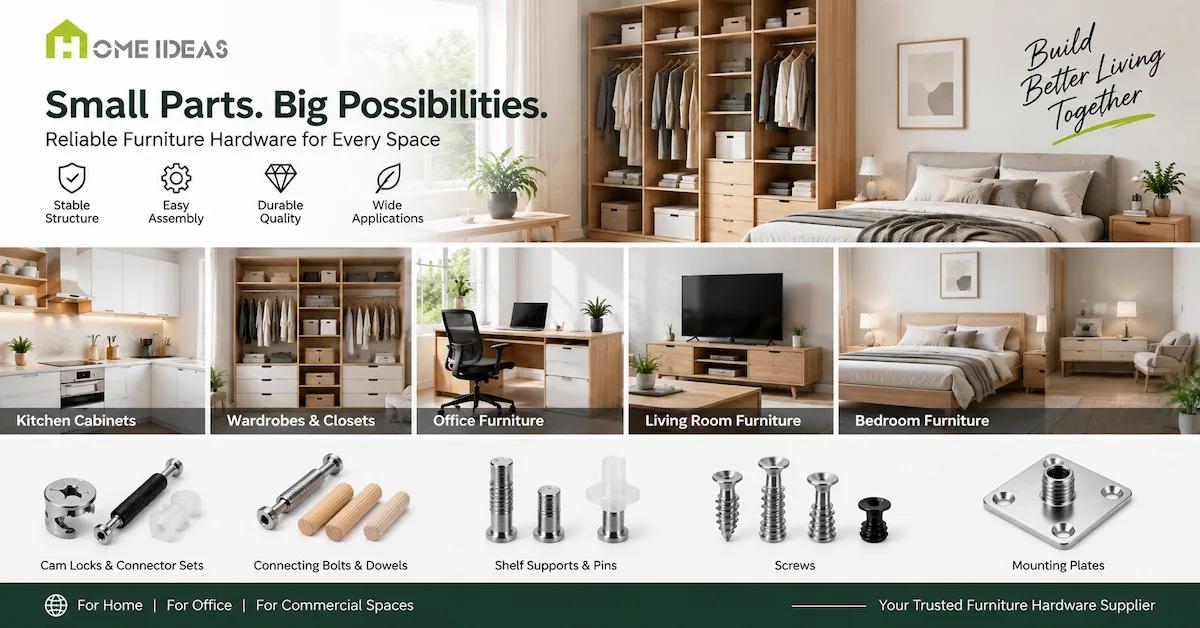
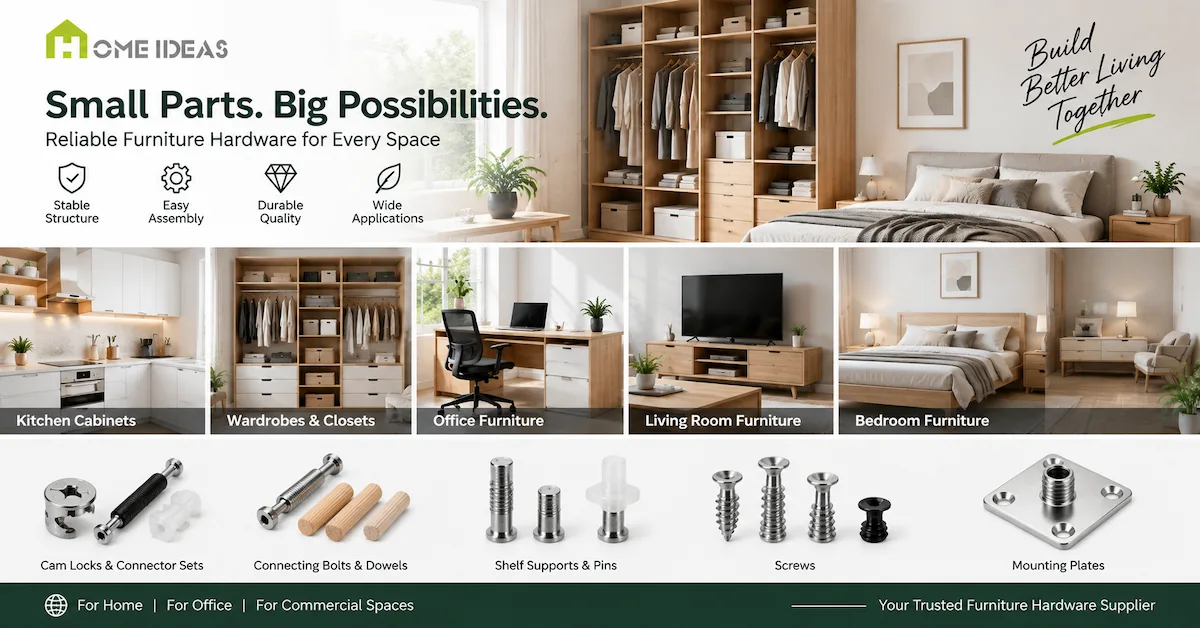
Start with the furniture structure. For a cabinet or wardrobe, review panel joints and shelf support requirements separately; for a desk or table, include the leg connection and any mounting plates. JHFIX’s cam locks and connector sets, furniture connecting bolts and dowels, and shelf supports and pins provide relevant product groups to review. Describe the actual service environment, including kitchen or bathroom exposure where applicable, rather than relying on a room name in a product listing. Ask the RTA furniture hardware supplier to identify the proposed components and the conditions that still require confirmation.
Create a Specification Sheet Before Comparing Prices
JHFIX’s furniture hardware guidance recommends reviewing panel material, drilling pattern, mating hardware and assembly drawings before ordering. Turn those inputs into a shared specification sheet rather than leaving them across emails and product photographs. Use the following checklist as an RFQ and approval template; it does not prescribe universal dimensions or performance values.
| Specification area | Information to confirm | Approval reference |
|---|---|---|
| Furniture identity | Furniture model, hardware-kit code and drawing revision | Released product and kit records |
| Panel and drilling | Board material, thickness, hole positions, diameters and depths | Panel drawing and representative sample |
| Connector assembly | Cam, bolt and mating component references; installed relationship | Matched component drawings |
| Screws and threaded parts | Thread form, diameter, pitch where applicable, length reference, head and drive | Part drawing and mating-part check |
| Materials and finishes | Material for each component, finish and appearance requirements | Purchase specification and approved sample |
| Kit contents | Part code, quantity per furniture unit and definition of “piece” versus “set” | Bill of materials |
| Packaging | Pack layout, labels, barcode, instructions and carton quantity | Approved packed sample and artwork |
| Acceptance requirements | Inspection scope, sampling arrangement and any functional testing | Agreed inspection plan |
Specify Materials and Finishes by Component
Avoid describing an entire hardware kit with one material label. For example, the HI-CB0012 connector listing identifies carbon steel, zinc alloy and plastic within its three-part assembly. The purchasing task is to confirm which material belongs to each component and which finish applies. A silver or black appearance is not a material grade or a corrosion-test result. For furniture exposed to humidity, cleaning or demanding storage conditions, state those conditions and agree on the supporting evaluation. Do not transfer an indoor approval to outdoor use, or accept an unspecified material substitution without reviewing its effect on the approved assembly.
Evaluate Manufacturing Through the Features That Affect Fit
JHFIX’s manufacturing overview shows cold-heading, tapping, punching, injection-molding, assembly, packing and inspection facilities. For supplier qualification, connect those capabilities to the actual parts in your order. Ask how the manufacturer checks the connector features that engage with mating hardware, the specified threads, and the hole positions on a mounting plate. Review plastic component dimensions and seating where plastic parts are included. A useful discussion should end with identified inspection points and reference drawings, not simply an equipment list. Ask which processes apply to each ordered item rather than assuming every component follows the same production route.
Approve the Joint, the Complete Kit and the Inspection Plan
When qualifying an RTA furniture hardware supplier, separate three approvals. Component approval covers the specified dimensions, finish and function of individual parts. Assembly approval checks the parts together with representative boards, actual drilling and intended tools. Kit approval checks part identities, quantities, packaging and instructions. JHFIX’s furniture hardware product guidance recommends trial assembly and retaining the accepted sample and drawing revision. Agree on what the inspection report must show, including any functional testing relevant to the intended furniture. Request current supporting documents for the exact product and applicable scope; do not substitute a general certificate image for the agreed acceptance evidence.
An Illustrative Quantity Check: Connector Sets Are Not Individual Pieces
Consider a planning example, not a JHFIX customer case: an order for 1,000 cabinet kits specifies eight three-piece connector sets, four shelf supports and twelve accessory screws per kit. The connector requirement is 8,000 sets, comprising 8,000 bolts, 8,000 cams and 8,000 matching nuts. The same order also needs 4,000 shelf supports and 12,000 accessory screws, before any separately agreed spares. The arithmetic is straightforward; the purchasing risk is an undefined unit. Record each component separately in the bill of materials, then show how those components form one finished kit. Do not let “8,000 connectors” stand in for an unambiguous packing instruction.
Confirm Capacity, MOQ and Lead Time for the Complete Order
Ask the RTA furniture hardware supplier to quote the first batch and repeat batches separately, with quantities stated for both individual parts and finished kits. JHFIX’s M8 mounting-plate page, for example, lists a minimum of 10,000 pieces per confirmed specification; that is a condition for that product, not a universal minimum for every furniture kit. Confirm the applicable minimums before finalizing your assortment. Request a schedule covering specification review, samples, approval, production, finishing, packing and shipment readiness. Identify when the production lead time begins and which approvals remain outstanding. An annual forecast is useful planning information, but it should not be treated as a confirmed release quantity.
Compare Product References by Their Role in the Kit
The following comparison uses products listed by JHFIX. These components perform different jobs and are not interchangeable alternatives. Use the listed information to start a technical discussion; confirm final dimensions, materials, mating components and commercial terms against the accepted drawings and samples.
| Listed product or model | Published identifying information | Role to evaluate | What still needs approval |
|---|---|---|---|
| HI-CB0012 three-in-one connector | Bolt, cam and nut assembly; 45 mm length listed as customizable | Matched furniture panel connection | Cam geometry, bolt position, mating parts and drilling |
| Φ6 × 44 mm connecting bolt | Carbon steel; 44 mm length listed as customizable | Connecting-bolt component within an approved joint | Thread details, measurement reference and mating connector |
| JH-103 shelf support | Listed as a self-tapping shelf-support peg | Shelf support within compatible furniture | Peg geometry, installation depth, panel fit and shelf contact |
| M8 furniture mounting plate | M8 mating connection; geometry specified by drawing | Sofa or table leg connection | Plate thickness, hole pattern, mating hardware and assembly |
Compare Total Supply Cost, Not Only the Price per Screw
Compare an RTA furniture hardware supplier on the same approved bill of materials, inspection scope and packaging format. A bulk-parts quote and a counted-kit quote represent different amounts of work. For your internal comparison, calculate the cost per accepted furniture kit: components, packing, labeling, agreed inspection, logistics and any sorting or repacking your team must still perform. Add expected rework or replacement costs only where your own records support those assumptions. Keep spare-part quantities explicit. A lower price becomes meaningful when you can see what is included, what remains your responsibility and whether both quotations refer to the same approved version.
Make Packaging Part of the OEM Approval
Use JHFIX’s bag packaging and box packaging categories to discuss the delivery format, then define the contents more precisely than “one hardware bag.” Specify whether a pack serves one furniture unit or one assembly stage, how similar-looking parts are separated, and which part codes appear in the instructions. Include the barcode and label artwork in approval rather than reviewing them after production. For replacement packs, define the furniture model and version they serve. Approve a physically packed sample as well as the loose components so the purchasing record describes what will actually arrive.
Use a Controlled OEM/ODM Workflow for Repeat Orders
JHFIX’s published OEM/ODM process moves from drawings or samples through technical discussion, quotation, sample development, mass production, inspection and shipping. Build your release documents around those stages. Before ordering, align the component drawings, kit bill of materials, approved sample, packing specification and inspection requirements under the same revision. Ask for proposed changes to materials, component geometry, quantities or packaging to be submitted for review before implementation. For a revised furniture model, specify when the new hardware version starts and how remaining old-version stock should be handled. A repeat purchase should identify an approved configuration, not merely repeat the wording of an earlier email.
Prepare an Inquiry That Can Be Reviewed and Quoted
Send the RTA furniture hardware supplier a furniture drawing or representative sample, panel and drilling information, a component list with quantities per kit, first-order volume, repeat forecast, delivery market and packaging requirements. Mark any unfinished design choices so they are not mistaken for approved specifications. Through the JHFIX contact page, request a review of the proposed components, sample arrangements, applicable minimums, inspection scope and production timing. Ask the quotation to distinguish confirmed items from points requiring further engineering or commercial agreement. This gives both teams a clear basis for the next approval.
FAQ
1. What is RTA furniture hardware?
RTA furniture hardware comprises the connecting, fastening and supporting components used in ready-to-assemble furniture. Depending on the design, a kit may include cam fittings, connecting bolts, screws, nuts, shelf supports and mounting plates. The finished furniture design determines which parts are required.
2. Should I buy loose parts or complete hardware kits?
Choose according to your packing operation. Loose parts may suit a factory with controlled counting and kitting. Complete kits are worth evaluating when one approved assembly pack will accompany each furniture unit. Compare both options using the work and inspection included.
3. Can matching thread diameters prove that two connectors are compatible?
No. Treat the nominal diameter as one specification field, not complete proof of fit. Ask for the mating-part drawings and verify the installed relationship, component geometry, drilling and assembly sequence. Approve the combination through a representative trial rather than appearance alone.
4. What should a furniture hardware bill of materials include?
Include a unique part code, description, drawing revision, material, finish, quantity per kit and unit of measure. Define multi-part connector sets explicitly. Add packaging and spare-part requirements without hiding them inside the basic assembly quantities.
5. Can JHFIX discuss custom parts and branded packaging?
JHFIX describes OEM/ODM support and packaging options on its website. Submit the proposed dimensions, materials, component combinations and packaging artwork for review. Confirm feasibility, samples, minimum quantities and pricing for the particular order rather than assuming every customization is standard.
6. How should I approve samples before bulk production?
Review individual components, assemble them with representative panels and mating parts, and check a finished packed kit. Record the accepted drawings and samples. Agree on any additional testing separately so a fit approval is not mistaken for evidence of every performance requirement.
7. How can I address missing or mixed parts before shipment?
Require a confirmed bill of materials, clear part identification, an approved packing layout and a quantity-inspection arrangement. Ask how the supplier distinguishes similar components and records kit checks. Specify how nonconforming packs will be handled rather than relying on a “complete kit” label.
8. Is there one standard MOQ or lead time for all RTA hardware?
Use the quotation for the confirmed order. Different components and packing arrangements need their own commercial review. State both the number of furniture kits and the corresponding component quantities, and confirm the approvals required before the agreed production schedule starts.
9. What certification and inspection documents should I request?
Identify the evidence your product, customer and destination require, then request current documents covering the relevant item and scope. Separately agree on dimensional, material, finish, function and packing records. Avoid treating a general company credential as a substitute for product-specific acceptance.
10. How should replacement kits be managed after a product revision?
Link the replacement-pack code to the furniture model, hardware revision and instruction version. Specify the approved contents and keep old and new versions distinguishable. Recheck compatibility before combining remaining stock with revised components or releasing it as a replacement pack.
Conclusion
Choose an RTA furniture hardware supplier by how clearly the proposed parts, trial assembly, packed kit and repeat-order records fit together. Start with the furniture drawing, make every component and quantity explicit, and approve the actual delivery format before bulk production. JHFIX’s furniture hardware and packaging range provides a starting point for that review—not a reason to skip it. Contact JHFIX with your drawings, hardware list and packaging requirements to discuss component selection, samples and a quotation based on the configuration your furniture needs.