
What Should a Furniture Joint Connector Manufacturer Verify?
Choose a furniture joint connector manufacturer by how clearly it can define and reproduce the connection your furniture requires. Before approving production, confirm the connector geometry, mating components, panel preparation, installation sequence and acceptance criteria together. A connector that matches a catalog description is only a candidate; approval should depend on its fit in the intended assembly. JHFIX’s product guidance recommends reviewing panel material, drilling patterns, mating hardware and assembly drawings, followed by a trial using representative boards and components. Its cam locks and connector sets provide a starting point for that review.
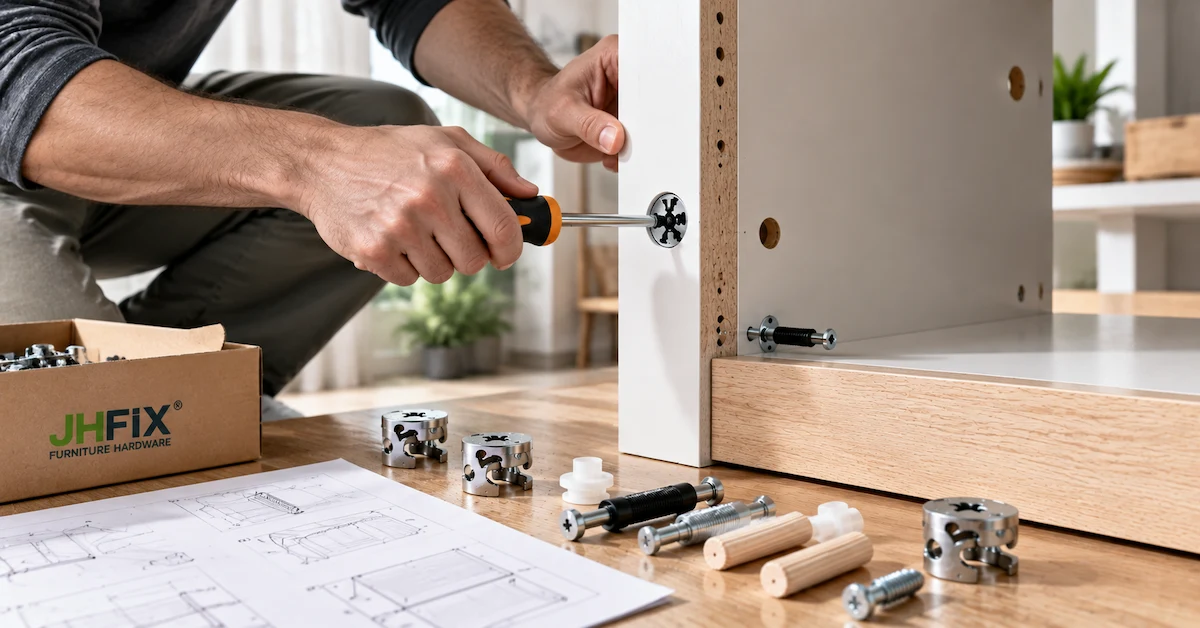
Which Furniture Projects Need This Level of Connector Review?
This guide is intended for cabinet factories, wardrobe manufacturers, modular storage brands and ready-to-assemble furniture programs selecting connectors for repeat production. Begin by stating whether the connection joins two panels, attaches a divider, secures a frame or connects a detachable leg. JHFIX lists both panel-connecting hardware and separate mounting-plate products, so these applications should not be treated as the same purchasing requirement. For example, its M8 furniture mounting plate requires confirmation of plate geometry, hole positions and the mating leg interface rather than a cam-lock drilling specification.
For a new cabinet program, define the joint before selecting the hardware. For a replacement program, provide the existing components together with the panel drawing or measured sample. This approach is not a shortcut for identifying an unknown spare part from a photograph, nor should a catalog connector be treated as an approved structural solution without the necessary application review.
Which Dimensions Determine Whether a Cam-Lock Joint Fits?
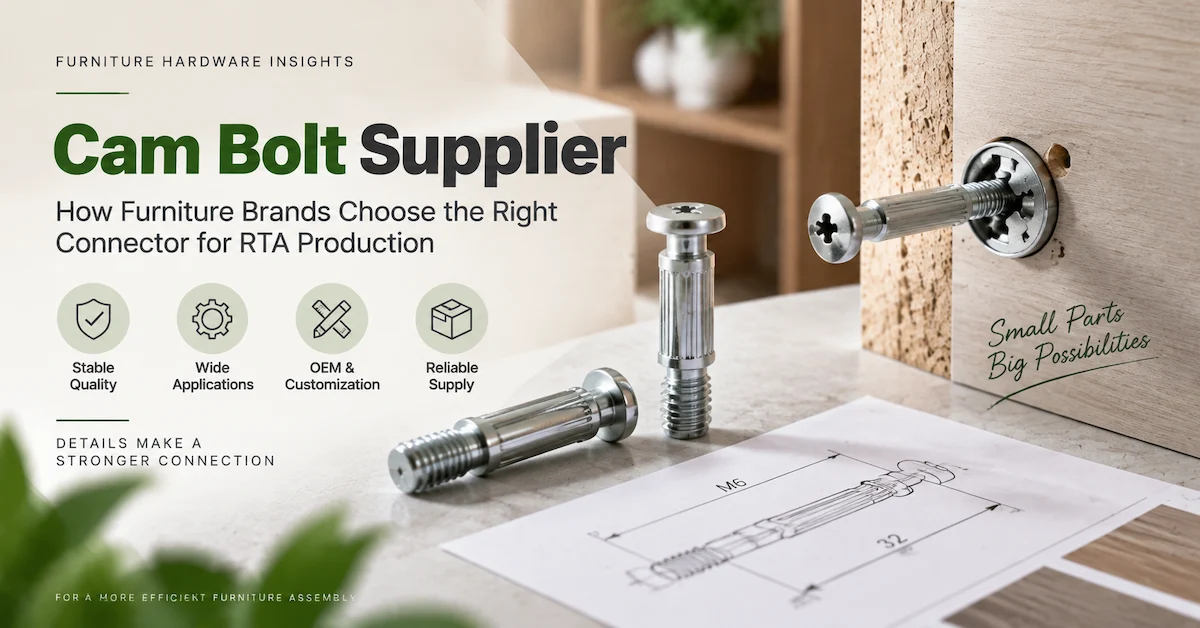
For a cam-and-bolt connection, do not review bolt length in isolation. JHFIX’s concealed connector selection guide identifies cam diameter, bolt length, hole diameter, drilling depth, center position and mating hardware as relevant checks. The practical purchasing task is to establish how these dimensions relate when the parts are installed. Ask the furniture joint connector manufacturer to distinguish the bolt’s overall length from its installed projection—the portion extending from the panel after installation—and to confirm how that projection relates to the mating cam.
Use the following as a proposed RFQ specification sheet, not as a universal drilling standard. Record actual values and tolerances from the approved furniture design.
| Specification area | What to define | What the review should establish |
|---|---|---|
| Panel construction | Material, finished thickness and relevant edge treatment | Which panel configuration the approval covers |
| Drawing references | Reference face, reference edge and dimensioning convention | Whether hardware and panel measurements use the same starting points |
| Cam housing | Body dimensions, installation orientation and drive access | Whether the proposed cam fits the prepared location |
| Cam bore | Diameter, depth and center position | Whether the machining matches the selected connector |
| Connecting bolt | Overall length, head and neck geometry, anchoring section | Whether the specified bolt matches the mating system |
| Installed bolt position | Projection from the panel and installation depth | Where the bolt sits after installation |
| Mating components | Cam, bolt, insert, sleeve or other required pieces | Exactly which combination is being approved |
| Assembly conditions | Tools, sequence, access and tightening instructions | How the joint is intended to be assembled |
| Acceptance criteria | Dimensional checks, joint alignment and agreed functional tests | What constitutes an acceptable sample and production batch |
Make unresolved dimensions visible in the RFQ. A blank field should remain an open engineering question, not become an assumed “standard” value in the quotation.
Compare Connector Models Without Assuming Interchangeability
Ask a furniture joint connector manufacturer to explain which catalog reference is a suitable starting point and which details still need confirmation. The following JHFIX listings illustrate why model selection requires more than choosing the nearest length. Published dimensions are reproduced as identification information; the final drawing must establish measurement references, thread details and compatible mating components.
| JHFIX catalog reference | Published specification | Main approval question |
|---|---|---|
| HI-CB0004 furniture connecting bolt | Carbon steel; listed lengths of 32, 40 and 42 mm, with customization indicated | Which length, installed position and mating cam match the cabinet drawing? |
| HI-CB0012 three-in-one connector | Listed length of 45 mm; bolt, cam and nut assembly; carbon steel, zinc alloy and plastic listed | What are the exact component specifications and quantities within the approved set? |
| Φ6.1 × 34 mm connecting bolt | Listed length of 34 mm; carbon steel and plastic; flat-head description | How do the installed bolt position, anchoring arrangement and mating component correspond to the panel preparation? |
Do not interpret these rows as a strength ranking or a list of interchangeable replacements. Select a reference for technical review, then approve the complete connection. Similarly, a diameter notation alone should not replace a full thread specification where threaded compatibility is required.
Define Materials and Finishes for Each Connector Component
Specify material by component rather than assigning one material description to an entire connector set. The HI-CB0012 listing, for example, identifies carbon steel, zinc alloy and plastic within its three-part product description. Ask which material belongs to each piece and what the proposed production specification will contain. Keep finish requirements separate: a zinc or nickel finish description does not supply every detail needed for an application-specific acceptance plan.
For kitchen, bathroom or other moisture-exposed furniture, describe the expected conditions during the inquiry. Request the required finish specification and any supporting test method before approval. Do not use a silver or black appearance as the acceptance criterion for corrosion performance, and do not carry an indoor approval into an outdoor application without a separate review. Material and finish substitutions should be submitted for assessment rather than treated as automatic equivalents.
What Manufacturing Evidence Should Buyers Request?
A furniture joint connector manufacturer should connect its factory capabilities to the features on your drawing. JHFIX’s manufacturing information identifies cold-heading, tapping, punching, injection-molding, assembly, packing and inspection facilities. During qualification, ask which processes apply to the proposed connector and which operations establish its critical dimensions. Do not assume that every piece in a mixed-material set follows the same manufacturing route.
For the quotation under review, request an inspection proposal covering the important dimensions and mating functions. Ask how the approved part is identified, what reference sample is retained, and how a proposed change reaches the buyer for approval. This gives the equipment discussion a practical purpose: understanding how the manufacturer will deliver the specified connector again, rather than simply confirming that a machine appears on a factory list.
Separate Dimensional Approval From Joint Performance
Check the Parts, Then Assemble Representative Panels
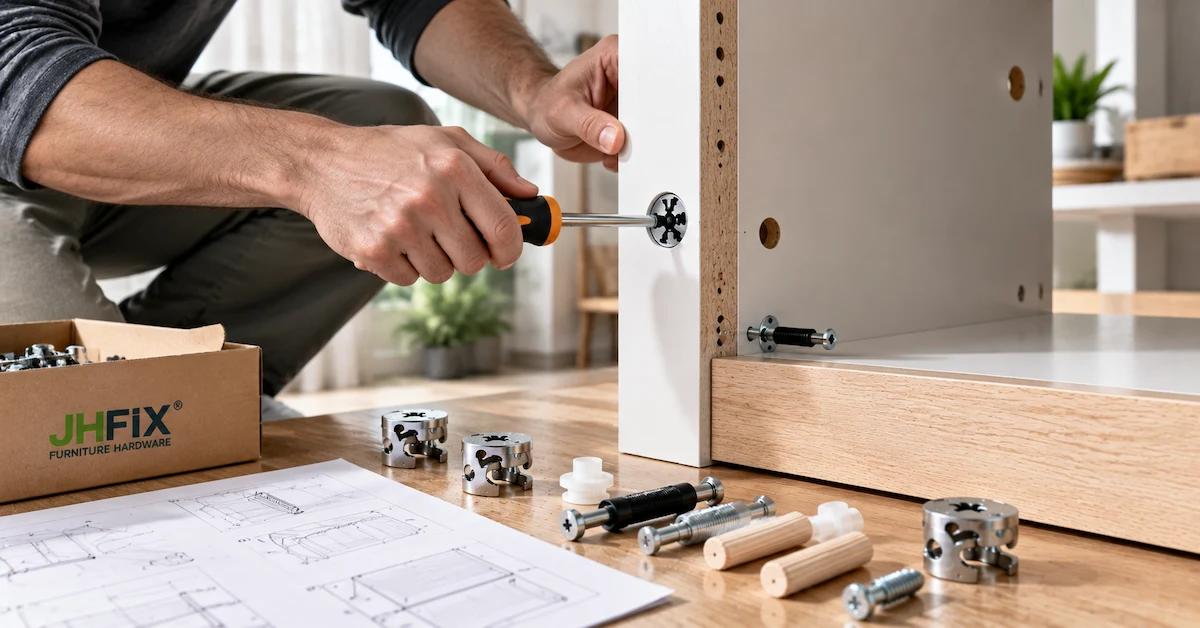
Ask the furniture joint connector manufacturer to identify the drawing revision represented by the samples. Review the individual parts first, then assemble them using representative panels, the intended drilling and the specified mating hardware. Check seating, alignment, locking operation and tool access. JHFIX’s connector guidance also advises confirming drilling accuracy, removing debris that could affect fit and avoiding excessive installation force. Record the accepted sample and drawing together so later batches have an identifiable reference.
Define Strength and Reassembly Requirements Separately
A joint that closes neatly has demonstrated fit under the conditions of that trial; it has not answered every performance question. In the test plan, separate assembly checks from load, durability, environmental or repeated-assembly requirements. Specify the test arrangement, acceptance criteria and responsible party where those requirements apply. Request current documentation for the relevant product and scope rather than treating a general company credential as proof of a particular connector’s performance. JHFIX’s product guidance similarly calls for test methods and acceptance criteria to be included in the RFQ when additional performance testing is required.
A Cabinet Joint Will Not Close: What Should You Check First?
The following is a suggested investigation method, not a reported JHFIX customer case. Suppose a candidate connector works in one panel sample but leaves a gap in another. Instead of changing several dimensions at once, compare an approved hardware set and the candidate set using fresh panels made to the approved drilling specification. Repeat the comparison with fresh panels from the batch associated with the problem. Keep the tools and assembly sequence consistent, and record connector seating, installed bolt position and final alignment. If both hardware sets pass on the reference panels but fail on the other panels, prioritize investigation of panel preparation and drilling. If only the candidate set fails across both panel groups, prioritize its geometry, version and mating compatibility. These patterns guide further checks; they do not prove a root cause by themselves.
Before changing the design, compare the measured findings with the approved drawings. A photograph of the final gap is useful, but it should accompany measurements and component identification. Avoid increasing tightening force as a workaround for an unresolved fit problem; JHFIX’s installation guidance warns that excessive force can damage the board or hardware.
Confirm MOQ, Capacity and Lead Time for the Matched Set
Request commercial conditions from the furniture joint connector manufacturer for the actual connector configuration, not for an unrelated fastener. State both the number of finished furniture units and the quantity of each connector component. Clarify whether the quotation covers loose bolts, complete matched sets or model-specific hardware packs. Ask for minimum quantities by specification, available production allocation and separate timing for samples, approval, production, finishing where applicable, packing and shipment readiness. Identify the event that starts the quoted production lead time. JHFIX’s connecting-bolt pages direct buyers to confirm quantities, packaging, sample arrangements and timing through a project-specific inquiry rather than providing one universal schedule.
Compare the Cost of an Accepted Joint, Not One Loose Part
Compare quotations on an identical basis: the same connector combination, material, finish, inspection scope and delivery format. For internal evaluation, calculate a cost per accepted joint using the components, agreed inspection, packaging and any handling work your team must perform after delivery. Keep one-time tooling or development charges separate from recurring unit costs. Where one proposal changes the connector interface, include the work required to review panel machining, prepare new samples and update instructions. Use your own operating records for rework or replacement-cost assumptions; do not insert unsupported savings percentages. The useful question is whether the quoted configuration meets the approved requirement at a clear total cost.
Manage Custom Connector Development Around the Interface
For OEM and ODM projects, explain the problem before requesting a custom length or shape. Your furniture joint connector manufacturer needs to know whether the objective is to retain existing drilling, accommodate a revised panel, change tool access or use a different connection arrangement. JHFIX’s published development process moves from drawings or samples through technical discussion, quotation, sample development, production, inspection and shipping. Its product guidance also allows discussion of dimensions, materials, finishes and compatible components, subject to review.
Before releasing production, approve the connector drawings, mating-part references, panel drawing and assembly instructions as one configuration. Mark any future substitution as a proposed change until its consequences have been reviewed. For a replacement supplier project, state explicitly whether the new parts must work with existing stock or whether the entire connector set will change together.
Keep Connector Compatibility Visible in the Packaging
Once a joint is approved, preserve that configuration through packing. Define each component in the bill of materials, including the individual pieces that make up one connector set. Separate assembly quantities from spare quantities and identify which furniture model or revision the pack serves. JHFIX’s bag packaging options provide a starting point for discussing counted packs, while its ready-to-assemble furniture hardware guide covers the wider relationship between component lists, labels, instructions and packed-sample approval. For this connector program, make the accepted mating combination—not just the total piece count—part of the packing record.
What Should You Send a Furniture Joint Connector Manufacturer?
Prepare a joint-level RFQ containing the furniture application, panel drawing, connector drawings or samples, mating components, required material and finish, quantities, intended assembly method and acceptance requirements. Include an assembled and disassembled view where useful, but keep dimensions and revisions in the technical record rather than relying on photographs alone. State whether you need loose components or matched packs, and mark unresolved choices clearly. Through JHFIX Contact Us, request a review of the proposed connector, sample scope, minimum quantities, production timing and quotation exclusions. Ask the response to distinguish confirmed specifications from items still awaiting technical agreement.
FAQ
1. What should I look for in a furniture joint connector manufacturer?
Evaluate the manufacturer’s ability to work from drawings, identify compatible mating parts, support representative sample assembly and reproduce an approved specification. Ask for evidence tied to your connector rather than relying only on product variety or general quality statements.
2. Are cam locks with similar dimensions interchangeable?
Do not assume interchangeability. Review the mating bolt, installed position, drilling depth, center locations and locking operation together. JHFIX’s connector selection guidance treats these as related checks, not independent catalog fields. Approve the proposed combination through a representative assembly.
3. Which length should I specify for a connecting bolt?
Record the overall length and its measurement reference, then separately define the required installed position. Request a drawing showing the anchoring section and the features that engage with the mating connector. A length label alone leaves important fit questions unanswered.
4. Should I buy the cam and bolt from the same manufacturer?
Ask for a matched quotation where practical, but still approve the combination. When sourcing separately, give each supplier the same interface information and identify the mating components. Purchasing from one source should not replace sample verification.
5. Can JHFIX discuss a connector based on an existing sample?
Yes. JHFIX’s connector guidance invites drawings, samples and measurement photographs for replacement review. Send the mating pieces and panel information as well, then confirm the proposed specification, sample arrangements and commercial conditions before ordering.
6. What tightening torque should I use for a furniture cam connector?
Request installation instructions for the exact connector and panel combination. Do not select a torque from an unrelated product. The JHFIX connector pages cited here do not establish a universal torque value; they advise following the agreed sequence and avoiding excessive force.
7. How much load can a furniture joint connector carry?
Request evidence for the complete joint and defined test conditions rather than assuming a load rating from the component name. State the panel, connector arrangement, load direction and acceptance requirement. The product references compared above do not establish one universal joint capacity.
8. Does a zinc-plated or nickel-finished connector suit every environment?
Treat the finish description as a starting specification, not an approval for every environment. Describe the intended exposure and agree on the finish and evaluation requirements. Confirm those requirements again when changing the material, coating or application.
9. What usually needs confirmation before MOQ and lead time can be quoted?
Provide the selected components, dimensions, material, finish, quantity and packing format. Ask the supplier to identify any sample, tooling or artwork approvals needed before production timing begins, and obtain the applicable minimum for each confirmed specification.
10. How should connector changes be handled on repeat orders?
Reference the approved drawings, mating parts, panel preparation, sample and packing version. Require proposed changes to be reviewed before implementation. For old and new stock, record which combinations are permitted rather than assuming that visually similar versions can be mixed.
Conclusion
Selecting a furniture joint connector manufacturer starts with defining the complete joint: the panel, drilling, connector, mating parts and installation conditions. Compare catalog references carefully, distinguish overall dimensions from installed geometry, and approve fit separately from any additional performance requirements. Then connect the accepted samples to the production and packing records used for repeat orders. For a cabinet, wardrobe or flat-pack furniture project, send JHFIX your connector drawings, mating samples and panel requirements to discuss a configuration that can be reviewed, quoted and approved before bulk production.